

Most American sellers mistakenly believe Amazon Best Seller Rank is just a simple scoreboard for top-selling products. In reality, this number shifts constantly and responds to sales velocity rather than likes or reviews. With BSR updated every hour and influenced by competitive category trends, understanding how it truly works can mean the difference between market growth and missed opportunity. Get clarity on the real factors behind BSR and separate the facts from persistent myths.
Table of Contents
- Defining Amazon Best Seller Rank And Common Myths
- How BSR Is Calculated And Updated
- Factors That Influence Your BSR Placement
- Using BSR Data To Guide Sales Strategies
- Mistakes To Avoid When Interpreting BSR
Key Takeaways
| Point | Details |
|---|---|
| Amazon Best Seller Rank (BSR) is calculated hourly. | BSR updates frequently based on recent sales data, reflecting product performance dynamics in real-time. |
| Only sales transactions influence BSR. | Factors like customer reviews and page views do not affect ranking; it is solely determined by actual sales. |
| BSR is relative to product categories. | A product’s rank is not an absolute measure of sales but compared within its market segment. |
| Strategic use of BSR can enhance performance. | Analyzing BSR trends can inform inventory management, marketing strategies, and competition assessment. |
Defining Amazon Best Seller Rank and Common Myths
Amazon Best Seller Rank (BSR) is a critical performance metric that reveals how a product ranks in sales within its specific category. A numerical representation of sales trends, BSR provides sellers with real-time insights into their product’s market performance.
The BSR calculation is more nuanced than most sellers realize. Sales volume is the primary driver, but the ranking updates hourly to reflect recent and historical transaction data. While a lower numerical rank suggests stronger sales performance, the metric is relative and can fluctuate dramatically based on category dynamics and overall market conditions.
Common myths about BSR often misunderstand its fundamental mechanics. Many sellers incorrectly believe factors like customer reviews, page views, or product ratings directly influence the ranking. In reality, BSR is exclusively determined by actual sales transactions. This means that conversion rate matters far more than vanity metrics like views or likes.
Key Insights About Amazon Best Seller Rank:
- Updated hourly based on recent sales data
- Specific to individual product categories
- Reflects relative sales performance, not absolute sales numbers
- Exclusively based on verified purchase transactions
- Can change rapidly depending on competitive marketplace dynamics
How BSR Is Calculated and Updated
Amazon’s Best Seller Rank calculation is a sophisticated algorithm that dynamically tracks product performance across different marketplace categories. A comprehensive empirical study reveals the intricate mechanics behind BSR calculation, showing that the system prioritizes recent sales data while also considering historical transaction patterns.

The hourly update mechanism ensures that BSR remains a current reflection of a product’s sales momentum. While the exact weightings are proprietary, sellers can understand that recent sales carry significantly more influence than older transactions. This means that a sudden surge in sales can quickly elevate a product’s ranking, just as a prolonged sales drought can cause rapid ranking decline.
Understanding the BSR algorithm requires recognizing its relative nature. Amazon does not simply count total sales but evaluates sales performance within specific product categories. This approach allows for more nuanced ranking that accounts for the unique dynamics of different market segments. A high-performing kitchen gadget might have a different BSR trajectory compared to a popular electronic accessory, reflecting the specialized nature of sales patterns.
Key Components of BSR Calculation:
- Hourly updates of sales data
- Weighted emphasis on recent sales transactions
- Category-specific performance measurements
- Dynamic recalculation based on competitive marketplace
- Comprehensive tracking of both current and historical sales trends
Factors That Influence Your BSR Placement
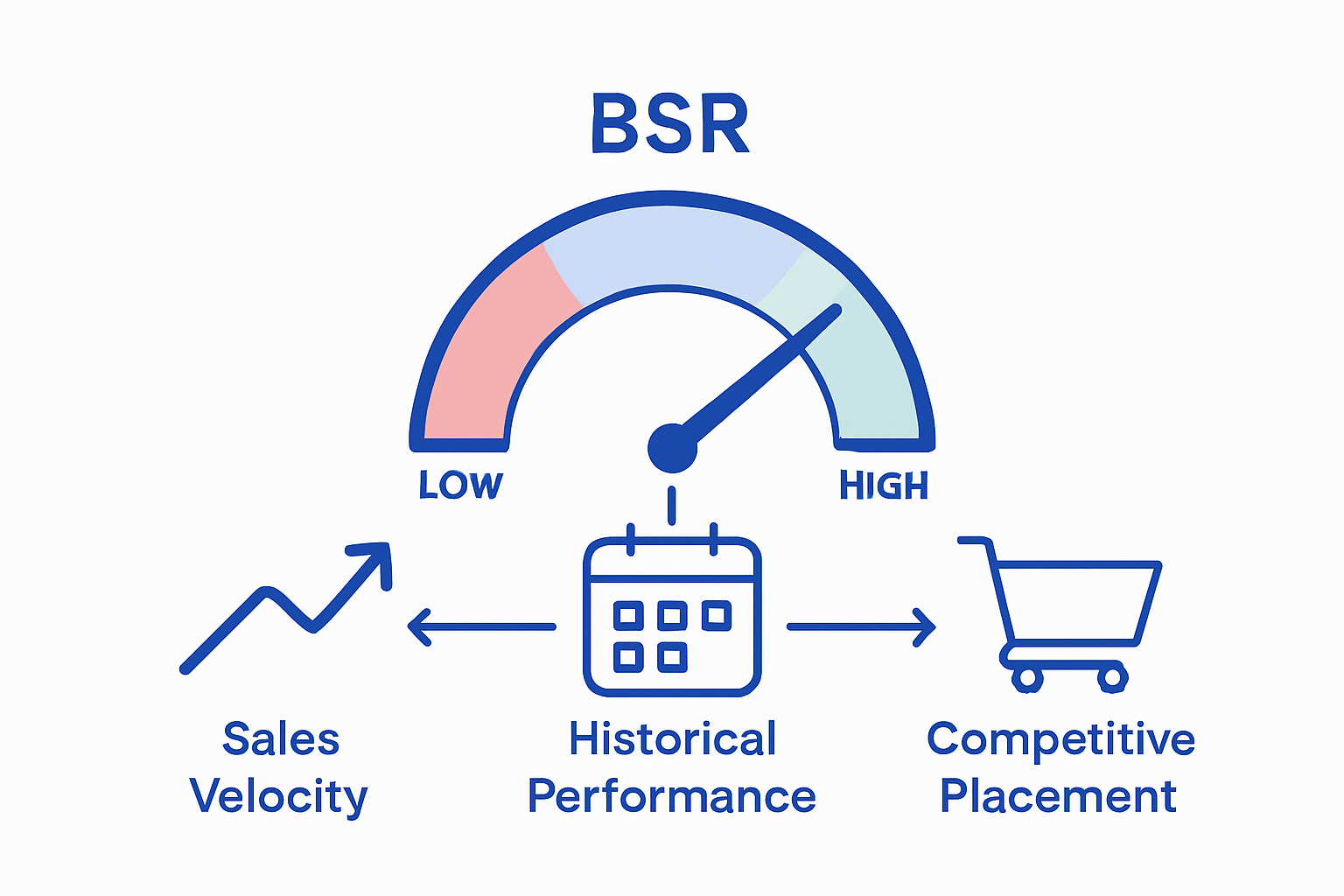
Sales velocity and historical performance metrics play a critical role in determining a product’s Best Seller Rank. Amazon’s algorithm considers multiple interconnected factors that go beyond simple transaction numbers, creating a complex evaluation system for product rankings within specific marketplace categories.
The primary drivers of BSR placement include recent sales momentum, total historical sales volume, and competitive product performance. Pricing strategies can dramatically impact a product’s ranking, with strategic promotions and sales events potentially triggering significant BSR shifts. Hourly algorithmic updates ensure that marketplace dynamics are continuously reflected in product rankings, making it crucial for sellers to maintain consistent sales performance.
While many sellers focus solely on total sales volume, Amazon’s sophisticated ranking system incorporates nuanced elements like sales consistency, price competitiveness, and relative performance within product categories. Customer engagement metrics such as review quantity and quality can indirectly influence BSR by affecting conversion rates and overall product visibility. This multifaceted approach means that sellers must develop comprehensive strategies that address multiple performance dimensions.
Key Factors Influencing BSR Placement:
- Recent sales velocity
- Total historical sales volume
- Competitive product performance
- Pricing and promotional strategies
- Customer review quantity and quality
- Conversion rate within product category
- Overall marketplace competitiveness
Using BSR Data to Guide Sales Strategies
Understanding BSR provides sellers with a powerful diagnostic tool for evaluating product performance and market positioning. By carefully analyzing these rankings, sellers can uncover critical insights that drive strategic decision-making across multiple aspects of their Amazon business.
The strategic interpretation of BSR data goes beyond simple number tracking. Sellers can use these metrics to identify emerging market trends, assess the competitive landscape, and develop targeted marketing approaches. For instance, tracking BSR fluctuations can reveal seasonal demand patterns, helping businesses optimize inventory management and procurement strategies. A product with consistent BSR performance might indicate stable market demand, while significant ranking variations could signal the need for product refinement or marketing interventions.
Effective BSR data utilization requires a holistic approach that combines quantitative analysis with strategic thinking. Sellers should not only monitor their own product rankings but also benchmark against competitors in their category. This comparative analysis can unveil opportunities for differentiation, pricing optimization, and product positioning. By understanding the nuanced factors that influence BSR, sellers can develop more sophisticated strategies that go beyond reactive measures and embrace proactive market engagement.
Strategic Applications of BSR Data:
- Inventory planning and demand forecasting
- Competitive market analysis
- Product development insights
- Marketing and promotional strategy optimization
- Pricing strategy refinement
- Performance benchmarking
- Seasonal trend identification
Mistakes to Avoid When Interpreting BSR
Interpreting Amazon Best Seller Rank requires nuanced understanding and strategic analysis. Many sellers fall into common traps that can lead to misguided business decisions, potentially undermining their marketplace performance.
The most critical misinterpretation revolves around viewing BSR as a direct, linear representation of total sales volume. Sellers often make the mistake of assuming a slightly lower BSR number automatically translates to significantly higher sales. In reality, BSR is a relative ranking that fluctuates based on complex marketplace dynamics, including category-specific competition and hourly sales variations. A product ranked 500th in a highly competitive category might actually generate more revenue than a product ranked 50th in a less competitive segment.
Another fundamental error is overemphasizing short-term BSR fluctuations while neglecting long-term performance trends. Sellers who react impulsively to minor ranking changes risk making hasty inventory or marketing decisions. Successful Amazon entrepreneurs understand that consistent performance matters more than momentary spikes or dips. They analyze BSR data through a comprehensive lens, considering factors like seasonal demand, competitive landscape, and sustained sales momentum.
Common BSR Interpretation Pitfalls:
- Treating BSR as a direct sales volume indicator
- Overreacting to short-term ranking variations
- Ignoring category-specific competitive contexts
- Comparing BSR across dissimilar product categories
- Neglecting the impact of pricing and promotional strategies
- Assuming BSR directly correlates with profitability
- Failing to recognize the hourly dynamic nature of rankings
Take Control of Your Amazon Best Seller Rank Today
Understanding the complexity of Amazon Best Seller Rank is just the first step. Many sellers struggle with interpreting BSR correctly and developing effective strategies that improve sales velocity and category performance. If you want to move beyond common mistakes and leverage precise data-driven insights like hourly sales dynamics and category competition, it is crucial to optimize your listings and SEO strategy with expert guidance.

Discover how our specialized services at SearchOneers can empower your Amazon business. From Amazon Listing Optimization that enhances titles, bullet points, and backend keywords to advanced Amazon SEO & Analytics tailored to evolving marketplace algorithms, we provide the tools to improve your BSR and overall sales performance. Don’t wait for ranking fluctuations to dictate your success. Visit us now and start optimizing your Amazon presence with proven, strategic solutions.
Frequently Asked Questions
What is Amazon Best Seller Rank (BSR)?
Amazon Best Seller Rank (BSR) is a metric that indicates how well a product sells within its specific category on Amazon, with a lower numerical rank reflecting stronger sales performance.
How often is BSR updated, and what factors influence it?
BSR is updated hourly, primarily reflecting recent sales data. Factors influencing BSR include recent sales velocity, total historical sales volume, competitive product performance, and pricing strategies.
Can customer reviews affect my BSR?
While customer reviews do not directly influence BSR, they can indirectly affect it by impacting conversion rates and overall product visibility, which may lead to increased sales.
How can I use BSR data to improve my sales strategies?
You can analyze BSR data to identify market trends, optimize inventory management, assess competition, and refine pricing and promotional strategies to enhance your product’s performance.

Comments
One response to “Amazon Best Seller Rank: What It Means for Sellers”
[…] Amazon Best Seller Rank: What It Means for Sellers – Searchoneers […]