

Over eighty percent of Amazon shoppers never click past the first page of search results. This single fact shows how crucial it is for sellers to master keyword research and strategy. Whether you are launching a new product or improving an existing listing, knowing how to outsmart competitors and reach buyers is the key difference between poor sales and real growth. Unlock the secrets to finding the best keywords and turning Amazon searches into more sales for your product.
Quick Summary
| Key Point | Explanation |
|---|---|
| 1. Analyze Your Unique Product Features | Identify what sets your product apart, including dimensions, materials, and customer-solving features. |
| 2. Research Competitor Keywords Strategically | Use tools like Keywordtool.io and Tool4seller to analyze competitor listings and discover their keyword strategies. |
| 3. Focus on Relevance and Search Intent | Prioritize keywords that are directly relevant to your product and reflect how customers typically search. |
| 4. Optimize Your Listing with High-Impact Keywords | Distribute your best keywords across the title, bullet points, and descriptions for maximum visibility. |
| 5. Continuously Refine Your Keyword Strategy | Regularly review performance metrics and adapt your keywords based on market trends and buyer behavior. |
Table of Contents
- Step 1: Analyze Your Product And Competitors
- Step 2: Research Relevant Keyword Options
- Step 3: Validate Keyword Search Volume And Trends
- Step 4: Select High-Impact Keywords For Your Listing
- Step 5: Test And Refine Your Keyword Strategy
Step 1: Analyze your product and competitors
You are about to discover how to uncover the most powerful keywords that will skyrocket your Amazon product visibility. In this step, we will strategically dissect your product and research your competitors to find hidden keyword opportunities that can transform your sales performance.
Start by thoroughly examining your own product. What makes it unique? What specific features solve customer problems? Write down every potential search term a customer might use to find a product like yours. Consider dimensions, materials, use cases, and specific benefits.
Next, dive into competitor research. According to insights from Aihello.com, tools like Keywordtool.io and Tool4seller are game changers for discovering competitor keywords. These platforms allow you to analyze competitor ASINs and uncover exactly what keywords they rank for including critical metrics like search volume and competition levels.
Here’s a comparison of essential keyword research tools mentioned in Step 1:
| Tool | Key Features | Best For |
|---|---|---|
| Keywordtool.io | Competitor analysis Search volume data Long-tail suggestions | Discovering competitor keywords Finding hidden opportunities |
| Tool4seller | ASIN keyword tracking Competition analysis Detailed metrics | Analyzing competitor listings Uncovering backend keywords |
When researching competitors, pay attention to:
- Top ranking products in your category
- Product titles and descriptions
- Customer reviews and frequently used phrases
- Backend keywords they might be targeting
Pro Tip: Do not just copy competitor keywords. Find gaps and unique angles that differentiate your product.
As you compile your keyword list, remember that quality trumps quantity. Focus on relevance, search volume, and how closely the keywords match your product’s actual features and benefits.

Ready to move forward? The next step will show you how to refine and prioritize these keywords for maximum Amazon search ranking potential.
Step 2: Research relevant keyword options
In this crucial step, you will discover powerful strategies to uncover the most effective keywords that will help your Amazon product stand out and attract potential buyers. Your goal is to generate a comprehensive list of relevant search terms that match how customers actually search for products like yours.
Start by leveraging Amazon’s own search bar. According to research from Automateed, the autocomplete feature provides real-time keyword ideas directly sourced from actual shopper behavior. Simply begin typing your primary product term and observe the suggestions that appear. These autocomplete results represent what customers are actively searching for right now.
Next, expand your keyword research using specialized tools. According to insights from Aihello.com, platforms like Keywordtool.io and Tool4seller can generate hundreds of long-tail keyword suggestions. These tools help you discover variations and specific search phrases related to your product that you might not have considered.
When researching keywords, focus on:
- Exact product descriptions
- Customer pain points
- Specific use cases
- Unique product features
- Alternative ways customers might describe your product
Pro Tip: Prioritize keywords with high search volume but lower competition for better ranking potential.
Remember that keyword research is not about collecting the most terms possible. It is about finding the most relevant and strategic keywords that genuinely represent your product and match customer search intent.
Ready to take your keyword strategy to the next level? The upcoming step will show you how to evaluate and prioritize these carefully researched keywords for maximum Amazon search visibility.
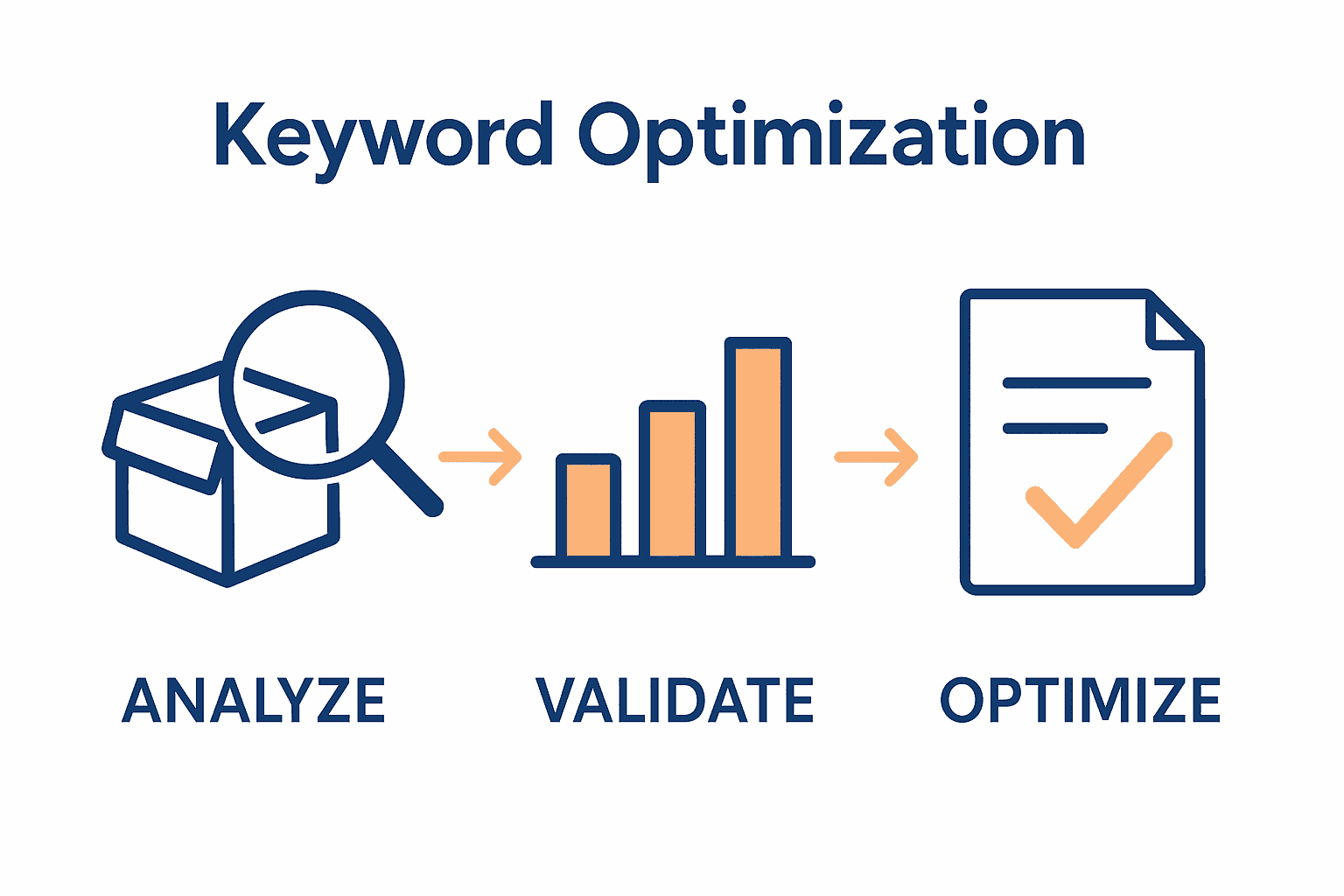
Step 3: Validate keyword search volume and trends
Now you will transform your keyword list from a collection of ideas into a strategic roadmap for Amazon success. Your mission is to understand which keywords not only match your product but also have genuine search potential and market momentum.
Start by using real-time data analysis tools that provide deep insights into keyword performance. According to research from Automateed, platforms like AMZScout and Keyword Tool can reveal which keywords are trending right now and help you capture spikes in buyer interest.
When validating keywords, examine these critical metrics:
- Monthly search volume
- Seasonal popularity trends
- Competition level
- Relevance to your specific product
- Potential customer conversion rate
Look beyond raw numbers and understand the story behind the data. A keyword with moderate search volume might be more valuable than a high-volume term that does not precisely match your product. Context and specificity matter more than sheer quantity.
Pro Tip: Track keyword trends over multiple months to identify consistent performers versus temporary spikes.
Pay special attention to long-tail keywords that show specific purchasing intent. These more detailed search phrases often indicate customers who are closer to making a buying decision and have higher conversion potential.
Ready to turn these insights into action? The next step will guide you through strategically incorporating these validated keywords into your Amazon listing for maximum visibility and sales potential.
Step 4: Select high-impact keywords for your listing
You are about to transform your keyword research into a strategic weapon that will elevate your Amazon product visibility and attract more potential buyers. This critical step focuses on strategically placing your most powerful keywords across different sections of your product listing.
According to insights from Kwickmetrics, optimizing your listing with carefully selected keywords can dramatically improve your visibility and conversion rates. The goal is to strategically distribute high-impact keywords across your product title, bullet points, description, and backend keyword fields.
Start with your product title. This is prime real estate for your most important keywords. Craft a title that reads naturally while incorporating top-performing search terms. Focus on including keywords that directly describe your product’s most compelling features and benefits.
In your bullet points, continue the strategic keyword placement. Each bullet should not only highlight a key product benefit but also naturally incorporate relevant search terms. This approach helps both potential customers and Amazon’s search algorithm understand your product’s value.
When selecting keywords, prioritize:
- Exact match search terms
- High-volume keywords with moderate competition
- Terms that precisely describe your product
- Keywords with clear purchase intent
- Unique product differentiators
Pro Tip: Balance keyword optimization with readability. Your listing must sound natural and appealing to human readers.
Remember that backend keywords are your secret weapon. Use this space to include additional relevant search terms that did not fit naturally in your visible listing. These hidden keywords can significantly boost your search visibility without compromising your listing’s readability.
Ready to maximize your Amazon listing’s potential? The next step will guide you through implementing these high-impact keywords strategically and effectively.
Step 5: Test and refine your keyword strategy
You have now reached the most dynamic phase of your Amazon keyword optimization journey. Your mission is to transform your keyword strategy from a static list into a living optimization system that continuously improves your product visibility and sales performance.
According to research from Automateed, successful sellers regularly adjust their keyword list based on real-time trend data. This ongoing refinement ensures your listings stay perfectly aligned with evolving buyer behavior and seasonal market shifts.
Start by tracking your listing’s performance metrics. Monitor key indicators like search ranking, click-through rates, and conversion rates for each keyword. These metrics will reveal which keywords are truly driving customer engagement and which might need replacement.
Implement a systematic approach to keyword testing:
- Rotate keywords quarterly
- Compare performance before and after changes
- Remove underperforming keywords
- Experiment with new search terms
- Track seasonal variations in keyword effectiveness
Pro Tip: Use Amazon’s advertising reports as a secret weapon for identifying high-performing keywords that convert into actual sales.
Do not view keyword optimization as a one-time task. Think of it as an ongoing conversation with your potential customers. Market trends change rapidly. What works today might become less effective tomorrow. Stay curious. Stay adaptable.
Remember that data trumps assumptions. Always let actual performance metrics guide your keyword strategy rather than relying on gut feelings or outdated information.
Ready to take your Amazon keyword strategy to the next level? Continuous learning and strategic adaptation are your keys to long-term success.
Supercharge Your Amazon Sales With Smarter Keyword Strategies
You know how challenging it is to find the right Amazon keywords that truly boost sales. Struggling with low visibility or worried your product listings are getting lost among competitors? If you want to turn in-depth keyword research and validation into real sales gains, you are not alone. Many sellers exhaust hours researching search trends, optimizing bullet points, and analyzing data, yet still feel unsure which Amazon SEO tactics actually move the needle.
For real, lasting results, you need more than just tools or checklists. You need proven guidance tailored to your product, sales goals, and buyer intent. That is where our team steps in. Our focus on E-commerce Tips & Strategies to Grow Your Online Business means you gain access to specialized advice for choosing and refining keywords that increase both your product’s visibility and conversions.
Ready to level up your Amazon sales and leave guesswork behind? Visit Searchoneers Amazon Optimization Experts and tap into our listing optimization and data-driven SEO solutions. Discover actionable support to amplify your keyword impact now, so you can rank higher, sell faster, and outpace your competitors.
Frequently Asked Questions
How can I analyze my product for effective Amazon keywords?
To analyze your product for effective Amazon keywords, identify its unique features and benefits. Write down potential search terms related to dimensions, materials, and specific use cases to create a targeted keyword list.
What competitor research methods should I use for choosing Amazon keywords?
Use competitor analysis to identify keywords that high-ranking products in your category are using. Focus on examining their product titles, descriptions, and customer reviews to discover effective keywords that could enhance your listing.
How do I generate keyword ideas using Amazon’s search features?
You can generate keyword ideas by using Amazon’s search bar and typing in your primary product term. The autocomplete suggestions that appear will reflect real-time search behavior from actual customers, providing valuable insights into what potential buyers are looking for.
What metrics should I consider when validating keyword search volume?
When validating keyword search volume, focus on metrics such as monthly search volume, competition level, and seasonal trends. Look for keywords that not only match your product but also have a good balance of search demand and competition to maximize visibility.
How should I incorporate keywords into my Amazon product listing?
Incorporate keywords into your Amazon product listing by placing them strategically in your title, bullet points, and product description. Ensure that the keywords fit naturally to improve both readability for customers and optimization for Amazon’s search algorithm.
What ongoing strategies can I use to refine my keyword list for better sales?
Continuously refine your keyword list by monitoring performance metrics like click-through and conversion rates for each keyword. Rotate keywords quarterly and experiment with new terms based on seasonal trends, ensuring your strategy adapts to market changes.

Comments
4 responses to “How to Choose Amazon Keywords for Higher Sales Fast”
[…] streamline your keyword selection process, check out our guide on choosing Amazon keywords, which provides deeper strategies for identifying the most impactful search terms for your product […]
[…] more detailed guidance, check out our guide on choosing Amazon keywords to refine your […]
[…] most successful Amazon sellers will be those who integrate AI insights into their keyword research strategy. By understanding user intent through intelligent data processing, you can craft product listings […]
[…] To maximize your keyword strategy, sellers should focus on finding terms that balance search volume, relevance, and competition level. This means identifying keywords that have significant search traffic, directly relate to your product, and aren’t so competitive that your listing gets lost among hundreds of similar products. For a deeper understanding of keyword selection strategies, check out our guide on how to choose Amazon keywords. […]