

Did you know that over 60 percent of product searches start on Amazon? With so many shoppers turning to this marketplace, standing out has never been more challenging or more critical. Success depends on much more than just listing a product and hoping for the best. By understanding proven optimization methods, you can transform your sales performance and reach customers who are ready to buy.
Table of Contents
- Step 1: Analyze Competitive Listings For Insights
- Step 2: Optimize Product Titles And Bullet Points
- Step 3: Enhance Backend Keywords And Descriptions
- Step 4: Leverage Amazon Seo And Data Analytics
- Step 5: Monitor Performance And Refine Strategies
Quick Summary
| Key Point | Explanation |
|---|---|
| 1. Analyze Competitor Listings | Research successful products to find market gaps and differentiate your listing. |
| 2. Optimize Titles and Bullet Points | Craft engaging titles and concise bullet points focusing on benefits to improve conversions. |
| 3. Enhance Backend Keywords | Use unique terms and synonyms as backend keywords to increase searchability of your listings. |
| 4. Leverage Data Analytics | Regularly track performance metrics to adjust your strategies for higher visibility and sales. |
| 5. Continuous Performance Monitoring | Set a schedule for systematic reviews of your metrics to identify trends and areas for optimization. |
Step 1: Analyze Competitive Listings for Insights
Successfully standing out on Amazon requires strategic competitive analysis. In this step, you will learn how to dissect competing product listings to uncover valuable market insights that can dramatically improve your own product visibility and sales performance.
According to research from thrivelift.org, analyzing competitor listings involves studying successful products while identifying potential market gaps. Start by searching for products in your category that have high sales but relatively few reviews. These are golden opportunities signaling emerging markets with less competition.
As you examine competitor listings, focus on several key areas. Look for products with subpar images or descriptions that still maintain good sales performance. This indicates areas where you can differentiate yourself through superior content. Pay close attention to their keyword strategies in titles and bullet points, noting how they incorporate search terms.
Research from hbs.edu suggests monitoring product rankings and seller engagement as additional competitive analysis strategies. Lower sales rankings often correlate with higher sales volumes. Additionally, examine the number of customer questions answered by sellers, which can reveal their level of market investment and customer interaction.
Quick pro tip: Use a spreadsheet to track and compare your findings across multiple competitor listings. This systematic approach will help you spot trends and opportunities more effectively.
Ready to take your Amazon strategy to the next level? In the next section, we will dive into transforming these competitive insights into actionable listing optimization strategies.
Step 2: Optimize Product Titles and Bullet Points
In this critical step, you will transform your Amazon product listing from average to extraordinary by crafting compelling titles and bullet points that capture attention and drive conversions. Your goal is to create content that not only ranks well in search results but also persuades potential buyers to click and purchase.
According to research from gs1uk.org, optimizing product titles requires a strategic approach. Include your brand name, core keywords, and essential features like size, color, and material. Be mindful of Amazon’s character limits while ensuring your title remains informative and engaging.
When developing bullet points, focus on creating concise benefit-driven content that addresses customer needs. Each bullet point should highlight unique product features and solve common customer pain points. As recommended by zeo.org, keep your language simple and avoid keyword stuffing. Aim to provide genuine value to potential buyers by presenting clear, compelling information.

Quick pro tip: Limit each bullet point to under 200 characters to maintain clarity and readability. Prioritize the most important features and benefits in the first two bullet points to capture immediate attention.
Ready to take your Amazon product listing to the next level? In the upcoming section, we will explore advanced strategies for crafting irresistible product descriptions that seal the deal.
Step 3: Enhance Backend Keywords and Descriptions
In this crucial step, you will unlock the hidden potential of your Amazon product listing by strategically optimizing backend keywords and crafting compelling product descriptions that drive visibility and conversions. Your goal is to maximize searchability while creating an irresistible narrative that speaks directly to potential buyers.
According to research from seodaily.org, backend keywords are your secret weapon for capturing additional traffic. Focus on including relevant terms not used elsewhere in your listing such as synonyms, alternative phrases, and even common misspellings. This approach helps you catch searches that might otherwise miss your product.
When crafting your product description, think of it as telling a compelling story. Civiclift.org recommends starting with a strong opening that directly addresses the customer’s problem. Dive deep into detailed features and benefits, and always conclude with a powerful call-to-action that creates a sense of urgency.
Quick pro tip: When adding backend keywords, use only spaces to separate terms and avoid any punctuation.
This ensures Amazon’s search algorithm can process your keywords effectively.
Ready to take your Amazon strategy to the next level? In the next section, we will explore advanced techniques for leveraging customer reviews and ratings to boost your product’s credibility and visibility.
Step 4: Leverage Amazon SEO and Data Analytics
In this strategic step, you will transform your Amazon selling approach by harnessing the power of SEO and data analytics to dramatically improve your product visibility and sales performance. Your mission is to understand and implement smart techniques that help you outperform competitors and capture more customer attention.
According to research from zeo.org, Amazon SEO goes beyond simple keyword placement. It involves a comprehensive optimization strategy that includes high-quality images, compelling content, and strategic keyword integration. Utilize data analytics tools to monitor critical performance metrics, track your keyword rankings, and make data driven adjustments to your listing strategy.
Research from seodaily.org suggests a multi-pronged approach to Amazon SEO. Start by using keyword research tools to identify relevant search terms. Place your most important keywords strategically in titles and bullet points. Pay close attention to your product descriptions and images, ensuring they are not just visually appealing but also optimized for search. Additionally, keep a watchful eye on your competitors and be prepared to adjust your pricing strategy to improve Buy Box eligibility.
Quick pro tip: Regularly review your Amazon analytics dashboard. Look for trends in search terms, click through rates, and conversion rates to continuously refine your optimization strategy.
Ready to take your Amazon strategy to the next level? In the next section, we will explore advanced techniques for building and managing customer reviews to boost your product’s credibility and sales performance.
Step 5: Monitor Performance and Refine Strategies
In this crucial final step, you will transform your Amazon selling approach from reactive to proactive by implementing a systematic performance monitoring and strategic refinement process. Your goal is to create a dynamic optimization strategy that continuously evolves based on real world data and market insights.
Research from civiclift.org reveals the importance of comprehensive performance tracking. Leverage Amazon’s Brand Analytics and reputable third-party tools to monitor critical metrics like keyword rankings and click-through rates. Consider running split tests on your product titles and images to identify the highest performing elements that capture customer attention and drive conversions.
According to thrivelift.org, monitoring competitor listings provides invaluable strategic insights. Study successful products in your category, analyze their pricing strategies, and assess their keyword usage in titles and bullet points. This competitive intelligence will help you identify market gaps and opportunities for continuous improvement in your own product listings.
Quick pro tip: Set up a monthly review schedule where you systematically analyze your performance metrics. Look for trends, unexpected changes, and potential areas of optimization to stay ahead of market dynamics.
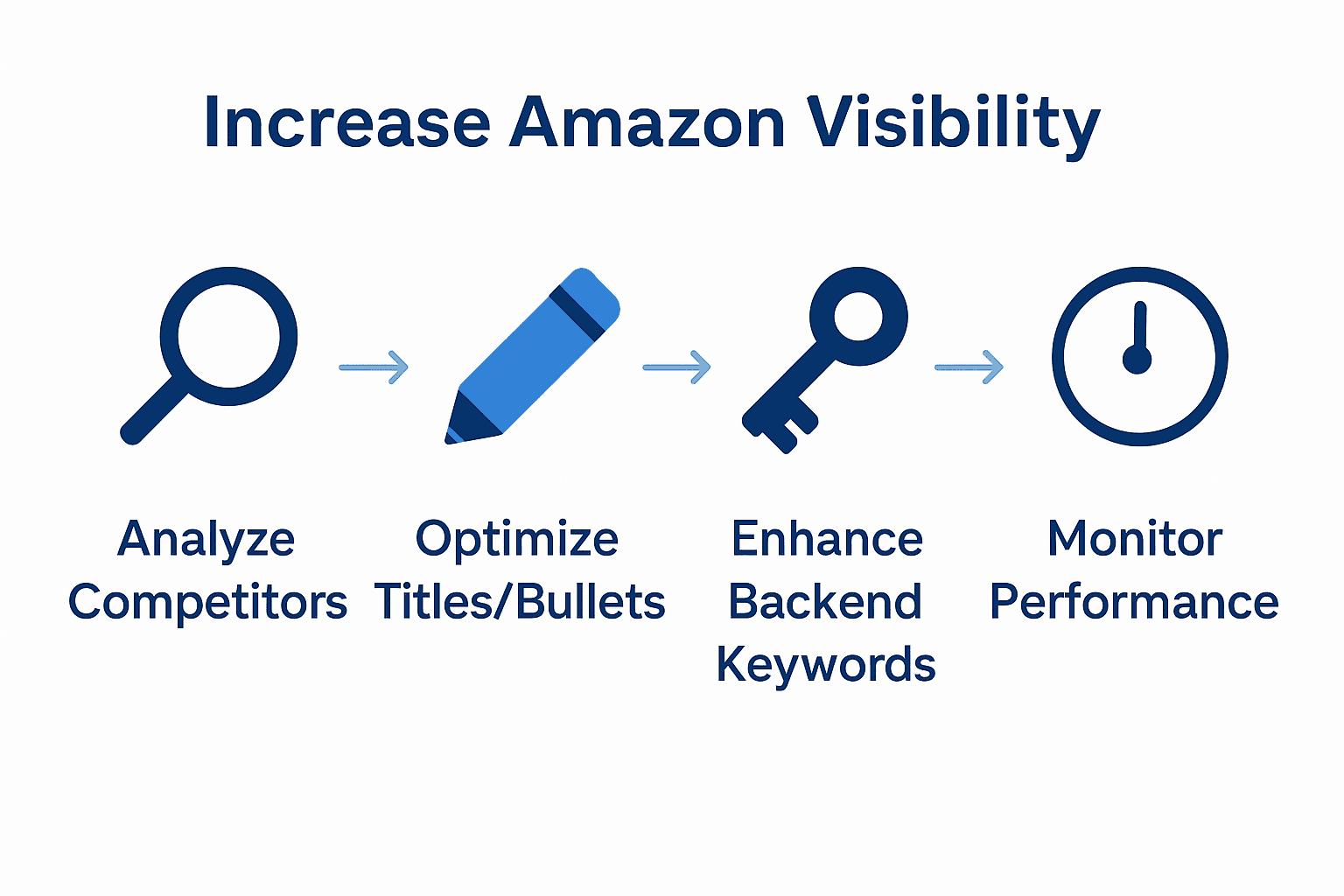
Congratulations on completing this comprehensive guide to increasing your Amazon visibility. By implementing these strategic steps, you are now equipped to transform your Amazon selling approach and drive meaningful sales growth.
Boost Your Amazon Visibility with Expert Strategies
Struggling to make your product listings stand out in the crowded Amazon marketplace can be frustrating. This article highlights key challenges like optimizing product titles, bullet points, backend keywords, and using data-driven SEO techniques to increase your sales. If you want to overcome these obstacles and transform your Amazon presence, you need a tailored approach that aligns perfectly with your goals.
Our team specializes in Amazon Listing Optimization and Amazon SEO & Analytics. We focus on enhancing titles, bullet points, and descriptions while leveraging smart data-backed strategies. By connecting deep market insights with actionable listing improvements, we help you capture more buyer attention and convert clicks into sales.
Ready to accelerate your growth and unlock your full potential? Discover essential tips and proven methods on our E-commerce Tips & Strategies to Grow Your Online Business page.

Take the next step to elevate your Amazon sales today by visiting SearchOneers and exploring how our expert services can drive your product visibility and revenue upward. Your competition is evolving fast Do not wait to get ahead with proven optimization and SEO that works.
Frequently Asked Questions
How can I analyze competitor listings to improve my Amazon visibility?
To analyze competitor listings, start by identifying successful products in your category that have high sales but few reviews. Focus on aspects like images, descriptions, and keyword usage, and use a spreadsheet to track these findings for comparison and trend identification.
What should I include in my product titles for better visibility?
Optimize your product titles by including your brand name and key features such as size, color, and material along with core keywords. Ensure that your title is engaging and informative, fitting within Amazon’s character limits to attract clicks and conversions.
How can I enhance my backend keywords to drive more traffic?
To enhance your backend keywords, incorporate relevant terms not used elsewhere, including synonyms and common misspellings. Use spaces to separate keywords without punctuation, making it easier for search algorithms to process them effectively, helping you capture additional traffic.
How can I track and refine my performance on Amazon?
Monitor your performance by regularly checking metrics like keyword rankings and click-through rates. Set a monthly review schedule to analyze these metrics and identify trends, adjusting your optimization strategies as needed to improve sales performance.
What role do product descriptions play in increasing Amazon visibility?
Product descriptions are crucial for engaging potential buyers and providing detailed information about your product. Craft a compelling narrative that addresses customer pain points and ends with a strong call-to-action, encouraging customers to make a purchase.
How often should I update my Amazon listings for optimal visibility?
Regularly update your listings based on performance metrics and market trends, aiming for updates at least once a month. This practice helps keep your listings fresh and relevant, potentially increasing visibility and sales.

Comments
2 responses to “How to Increase Amazon Visibility for Higher Sales”
[…] sophisticated marketing approaches that simultaneously drive sales and improve search rankings. How to Increase Amazon Visibility provides advanced insights into leveraging advertising and external traffic to enhance marketplace […]
[…] How to Increase Amazon Visibility for Higher Sales – Searchoneers […]