

Amazon sellers hoping to climb to the top in crowded search results know every detail counts. Here is the wild part. Listings optimized with the right keywords can increase conversion rates by over 50 percent compared to the average. Most sellers think flashy images or deep discounts are what drive those wins, but real breakthroughs come from quietly updating the basics you probably ignored.
Table of Contents
- Step 1: Analyze Your Current Listing Performance
- Step 2: Conduct Keyword Research For Optimization
- Step 3: Enhance Product Titles And Descriptions
- Step 4: Improve Product Images For Visual Appeal
- Step 5: Optimize Pricing And Inventory Management
- Step 6: Monitor Performance And Adjust Accordingly
Quick Summary
| Key Point | Explanation |
|---|---|
| 1. Analyze Your Listing’s Performance | Regularly review conversion rates and click-through metrics to identify improvement areas. |
| 2. Conduct Thorough Keyword Research | Utilize tools to pinpoint high-volume, relevant keywords that enhance search visibility. |
| 3. Optimize Titles and Descriptions | Create engaging, informative titles and narratives that attract and convert potential buyers. |
| 4. Invest in High-Quality Product Images | Use professional images to establish trust and effectively showcase product features. |
| 5. Monitor and Adjust Strategies Continuously | Regularly evaluate your listing’s performance and revise strategies based on changing market dynamics. |
Step 1: Analyze Your Current Listing Performance
Successful Amazon sellers understand that optimizing listings begins with a comprehensive performance analysis. By meticulously examining your current product listing’s metrics, you establish a strategic foundation for improvement. Performance analysis reveals hidden opportunities and provides actionable insights that can dramatically transform your sales trajectory.
Start by accessing your Amazon Seller Central dashboard, which serves as your primary analytical hub. Focus on key performance indicators that directly reflect your listing’s effectiveness. Conversion rate, click-through rate, and search ranking are critical metrics that unveil your product’s market position. Pay special attention to how potential customers interact with your listing – are they viewing but not purchasing? This could signal underlying issues with product presentation or pricing.
Utilize Amazon’s built-in analytics tools alongside third-party software to gain deeper insights. Discover advanced Amazon search optimization techniques that can help transform your data into strategic actions. Look for patterns in customer behavior: Which search terms are driving traffic? What are the demographics of customers viewing your product? Understanding these nuances helps you refine your listing’s targeting and appeal.
Below is an overview table summarizing the key tools and resources referenced in the keyword research and performance analysis processes for Amazon listing optimization.
| Tool/Resource | Purpose | Key Features or Use |
|---|---|---|
| Amazon Search Bar | Reveal popular search terms | Autocomplete shows trending customer queries |
| Helium 10 | Keyword research & analytics | Advanced keyword data, search volume, competition |
| Jungle Scout | Keyword research & competitive analysis | Product tracking, keyword ideas, competitor insights |
| Amazon Brand Analytics | Official Amazon data on customer behavior | Search frequency, demographic data |
| Amazon Seller Central | Listing performance analytics | Conversion, click-through rates, search ranking |
| Third-Party Analytics Tools | Deeper insights into product and keyword trends | Track performance trends, competitor benchmarking |
Compare your listing’s performance against top-performing competitors in your product category. Analyze their titles, images, bullet points, and descriptions. What makes their listings more compelling? Are they using enhanced marketing techniques or presenting information more effectively? This competitive benchmarking provides a blueprint for potential improvements and helps you identify gaps in your current strategy.
Successful listing optimization is an iterative process. Document your current performance metrics as a baseline, then systematically implement changes and track their impact. By maintaining a data-driven approach, you transform your Amazon listing from a static product page into a dynamic, high-converting sales tool.
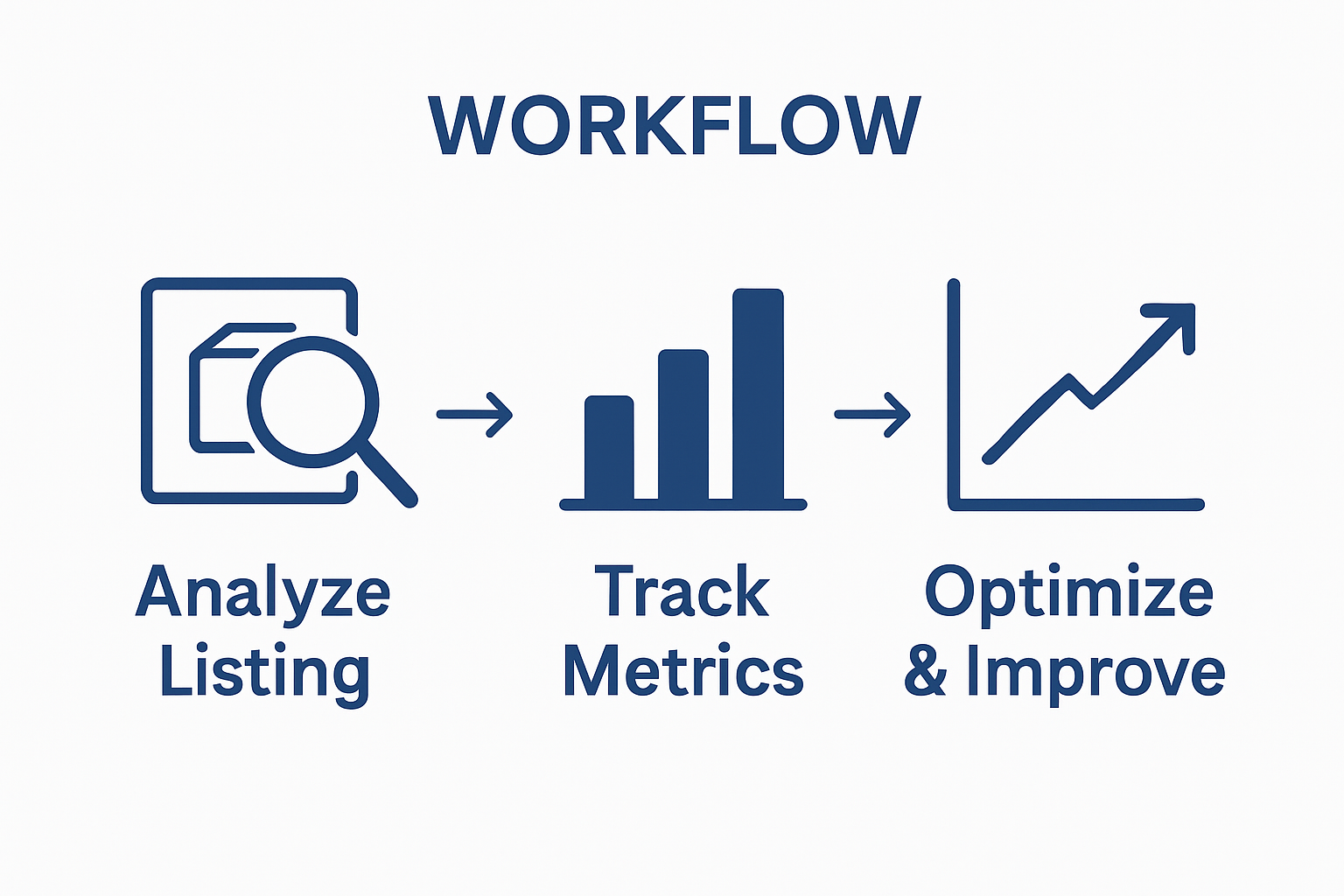
This step overview table provides a concise summary of the main steps for optimizing Amazon listings, including the focus area and primary goal of each step.
| Step | Focus Area | Primary Goal |
|---|---|---|
| Analyze Current Listing Performance | Performance Metrics | Identify strengths and areas for improvement |
| Conduct Keyword Research | Search Visibility | Find relevant, high-volume keywords |
| Enhance Titles and Descriptions | Content Optimization | Craft compelling, keyword-rich copy |
| Improve Product Images | Visual Presentation | Boost trust and detail product features |
| Optimize Pricing & Inventory | Financial & Stock Management | Balance profit with market competitiveness |
| Monitor Performance, Adjust Accordingly | Ongoing Data Review | Refine based on analytics and feedback |
Step 2: Conduct Keyword Research for Optimization
Keyword research represents the strategic backbone of Amazon listing optimization, transforming how potential customers discover your products. Understanding the language your target audience uses is crucial for creating a listing that resonates and ranks effectively in search results. This step goes beyond simple guesswork – it’s about precision and strategic insight into customer search behaviors.
Begin your keyword research by leveraging multiple tools and perspectives. Amazon’s own search bar provides immediate insights through autocomplete suggestions, revealing the most common search terms customers use. Combine this with professional keyword research tools like Helium 10, Jungle Scout, or Amazon’s Brand Analytics to uncover high-volume, relevant search terms specific to your product category. Learn advanced strategies for Amazon SEO consulting that can elevate your keyword strategy from basic to sophisticated.
Dive deep into understanding search intent behind keywords. Not all high-volume keywords are equal – some might attract browsers while others draw in serious buyers. Analyze the search volume, competition level, and relevance of each potential keyword. Look for long-tail keywords that demonstrate specific purchasing intent. For instance, instead of targeting a broad term like “running shoes,” focus on more specific phrases like “women’s trail running shoes with ankle support” that indicate a more targeted customer looking to make a purchase.
Organize your keyword research into strategic categories: primary keywords that define your product, secondary keywords that provide additional context, and backend keywords that improve searchability without cluttering your visible listing. Prioritize keywords with high search volume and low competition, creating a balanced approach that maximizes visibility while maintaining realistic ranking potential. Remember that keyword optimization is an ongoing process – continually refine your strategy based on performance metrics and emerging search trends to stay ahead of market dynamics.
Step 3: Enhance Product Titles and Descriptions
Crafting compelling product titles and descriptions represents a critical turning point in your Amazon listing optimization journey. Your product’s first impression hinges on these essential elements, transforming casual browsers into committed buyers. The goal is to create content that simultaneously satisfies Amazon’s algorithmic requirements and speaks directly to your potential customer’s needs and desires.
Start by constructing a product title that acts as a powerful, information-dense beacon. Prioritize key details within the first 70 characters, as this is typically what customers see in search results. Include critical information like brand name, primary product features, size, color, and unique selling propositions. Avoid keyword stuffing, but strategically incorporate high-performing keywords discovered during your previous research. Learn advanced Amazon SEO strategies to outrank your competition and elevate your listing’s visibility.
Your product description should be a narrative that goes beyond mere specifications. According to research from the Shopping Queries Dataset, effective product descriptions create a connection by addressing customer pain points and showcasing clear benefits. Write in a conversational tone that speaks directly to your target audience. Highlight what makes your product unique – perhaps it solves a specific problem, offers exceptional quality, or provides a novel solution that differentiates it from competitors.
Structure your description with readability in mind. Use short paragraphs, clear headings, and bullet points to break up text and make information easily digestible. Include specific details about product dimensions, materials, compatibility, and potential use cases. Anticipate and proactively address potential customer questions within the description, reducing barriers to purchase and demonstrating transparency. Remember that your description is not just about selling a product – it’s about telling a story that resonates with your potential buyer’s needs and aspirations.

Step 4: Improve Product Images for Visual Appeal
Product images serve as the visual gateway to your Amazon listing, acting as the critical first impression that can make or break a potential sale. High-quality, professional images communicate product value and build customer trust more effectively than any written description ever could. According to research examining e-commerce visual marketing, strategic image presentation significantly influences purchase behavior across different product categories.
Invest in professional photography that showcases your product from multiple angles and in realistic contexts. Your primary image must meet Amazon’s strict requirements: a pure white background, featuring the product filling 85% of the frame, with high resolution (minimum 1000×1000 pixels to enable zoom functionality). Beyond the main image, create a comprehensive visual story through additional images that demonstrate product usage, highlight unique features, and provide scale and dimension. Explore our advanced Amazon SEO strategies to understand how visual presentation impacts search rankings.
Consider creating lifestyle images that help potential buyers envision the product in their own environment. These contextual images can dramatically increase emotional connection and perceived value. Include close-up shots that reveal texture and quality, images showing product dimensions, and – where relevant – shots demonstrating the product in action. Technical precision matters: ensure consistent lighting, sharp focus, and professional editing that removes background distractions while maintaining natural color representation.
Think strategically about image sequence and storytelling. The first few images are your most critical real estate, so arrange them to progressively reveal your product’s most compelling attributes. Start with a clear, front-facing professional shot, then move to detail images, followed by lifestyle or contextual images that help customers understand how the product integrates into their lives. By treating your product images as a visual narrative, you transform them from mere documentation into a powerful sales tool that connects emotionally and practically with potential buyers.
Step 5: Optimize Pricing and Inventory Management
Pricing and inventory management represent the financial heartbeat of your Amazon selling strategy, directly impacting profitability and long-term success. Effective management requires a delicate balance between competitive pricing and maintaining healthy profit margins. Understanding Amazon’s dynamic marketplace demands a strategic approach that goes beyond simple price tagging.
Begin by conducting comprehensive competitive analysis using Amazon’s built-in tools and third-party pricing software. Monitor your competitors’ pricing in real-time, but resist the temptation to engage in destructive price wars that erode your margins. Instead, develop a nuanced pricing strategy that considers factors like product quality, shipping costs, and unique value propositions. Learn advanced Amazon SEO consulting strategies to understand how pricing influences search rankings and visibility.
According to research examining inventory management in online retail, dynamic inventory management is crucial for maintaining consistent sales performance. Implement a robust inventory tracking system that prevents stockouts while avoiding excessive inventory holding costs. Utilize Amazon’s inventory performance metrics to understand your current standing and optimize your stock levels. Consider leveraging fulfillment services like Fulfillment by Amazon (FBA) to streamline inventory management and potentially improve your product’s visibility and shipping efficiency.
Develop a pricing algorithm that adjusts dynamically based on market conditions, seasonality, and competitor movements. Experiment with strategic pricing techniques such as psychological pricing (ending prices in .99), volume discounts, and limited-time promotions. Monitor your price elasticity – understanding how small price changes impact demand can provide significant competitive advantages. Remember that pricing is not a one-time task but an ongoing process of refinement and adaptation in the ever-changing Amazon marketplace.
Step 6: Monitor Performance and Adjust Accordingly
Successful Amazon sellers understand that optimization is an ongoing journey, not a destination. Continuous monitoring and strategic adjustment are the keys to maintaining and improving your product’s performance. Your ability to interpret data, recognize trends, and make informed decisions will ultimately determine your long-term success in the competitive Amazon marketplace.
Establish a regular performance review schedule using Amazon’s robust analytics tools. Seller Central provides a wealth of metrics that offer deep insights into your listing’s performance. Focus on critical indicators like conversion rate, click-through rate, and search ranking. Explore advanced Amazon SEO strategies to understand how these metrics interconnect and influence your overall sales potential. Pay close attention to customer feedback, reviews, and questions – these are goldmines of information that can reveal hidden opportunities for improvement or potential issues with your product listing.
Develop a systematic approach to performance analysis. Create a spreadsheet or use specialized Amazon seller analytics tools to track your key performance indicators over time. Look for patterns and correlations – perhaps certain keywords drive more traffic, or specific image modifications increase conversion rates. Be prepared to make incremental adjustments to your listing, testing one change at a time to understand its direct impact. This might involve tweaking product titles, refreshing images, adjusting pricing, or refining your keyword strategy.
Remember that Amazon’s algorithm constantly evolves, and what works today might not be as effective tomorrow. Stay informed about marketplace trends, seasonal variations, and changes in Amazon’s search algorithms. Treat your Amazon listing as a living, breathing entity that requires consistent nurturing and adaptation. By maintaining a proactive and data-driven approach to performance monitoring, you’ll position yourself to quickly capitalize on opportunities and mitigate potential challenges before they significantly impact your sales performance.
Ready to Transform Your Amazon Listings into Sales Powerhouses?
Are you frustrated by stagnant sales, low conversion rates, or listings buried deep in Amazon search results? Our article showed that many sellers struggle to bridge the gap between solid listing fundamentals and real, measurable growth. If you want to take your Amazon product pages from basic to best-in-class, it’s time to use proven strategies and expert guidance. Our E-commerce Tips & Strategies section offers actionable advice tailored to online sellers like you, focusing on high-impact methods such as keyword optimization, data-driven analysis, and dynamic pricing.
The path to higher sales starts with a custom strategy. At Searchoneers, we specialize in Amazon listing optimization, crafting high-performing titles, compelling bullet points, and advanced backend keywords that boost your visibility and conversions. Let us help you uncover hidden opportunities using smart Amazon SEO and ongoing analytics. Do not wait for your competition to pull ahead—visit our homepage now and take your next step towards outperforming your rivals and growing your business.
Frequently Asked Questions
How can I analyze my current Amazon listing performance?
To analyze your current Amazon listing performance, start by accessing your Amazon Seller Central dashboard. Focus on key performance indicators like conversion rate, click-through rate, and search ranking. Pay attention to how potential customers interact with your listing to identify areas for improvement.
What tools can I use for effective keyword research in Amazon listing optimization?
You can leverage Amazon’s autocomplete suggestions, along with professional tools like Helium 10, Jungle Scout, and Amazon’s Brand Analytics. These tools help uncover high-volume, relevant search terms specific to your product category, enhancing your keyword strategy.
What elements should I focus on when enhancing my product titles and descriptions?
When enhancing product titles, prioritize key details like brand name, features, and unique selling points within the first 70 characters. For descriptions, address customer pain points and highlight benefits. Use a conversational tone, break up text for readability, and include specifics about dimensions, materials, and use cases.
How can I improve my product images for better sales performance?
Invest in professional photography that meets Amazon’s requirements, including high resolution and a pure white background. Showcase your product from multiple angles and in realistic contexts. Use lifestyle images to create emotional connections, and structure images to tell a compelling visual story that emphasizes your product’s features.

Comments
10 responses to “How to Optimize Amazon Listings for Higher Sales”
[…] Explore advanced Amazon listing optimization techniques to refine your category selection strategy. Mastering these key concepts transforms category selection from an administrative task into a powerful competitive advantage in the complex Amazon ecosystem. […]
[…] Explore advanced Amazon listing optimization techniques to elevate your product presentation strategy. […]
[…] Explore comprehensive Amazon listing optimization techniques to stay ahead of marketplace dynamics. Customer reviews are your most valuable optimization resource. Read them carefully, identifying patterns in both praise and criticism. Look beyond star ratings and dive into the specific language customers use. These insights can reveal opportunities to refine your product description, address potential concerns, and highlight features that truly matter to buyers. […]
[…] learn more about advanced listing optimization by prioritizing the most important information at the beginning of your title. Position primary keywords early to maximize search algorithm recognition. Buyers and Amazon’s search engine typically pay most attention to the first 50-80 characters, so frontload your most compelling product attributes. […]
[…] Positive feedback creates a psychological reassurance that influences purchasing decisions. Learn more about optimizing Amazon listings to maximize your conversion […]
[…] Discover advanced techniques for Amazon listing optimization to elevate your marketplace performance. By implementing these sophisticated strategies, sellers can transform their Amazon businesses from passive participants to proactive market leaders. […]
[…] Discover advanced pricing optimization techniques to refine your approach. Consider implementing a price segmentation strategy that allows you to offer different pricing for various product variations or bundle options. This can help capture a broader range of customer price sensitivities while maintaining overall profitability. […]
[…] Our comprehensive Amazon listings optimization guide emphasizes that product performance data is a primary catalyst for listing updates. Sellers must closely monitor critical metrics such as: […]
[…] strategies that prioritize accurate product representation over short-term visibility tricks. How to Optimize Amazon Listings emphasizes that sustainable success comes from authentic, value-driven keyword optimization that […]
[…] sellers to tap into cost-conscious markets while providing sustainable shopping alternatives. Our guide on optimizing Amazon listings provides comprehensive insights into creating compelling product […]