

Most American sellers discover that even standout products can be buried in Amazon’s search results if listings are not optimized. With over 350 million items competing on the platform, it takes more than just a great product to capture buyer attention. Mastering listing optimization helps American sellers boost visibility and drive sales by tailoring every element of their product pages for both Amazon’s algorithm and real shoppers.
Table of Contents
- Defining Listing Optimization For Amazon Sellers
- Key Strategies For Optimizing Listings
- Types Of Listing Elements And Their Roles
- How Listing Optimization Impacts Visibility And Sales
- Common Pitfalls In Amazon Listing Optimization
Key Takeaways
| Point | Details |
|---|---|
| Listing Optimization is Essential | Effective listing optimization enhances product visibility and conversion rates on Amazon by strategically crafting key elements. |
| Ongoing Process | Regularly analyze and adjust listings every 60-90 days to maintain competitive advantage and adapt to marketplace changes. |
| High-Quality Visuals Matter | Investing in professional, high-quality images significantly impacts customer trust and purchasing decisions. |
| Avoid Common Mistakes | Steer clear of keyword stuffing and neglecting backend keywords to improve search rankings and product discoverability. |
Defining Listing Optimization for Amazon Sellers
Listing optimization is the strategic process of enhancing product listings to improve visibility, attract potential buyers, and increase sales performance on Amazon’s competitive marketplace. Amazon SEO refers to the process of strategically improving product listings to rank higher in search results, which directly impacts a seller’s ability to reach potential customers.
At its core, listing optimization involves carefully crafting multiple elements of a product page to align with both Amazon’s algorithm and customer search behaviors. These critical elements include product titles, bullet points, descriptions, backend keywords, and high-quality images. Sellers who master these components can significantly improve their product’s discoverability and conversion potential. Effective optimization isn’t just about inserting keywords randomly – it requires a nuanced understanding of how Amazon’s search algorithm evaluates and ranks product listings.
Successful Amazon sellers understand that listing optimization is an ongoing process, not a one-time task. The marketplace continually evolves, with changing consumer preferences, algorithm updates, and competitive dynamics. This means sellers must regularly analyze their listing performance, track key metrics like click-through rates and conversion rates, and make data-driven adjustments. By treating listing optimization as a dynamic strategy, sellers can maintain and improve their product’s competitive edge.
Pro Tip: Performance Review: Conduct a comprehensive listing optimization audit every 60-90 days, analyzing your current metrics, competitor performance, and making strategic adjustments to maintain your product’s visibility and attractiveness.
Key Strategies for Optimizing Listings
Amazon sellers must focus on a comprehensive approach to listing optimization that addresses multiple critical components. Effective strategies include using high-quality images, writing compelling product titles and descriptions, and utilizing backend keywords, which collectively enhance product visibility and attract potential buyers.
The foundation of successful listing optimization begins with crafting strategic product titles. These titles should be clear, concise, and include relevant keywords that potential customers might use when searching for products. High-quality product images play an equally crucial role, as they provide visual information and can significantly impact a customer’s purchasing decision. Sellers should invest in professional, high-resolution images that showcase the product from multiple angles and highlight its key features.
Beyond visual elements, sellers must craft clear and concise titles while highlighting product benefits in bullet points and leveraging backend keywords effectively. The product description and bullet points are critical opportunities to communicate value proposition, unique selling points, and address potential customer questions. Backend keywords, though invisible to customers, help Amazon’s search algorithm better understand and categorize the product, improving its chances of appearing in relevant search results.
Pro Tip: Keyword Precision: Regularly update and refine your backend keywords by analyzing search term reports and tracking which keywords are driving the most traffic to your product listings.
Types of Listing Elements and Their Roles
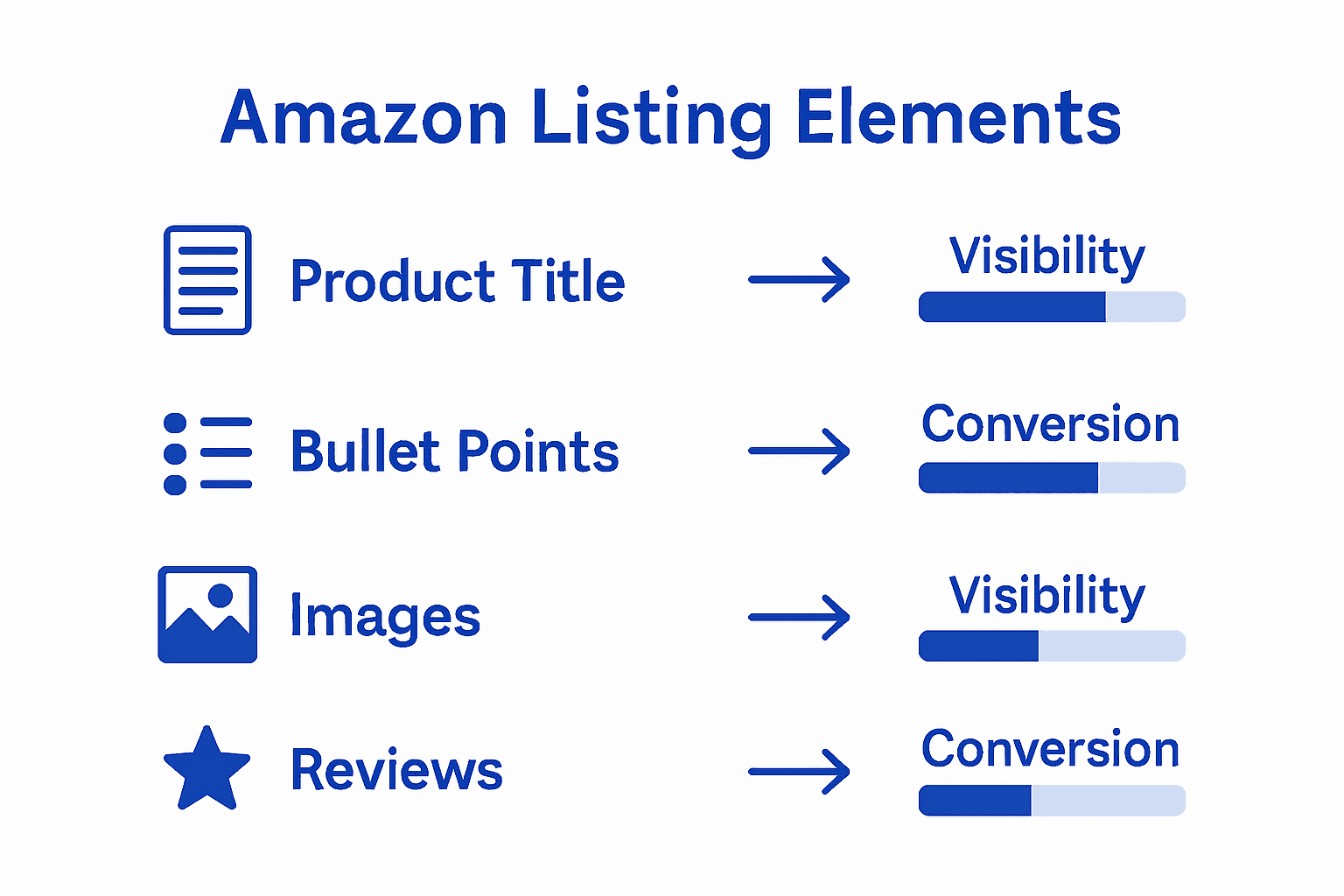
Key components of an Amazon listing are the product title, bullet points, product description, images, and customer reviews, all contributing to the product’s appeal and search ranking. These elements work together as a comprehensive ecosystem, each playing a critical role in attracting and converting potential buyers.
The product title serves as the primary identifier and first point of contact for customers. It should be strategically crafted to include primary keywords, highlight key product features, and provide essential information like brand name, size, color, or quantity. Immediately following the title, bullet points act as rapid-fire communication tools, allowing sellers to quickly showcase the most compelling product benefits, specifications, and unique selling propositions. These concise points help customers quickly assess whether the product meets their needs.

Product descriptions and backend keywords represent the more nuanced aspects of listing optimization. While the description provides a detailed narrative about the product’s capabilities, features, and potential use cases, backend keywords operate behind the scenes to improve search visibility. These hidden keywords help Amazon’s algorithm understand and categorize the product more effectively, increasing the likelihood of appearing in relevant search results. Additional visual elements like high-quality product images further enhance the listing by providing customers with a comprehensive understanding of the product’s appearance, functionality, and potential value.
Here’s a summary of how each Amazon listing element impacts both visibility and conversion rate:
| Listing Element | Contribution to Visibility | Impact on Conversion Rate |
|---|---|---|
| Product Title | Improves search performance through keywords | Sets first impression and relevance |
| Bullet Points | Enhances keyword diversity for ranking | Highlights essential product benefits |
| Product Description | Adds long-tail keywords and context | Informs and persuades buyers |
| High-Quality Images | Boosts listing attractiveness in search | Builds trust, aids in purchase decision |
| Backend Keywords | Expands reach in search algorithm | No direct impact, supports discovery |
Pro Tip: Visual Storytelling: Develop a set of product images that not only showcase the item from multiple angles but also demonstrate its practical use, context, and unique features to create a more engaging and informative visual narrative.
How Listing Optimization Impacts Visibility and Sales
Effective listing optimization dramatically improves search rankings, making products more discoverable to potential buyers and boosting sales performance. The Amazon marketplace operates on a complex algorithm that rewards well-crafted listings with increased visibility, creating a direct pathway between optimization efforts and potential revenue growth.
The search ranking mechanism of Amazon’s platform is fundamentally driven by relevance and performance metrics. Listings that incorporate strategic keywords, compelling product descriptions, and high-quality images are more likely to appear in top search results. This increased visibility translates directly into higher click-through rates, as potential customers are more likely to engage with listings that appear prominent and professionally presented. Sellers who invest time in understanding and implementing sophisticated optimization techniques can significantly outperform competitors who rely on basic, generic listing approaches.
Beyond initial visibility, listing optimization influences critical conversion metrics. A well-optimized listing not only attracts potential buyers but also provides them with comprehensive, clear information that reduces purchase hesitation. Detailed bullet points, precise product descriptions, and multiple high-resolution images help customers make informed purchasing decisions. This transparency builds trust and reduces the likelihood of returns, ultimately improving the seller’s overall performance metrics and potentially unlocking better positioning within Amazon’s competitive marketplace.
Pro Tip: Performance Tracking: Implement a monthly review process to analyze your listing’s performance metrics, comparing click-through rates, conversion rates, and search ranking to identify and immediately address any optimization opportunities.
Common Pitfalls in Amazon Listing Optimization
Common mistakes in Amazon listing optimization include keyword stuffing, neglecting high-quality images, and failing to utilize backend keywords effectively. These errors can significantly undermine a seller’s ability to attract and convert potential customers, making strategic optimization crucial for marketplace success.
One of the most prevalent optimization mistakes involves mishandling keywords. Sellers often fall into the trap of keyword stuffing, cramming excessive and irrelevant keywords into titles and descriptions in an attempt to game the search algorithm. This approach not only looks unprofessional but can actually harm search rankings and deter potential buyers. Instead, keywords should be carefully selected and integrated naturally, focusing on relevance and readability. Frequent pitfalls also involve overloading titles with keywords and underutilizing critical listing elements like bullet points, which are essential for communicating product value and features.
Another significant challenge is the visual presentation of products. Many sellers underestimate the importance of high-quality, professional images that showcase the product from multiple angles and in various contexts. Poor image quality, insufficient image count, or images that fail to highlight key product features can dramatically reduce customer engagement and conversion rates. Backend keywords, often overlooked, represent another critical area where sellers frequently miss optimization opportunities. These hidden search terms play a crucial role in helping Amazon’s algorithm understand and categorize products, potentially expanding their visibility to more potential buyers.
To help Amazon sellers avoid critical mistakes, here’s a quick reference table comparing common pitfalls and recommended best practices:
| Common Pitfall | Potential Impact | Recommended Best Practice |
|---|---|---|
| Keyword Stuffing | Lower rankings, poor readability | Integrate relevant keywords naturally |
| Low-Quality Images | Reduced buyer trust, fewer sales | Use high-resolution, clear images |
| Ignoring Backend Keywords | Missed search opportunities | Update backend keywords regularly |
| Overloaded Titles | Confusing search relevance | Keep titles clear and focused |
Pro Tip: Optimization Audit: Conduct a quarterly comprehensive review of your product listings, systematically analyzing each element for optimization potential, including keyword relevance, image quality, and backend search term effectiveness.
Unlock Your Amazon Listing’s True Potential Today
Struggling to master listing optimization for your Amazon products? You are not alone. Common challenges like crafting compelling titles, optimizing backend keywords, and using high-quality images can feel overwhelming. This article points out how crucial it is to continually update and refine these elements to boost search visibility and increase sales. If you want practical solutions tailored to these exact pain points, our expertise at Search Oneers is here to help.

Explore our proven strategies in E-commerce Tips & Strategies to Grow Your Online Business that focus on Amazon Listing Optimization with precise titles, bullet points, and keyword research. We combine smart Amazon SEO and analytics to keep your listings ahead in the ever-changing marketplace. Take action now and visit Search Oneers to start transforming your Amazon listing for higher visibility and stronger sales momentum.
Frequently Asked Questions
What is listing optimization on Amazon?
Listing optimization is the strategic process of enhancing product listings on Amazon to improve visibility, attract potential buyers, and increase sales performance by aligning with Amazon’s algorithm and customer search behaviors.
Why is listing optimization important for Amazon sellers?
Listing optimization is crucial because it directly affects a seller’s ability to reach potential customers through improved search rankings, leading to higher click-through and conversion rates, ultimately resulting in increased sales.
What are the key elements of an optimized Amazon listing?
The key elements of an optimized Amazon listing include strategic product titles, bullet points that highlight benefits, detailed product descriptions, high-quality images, and effective use of backend keywords to enhance visibility and appeal to customers.
How often should I review and optimize my Amazon listings?
It is recommended to conduct a comprehensive listing optimization audit every 60-90 days to analyze performance metrics, competitor performance, and make necessary adjustments to maintain product visibility and attractiveness.

Comments
2 responses to “What Is Listing Optimization and Why It Matters”
[…] demands strategic approach to product listing optimization. Sellers who master the art of listing optimization techniques can dramatically improve their product’s search rankings and conversion potential. Successful […]
[…] product listings represent the critical interface between sellers and potential customers, making strategic optimization essential for driving visibility and sales. Successful sellers understand that a well-crafted listing goes far beyond basic product […]