Finding ways to stand out on Amazon can feel challenging, especially for sellers aiming to appeal to environmentally conscious buyers. As more customers seek products that reflect their values, understanding the power behind Eco Rank and Climate Pledge Friendly badges becomes a crucial advantage. This overview reveals how Amazon Eco Rank goes beyond pricing and sales, equipping you to use sustainability certifications, consumer reviews, and verified badges to boost visibility while driving real business growth.
Table of Contents
- Defining Amazon Eco Rank And Key Concepts
- How Eco Rank Works On Amazon
- The Role Of Eco Labels And Certifications
- Practical Benefits For Product Visibility
- Common Challenges And How To Succeed
Key Takeaways
| Point | Details |
|---|---|
| Amazon Eco Rank | Amazon Eco Rank evaluates product sustainability through metrics like carbon footprint and recyclability, influencing purchasing decisions and seller practices. |
| Importance of Eco Labels | Eco labels, such as Climate Pledge Friendly, enhance product visibility and credibility, attracting eco-conscious consumers and supporting premium pricing. |
| Challenges in Sustainability Marketing | Overcoming consumer skepticism about green claims requires transparent documentation and a compelling sustainability narrative. |
| Actionable Strategies for Sellers | Sellers should optimize product listings with eco-certifications and provide detailed sustainability information to build consumer trust. |
Defining Amazon Eco Rank and Key Concepts
Amazon Eco Rank represents a sophisticated scoring system designed to evaluate and highlight products based on their environmental sustainability and ecological impact. Unlike traditional ranking mechanisms, this innovative approach goes beyond mere sales performance to assess a product’s green credentials. Eco-labels like Climate Pledge Friendly aggregate multiple sustainability certifications into a unified badge, enabling consumers to quickly recognize environmentally responsible offerings.
At its core, Amazon Eco Rank aggregates critical metrics that demonstrate a product’s environmental commitment. These metrics typically include factors such as carbon footprint, recyclability, sustainable manufacturing processes, packaging efficiency, and overall environmental impact. Consumer reviews of eco-friendly products reveal that modern buyers increasingly prioritize products with transparent sustainability credentials, making Eco Rank a powerful differentiator in the competitive Amazon marketplace.
The ranking system considers multiple dimensions beyond traditional product evaluation. Key assessment areas include raw material sourcing, manufacturing transparency, energy consumption during production, waste reduction strategies, and potential carbon offset initiatives. By creating a comprehensive scoring mechanism, Amazon encourages sellers to adopt more sustainable practices while providing consumers with clear, comparable environmental performance indicators.
Pro tip: Sellers can improve their Amazon Eco Rank by documenting and showcasing their sustainability efforts, obtaining recognized environmental certifications, and using eco-friendly packaging materials.
How Eco Rank Works on Amazon
Amazon’s Eco Rank system operates through a sophisticated machine learning mechanism that evaluates product sustainability across multiple dimensions. Climate Pledge Friendly badges serve as the primary visual indicator of a product’s environmental credentials, signaling to consumers that an item meets specific sustainability standards. The ranking process incorporates complex algorithms that analyze product attributes, manufacturing processes, and consumer feedback to generate comprehensive environmental performance scores.
The core functionality involves advanced natural language processing techniques that examine consumer reviews and product descriptions. Consumer review sentiment analysis plays a critical role in determining a product’s perceived eco-friendliness, allowing Amazon to create dynamic rankings that reflect real-world environmental perceptions. This approach goes beyond static certifications, creating a more nuanced evaluation of a product’s sustainability.
Key evaluation criteria for Eco Rank include carbon footprint assessment, sustainable sourcing verification, packaging efficiency, recyclability, and overall environmental impact. The system uses machine learning to continuously refine its scoring mechanism, encouraging sellers to improve their sustainability practices. Brands can enhance their ranking by providing transparent documentation about their environmental initiatives, obtaining recognized eco-certifications, and demonstrating measurable sustainability improvements.

Here’s a summary of the core Eco Rank evaluation criteria and their business impact:
| Evaluation Criterion | What It Assesses | Business Impact |
|---|---|---|
| Carbon Footprint | Emissions during production | Reduces climate impact, attracts eco-conscious buyers |
| Sustainable Sourcing | Origin and renewability of materials | Enhances brand trust, competitive differentiation |
| Recyclability | Potential for product/material reuse | Lowers landfill waste, supports sustainability marketing |
| Packaging Efficiency | Minimization and eco-friendliness of packaging | Cuts costs, improves customer satisfaction |
| Manufacturing Transparency | Clarity on supply chain and eco practices | Builds credibility, strengthens reputation |
This table helps clarify how each dimension contributes to both scoring and business outcomes.
Pro tip: Sellers can strategically improve their Amazon Eco Rank by collecting and showcasing detailed environmental impact data, obtaining multiple sustainability certifications, and implementing transparent green manufacturing practices.
The Role of Eco Labels and Certifications
Eco labels and certifications serve as critical verification mechanisms within Amazon’s sustainability ecosystem. Climate Pledge Friendly badges consolidate over 50 independent sustainability certifications, creating a transparent and standardized approach to identifying environmentally responsible products. These visual markers provide consumers with immediate insight into a product’s ecological credentials, simultaneously incentivizing brands to pursue rigorous environmental standards.
The certification process involves comprehensive evaluations across multiple sustainability dimensions. Brands must demonstrate measurable environmental commitments through detailed documentation, third-party audits, and verifiable sustainability metrics. Amazon’s sustainability reporting emphasizes that these certifications are not merely marketing tools but fundamental mechanisms for driving meaningful environmental transformation across global supply chains.
Different types of eco labels address specific sustainability aspects, including carbon neutrality, organic production, recycled materials, energy efficiency, and responsible sourcing. These certifications create a nuanced framework that goes beyond generic environmental claims, requiring brands to meet stringent, measurable standards. By establishing clear benchmarks, Amazon encourages continuous improvement in sustainable product development, creating a competitive landscape where environmental responsibility becomes a key differentiator for businesses.
Compare these popular eco-certifications and the advantages they offer:
| Certification Type | Focus Areas | Advantages for Brands |
|---|---|---|
| Carbon Neutral | Offset emissions, renewable energy | Positions brand as climate leader |
| Organic Production | Pesticide-free, non-GMO | Appeals to health-aware consumers |
| Recycled Materials | Use of post-consumer content | Demonstrates waste reduction efforts |
| Energy Efficiency | Reduced energy consumption | Lowers operational costs, eco credibility |
| Responsible Sourcing | Ethical supplier practices | Aligns with consumer values, increases trust |
This reference table highlights how certification types enhance brand reputation and market appeal.
Pro tip: Sellers should strategically target multiple complementary eco certifications to enhance their product’s credibility and improve their visibility within Amazon’s sustainability ranking system.
Practical Benefits for Product Visibility
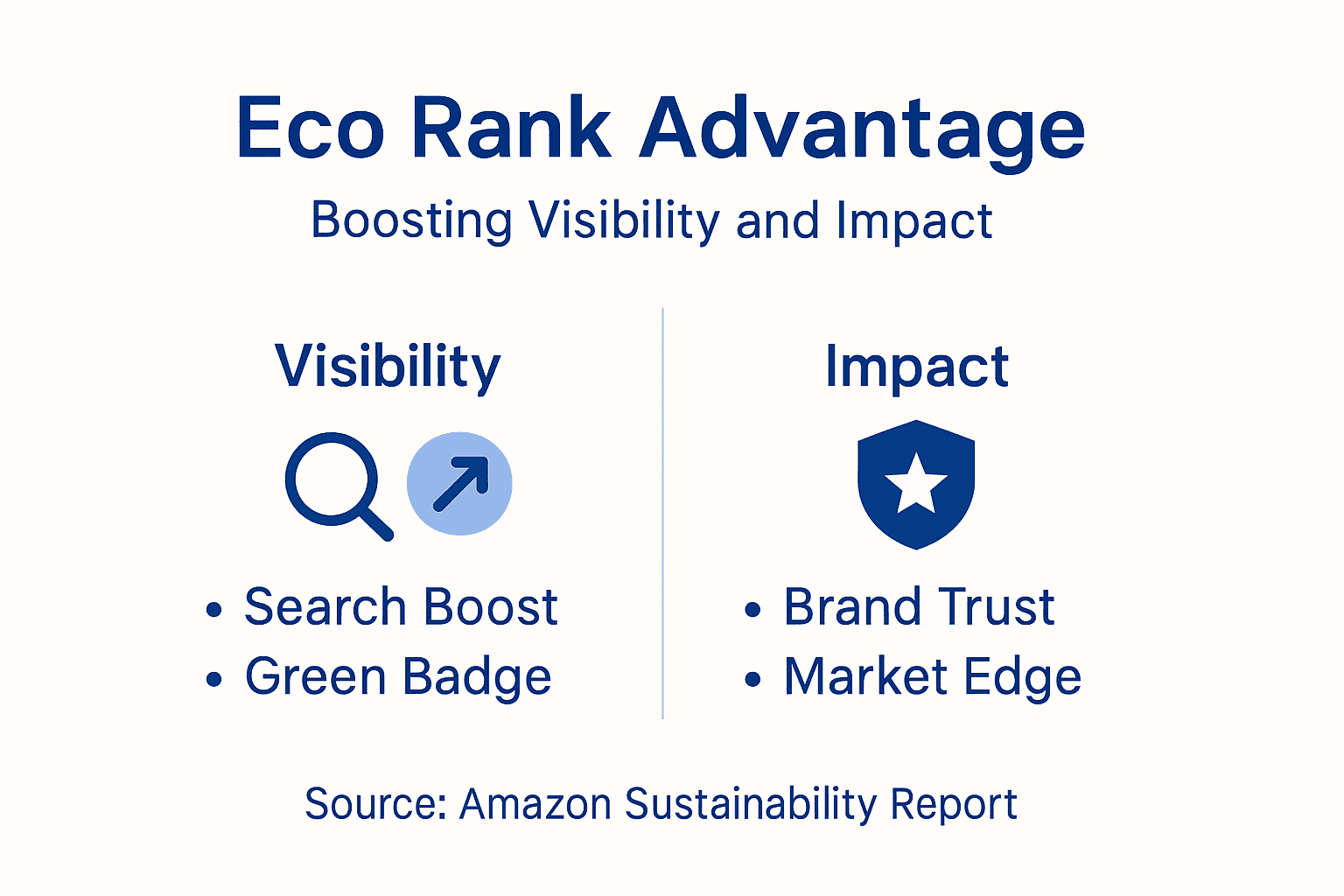
Climate Pledge Friendly badges dramatically transform product visibility by attracting environmentally conscious consumers and creating a competitive advantage in Amazon’s marketplace. These eco-credentials serve as powerful signaling mechanisms that elevate product rankings, increase search prominence, and justify premium pricing strategies. By showcasing verified sustainability attributes, sellers can distinguish their offerings from generic competitors, capturing the attention of increasingly discerning buyers who prioritize environmental responsibility.
The visibility benefits extend beyond simple marketing advantages. Amazon’s sustainability reporting reveals that products with green certifications experience enhanced customer engagement, faster product discovery, and improved algorithmic ranking. These eco-labels create a trust signal that resonates with consumers seeking transparent, environmentally responsible purchasing options. Sellers who strategically leverage these certifications can expect improved click-through rates, increased consumer confidence, and potentially higher conversion rates.
Beyond immediate visibility advantages, eco-friendly product designations create long-term competitive differentiation. Brands implementing comprehensive sustainability strategies gain access to growing market segments of environmentally conscious consumers. These certifications transform product listings from mere transactional entries into compelling narratives of environmental stewardship, allowing sellers to connect with customers on a deeper, values-driven level. The cumulative effect is a more nuanced approach to product marketing that goes beyond traditional performance metrics.
Pro tip: Optimize your product listings by prominently displaying eco-certification badges and integrating specific sustainability achievements into your product description to maximize visibility and consumer trust.
Common Challenges and How to Succeed
Consumer skepticism about eco-labels represents a significant challenge for sellers navigating Amazon’s sustainability ranking system. Many buyers remain cautious about green marketing claims, requiring brands to demonstrate genuine commitment through transparent documentation and verifiable certifications. Overcoming this skepticism demands a strategic approach that balances authentic sustainability practices with clear, compelling communication about environmental achievements.
Successful implementation involves integrating multidimensional consumer insights that go beyond simple product descriptions. Sellers must develop nuanced strategies that address diverse consumer values, including environmental impact, product performance, and price considerations. This approach requires careful data interpretation, combining quantitative certification metrics with qualitative feedback from consumer reviews to create a comprehensive sustainability narrative.
Navigating price sensitivity emerges as another critical challenge in the Eco Rank ecosystem. Sustainable products often carry higher production costs, which can potentially deter budget-conscious consumers. Successful sellers mitigate this by clearly articulating the long-term value of eco-friendly products, highlighting lifecycle cost benefits, and demonstrating how sustainable choices contribute to broader environmental goals. This strategy transforms potential price barriers into opportunities for consumer education and brand differentiation.
Pro tip: Develop a comprehensive sustainability story that goes beyond certifications, using detailed product descriptions, transparent manufacturing information, and clear environmental impact metrics to build consumer trust and overcome potential skepticism.
Elevate Your Amazon Eco Rank with Expert Listing Optimization
Struggling to stand out in Amazon’s evolving sustainability landscape? With increasing emphasis on Eco Rank and eco labels like Climate Pledge Friendly, your product listings must clearly communicate authentic green credentials to win eco-conscious shoppers. Key challenges include overcoming consumer skepticism, highlighting verified certifications, and optimizing product visibility through smart SEO strategies.
At SearchOneers we specialize in enhancing Amazon listings with optimized titles bullet points descriptions and backend keywords that spotlight your sustainability efforts effectively. Leveraging data-backed insights from our E-commerce Tips & Strategies to Grow Your Online Business helps you navigate the complex Amazon Eco Rank ecosystem, turning environmental investments into competitive advantages.
Ready to boost your product’s visibility and credibility with proven Amazon SEO and analytics techniques? Visit SearchOneers today to explore comprehensive solutions that align with Amazon’s sustainability priorities and maximize your impact in the marketplace.
Frequently Asked Questions
What is Amazon Eco Rank?
Amazon Eco Rank is a scoring system used by Amazon to evaluate products based on their environmental sustainability and ecological impact, considering factors like carbon footprint, recyclability, and sustainable manufacturing processes.
How can sellers improve their Amazon Eco Rank?
Sellers can enhance their Amazon Eco Rank by documenting their sustainability efforts, obtaining recognized environmental certifications, and using eco-friendly packaging materials to demonstrate their commitment to environmental responsibility.
What are the benefits of obtaining eco-labels and certifications for products on Amazon?
Eco-labels and certifications help verify a product’s sustainability claims, enhance brand trust, attract environmentally conscious consumers, and improve visibility and rankings on Amazon’s platform.
What challenges do sellers face in the Eco Rank system?
Sellers often face challenges such as consumer skepticism regarding eco-labels and price sensitivity associated with sustainable products. Addressing these requires transparent documentation of sustainability efforts and highlighting the long-term value of eco-friendly products.