

Most sellers are surprised to learn that over 70 percent of Amazon purchases begin with a search, and where a product appears can make or break its success. With fierce competition on every results page, understanding what determines product ranking is crucial for anyone hoping to increase sales. This guide sheds light on the hidden forces shaping Amazon’s search results, revealing how key factors like conversion rates and customer reviews influence your product’s visibility.
Table of Contents
- What Amazon Ranking Factor Means
- Key Relevance And Performance Types
- How Sales And Conversion Influence
- Role Of Inventory And Fulfillment
- Impact Of Reviews And Customer Signals
- Advertising And External Traffic Effects
Key Takeaways
| Point | Details |
|---|---|
| Understanding Ranking Factors | Amazon’s ranking factors are complex and include metrics like conversion rates, sales velocity, and customer reviews, which dynamically influence product visibility. |
| Relevance and Performance | Sellers must enhance both relevance (keyword matching) and performance (sales metrics) to improve product ranking and visibility on Amazon. |
| Inventory and Fulfillment Impact | Robust inventory management and fast fulfillment methods, such as FBA, are critical for maintaining high product rankings in search results. |
| Proactive Review Management | High-quality customer reviews and consistent feedback management are essential to build trust and enhance product ranking potential on Amazon. |
What Amazon Ranking Factor Means
Amazon ranking factors are complex algorithmic criteria that determine how products are displayed and positioned within Amazon’s search results. According to research from arxiv.org, these ranking mechanisms go far beyond simple keyword matching, involving sophisticated multi-dimensional evaluation processes that assess product relevance, performance, and customer engagement.
At its core, a ranking factor represents a specific metric Amazon’s algorithm uses to judge and prioritize product listings. The arxiv.org study on search session Markov decision processes reveals that these factors are dynamically weighted, meaning their importance can shift based on user behavior, search context, and real-time marketplace trends.
The primary ranking factors typically include:
- Conversion rate
- Sales velocity
- Product listing quality
- Customer review volume and rating
- Relevance of product title and keywords
- Click-through rates
- Inventory availability
Sellers who understand these ranking factors can strategically optimize their listings to improve visibility. By analyzing how each factor contributes to search placement, Amazon sellers can develop targeted strategies that align with the platform’s algorithmic preferences.
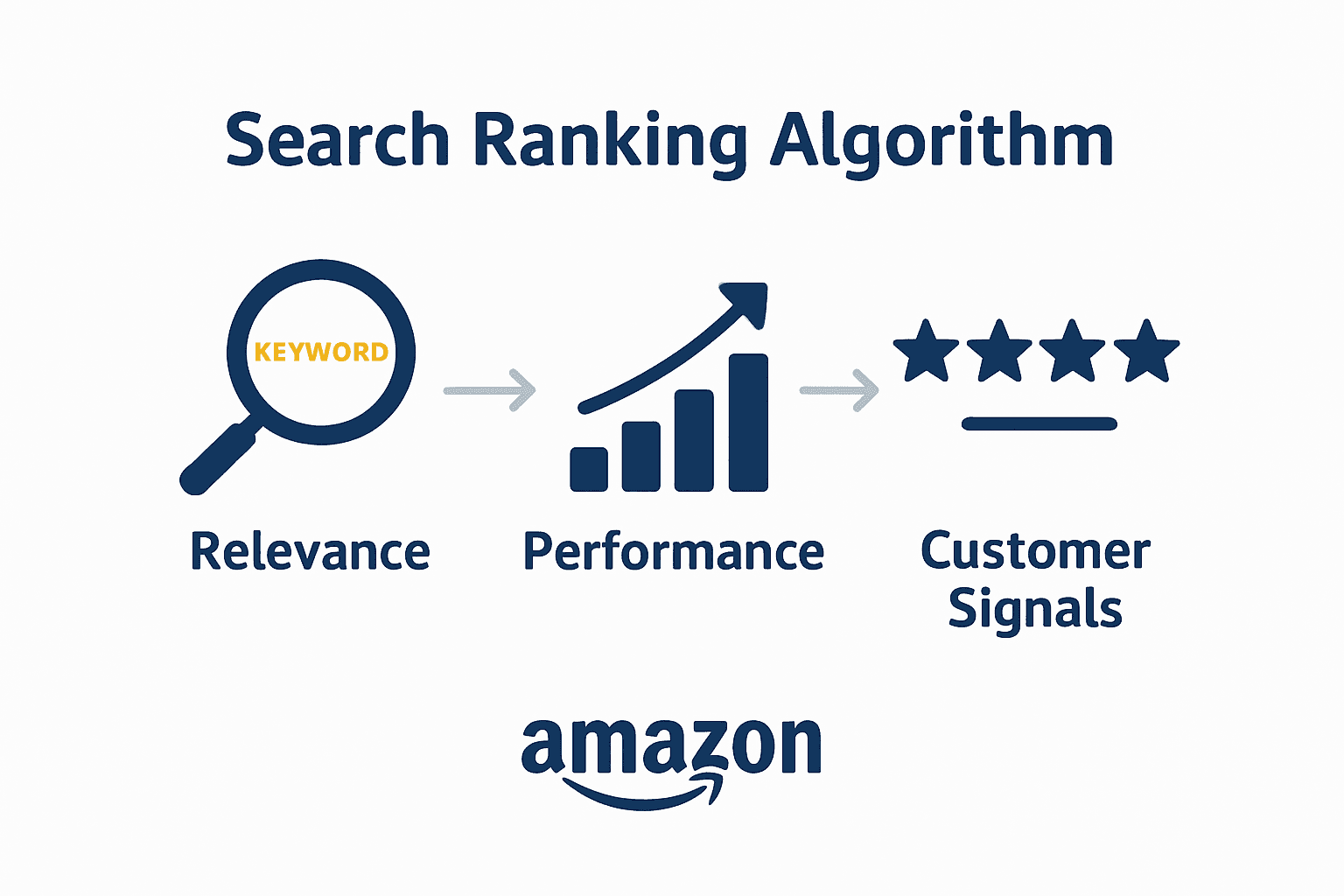
Here’s a summary of the main Amazon ranking factor categories and their key influences:
| Category | Key Influences | Optimization Strategies |
|---|---|---|
| Relevance | Keyword matching Title accuracy | Refine product titles Use relevant keywords |
| Performance | Conversion rate Sales velocity Click-through | Improve images/descriptions Competitive pricing |
| Inventory & Fulfillment | Stock levels Shipping speed Fulfillment type | Maintain inventory Use FBA for fast shipping |
| Customer Signals | Star rating Number/recent reviews Review quality | Encourage feedback Address negative reviews |
| Advertising & Traffic | Sponsored ads External clicks Ad conversion | Invest in PPC Drive targeted external traffic |
Understanding Amazon’s Search Algorithm: How It Works provides deeper insights into how these complex ranking mechanisms operate in practice, helping sellers navigate the nuanced world of Amazon SEO.
Key Relevance And Performance Types
In the complex ecosystem of Amazon’s search algorithm, relevance and performance types play a critical role in determining product visibility and ranking. According to research from arxiv.org, the integration of review scores and popularity metrics creates nuanced trade-offs between how relevant a product appears and how well it performs in actual marketplace conditions.
The primary relevance and performance types can be categorized into several key dimensions:
- Textual Relevance: How closely product keywords match search queries
- Behavioral Relevance: User interaction metrics like click-through and conversion rates
- Historical Performance: Previous sales velocity and consistent product performance
- Quality Signals: Customer reviews, ratings, and overall product satisfaction
Research exploring sponsored listings ranking from arxiv.org highlights the delicate balance between revenue maximization and maintaining genuine product relevance. This means Amazon’s algorithm doesn’t just prioritize high-selling products, but carefully weighs multiple performance indicators to ensure search results remain meaningful and useful for customers.
Sellers can optimize their listings by understanding these nuanced ranking criteria. By strategically improving both relevance and performance metrics, sellers can enhance their product’s visibility and competitiveness. Understanding Keyword Relevance on Amazon offers deeper insights into crafting listings that align with these complex algorithmic preferences.
How Sales And Conversion Influence
Sales and conversion rates are pivotal mechanisms that directly impact a product’s visibility and ranking within Amazon’s complex search ecosystem. According to research from Similarweb, sales velocity serves as a critical signal that demonstrates a product’s popularity and relevance in the marketplace.
Conversion Rate Dynamics play a fundamental role in determining product ranking. When a product consistently converts browsers into buyers, Amazon’s algorithm interprets this as a strong indicator of product quality and market demand. Key conversion influencers include:
- Price competitiveness
- Product image quality
- Detailed and accurate product descriptions
- Positive customer reviews
- Fast shipping options
- Clear product specifications
Research from Darkroom Agency emphasizes that higher sales volumes and superior conversion rates send powerful signals to Amazon’s ranking algorithm. Products that demonstrate sustained sales performance are more likely to be prioritized in search results, creating a virtuous cycle of increased visibility and potential revenue.
Strategic sellers can leverage these insights by continuously optimizing their listings and focusing on metrics that drive conversions.
 What Is Amazon Conversion Rate? provides comprehensive strategies for sellers looking to enhance their product’s performance and visibility in this competitive marketplace.
Role Of Inventory And Fulfillment
Inventory management and fulfillment strategies are critical components that significantly influence a product’s ranking and visibility on Amazon. According to research from Darkroom Agency, fulfillment methods like Prime eligibility directly impact conversion rates and search result positioning.
The key inventory and fulfillment factors that Amazon’s algorithm considers include:
- Stock availability and consistency
- Shipping speed and reliability
- Fulfillment method (FBA vs. Seller Fulfilled)
- Product delivery time
- Inventory replenishment rate
- Ability to meet customer demand
- Minimum stock level maintenance
Amazon prioritizes sellers who demonstrate robust inventory management and can consistently fulfill customer orders quickly. Products with Fulfillment by Amazon (FBA) status typically receive preferential treatment, as they guarantee faster shipping and more reliable delivery times. This reliability signals to Amazon’s algorithm that the product is trustworthy and capable of meeting customer expectations.
Strategic sellers must view inventory management not just as a logistical challenge, but as a critical ranking factor. Amazon Inventory Ranking provides deeper insights into optimizing your inventory strategies to improve search rankings and overall marketplace performance.
Impact Of Reviews And Customer Signals
Customer reviews and signals represent a powerful mechanism that profoundly influences product ranking and visibility on Amazon. Research from arxiv.org reveals how review scores and popularity information are intricately integrated into ranking algorithms, directly impacting user purchasing decisions and product positioning.
The critical customer signals that Amazon’s algorithm considers include:
- Overall star rating
- Total number of reviews
- Review recency
- Review quality and depth
- Verified purchase percentage
- Customer feedback sentiment
- Detailed review content
- Review helpfulness votes
According to Ranking Geek, customer reviews are more than just social proof. They serve as a sophisticated ranking signal that communicates product reliability, customer satisfaction, and marketplace relevance. Products with consistent, high-quality reviews are perceived as more trustworthy by both Amazon’s algorithm and potential buyers.
Strategic sellers must proactively manage their review ecosystem, understanding that each customer interaction contributes to their product’s overall ranking potential.
 Amazon Ranking Factors List offers comprehensive strategies for sellers looking to optimize their review management and improve their marketplace visibility.
Advertising And External Traffic Effects
Advertising and external traffic play a crucial role in shaping a product’s visibility and ranking within Amazon’s complex marketplace ecosystem. Research from arxiv.org demonstrates how strategic advertising approaches can significantly influence product placement and revenue generation through sophisticated ranking algorithms.
The key advertising and external traffic factors that impact Amazon SEO include:
- Sponsored product ad performance
- Click-through rates from external sources
- Traffic quality from off-Amazon marketing channels
- Advertising spend and efficiency
- Conversion rates from ad-driven traffic
- Brand recognition and external marketing efforts
- Social media and external platform referrals
Amazon’s algorithm increasingly values traffic sources that demonstrate genuine user interest and purchase intent. This means that high-quality external traffic from targeted marketing campaigns can substantially improve a product’s organic ranking potential. The platform rewards sellers who can drive meaningful, conversion-oriented traffic to their listings.
Strategic sellers must view advertising not just as a sales tool, but as a critical ranking optimization strategy. By understanding how external traffic signals impact product visibility, sellers can develop more sophisticated marketing approaches that simultaneously drive sales and improve search rankings. How to Increase Amazon Visibility provides advanced insights into leveraging advertising and external traffic to enhance marketplace performance.
Unlock Your Amazon Success with Expert SEO Strategies
Struggling to crack the code behind Amazon’s complex ranking factors like conversion rate, inventory management, and customer reviews? You are not alone. Many sellers face frustration trying to balance relevance and performance while competing in a marketplace that constantly shifts algorithms. Our tailored approach targets the exact pain points highlighted in the article — from improving click-through rates with better product titles to boosting sales velocity through strategic inventory and fulfillment. Amazon SEO is not guesswork when you have the right partner guiding your every move.

Take control of your Amazon growth today by exploring proven tactics for listing optimization, backed by analytics that adapt to marketplace changes. Visit E-commerce Tips & Strategies to Grow Your Online Business and get access to comprehensive solutions designed for sellers ready to rise above the competition. Start now at SearchOneers and transform your Amazon listings into powerful sales engines.
Frequently Asked Questions
What are Amazon ranking factors?
Amazon ranking factors are algorithmic criteria that determine how products are displayed in search results on Amazon. They evaluate product relevance, performance, and customer engagement, affecting visibility significantly.
How can I improve my product’s conversion rate on Amazon?
To improve conversion rates, focus on optimizing product images, providing detailed descriptions, ensuring competitive pricing, receiving positive reviews, and offering fast shipping options to entice potential buyers.
What role does inventory management play in Amazon SEO?
Inventory management is crucial for maintaining product visibility. Having sufficient stock levels, fast shipping solutions like Fulfillment by Amazon (FBA), and efficient replenishment strategies can enhance your product’s ranking in search results.
How do customer reviews affect product ranking on Amazon?
Customer reviews act as important signals in Amazon’s ranking algorithm. A higher star rating, the number of reviews, and positive feedback can significantly boost product visibility, while low scores or negative reviews can harm a product’s ranking.

Comments
3 responses to “Amazon Ranking Factor: Complete Guide to Amazon SEO”
[…] To gain deeper insights into Amazon’s complex ranking dynamics, explore our comprehensive Amazon Ranking Factors guide. […]
[…] For sellers, understanding this algorithm is not just beneficial—it’s essential. Mastering its intricacies can mean the difference between being buried on page 10 of search results or securing a prime position that drives substantial traffic and sales. Learn more about Amazon ranking factors in our comprehensive guide. […]
[…] Amazon Ranking Factor: Complete Guide to Amazon SEO – Searchoneers […]