

Most Amazon sellers are surprised to learn that conversion rate, customer satisfaction, and relevance matter more for ranking than just keyword use. With millions of products competing for the top spots, Amazon’s A9 algorithm judges listings across countless details, from review quality to sales velocity. Sellers who understand what truly drives product visibility can rise above the competition, attracting more buyers and boosting sales through targeted improvements.
Table of Contents
- Amazon Ranking Factors Explained Clearly
- Types of Amazon Ranking Factors in Detail
- How the A9 Algorithm Impacts Rankings
- Key Optimization Elements for Higher Visibility
- Common Mistakes Affecting Amazon SEO Performance
Key Takeaways
| Point | Details |
|---|---|
| A9 Algorithm Complexity | Amazon’s A9 ranking algorithm evaluates products based on conversion rate, customer satisfaction, and relevance, requiring a multifaceted optimization approach. |
| Holistic Listing Optimization | Sellers should enhance every aspect of their product listings, including titles, images, descriptions, and customer service, to improve visibility. |
| Performance Metrics Priority | Key performance signals like total sales, conversion rates, and customer engagement significantly influence product rankings on Amazon. |
| Common SEO Mistakes | Frequent errors such as keyword stuffing, inconsistent information, and neglecting customer service can harm search rankings and product visibility. |
Amazon Ranking Factors Explained Clearly
Amazon’s complex ranking algorithm, known as A9, determines product visibility through a sophisticated evaluation process that goes far beyond simple keyword matching. According to research from iosrjournals, the algorithm assesses products based on three critical dimensions: conversion rate, customer satisfaction, and relevance.
The A9 algorithm leverages an intricate system of performance metrics that directly impact a product’s search ranking. Key factors that influence rankings include:
- Total number of sales
- Product page conversion rates
- Customer review quality and quantity
- Relevance of product title and description
- Customer engagement with the product listing
- Price competitiveness
- Product availability and shipping speed
Research from arxiv reveals that Amazon’s sales rank is significantly influenced by additional nuanced factors like the number of related products viewed or purchased by customers. This means that products which encourage broader customer exploration and trigger complementary purchase behaviors are more likely to receive favorable ranking treatment.
Successfully navigating Amazon’s ranking system requires sellers to adopt a holistic approach. By optimizing every aspect of their product listing—from compelling imagery and detailed descriptions to competitive pricing and robust customer service—sellers can improve their chances of achieving higher visibility. For a deeper understanding, check out our guide on understanding Amazon’s search algorithm.
Types of Amazon Ranking Factors in Detail
Understanding Amazon’s ranking factors requires a comprehensive approach that goes beyond simple metrics. According to research from arxiv, Amazon’s ranking system analyzes multiple complex dimensions including user behavior, product relevance, and sales performance to optimize search results and product visibility.
The ranking factors can be categorized into several critical types:
Here’s a comparison of the main types of Amazon ranking factors:
| Ranking Factor Type | Example Metrics | Importance for SEO |
|---|---|---|
| Performance Metrics | Conversion rate Click-through rate Total sales | Drives sales-based ranking |
| Product Relevance Factors | Keyword match Title alignment Image quality | Improves listing visibility |
| Customer Interaction | Review count Average rating Q&A frequency | Builds trust and engagement |
- Performance Metrics
- Conversion rate
- Click-through rate
- Total sales volume
- Product page view duration
- Product Relevance Factors
- Keyword matching in titles and descriptions
- Product category alignment
- Image quality and quantity
- Detailed product specifications
- Customer Interaction Signals
- Number and quality of customer reviews
- Review rating average
- Recent review frequency
- Customer questions and answers
Research from journals confirms that the A9 algorithm meticulously evaluates these elements to determine product rankings. The most successful sellers understand that ranking is not about manipulating individual factors, but creating a holistic, high-quality product experience.
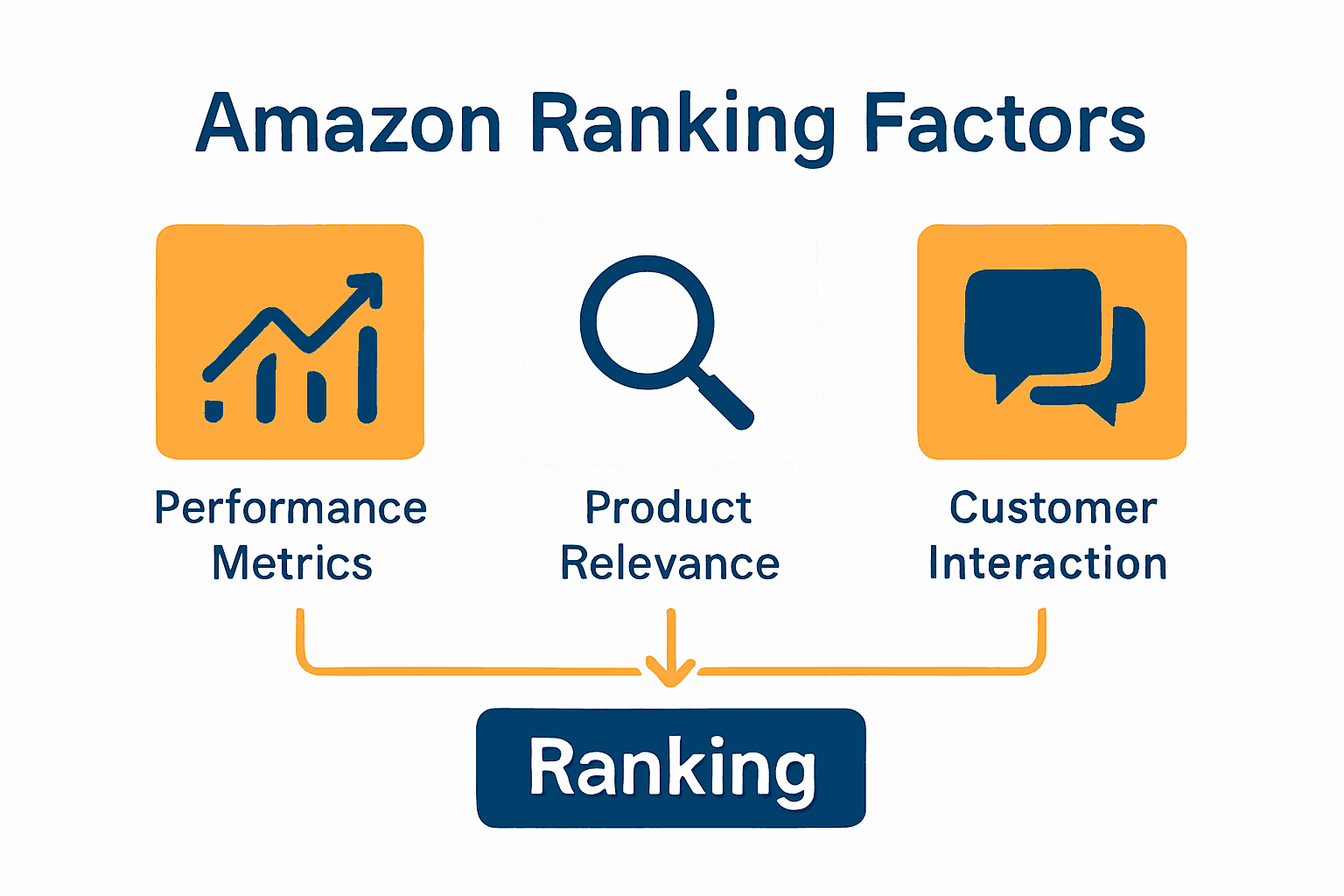
To gain deeper insights into how these ranking factors interconnect, sellers should explore our guide on understanding keyword relevance, which provides a nuanced breakdown of how Amazon evaluates product listings. Success on the platform demands continuous learning and adaptive strategies that align with the platform’s sophisticated ranking mechanisms.

How the A9 Algorithm Impacts Rankings
Amazon’s A9 algorithm is a sophisticated ranking system that fundamentally transforms how products are discovered and displayed in search results. According to research from blogs, the algorithm prioritizes products based on their inherent likelihood to generate sales, placing significant emphasis on conversion potential and nuanced customer behavior patterns.
The algorithm’s impact on product rankings can be understood through several key mechanisms:
- Sales Performance Weighting
- Recent sales volume
- Velocity of sales
- Historical sales trends
- Consistent revenue generation
- Customer Interaction Signals
- Click-through rates
- Time spent on product page
- Conversion rate
- Cart addition frequency
- Relevance and Matching
- Keyword alignment
- Product title optimization
- Precise category matching
- Backend search term effectiveness
Research from iosrjournals confirms that the A9 algorithm meticulously ranks products by analyzing user reviews, conversion rates, and precise relevance to customer search intent. This means sellers cannot simply optimize one aspect but must create a holistic, high-performing product listing.
To maximize visibility within Amazon’s complex ranking ecosystem, sellers should explore our guide on Amazon SEO strategies, which provides actionable insights into navigating the A9 algorithm’s intricate ranking mechanisms.
Key Optimization Elements for Higher Visibility
Successful Amazon product visibility requires a strategic, multifaceted approach that goes beyond simple keyword insertion. According to research from arxiv, product listing optimization fundamentally involves enhancing relevance through precise keyword strategies and systematically improving critical sales performance metrics.
The most impactful optimization elements can be categorized into several key domains:
- Content Optimization
- Compelling, keyword-rich product titles
- Detailed, informative bullet points
- High-quality product images
- Comprehensive product descriptions
- Strategic backend search terms
- Performance Signals
- Consistent sales velocity
- Rapid order fulfillment
- Competitive pricing
- Low return rates
- Quick shipping times
- Customer Engagement Factors
- Positive customer reviews
- High review quantity
- Responsive customer service
- Quick resolution of customer inquiries
- Minimal negative feedback
Research from journals confirms that successful sellers focus intensively on product relevance, accumulating authentic positive reviews, and maintaining a robust sales history. This holistic approach signals to Amazon’s algorithm that your product deserves higher visibility.
To transform these insights into actionable strategies, sellers can dive deeper by exploring our guide on optimizing Amazon search visibility, which provides nuanced techniques for elevating product performance in Amazon’s competitive marketplace.
Common Mistakes Affecting Amazon SEO Performance
Amazon sellers often undermine their product visibility through critical SEO missteps that can dramatically impact their search rankings. According to research from arxiv, one of the most significant performance killers is failing to address potential misinformation within product listings, which can substantially erode customer trust and negatively influence search rankings.
The most prevalent SEO mistakes sellers consistently make include:
- Content and Listing Errors
- Keyword stuffing
- Incomplete product descriptions
- Low-quality product images
- Inconsistent product information
- Neglecting backend search terms
- Performance and Pricing Mistakes
- Inconsistent pricing strategies
- Slow shipping times
- High product return rates
- Inadequate inventory management
- Ignoring competitor pricing
- Customer Experience Failures
- Unaddressed negative reviews
- Poor customer service
- Delayed response to customer inquiries
- Insufficient product variations
- Lack of clear product specifications
Research from arxiv further highlights that sellers frequently overlook critical factors like related product views and competitive pricing, which can significantly hinder a product’s sales rank and overall marketplace performance.
To systematically address these challenges and transform your Amazon SEO strategy, sellers can gain deeper insights by exploring our guide on optimizing Amazon listings, which provides comprehensive techniques for avoiding common pitfalls and maximizing product visibility.
Boost Your Amazon Rankings with Expert Strategies
Struggling to navigate Amazon’s complex ranking factors like conversion rates, customer interactions, and keyword relevance? You are not alone. Many sellers face the challenge of creating a complete, high-performing product listing that satisfies the A9 algorithm and wins customer trust. From optimizing titles and bullet points to mastering backend keywords and analytics, the path to higher visibility demands focused and data-driven actions.

Take control of your Amazon success today by exploring our E-commerce Tips & Strategies to Grow Your Online Business. At SearchOneers, we specialize in Amazon Listing Optimization and Amazon SEO & Analytics tailored to help you outrank the competition. Don’t wait to turn these ranking insights into real sales gains. Visit us now and start elevating your product visibility with proven tactics designed for 2024 and beyond.
Frequently Asked Questions
What are the key factors that influence product rankings on Amazon?
The primary factors influencing product rankings on Amazon include conversion rates, customer satisfaction, product relevance, total number of sales, customer reviews quality, price competitiveness, and product availability and shipping speed.
How can I improve my product’s visibility on Amazon?
To enhance your product’s visibility, focus on optimizing your product listing by using compelling titles, high-quality images, detailed descriptions, and strategic backend search terms. Additionally, maintain a strong sales performance and foster positive customer interactions.
What mistakes should I avoid in my Amazon product listing?
Common mistakes to avoid include keyword stuffing, incomplete descriptions, low-quality images, inconsistent pricing, and neglecting customer service issues. These can harm your product’s visibility and overall performance on the platform.
How does Amazon’s A9 algorithm work?
Amazon’s A9 algorithm ranks products based on their likelihood to generate sales, taking into account several metrics such as sales volume, click-through rates, customer interactions, and relevance to search queries. Sellers must optimize multiple elements of their listings to align with these ranking factors.
Recommended
- Amazon Inventory Ranking: What It Means & How to Improve
- How Amazon SEO Works in 2025 | Rank Higher & Sell More
- Understanding Amazon’s Search Algorithm: How It Works
- Amazon Seller Tips 2025: Essential Strategies for Success
- Improving AI Search Rankings: Proven Step-by-Step Strategies – FAII
- A/B Testing for Ecommerce: Strategies and Trends for 2025

Comments
2 responses to “Amazon Ranking Factors List: Complete Guide 2024”
[…] seeking deeper insights into navigating this complex system can explore our comprehensive guide on Amazon ranking factors to develop more effective product positioning […]
[…] these metrics requires a strategic approach. Amazon Ranking Factors List Guide provides deeper insights into how these elements interact and influence your product’s […]