

Finding the right balance between eye-catching product listings and strict marketplace rules can trip up even experienced Amazon sellers. Adhering to Amazon’s listing guidelines is the foundation for keeping your products visible and avoiding penalties that could impact your North American business. This guide breaks down the most critical compliance standards and proven optimization techniques so you can confidently craft listings that attract shoppers while meeting Amazon’s quality and content requirements.
Table of Contents
- Amazon Listing Guidelines Defined And Debunked
- Key Components Of An Optimized Listing
- Amazon SEO Rules And Ranking Factors
- Image And Content Standards For Listings
- Common Listing Errors And How To Prevent Them
Key Takeaways
| Point | Details |
|---|---|
| Compliance with Guidelines | Adhering to Amazon’s listing guidelines is essential to prevent penalties and ensure marketplace integrity. |
| Essential Listing Components | Optimizing product titles, images, bullet points, and descriptions enhances visibility and conversion rates. |
| Backend Keywords Importance | Strategic use of backend keywords can significantly improve product discoverability when implemented correctly. |
| Regular Performance Review | Consistently monitoring and updating listings based on performance metrics is critical for long-term success on Amazon. |
Amazon Listing Guidelines Defined and Debunked
Understanding Amazon’s listing guidelines is crucial for sellers seeking to maximize visibility and avoid potential account penalties. These comprehensive rules govern every aspect of product presentation, from titles and images to descriptions and overall content quality. Compliance is not optional – it’s a fundamental requirement for selling successfully on the platform.
Amazon’s guidelines serve multiple critical purposes:
- Maintain marketplace quality standards
- Protect consumer shopping experiences
- Ensure fair and transparent product representation
- Prevent misleading or fraudulent listings
The core principles revolve around creating accurate, honest, and comprehensive product listings that provide genuine value to potential buyers. Amazon’s content compliance rules mandate sellers disclose key information and avoid potentially offensive or problematic content.
Key compliance areas sellers must carefully navigate include:
- Accurate product titles
- High-quality, representative images
- Detailed, truthful product descriptions
- Transparent pricing information
- Proper category selection
Listing Violations can result in serious consequences, ranging from temporary listing suppression to complete account suspension. Sellers must proactively understand and implement these guidelines to maintain their selling privileges.
Amazon reserves the right to remove or reject listings that do not meet their comprehensive quality standards.
Backend keywords play a significant role in listing optimization. Sellers should strategically select relevant, high-search-volume terms that accurately represent their product without resorting to keyword stuffing or misleading tactics.
Pro Tip: Regularly review Amazon’s updated guidelines, as platform requirements evolve frequently to improve marketplace integrity and user experience.
Key Components of an Optimized Listing
Creating an effective Amazon product listing requires strategic attention to multiple critical elements that work together to attract potential buyers and improve search visibility. Listing optimization is not just about inserting keywords, but crafting a compelling narrative that converts browser interest into sales.
The essential components of a high-performing Amazon listing include:
- Product Title: Balances descriptive clarity with strategic keyword placement
- Product Images: High-resolution visuals that showcase product features
- Bullet Points: Concise value propositions highlighting key benefits
- Product Description: Detailed explanation of product capabilities and unique selling points
- Backend Keywords: Strategic search terms invisible to customers but crucial for discoverability
Sellers can significantly enhance their listing performance by optimizing Amazon listing structure. The most successful listings combine technical optimization with genuine, customer-focused communication.
Here’s a quick overview of Amazon listing components and their business impact:
| Listing Element | Main Function | Business Impact |
|---|---|---|
| Product Title | Boosts search visibility | Attracts targeted shoppers |
| Product Images | Drives visual engagement | Increases conversion potential |
| Bullet Points | Highlights product benefits | Improves quick decision-making |
| Product Description | Provides detailed context | Reduces purchase hesitation |
| Backend Keywords | Enhances search discoverability | Broadens customer reach |
Each listing component serves a specific strategic purpose:
- Titles drive initial search visibility
- Images create visual engagement
- Bullet points communicate quick value
- Descriptions provide comprehensive product understanding
- Backend keywords expand searchability
Product Imagery plays a particularly crucial role in conversion. Amazon recommends using multiple high-quality images that demonstrate product utility, including:
- Primary product image on white background
- Lifestyle images showing product in use
- Close-up detail shots
- Comparative or scale reference images
Quality visual content can increase conversion rates by up to 300% compared to listings with minimal imagery.
Backend Keywords represent a hidden optimization opportunity. Sellers should strategically select relevant search terms that potential customers might use, without repeating words already present in the title or bullet points.
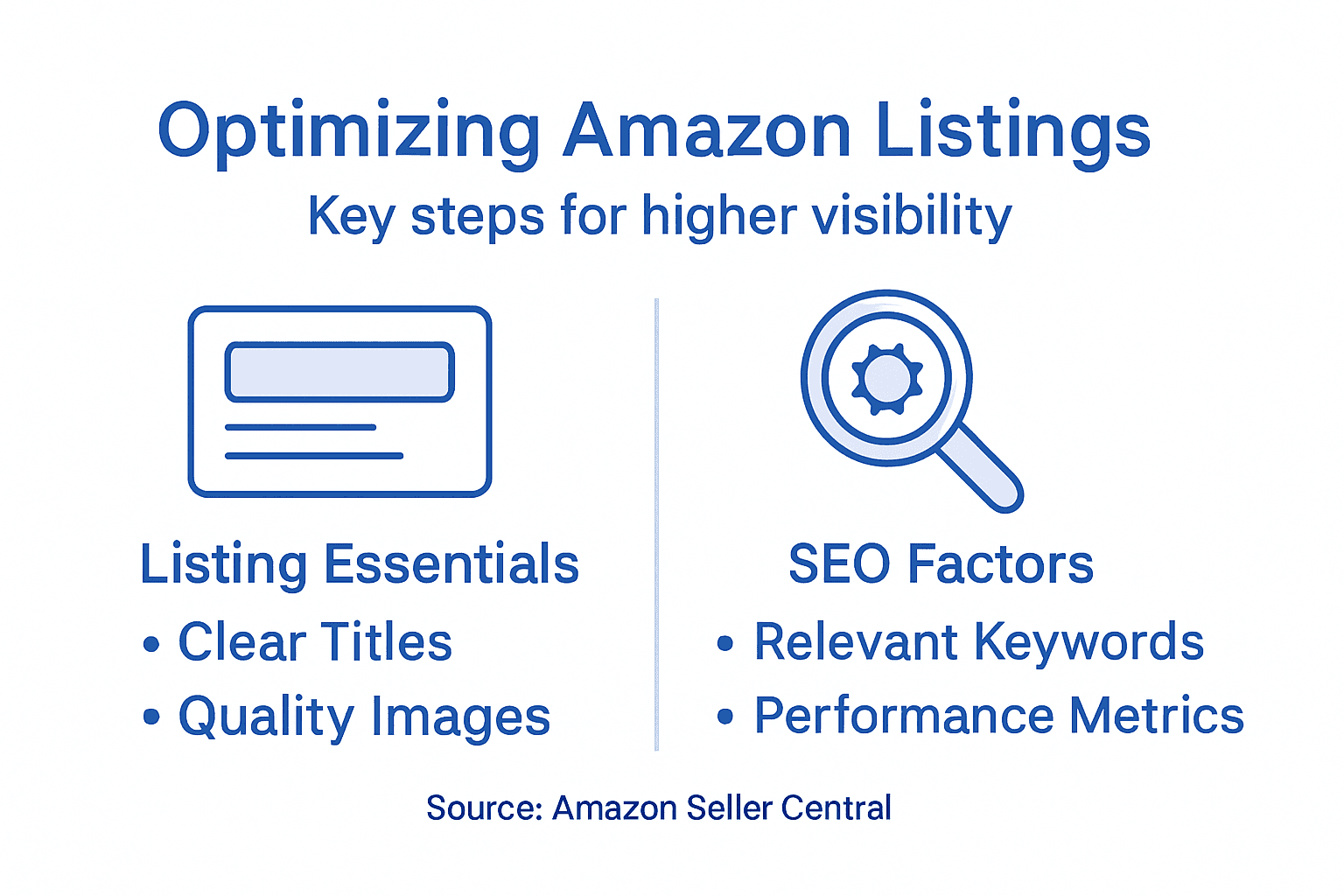
Pro Tip: Regularly analyze your listing’s performance metrics and be prepared to iterate your optimization strategy based on real customer interaction data.
Amazon SEO Rules and Ranking Factors
Amazon SEO represents a complex ecosystem of strategic optimization techniques designed to improve product visibility and drive potential customer engagement. Understanding these intricate ranking factors is crucial for sellers seeking to maximize their marketplace potential and outperform competitors in search results.
The core ranking factors that significantly influence Amazon product placement include:
- Relevance: Matching customer search intent
- Conversion Rate: Percentage of visitors who complete a purchase
- Sales Velocity: Total number and speed of product sales
- Customer Satisfaction: Review quantity and quality
- Pricing Competitiveness: Alignment with market expectations
Amazon SEO strategies fundamentally revolve around understanding and manipulating these critical performance metrics. Successful sellers recognize that visibility is not just about keywords, but about creating a comprehensive, customer-focused listing experience.
Sellers must strategically approach optimization through multiple interconnected channels:
- Keyword research and strategic placement
- Compelling product imagery
- Competitive pricing
- Consistent sales performance
- Positive customer interactions
Search Ranking Mechanics operate on a sophisticated algorithm that continuously evaluates product listings. The most successful sellers adapt their strategies by understanding these dynamic ranking principles, which go far beyond simple keyword matching.
Amazon’s algorithm prioritizes listings that demonstrate consistent customer value and engagement.
Performance Metrics play a crucial role in determining search placement. Factors like click-through rates, conversion rates, and customer review quality directly impact a product’s visibility and organic search positioning.
Pro Tip: Monitor your listing’s performance metrics weekly and be prepared to make data-driven adjustments to maintain and improve your search rankings.
Image and Content Standards for Listings
Crafting compelling Amazon product listings requires meticulous attention to both visual and textual content standards. Product presentation goes far beyond simple description – it’s a strategic communication tool that directly influences customer purchasing decisions.
Amazon’s image requirements are exceptionally precise:
- Main product image must feature pure white background
- Images must range between 500-10,000 pixels
- JPEG format is strongly preferred
- High resolution with zero pixelation
- Clear, professional product representation
- Multiple supplementary images recommended
Amazon product image standards represent critical technical guidelines that sellers must master to maximize listing effectiveness. These standards are not mere suggestions, but mandatory requirements for marketplace visibility.
Image optimization strategies include:
- Showcase product from multiple angles
- Include lifestyle and scale reference images
- Highlight unique product features
- Maintain consistent visual branding
- Ensure professional, high-quality photography
Content Quality matters as much as visual presentation. Amazon’s algorithm evaluates listings based on clarity, accuracy, and customer-focused information. Sellers must craft descriptions that are both informative and compelling.
High-quality images can increase conversion rates by up to 300% compared to basic listings.
Technical Image Requirements demand precision. Every image should be professionally edited, featuring crisp details, accurate color representation, and zero distracting background elements.

Pro Tip: Invest in professional product photography and regularly update your images to maintain listing attractiveness and relevance.
Common Listing Errors and How to Prevent Them
Successful Amazon selling requires vigilant attention to potential listing pitfalls that can dramatically undermine product visibility and sales performance. Listing compliance is not just a technical requirement, but a critical strategy for marketplace success.
Most common listing errors fall into several key categories:
- Product ID mismatches
- Incomplete product information
- Incorrect categorization
- Poor keyword optimization
- Non-compliant image standards
- Misleading product descriptions
Amazon listing error prevention demands a systematic approach to identifying and resolving potential issues before they impact your selling performance. Understanding these common mistakes helps sellers proactively maintain listing quality.
Critical areas sellers must carefully monitor include:
- Verify all product identifiers
- Ensure complete and accurate information
- Follow Amazon’s style guidelines precisely
- Maintain high-quality, compliant images
- Regularly audit listing performance
Keyword Optimization requires strategic, thoughtful implementation. Sellers must balance search visibility with content clarity, avoiding the temptation to overstuff descriptions with repetitive terms.
Listings with multiple compliance issues can be suppressed, directly impacting sales potential.
Technical Compliance goes beyond simple formatting. Amazon’s algorithm scrutinizes every aspect of product presentation, from title length to image resolution and descriptive accuracy.
Common Amazon listing errors and their prevention strategies:
| Listing Error | Potential Impact | Prevention Strategy |
|---|---|---|
| Product ID mismatch | Causes listing suppression | Double-check identifiers |
| Incomplete information | Reduces customer trust | Use templates for accuracy |
| Poor keyword usage | Low search visibility | Research high-value terms |
| Non-compliant images | Decreases conversion and ranking | Follow image requirements |
| Misleading description | Account risk and buyer complaints | Emphasize clarity and honesty |
Pro Tip: Conduct a monthly comprehensive review of your listings, checking for potential errors or compliance issues that could reduce your product’s marketplace visibility.
Unlock Your Amazon Listing Potential with Expert Strategies
Struggling to align your product listings with Amazon’s strict guidelines can feel overwhelming. From crafting optimized titles and compelling bullet points to selecting the right backend keywords, every detail impacts your visibility and sales. This article highlighted key challenges like avoiding listing suppression and improving search rankings by mastering Amazon’s compliance and SEO rules.
Take control of your selling success by leveraging proven solutions tailored specifically for Amazon sellers. At Search Oneers, we specialize in Amazon Listing Optimization and Amazon SEO & Analytics, designed to elevate your product presence and sharpen your competitive edge. Dive deeper into actionable insights with our comprehensive E-commerce Tips & Strategies to Grow Your Online Business and start transforming your listings today. Visit our site now for expert guidance that turns guidelines into growth.
Frequently Asked Questions
What are the key components of an optimized Amazon listing?
An optimized Amazon listing includes a well-crafted product title, high-quality product images, concise bullet points highlighting key benefits, a detailed product description, and strategic backend keywords to enhance discoverability.
How do Amazon’s guidelines affect listing visibility?
Amazon’s guidelines ensure product listings maintain quality standards, which is essential for visibility. Adhering to these guidelines improves customer trust and increases the likelihood of being showcased in search results.
What are some common listing errors to avoid on Amazon?
Common listing errors include product ID mismatches, incomplete product information, incorrect categorization, poor keyword optimization, and non-compliant image standards. Avoiding these errors helps to maintain visibility and compliance.
How can I effectively use backend keywords in my Amazon listing?
To use backend keywords effectively, select relevant terms that accurately describe your product without repeating words from the title or bullet points. This helps improve search visibility while keeping the listing focused and honest.
Recommended
- 10 Effective Ways to Increase Amazon Sales in 2025
- Copywriting for Amazon Listings: Tips & Best Practices
- Optimize for Amazon Search: Boost Your Product Visibility
- Amazon Listing SEO: Boosting Visibility and Sales Fast – Searchoneers
- eBay.co.uk Review: A Complete Buyer’s Guide – STOMART.CO.UK
- Shop on Shopify: Elevating Tech Accessory Sales – Bettermockups

Leave a Reply