Over 80 percent of Amazon customers rely on category filters to narrow their searches. The way products are organized behind the scenes can make or break their chances of being found. If your listings are buried in the wrong corner of Amazon’s vast marketplace, your visibility and sales may suffer. By understanding how Amazon’s product taxonomy system works, you set your products up for greater discovery, better rankings, and higher sales potential.
Table of Contents
- Defining Amazon Product Taxonomy
- Hierarchy and Category Structures Explained
- Choosing and Assigning Categories Effectively
- Optimizing Listings Within Taxonomy Constraints
- Common Errors and How to Avoid Them
Key Takeaways
| Point | Details |
|---|---|
| Understanding Product Taxonomy | Amazon’s product taxonomy is a hierarchical classification system that aids sellers in organizing and categorizing products effectively. Mastering this system is essential for maximizing search visibility and sales performance. |
| Effective Category Selection | Selecting the right category is critical; it requires specificity, relevance, and understanding of the competitive landscape to enhance product visibility. Sellers should utilize research and Amazon’s browsing tools for optimal placement. |
| Listing Optimization Strategies | Sellers must focus on precise attribute matching, keyword integration, and high-quality images when optimizing listings to align with Amazon’s taxonomy constraints. These strategies improve product discoverability and ranking. |
| Common Errors to Avoid | Misclassification, incomplete attributes, and keyword stuffing can severely impact visibility. Regular audits and adherence to category guidelines are essential to mitigate these risks and ensure accurate product representation. |
Defining Amazon Product Taxonomy
Product taxonomy is the systematic organization and categorization of products into hierarchical structures that help businesses, sellers, and platforms like Amazon efficiently manage and classify merchandise. According to the United Nations Standard Products and Services Code (UNSPSC), product classification involves creating a structured hierarchy that enables precise product identification and management.
At its core, Amazon’s product taxonomy is a detailed classification system that breaks down products into increasingly specific categories and subcategories. This hierarchical structure allows sellers to place their products in the most appropriate and targeted location within Amazon’s vast marketplace. The taxonomy typically includes multiple levels:
- Segment: The broadest product category
- Family: A more refined product group
- Class: Specific product type within the family
- Commodity: The most granular product classification
For Amazon sellers, understanding this taxonomy is crucial. Accurate product categorization directly impacts search visibility, customer discovery, and overall sales performance. By selecting the most precise category, sellers can ensure their products appear in the right search results and reach their target customers more effectively.

The beauty of Amazon’s product taxonomy lies in its flexibility and depth. Each category contains unique attributes and requirements, which means sellers must carefully navigate these classifications to optimize their product listings. Our complete guide on Amazon Category Selection can help you master these nuanced placement strategies and maximize your marketplace potential.
Hierarchy and Category Structures Explained
Amazon’s product taxonomy isn’t just a simple list – it’s a sophisticated hierarchical structure that enables precise product classification and discovery. Research from arXiv highlights how advanced knowledge extraction models like TXtract can navigate complex product taxonomies with thousands of categories, demonstrating the intricate nature of these classification systems.
The hierarchy of Amazon’s product categories typically follows a multi-level structure that becomes increasingly specific:
- Top-Level Categories: Broad groupings like Electronics, Clothing, Home & Kitchen
- Department Level: Narrower divisions within top-level categories (e.g., Men’s Clothing, Computer Components)
- Product Type Level: Specific product classifications (e.g., Men’s T-shirts, Graphics Cards)
- Sub-Category Level: Ultra-precise product descriptions (e.g., V-neck Athletic T-shirts, NVIDIA RTX Graphics Cards)
This granular approach serves multiple purposes beyond simple organization. It enables sophisticated search algorithms, helps customers find exactly what they’re looking for, and allows sellers to position their products with maximum precision. Research on taxonomy expansion suggests that these hierarchical structures are not static but can evolve to incorporate new product types and emerging market trends.
For sellers, mastering this hierarchy is crucial. Each level of categorization impacts visibility, search ranking, and potential customer reach. Understanding how to correctly navigate these structures can mean the difference between a product getting lost in the marketplace and becoming a top-selling item.
Our guide on product listings provides deeper insights into making the most of Amazon’s complex category system.
Choosing and Assigning Categories Effectively
Selecting the right category for your Amazon product is more than just a bureaucratic exercise – it’s a strategic decision that directly impacts your product’s visibility and sales potential. Research from arXiv suggests that understanding product networks and relationships can significantly influence how customers discover and interact with your merchandise.
When choosing a category, sellers should consider several critical factors:
- Specificity: Select the most granular and precise category possible
- Relevance: Ensure the category accurately reflects your product’s core function
- Competitive Landscape: Analyze the difficulty and saturation of potential categories
- Listing Requirements: Understand unique attribute demands for each category
Advanced taxonomic research, such as the work on TaxoKnow, demonstrates how hierarchical classification systems can dramatically improve product discovery and categorization. For Amazon sellers, this means going beyond surface-level placement and strategically positioning products where they’ll gain maximum visibility.
There are practical strategies to optimize your category selection. Start by thoroughly researching similar products and understanding where they’re listed. Use Amazon’s category browse tree to locate the most appropriate placement. Be prepared to make adjustments – categories aren’t permanent, and you can request changes if you find a more suitable location. Our comprehensive Amazon Category Selection guide can walk you through the nuanced process of finding your product’s perfect home in Amazon’s vast marketplace.
Optimizing Listings Within Taxonomy Constraints
Product listing optimization requires a strategic approach that goes beyond simple category placement. Research from Amazon Science highlights advanced classification techniques that leverage sophisticated machine learning strategies like bootstrap learning and semantic augmentation to improve product visibility.
To maximize your listing’s performance within Amazon’s taxonomy constraints, sellers should focus on several key optimization strategies:
- Precise Attribute Matching: Ensure every required attribute is accurately completed
- Keyword Optimization: Integrate category-specific search terms naturally
- Title Optimization: Create clear, descriptive titles that include critical search keywords
- Backend Search Terms: Utilize all available backend keyword spaces strategically
- High-Quality Images: Provide multiple, professional product images that meet category guidelines
A study from Stanford University demonstrates the complexity of hierarchical product classification, emphasizing that success depends on understanding both technical constraints and customer search behaviors. This means going beyond basic listing requirements and truly understanding how Amazon’s algorithm interprets and ranks products.
Navigating these constraints isn’t just about compliance – it’s about strategic positioning. Each category has unique nuances that can dramatically impact your product’s discoverability. Our comprehensive product listings guide can help you master these intricate details and transform your Amazon listings from merely acceptable to truly exceptional.
Common Errors and How to Avoid Them
Navigation through Amazon’s product taxonomy is fraught with potential pitfalls that can dramatically impact a seller’s visibility and sales performance. According to Amazon Business, even sophisticated machine learning models struggle with product classification, achieving only 91.6% accuracy at the family code level, which underscores the complexity sellers face.
The most frequent taxonomy-related errors sellers encounter include:
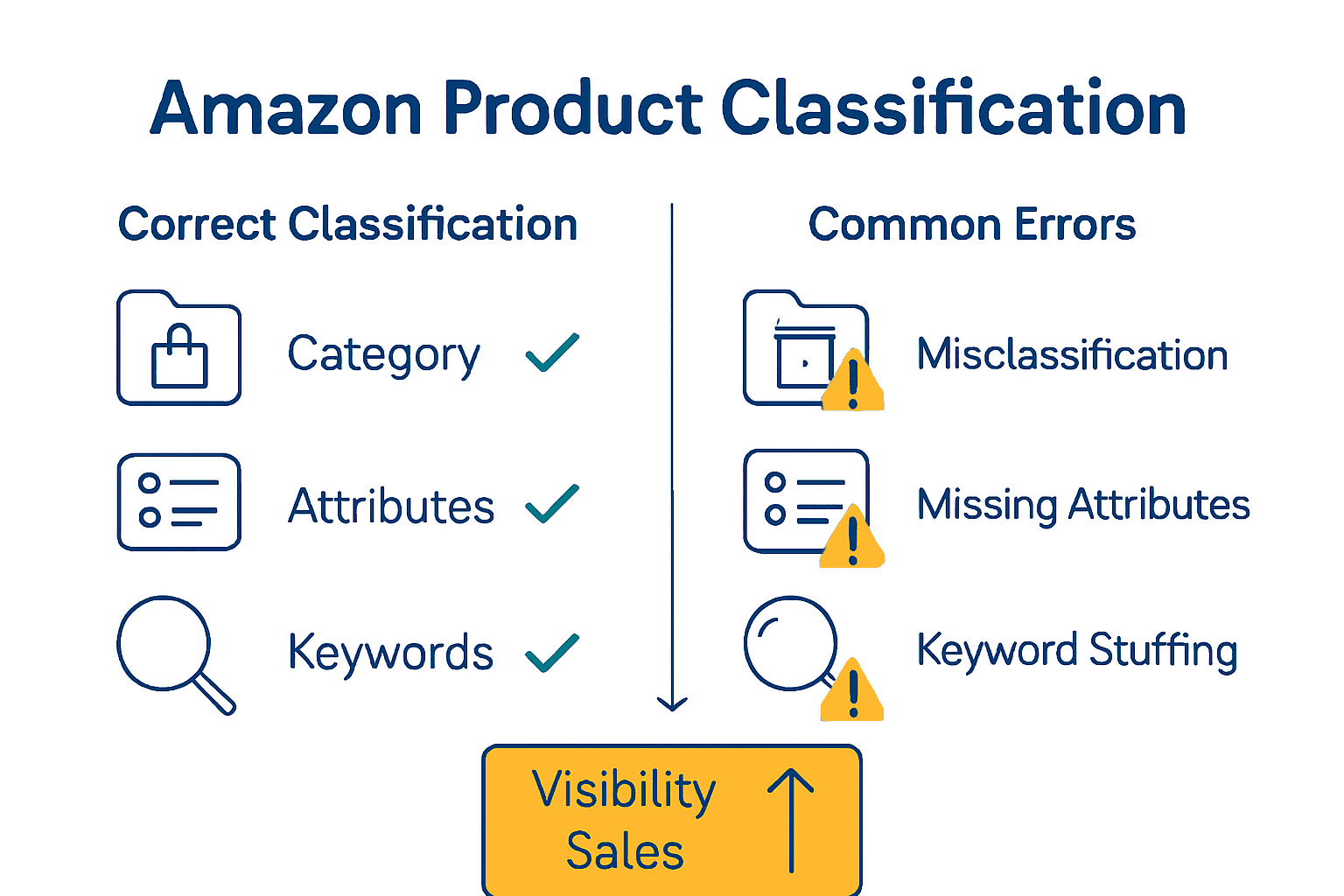
- Misclassification: Placing products in incorrect or overly broad categories
- Incomplete Attributes: Failing to fill out all required product specifications
- Inconsistent Naming: Using non-standard product descriptions
- Keyword Stuffing: Attempting to manipulate search results through excessive tagging
Research from AWS highlights the challenges of manual taxonomy mapping, emphasizing the need for systematic and precise product categorization. Sellers must be meticulous in understanding each category’s unique requirements and nuanced attribute expectations.
To mitigate these risks, develop a proactive approach: regularly audit your listings, stay updated on category guidelines, and be prepared to make swift corrections. Our comprehensive product listings guide can provide the strategic insights needed to navigate these complex taxonomic landscapes and minimize costly classification errors.
Enhance Your Amazon Listings with Expert Taxonomy Guidance
Navigating the complexities of Amazon product taxonomy can feel overwhelming. Selecting the right category, optimizing your listing attributes, and avoiding common classification errors are crucial steps to boost your product’s visibility and sales. If you want to master this essential aspect of Amazon selling and ensure your products stand out in the vast marketplace, gaining targeted strategies is key.

Discover how our expertise in E-commerce Tips & Strategies to Grow Your Online Business can help you overcome these challenges. At SearchOneers, we specialize in Amazon listing optimization and data-driven SEO that align perfectly with Amazon’s taxonomy requirements. Take the next step now to transform your product placements and enjoy increased customer reach with precision and confidence.
Frequently Asked Questions
What is Amazon product taxonomy?
Product taxonomy refers to the systematic organization and categorization of products into hierarchical structures that allow businesses, sellers, and platforms like Amazon to manage and classify products effectively. It helps in precise product identification and enhances customer discovery.
Why is understanding Amazon’s product taxonomy important for sellers?
Understanding Amazon’s product taxonomy is crucial for sellers because accurate product categorization directly impacts search visibility, customer discovery, and overall sales performance. Proper categorization ensures that products appear in relevant search results, reaching the target customers effectively.
How do I choose the right category for my product on Amazon?
To choose the right category, sellers should consider specificity, relevance, the competitive landscape, and listing requirements. Selecting the most granular and precise category helps improve product visibility and aligns the listing with customer searches.
What are common mistakes sellers make with Amazon product taxonomy?
Common mistakes include misclassification of products, incomplete product attributes, inconsistent naming conventions, and keyword stuffing. These errors can hinder product visibility and affect sales performance significantly.