Nearly 90 percent of Amazon searches now lead shoppers directly to AI-generated results instead of classic search lists. This shift is forcing sellers to rethink every step of their content strategy. In 2025, staying visible means understanding how generative AI shapes both what buyers see and how information gets ranked. Mastering this new workflow gives Amazon sellers a clear edge as search experience becomes more dynamic and citation-driven.
Table of Contents
- Defining Amazon SEO Workflow In 2025
- Core Elements Of Amazon SEO Success
- Optimizing Listings For Algorithm Changes
- Leveraging Analytics And Automation Tools
- Common Seller Mistakes And How To Avoid Them
Key Takeaways
| Point | Details |
|---|---|
| Adopt Generative Engine Optimization (GEO) | Sellers must focus on creating in-depth, citation-rich content to optimize for AI-driven search environments. |
| Emphasize Contextual Understanding | Modern product visibility depends on aligning content strategies with AI’s interpretation of search intent, moving away from keyword density. |
| Utilize Advanced Analytics and Automation | Leveraging analytics tools and automation is crucial for managing key selling aspects and making data-driven decisions. |
| Avoid Common Seller Mistakes | Sellers should remain vigilant against broad PPC strategies and over-reliance on AI, ensuring human oversight in decision-making. |
Defining Amazon SEO Workflow in 2025
The Amazon SEO workflow in 2025 represents a radical transformation from traditional search optimization strategies. According to recent research from arxiv.org, the rapid emergence of generative AI-powered search engines is fundamentally reshaping information retrieval, moving beyond conventional ranked lists to synthesized, citation-backed answers.
This new paradigm demands a sophisticated approach that integrates Generative Engine Optimization (GEO) principles. As research indicates, conventional SEO metrics are becoming obsolete, creating an urgent need to understand and optimize content for AI-driven search environments. Sellers must now focus on creating content that not only ranks well but also generates high-quality, authoritative synthesized responses.
Key characteristics of the Amazon SEO workflow in 2025 include:
- Prioritizing content depth and substantive information
- Creating citation-rich, contextually comprehensive product descriptions
- Developing adaptive content strategies that align with AI search algorithms
- Emphasizing semantic relevance over traditional keyword density
By adopting this forward-thinking approach, Amazon sellers can position themselves at the forefront of content strategy evolution, ensuring their listings remain competitive in an increasingly AI-driven marketplace.
Core Elements of Amazon SEO Success
Successful Amazon SEO in 2025 hinges on understanding the sophisticated nuances of modern product visibility. According to Canopy Management, the algorithm now emphasizes contextual understanding over traditional keyword density, requiring sellers to develop more intelligent content strategies that align with how AI interprets search intent.
The landscape of product ranking has dramatically evolved. Top-performing listings now achieve 15-20% click-through rates by implementing mobile-first optimization strategies. This means creating compelling primary images that look stunning even at small mobile sizes, incorporating long-tail conversational phrases for voice queries, and developing AI-generated visuals that capture potential buyers’ attention instantly.
Key core elements of Amazon SEO success include:
- Developing semantically rich, intent-driven product titles
- Creating high-engagement product descriptions
- Optimizing images for both visual appeal and algorithmic preference

- Generating authentic, helpful customer reviews
- Implementing strategic backend keyword targeting
To stay competitive in this dynamic marketplace, sellers must understand how Amazon SEO works to make or break sales, continuously adapting their strategies to meet the platform’s increasingly sophisticated search algorithms. The future of Amazon selling is not just about being found—it’s about being precisely matched with the right customer at the right moment.
Here’s a structured comparison of the core elements of Amazon SEO in 2025:
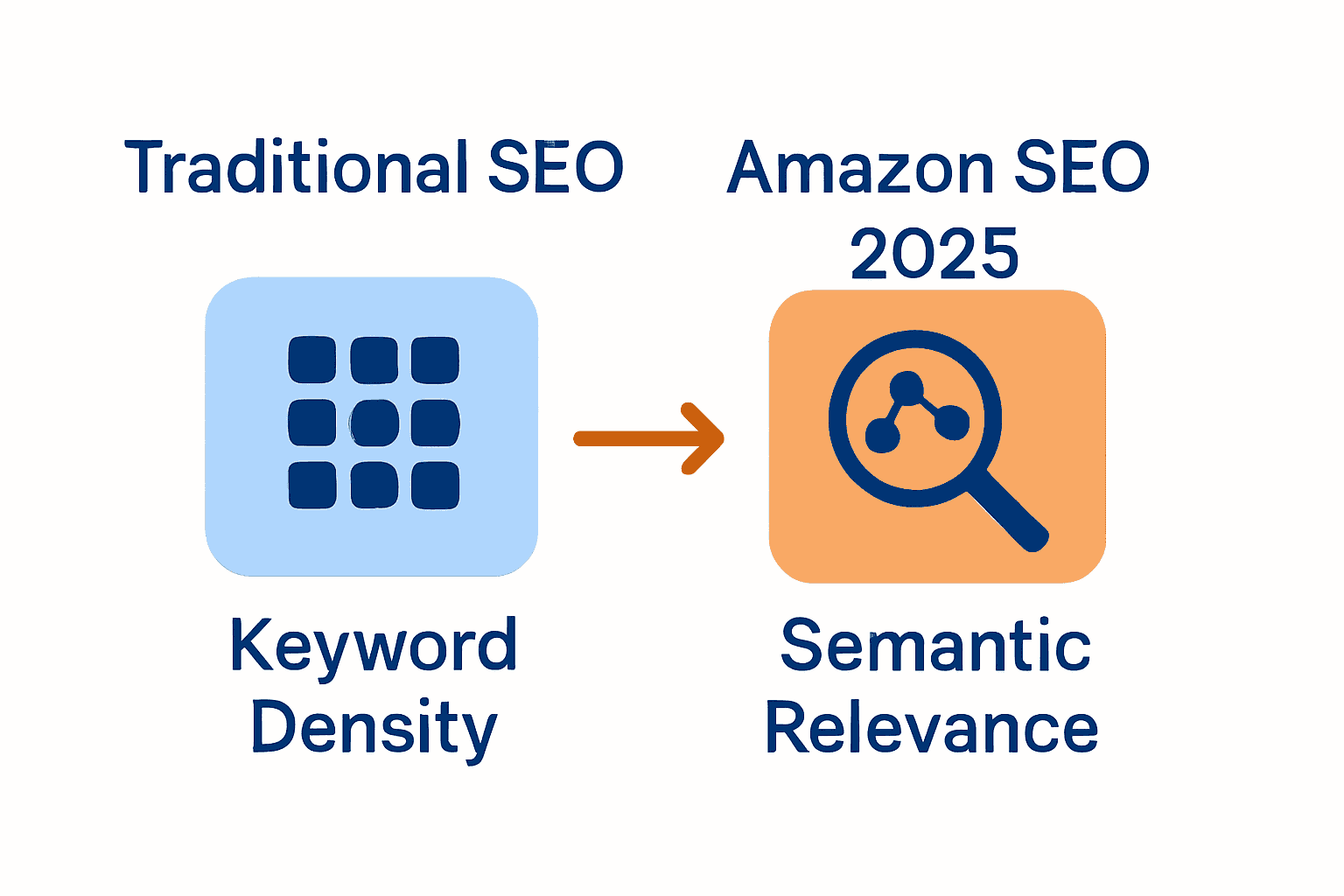
| Element | Traditional SEO (Pre-2025) | Amazon SEO 2025 (AI-Driven) |
|---|---|---|
| Keyword Strategy | Keyword density focus | Semantic relevance Intent matching |
| Content Approach | Short, optimized text Keyword stuffing | In-depth, citation-rich Comprehensive info |
| Product Titles | Simple descriptive Keyword-rich | Intent-driven Naturally phrased titles |
| Image Optimization | Basic product images Desktop focus | Mobile-first AI-generated visuals |
| Reviews & Engagement | Passive collection | Authentic reviews Active feedback |
| Backend Keyword Targeting | Set-and-forget List-based | Strategic Context-aware targeting |
| Use of Automation & Analytics | Limited Manual tracking | Advanced AI tools Predictive analytics |
Optimizing Listings for Algorithm Changes
Adapting to Amazon’s evolving algorithm requires a strategic and nuanced approach. According to Canopy Management, the platform now emphasizes contextual understanding far beyond traditional keyword strategies, requiring sellers to develop more sophisticated content that aligns precisely with AI-driven search intent interpretation.
The new algorithmic landscape demands a holistic optimization strategy that goes well beyond surface-level keyword placement. Amazon’s algorithm now performs deep analysis of customer satisfaction metrics, incorporating complex evaluations of review content, question and answer interactions, and post-purchase engagement signals. This means sellers must create comprehensive, genuinely helpful product listings that demonstrate real value to potential customers.
Key optimization strategies for algorithm adaptability include:
- Crafting semantically rich product titles that capture natural language patterns
- Developing in-depth product descriptions that answer potential customer questions
- Generating authentic, high-quality customer reviews and actively managing feedback
- Implementing structured, meaningful backend keyword targeting
- Creating multimedia content that enhances user engagement and provides comprehensive product information
To navigate these complex algorithmic changes successfully, sellers should optimize Amazon listings with a forward-thinking, customer-centric approach. The future of Amazon SEO is about creating genuine value, not just gaming the system—understanding and anticipating customer needs remains the ultimate optimization strategy.
Leveraging Analytics and Automation Tools
As the Amazon marketplace becomes increasingly complex, sellers must embrace sophisticated analytics and automation tools to stay competitive. According to Seller Labs, automation has become essential for managing critical aspects of selling, including profit analysis, catalog management, advertising, and strategic forecasting.
The latest research reveals groundbreaking approaches to e-commerce optimization. An innovative study from arxiv.org demonstrates how advanced recommendation systems can predict potential product co-purchasing relationships, enabling sellers to understand and anticipate customer purchasing behaviors with unprecedented accuracy. This means sellers can now leverage data-driven insights to make more intelligent inventory and marketing decisions.
Key strategies for leveraging analytics and automation include:
- Implementing real-time profit tracking and forecasting tools
- Using AI-powered advertising optimization platforms
- Developing dynamic pricing strategies based on market trends
- Automating inventory management and restocking processes
- Creating intelligent product recommendation systems
To navigate this complex technological landscape, sellers should explore the role of Amazon SEO tools that can transform raw data into actionable insights. The future of Amazon selling is not about working harder, but working smarter—using technology to understand customer needs, optimize operations, and stay ahead of market trends.
Common Seller Mistakes and How to Avoid Them
In the competitive Amazon marketplace of 2025, sellers must be vigilant about avoiding critical strategic errors. According to Ad Badger, the most significant challenges include managing effective PPC campaigns, selecting appropriate product categories, and leveraging analytics with precision.
The landscape of Amazon selling has become increasingly complex, with sellers facing nuanced pitfalls at every turn. Krolog highlights a critical emerging trend: while AI tools have become powerful allies, blindly trusting them without human judgment can lead to catastrophic marketing and budgeting mistakes. This means sellers must develop a sophisticated approach that balances technological insights with strategic human oversight.
Common mistakes sellers must proactively avoid include:
- Running broad PPC campaigns without strategic negative keyword management
- Launching products without comprehensive demand analysis
- Misinterpreting or completely ignoring critical performance data
- Neglecting product listing optimization
- Relying exclusively on AI tools without critical human evaluation
To navigate these challenges successfully, sellers should understand Amazon growth strategies that emphasize continuous learning and adaptive techniques. The most successful Amazon sellers in 2025 will be those who combine technological tools with strategic human insights, maintaining a flexible and data-informed approach to marketplace dynamics.
Master Amazon SEO Workflow 2025 With Expert Support
Navigating the new world of Amazon SEO in 2025 can feel overwhelming. The shift toward Generative Engine Optimization, semantic relevance, and adaptive content requires more than basic keyword stuffing. If you want your listings to truly stand out with in-depth, citation-rich descriptions, mobile-first optimized images, and data-driven backend keyword strategies, you need a partner who knows how to turn these complex challenges into actionable results.
Explore our specialized services in E-commerce Tips & Strategies to Grow Your Online Business for a deep dive into smart listing enhancement techniques.

Don’t let Amazon’s evolving algorithm hold back your sales growth. Visit SearchOneers today and discover how our proven Amazon Listing Optimization and SEO & Analytics solutions deliver the competitive edge you need. Take the first step to future-proof your Amazon success with expert strategies tailored to 2025’s marketplace demands.
Frequently Asked Questions
What is Generative Engine Optimization (GEO) in the context of Amazon SEO?
Generative Engine Optimization (GEO) involves creating content designed to be understood and favored by AI-powered search engines, focusing on generating authoritative and synthesized responses rather than merely optimizing for traditional keywords.
How has Amazon SEO changed in 2025 compared to previous years?
In 2025, Amazon SEO emphasizes contextual understanding, semantic relevance, and comprehensive content creation, moving away from simple keyword density to a sharper focus on meeting AI-driven search intent.
What are essential strategies for optimizing product listings on Amazon in 2025?
Key strategies include crafting semantically rich product titles, developing detailed product descriptions, optimizing images for mobile, generating authentic customer reviews, and implementing strategic backend keyword targeting.
What common mistakes should Amazon sellers avoid to succeed in 2025?
Sellers should avoid running broad PPC campaigns without strategic management, launching products without demand analysis, misinterpreting performance data, neglecting optimization of listings, and relying solely on AI tools without human oversight.