Amazon holds a staggering grip on ecommerce, with its third-party seller services pulling in over $31.4 billion in revenue in just one year. Most people expect that the big wins come from simply listing more products or running a few ads. Yet the real secret sits in how smart sellers craft their entire growth strategy from data analysis to customer experience and not just what they sell. This flips the whole idea of Amazon success on its head.
Table of Contents
- What Are Amazon Growth Strategies And Why Matter?
- Key Concepts Behind Successful Amazon Growth Strategies
- The Role Of Data Analytics In Amazon Growth
- Real-World Examples Of Effective Growth Strategies
Quick Summary
| Takeaway | Explanation |
|---|---|
| Understand market dynamics thoroughly | Sellers must analyze competitors, trends, and customer behavior to identify strategic opportunities. |
| Optimize product visibility continuously | Improving product listings through keywords and imagery is crucial for attracting customers. |
| Leverage data analytics for informed decisions | Using predictive analytics helps sellers anticipate trends and adjust strategies proactively. |
| Diversify product offerings for resilience | Building a varied product portfolio mitigates risks and can enhance revenue growth. |
| Focus on customer experience for retention | Exceptional customer service and quality establish brand loyalty and encourage repeat purchases. |
What Are Amazon Growth Strategies and Why Matter?
Amazon growth strategies represent systematic approaches sellers use to expand their business presence and sales performance within the Amazon marketplace. These comprehensive methods combine tactical planning, market understanding, and strategic execution to help sellers optimize their online selling potential.
The Core Philosophy Behind Growth Strategies
At their foundation, Amazon growth strategies focus on understanding the intricate ecosystem of the world’s largest ecommerce platform. Sellers who successfully navigate this environment recognize that growth isn’t just about listing products but creating a holistic approach that encompasses visibility, customer satisfaction, and competitive positioning.
Successful strategies typically involve multiple interconnected elements:
Here is a concise comparison of key elements underlying successful Amazon growth strategies, offering a quick overview of each approach and its primary focus:
| Element | Description |
|---|---|
| Product Optimization | Improving listings through imagery, keywords, and content |
| Keyword Research | Identifying high-impact search terms for greater visibility |
| Strategic Pricing | Adjusting prices to balance profit and competitiveness |
| Customer Experience Management | Focusing on service quality and satisfaction |
| Continuous Performance Monitoring | Regularly reviewing and refining all strategy areas |
- Comprehensive product optimization
- Advanced keyword research
- Strategic pricing mechanisms
- Enhanced customer experience management
- Continuous performance monitoring
According to Statista, Amazon third-party seller services generated approximately $31.4 billion in revenue in 2021, underscoring the massive potential for sellers who implement intelligent growth approaches.
Strategic Importance for Amazon Sellers
Why do growth strategies matter? They transform sellers from passive participants to active market competitors. Without a structured approach, sellers risk becoming lost in Amazon’s vast marketplace, where millions of products compete for customer attention.
Effective growth strategies help sellers:
- Increase product discoverability
- Improve conversion rates
- Build sustainable competitive advantages
- Maximize return on investment
- Adapt to rapidly changing market dynamics
Learn more about advanced Amazon sales techniques to complement your growth strategy approach. By understanding and implementing these strategic frameworks, sellers can systematically elevate their Amazon business performance and unlock significant revenue potential.
Key Concepts Behind Successful Amazon Growth Strategies
Successful Amazon growth strategies require a nuanced understanding of multiple interdependent elements that work together to drive seller performance. These strategies transcend simple product listing and demand a sophisticated approach to marketplace dynamics.
Market Positioning and Competitive Intelligence
Effective growth begins with understanding your precise market positioning. This involves deep research into competitor performance, product demand, and emerging market trends. Sellers must develop a keen ability to analyze competitive landscapes and identify strategic opportunities that differentiate their offerings.
Key competitive intelligence factors include:
- Pricing strategies of top-performing sellers
- Product review and rating analysis
- Search ranking performance
- Customer feedback patterns
- Seasonal demand fluctuations
Research from McKinsey & Company highlights that successful digital marketplace strategies require continuous adaptation and real-time market intelligence.
Performance Optimization Mechanisms
Growth strategies are fundamentally about creating robust performance optimization mechanisms. This involves systematic approaches to improving product visibility, conversion rates, and overall seller metrics. Successful sellers understand that performance is not static but a dynamic process requiring constant refinement.
Critical performance optimization elements include:
- Amazon search algorithm understanding
- Precise keyword targeting
- Enhanced product imagery and descriptions
- Comprehensive customer experience management
- Data-driven decision making
Discover advanced techniques for Amazon listing optimization to elevate your marketplace performance. By implementing these sophisticated strategies, sellers can transform their Amazon businesses from passive participants to proactive market leaders.
The Role of Data Analytics in Amazon Growth
Data analytics has emerged as a critical component in developing sophisticated Amazon growth strategies. By transforming raw marketplace information into actionable insights, sellers can make precise, informed decisions that drive substantial business performance.
Understanding Predictive Analytics Mechanisms
Predictive analytics enables sellers to anticipate market trends, customer behaviors, and potential performance opportunities before they fully materialize. This forward-looking approach allows sellers to proactively adjust their strategies rather than merely reacting to marketplace changes.
Key predictive analytics domains include:
- Sales volume forecasting
- Customer purchasing pattern identification
- Seasonal demand prediction
- Competitive landscape mapping
- Price sensitivity analysis
According to Harvard Business Review, companies leveraging advanced predictive analytics can increase their operational efficiency by up to 35% compared to traditional decision-making approaches.
Performance Metrics and Strategic Insights
Successful Amazon sellers view data not as static numbers, but as dynamic storytelling instruments. Analytics provide comprehensive visibility into multiple performance dimensions, helping sellers understand complex marketplace interactions.
The following table summarizes critical performance metrics Amazon sellers should monitor and the strategic insights these metrics provide for growing their business:
| Performance Metric | Strategic Insight |
|---|---|
| Conversion Rate | Measures effectiveness of listing to turn visitors into buyers |
| Click-Through Percentage | Indicates how well listings attract customer attention |
| Customer Acquisition Cost | Assesses cost efficiency in gaining new customers |
| Product Ranking Trajectory | Tracks position changes in Amazon search results |
| Review Sentiment Analysis | Reveals customer satisfaction and potential improvement areas |
Critical performance metrics sellers should monitor include:
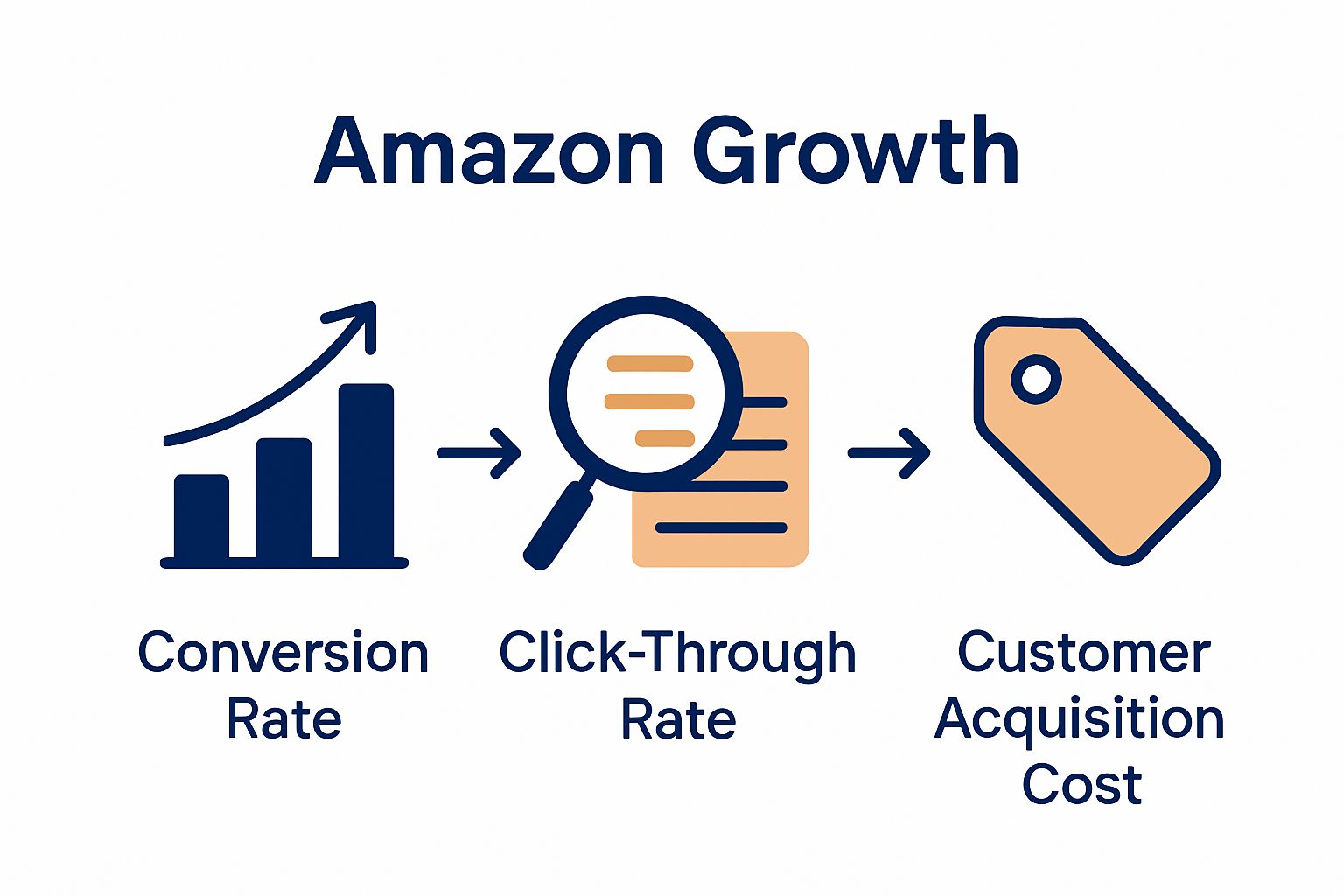
- Conversion rates
- Click-through percentages
- Customer acquisition costs
- Product ranking trajectories
- Review sentiment analysis
Explore advanced keyword analysis techniques to unlock deeper marketplace insights. By embracing data-driven strategies, sellers can transform raw information into competitive advantages that propel their Amazon businesses forward.
Real-World Examples of Effective Growth Strategies
Successful Amazon growth strategies are not theoretical constructs but practical approaches demonstrated by sellers who have mastered marketplace dynamics. These real-world examples illuminate how strategic thinking and precise execution can transform an Amazon business from ordinary to exceptional.
Product Diversification and Portfolio Management
Smart sellers recognize that growth is not about perfecting a single product but building a resilient, adaptable product portfolio. Successful Amazon businesses often leverage cross-selling and strategic product expansion to mitigate market risks.
Effective portfolio management strategies include:

- Identifying complementary product lines
- Developing product variations
- Exploring niche market segments
- Creating product bundles
- Maintaining diverse price points
According to McKinsey & Company, companies with diversified product strategies can experience up to 2.5 times higher revenue growth compared to single-product sellers.
Strategic Brand Positioning and Customer Experience
Top-performing Amazon sellers understand that growth transcends transactional relationships. They focus on creating compelling brand narratives and delivering exceptional customer experiences that encourage repeat purchases and positive word-of-mouth marketing.
Key brand positioning techniques include:
- Consistent product quality
- Professional product photography
- Detailed, informative product descriptions
- Responsive customer support
- Strategic pricing
Explore advanced Amazon sales techniques to elevate your marketplace performance. By studying and implementing these sophisticated growth strategies, sellers can transform their Amazon businesses from passive participants to proactive market innovators.
Ready to Transform Your Amazon Growth Strategy into Real Results?
Are you struggling to break through Amazon’s intense competition or worried that your listings get buried under thousands of similar products? The article highlighted the need for smarter marketplace navigation, sharper listing optimization, and powerful data analytics. If your pain points include low visibility, sluggish sales, or the pressure to refine your growth strategies for higher conversion, you deserve a proven solution tailored to these exact challenges. Discover actionable E-commerce Tips & Strategies to Grow Your Online Business and see how advanced Amazon listing optimization and data-driven SEO can unlock results you have yet to imagine.
Let our experts guide you with superior titles, bullet points, and backend keywords that cut through the noise on Amazon. Take control of your business performance now. Visit Searchoneers.com and put your growth plan into action, or explore the latest insights designed for sellers like you at our E-commerce Tips hub. Your next level of Amazon success is just a click away.
Frequently Asked Questions
What are Amazon growth strategies?
Amazon growth strategies are systematic approaches that sellers use to expand their business and sales performance on the Amazon marketplace. These methods involve tactical planning, market understanding, and strategic execution to optimize online selling potential.
Why are growth strategies important for Amazon sellers?
Growth strategies are crucial for Amazon sellers as they help transform them from passive participants to active competitors. A structured approach can significantly enhance product visibility, conversion rates, and overall market positioning, enabling sellers to achieve sustainable growth.
How can data analytics improve Amazon growth strategies?
Data analytics plays a critical role in developing effective growth strategies. By transforming raw marketplace information into actionable insights, sellers can make informed decisions, anticipate market trends, and refine their strategies for improved performance.
What elements should be considered in performance optimization for Amazon sellers?
Key elements for performance optimization include understanding the Amazon search algorithm, precise keyword targeting, enhancing product imagery, managing customer experience, and making data-driven decisions to improve visibility and conversion rates.