Trying to grow your Amazon sales with just single-product listings often leaves you feeling stuck. Experienced sellers know that real revenue gains come from recommending related or complementary products that genuinely solve customer needs. Understanding the difference between cross-selling and upselling can reshape your inventory planning and connect every purchase to a helpful follow-up. This guide reveals how strategic cross-selling on Amazon builds loyalty, boosts average order value, and positions your catalog for steady growth.
Table of Contents
- Cross-Selling Amazon Explained For Sellers
- Essential Types And Proven Strategies
- How Amazon’s Cross-Selling Features Work
- Best Practices For Implementing Cross-Sales
- Common Mistakes And Pitfalls To Avoid
Key Takeaways
| Point | Details |
|---|---|
| Cross-selling vs. Upselling | Cross-selling offers complementary products, while upselling encourages purchasing premium versions. Both strategies enhance customer experience and cart value. |
| Data Utilization | Use backend analytics to identify products frequently bought together for effective cross-selling opportunities. Understand customer behavior at different buying stages to tailor recommendations. |
| Relevance and Timing | Ensure recommendations are relevant and made at the right time in the customer journey to enhance conversion rates. Avoid pushy suggestions that may lead to negative customer reactions. |
| Common Mistakes | Avoid irrelevant product recommendations, overwhelming customers with too many options, and poorly timed suggestions to maintain trust and integrity in the buying process. |
Cross-selling Amazon explained for sellers
Cross-selling on Amazon means recommending related or complementary products to customers who are already viewing or purchasing from you. Rather than pushing them toward a more expensive version of what they want (that’s upselling), cross-selling introduces them to products that pair naturally with their current selection. Think of it like this: a customer buying a camera lens isn’t necessarily ready to upgrade to a pricier camera body, but they might need a protective filter, a cleaning kit, or a quality carrying case. That’s cross-selling in action.
The core difference between these strategies matters for your inventory strategy. Cross-selling involves offering complementary products that solve related problems, while upselling encourages customers to purchase premium versions of items they’re already considering. On Amazon, both work together seamlessly. You might cross-sell a phone case to someone buying a smartphone, then upsell them to a premium protective case variant. The beauty of cross-selling is that it feels helpful rather than pushy—you’re genuinely solving customer problems, not just inflating their cart.
Here’s a comparison of cross-selling and upselling to clarify their strategic differences:
| Aspect | Cross-selling | Upselling |
|---|---|---|
| Primary Goal | Offer related or complementary products | Encourage move to premium version |
| Customer Perception | Feels helpful and relevant | Can appear pushy if not done carefully |
| Typical Use Case | Recommending accessories or add-ons | Suggesting upgraded models or variants |
| Impact on Cart Value | Increases total order size | Increases order value per item |
What makes cross-selling effective on Amazon is data. Your backend analytics show which products customers frequently buy together, which items sit in carts without purchase completion, and which search queries lead to browsing specific categories. You can use this intelligence to identify high-probability cross-sell opportunities. Sellers with 1-3 years of experience often miss this because they focus only on optimizing individual listings instead of mapping the customer journey across their entire catalog. The stronger approach involves understanding how customers progress through their buying decisions, then positioning complementary products at each stage. A customer researching a product category is in a different mindset than someone with an item in their cart, so your cross-sell recommendations should reflect that timing.
Ethical cross-selling requires transparency and relevance. Amazon’s algorithm favors recommendations that genuinely interest customers, not random product suggestions. If your cross-sell feels forced or irrelevant, customers notice immediately through negative reviews or high return rates. The winners in this space focus on creating genuine value—your cross-sell recommendations should feel like helpful suggestions, not aggressive marketing tactics.
Pro tip: Start by analyzing your top 10 best-selling products using Amazon’s sales data, then manually identify 3-5 genuinely complementary items for each, testing which combinations generate the highest conversion rates before scaling your cross-selling strategy across your entire catalog.
Essential types and proven strategies
Cross-selling on Amazon breaks down into distinct approaches, each designed to work with your product catalog and customer behavior. The two primary types work in tandem. Complementary product recommendations suggest items that enhance or pair with what customers already want, while premium upsells encourage them to buy higher-tier versions of the same category. A seller offering fitness trackers might cross-sell charging cables and protective cases (complementary) while also promoting the premium tracker model (upsell). Both matter for your bottom line, but they serve different conversion paths.
Market basket analysis reveals which products customers frequently buy together, and this data becomes your foundation for strategic bundling. When you notice that customers buying running shoes often purchase moisture-wicking socks within 30 days, you’ve identified a natural cross-sell opportunity. Proven strategies that generate real results include product bundling (grouping complementary items at a slight discount), strategic remarketing (showing past browsers related products on Amazon via ads), and personalized offers based on purchase history. These tactics work because they solve genuine customer needs rather than feeling like random suggestions.

Dynamic pricing and automation amplify your cross-selling effectiveness without requiring constant manual effort. If you set up marketing automation to recommend complementary products at specific touchpoints in the customer journey, you capture opportunities at scale. A customer who clicks on a camera lens and abandons without purchasing could receive an automated recommendation for lens filters or protective cases. The timing matters significantly—these suggestions arrive when the customer is actively researching, not days later when interest has faded. Your backend systems handle this automatically, allowing you to maintain high relevance while managing dozens or hundreds of products.
Success with these strategies depends on relevance and timing. Generic recommendations tank your conversion rates and trigger returns. Sellers who win analyze their specific customer behavior, identify the strongest product combinations, then test different messaging and positioning before rolling out across their catalog. What works for one product category might completely flop for another, so avoid copying competitor tactics blindly.
Pro tip: Use Amazon’s “Frequently Bought Together” section data as your starting point, then test adding 2-3 additional complementary products to that widget through your backend optimization, measuring conversion rate changes weekly to identify your highest-performing combinations.
How Amazon’s cross-selling features work
Amazon’s cross-selling engine operates behind the scenes on nearly every product page you visit. The platform strategically places recommendations at multiple touchpoints throughout the buying journey, with the most visible being the “Frequently Bought Together” widget and the “Customers who Bought This also Bought” section. These aren’t random suggestions. Amazon’s algorithms analyze transactional data to identify products frequently purchased together, then surface those combinations to shoppers at critical decision moments. When a customer views a laptop, they immediately see complementary items like mouse pads, cables, and laptop stands. This positioning is intentional, designed to catch buyers while they’re in purchasing mode, encouraging them to add more items to their cart before checkout.
The mechanics rely on machine learning that improves over time. Every purchase, every abandoned cart, every product page view feeds into Amazon’s recommendation system. The platform learns which product pairings convert best, which combinations drive return rates up or down, and which suggestions customers ignore entirely. Your listings feed this system automatically. When you create proper product relationships and ensure your items are correctly categorized, you help Amazon’s algorithms connect your products with relevant buyers. Sellers who understand this advantage their competition by ensuring their catalog is organized logically, making it easier for the algorithm to identify natural product combinations. Your backend keyword strategy and category selection directly influence which cross-sell opportunities Amazon surfaces.
What makes this system powerful for your business is that Amazon handles the heavy lifting. You don’t manually place each recommendation. Instead, the platform continuously tests combinations, measuring which drive the highest average order value and customer satisfaction. This means your cross-sell opportunities improve automatically as more customers purchase from you. However, you still control the input. Strategic product alignment and optimized listing details help Amazon understand your product relationships better. Sellers who optimize their titles, bullet points, and backend keywords see stronger cross-sell performance because the algorithm can more easily identify which products belong together.
The checkout page and post-purchase emails represent additional cross-selling touchpoints that Amazon controls. You cannot directly manipulate these placements, but your overall sales velocity, customer ratings, and product performance determine whether your items appear in these high-value real estate spots. Consistency matters here. If your complementary products maintain similar quality standards and customer satisfaction scores, Amazon trusts the relationship and promotes it more aggressively.
Pro tip: Audit your product catalog to identify your top 20 best-selling items, then ensure each has accurate backend keywords and proper category selection so Amazon’s algorithm can naturally discover and recommend your complementary products without requiring manual intervention.
Best practices for implementing cross-sales
Success with cross-selling requires understanding exactly where your customers are in their buying process and matching your recommendations to that moment. Placement matters enormously. Strategic product suggestions work best on product detail pages, in shopping carts, and through post-purchase emails because these are the moments when customers are most receptive. A visitor browsing a coffee maker hasn’t committed yet, so a soft recommendation for filters or a grinder feels natural. That same customer in their cart is actively preparing to buy, making them even more likely to add complementary items. After purchase, follow-up emails recommending accessories or related products capitalize on their satisfaction while the buying impulse remains fresh. Timing transforms a suggestion from intrusive to helpful.
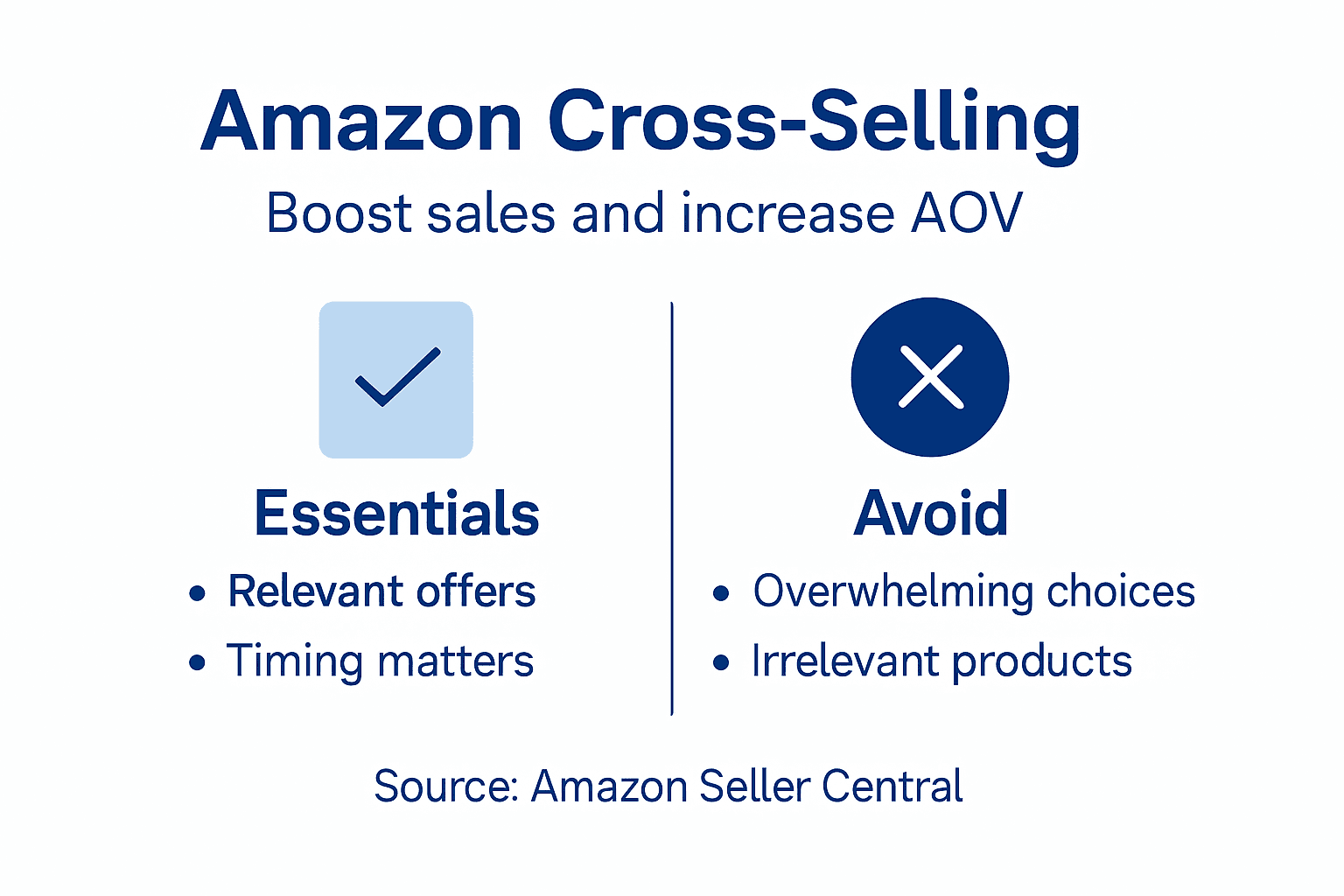
Relevance is your foundation. Never cross-sell just to increase order value. Customers instantly recognize forced recommendations and respond with negative reviews, returns, or worse, by switching to competitors. Your cross-sell items must solve real problems or genuinely enhance the primary purchase. If you sell premium headphones, recommending a phone stand makes sense. Recommending a laptop bag does not, even if some customers buy both. The relationship has to feel obvious to the buyer. Additionally, avoid recommendation overload. Presenting 15 options paralyzes customers. Three to five well-chosen complementary products perform significantly better than lengthy lists. Quality beats quantity every time.
Creating product bundles with clear value propositions and testing different promotional timings strengthens conversion rates far more than random experimentation. Bundle a phone with a protective case and screen protector at a 12 percent discount, then measure whether that conversion rate beats bundling the same items at 8 percent. Track which email send times drive higher click-through rates. Monitor whether in-cart recommendations perform better when customers have one item versus three items already selected. This data tells you what actually works for your specific audience, not what worked for someone else’s product category. Your analytics reveal patterns unique to your customers.
Use Amazon’s native tools strategically. The “Frequently Bought Together” widget requires no manual setup but depends on your sales volume and listing quality. A+ Content with comparison charts helps customers visualize complementary products side by side. Your backend keywords influence which products the algorithm groups together. Clear, detailed bullet points and descriptions help Amazon understand exactly what problem your product solves, making it easier to match with relevant complements. Consistency across your catalog multiplies these effects. When your complementary products maintain similar quality standards, review ratings, and fulfillment speed, Amazon’s algorithm trusts the relationship and promotes it more aggressively.
Pro tip: Start with your top five best-sellers, identify 2-3 complementary products for each, then A/B test placements and messaging for 30 days before expanding your cross-selling approach across your entire catalog based on which combinations generate the highest conversion rates.
Common mistakes and pitfalls to avoid
The most damaging mistake sellers make is pushing irrelevant products onto customers. You see this constantly on Amazon, and it tanks conversion rates immediately. A shopper buying a wireless mouse gets recommended a desk lamp, then kitchen knives, then random electronics that have nothing to do with their purchase. This isn’t cross-selling. This is noise. Customers recognize it as lazy algorithm work or worse, as manipulation. They respond by closing your listings and finding competitors instead. Offering irrelevant suggestions that confuse buyers destroys trust and damages your review ratings far more than having no cross-sell at all. Your recommendations must solve genuine problems connected to what customers already want. If the connection isn’t obvious within two seconds, it doesn’t belong in your cross-sell.
Overwhelming customers with too many options is a close second. Presenting 12 complementary products sounds like choice, but it actually paralyzes buyers. They abandon carts because decision fatigue sets in. Three to five carefully chosen recommendations perform dramatically better than extensive lists. Additionally, aggressive timing destroys intent. Bombarding shoppers with cross-sell suggestions before they’ve even committed to the primary purchase feels pushy. The same recommendation at checkout or in a post-purchase email feels helpful. Context matters. Many sellers also depend too heavily on discounting to drive cross-sells. Discounting your cross-sell items trains customers to expect deals, eroding margins and normalizing price haggling. Your cross-sells should stand on their own merit through relevance and quality, not survival-mode pricing.
Below is a summary of costly cross-selling mistakes and their consequences:
| Mistake Type | Short Description | Negative Impact |
|---|---|---|
| Irrelevant Products | Unrelated suggestions confuse buyers | Lower conversion, loss of trust |
| Option Overload | Too many recommendations shown | Decision fatigue, cart abandon |
| Poor Timing | Suggestions at wrong stage | Perceived as spammy or pushy |
| Compatibility Issues | Products not fitting main purchase | High return rates, bad reviews |
Failing to analyze performance and lacking strategic customer targeting leads to cross-selling that increases costs without generating profit. Some customers cost you money to serve through cross-sells. A high-return customer who generates 40 percent returns on accessories is actually dragging your bottom line down. You need to segment your audience. Your best customers are worth different cross-sell strategies than customers who rarely repeat purchase. Measure everything. Track which cross-sell combinations convert, which generate returns, which drive customer satisfaction scores up or down. Without data, you’re guessing. Without segmentation, you’re treating your premium customers the same as your problem customers. Both approaches waste profit potential.
Compatibility confusion also kills conversions. If your cross-sell item works with only certain product variations, specify that clearly. Don’t recommend a specific phone case to everyone buying phones if it only fits the Pro model. Returns spike instantly. Track your cross-sell performance weekly, adjusting which items you recommend based on actual conversion and return data. What worked last month might not work this month as customer preferences shift. Continuous monitoring transforms cross-selling from a set-it-and-forget-it feature into a profit engine.
Pro tip: Pull your cross-sell return rate data from the last 90 days and compare it against your primary product return rate; if cross-sell returns exceed your primary product returns by more than 2 percent, your recommendations are too loose and need immediate tightening.
Elevate Your Amazon Cross-Selling Strategy with Expert Optimization
Navigating the complexities of cross-selling on Amazon demands more than just listing complementary products. You must unlock the power of Amazon Listing Optimization and data-driven insights to truly boost sales and average order value as highlighted in this article. If you have struggled with timing your recommendations, relevance of cross-sells, or simply want to enhance your entire product catalog for smarter algorithms, you are not alone. Sellers who master optimized titles, bullet points, and backend keywords see higher visibility and more natural cross-sell connections that feel helpful instead of pushy.
Discover how to align your listings strategically by exploring our E-commerce Tips & Strategies to Grow Your Online Business and harness the latest in Amazon SEO & Analytics to outpace competitors. Don’t wait until irrelevant recommendations cost you conversions and trust. Visit https://searchoneers.com today to start tailoring your Amazon store with proven optimization methods that turn cross-selling into a genuine profit engine.
Frequently Asked Questions
What is cross-selling on Amazon?
Cross-selling on Amazon involves recommending complementary products to customers who are viewing or purchasing an item. Instead of upselling a more expensive version, cross-selling introduces items that naturally pair with the primary product, enhancing the customer’s shopping experience.
How does cross-selling differ from upselling?
Cross-selling focuses on suggesting related or complementary products to customers, while upselling encourages customers to purchase higher-end versions of the items they are already interested in. Cross-selling feels helpful, whereas upselling can sometimes feel pushy if not done carefully.
What are effective strategies for cross-selling on Amazon?
Effective strategies include utilizing market basket analysis to find products frequently bought together, product bundling with slight discounts, personalized offers based on purchase history, and using Amazon’s built-in features like the “Frequently Bought Together” widget to suggest related items.
How can I avoid common cross-selling mistakes?
To avoid mistakes, ensure your recommendations are relevant and truly complementary to the primary products. Avoid overwhelming customers with too many options, suggest items at the right stage of their buying process, and clearly communicate any compatibility issues to reduce return rates.