

Most American Amazon sellers underestimate the power of a well-mapped customer journey. With over 65 percent of buyers admitting that product presentation and reviews shape their final purchase decisions, getting each interaction right makes a real impact. Understanding how your listings guide shoppers from discovery to purchase lets you tune every detail for higher visibility and trust—skills that directly influence your sales numbers in a crowded North American marketplace.
Table of Contents
- What Amazon Customer Journey Means
- Key Stages In Amazon Journey
- How Amazon Journey Works For Sellers
- Touchpoints And Seller Responsibilities
- Risks And Missteps In Journey
- Tools And Metrics For Optimization
Key Takeaways
| Point | Details |
|---|---|
| Understanding the Customer Journey | Recognize the stages of the Amazon Customer Journey—awareness, consideration, decision, and post-purchase—to effectively engage potential buyers. |
| Optimize Every Touchpoint | Enhance product listings through strategic keyword placement, high-quality images, and clear descriptions to improve visibility and conversion rates. |
| Prioritize Customer Satisfaction | Focus on delivering exceptional service and maintaining transparent communication to build trust and encourage repeat purchases. |
| Leverage Performance Metrics | Regularly analyze key metrics such as conversion rates and customer reviews to identify improvement opportunities and adapt strategies accordingly. |
What Amazon Customer Journey Means
The Amazon Customer Journey represents the complete series of interactions and experiences a potential buyer undergoes from initial product discovery to final purchase. Unlike traditional retail pathways, this digital journey involves multiple complex touchpoints where consumer psychology and strategic product presentation intersect. Consumer behavior research highlights how emotions, attitudes, and external cues significantly influence purchasing decisions.
This journey typically encompasses several critical stages: awareness, consideration, decision, and post-purchase evaluation. For Amazon sellers, understanding these stages means recognizing that customers don’t just buy products they encounter random product listings. They engage in a nuanced decision making process influenced by visual presentation, pricing, reviews, and perceived value. The customer journey transforms from a linear path to an intricate web of digital interactions where each element can potentially convert or deter a potential buyer.
Successful navigation of the Amazon Customer Journey requires sellers to optimize every potential interaction point. This means crafting compelling product titles, utilizing high quality images, writing clear bullet points, developing comprehensive descriptions, and maintaining responsive customer communication. Amazon SEO techniques play a crucial role in ensuring visibility and attracting potential buyers through strategic keyword placement and ranking optimization.
Pro Seller Tip: Continuously analyze your product listing performance metrics and customer feedback to understand how buyers interact with your listings, using those insights to incrementally improve your presentation and conversion potential.
Key Stages In Amazon Journey
The Amazon Customer Journey consists of four fundamental stages that transform a casual browser into a committed buyer. Consumer behavior analysis reveals these stages are not linear but interconnected, representing a complex decision making ecosystem where each interaction can profoundly influence purchasing outcomes.

Awareness Stage
In this initial phase, potential customers discover products through various channels like search results, sponsored ads, or recommendations. Sellers must optimize their product visibility through strategic keyword placement, compelling imagery, and targeted advertising. This stage is about capturing attention and creating initial interest that compels shoppers to explore further.
Consideration Stage
Once a potential buyer shows interest, they begin evaluating product details, comparing alternatives, and reading reviews. Sellers need to provide comprehensive, transparent product information that addresses potential questions and concerns. Amazon Content Workflow becomes critical here, ensuring listings communicate value proposition, product features, and unique selling points effectively.
Decision Stage
This crucial stage determines whether a customer completes the purchase. Factors like competitive pricing, shipping options, seller reputation, and product availability play significant roles. High quality product images, clear descriptions, and positive customer reviews can tip the balance toward conversion.
Post Purchase Stage
Contrary to traditional retail, the Amazon journey continues after purchase through reviews, potential returns, and future buying decisions. Responsive customer service, smooth delivery, and encouraging positive feedback can transform one time buyers into loyal customers.
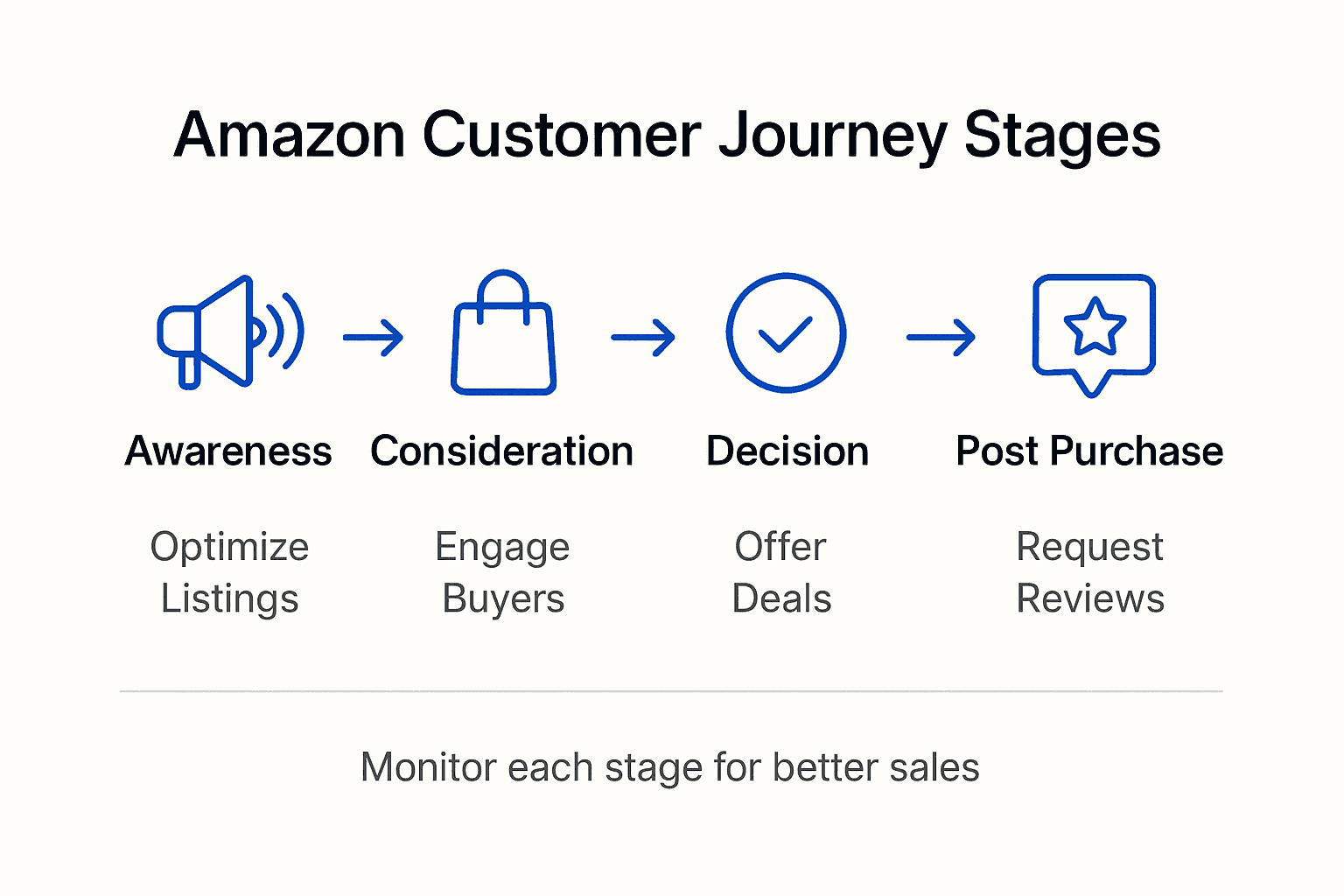
Pro Seller Tip: Map out your specific product’s unique customer journey, identifying potential friction points and optimization opportunities at each stage to incrementally improve conversion rates.
Here’s a summary of the four stages in the Amazon customer journey and what matters most at each:
| Stage | Main Customer Focus | Seller Strategy | Key Conversion Drivers |
|---|---|---|---|
| Awareness | Product discovery | Maximize visibility | Search, ads, visuals |
| Consideration | Evaluate & compare options | Share details, build trust | Reviews, info, differentiation |
| Decision | Complete purchase | Remove barriers, reassure | Price, shipping, reputation |
| Post Purchase | Reflect & provide feedback | Follow up, support, retain | Service, delivery, review request |
How Amazon Journey Works For Sellers
Amazon Fulfillment by Amazon (FBA) programs represent a critical mechanism through which sellers can strategically navigate the Amazon ecosystem. The platform essentially transforms traditional selling models by providing comprehensive infrastructure that allows sellers to focus on product development and marketing while Amazon handles logistics, shipping, and customer service.
The seller’s journey on Amazon begins with understanding the platform’s intricate ranking algorithms and customer engagement strategies. Sellers must optimize their product listings, utilize targeted keywords, create compelling product descriptions, and maintain competitive pricing. Amazon SEO techniques play a crucial role in determining product visibility and potential sales performance.
Successful sellers recognize that the Amazon journey is not just about listing products but creating a holistic customer experience. This means maintaining high quality standards, responding promptly to customer inquiries, managing reviews strategically, and continuously adapting to marketplace dynamics. The most effective sellers treat their Amazon presence as a dynamic, evolving business platform rather than a static sales channel.
Customer satisfaction remains the fundamental driver of success on Amazon. Strategic customer-centric approaches inspired by Amazon’s core philosophy emphasize building trust, providing exceptional service, and creating positive buying experiences that encourage repeat purchases and positive reviews.
Pro Seller Tip: Develop a comprehensive strategy that balances product optimization, customer service excellence, and continuous learning about Amazon’s evolving marketplace dynamics.
Touchpoints And Seller Responsibilities
Customer Interaction Touchpoints form the critical connection between Amazon sellers and potential buyers. Strategic marketing approaches reveal that successful sellers must meticulously manage every potential point of customer engagement throughout the purchasing process.
These touchpoints encompass multiple strategic areas: product listings, search result visibility, product images, descriptions, pricing, customer reviews, shipping options, and post purchase support. Each interaction represents an opportunity to build trust, demonstrate value, and differentiate from competing products. Seller Central provides sellers comprehensive tools to manage these critical interaction points effectively.
Key seller responsibilities include maintaining accurate product information, responding promptly to customer inquiries, managing review feedback constructively, ensuring timely shipping, and maintaining competitive pricing. Sellers must also continuously optimize their product listings using strategic keyword placement, high quality images, and compelling product descriptions that address potential customer questions and concerns.
The most successful Amazon sellers approach these touchpoints as interconnected elements of a holistic customer experience. This means viewing each interaction not as a transactional moment, but as an opportunity to build long term customer relationships, generate positive word of mouth, and create a sustainable selling strategy that can adapt to changing marketplace dynamics.
Pro Seller Tip: Systematically audit your product listings monthly, analyzing customer interactions, feedback, and performance metrics to identify and implement continuous improvement strategies.
Risks And Missteps In Journey
Amazon sellers face numerous potential pitfalls that can derail their success, with digital dark patterns representing one of the most subtle yet dangerous risks in the online marketplace. These deceptive design strategies can inadvertently damage seller reputation, create negative customer experiences, and potentially lead to account restrictions or suspension.
One of the most significant risks involves review manipulation and integrity challenges. Online review dynamics reveal that platforms invest substantial resources in detecting and preventing fake review strategies. Sellers who attempt to artificially inflate ratings or engage in review fraud risk severe consequences, including permanent account banning and potential legal challenges.
Common missteps in the Amazon seller journey include inconsistent product information, poor quality images, misleading descriptions, inadequate customer service, slow shipping, and failure to respond to customer feedback. These errors can dramatically reduce product visibility, lower search rankings, and diminish customer trust. Successful sellers must maintain rigorous standards across every aspect of their product presentation and customer interaction.
The most critical risks involve compliance violations, such as selling restricted products, misrepresenting item specifications, or failing to adhere to Amazon’s constantly evolving marketplace policies. Sellers must stay continuously informed about platform guidelines, maintain transparent business practices, and proactively address potential compliance issues before they escalate.
Pro Seller Tip: Develop a comprehensive compliance checklist and review it quarterly, ensuring your selling practices remain aligned with Amazon’s most current marketplace requirements and best practices.
Tools And Metrics For Optimization
Strategic analysis techniques reveal that successful Amazon sellers must leverage sophisticated tools and metrics to drive continuous improvement in their product listings. The optimization ecosystem encompasses multiple analytical approaches designed to enhance visibility, conversion rates, and overall sales performance.
Key optimization tools fall into several critical categories. Performance Tracking Tools provide comprehensive insights into sales velocity, keyword rankings, and competitor analysis. Amazon Listing Optimization platforms help sellers understand critical metrics like click through rates, conversion percentages, and search result positioning. These tools enable data driven decision making by transforming raw marketplace data into actionable strategic intelligence.
Essential metrics sellers must monitor include conversion rate, average order value, search ranking, customer review ratings, and product visibility score. Advanced sellers utilize sophisticated analytics platforms that integrate multiple data sources, providing a holistic view of product performance. These tools help identify optimization opportunities, track competitive landscape shifts, and predict emerging marketplace trends with remarkable precision.
Successful sellers approach metrics as dynamic indicators requiring continuous interpretation. This means not just collecting data, but developing systematic processes to translate insights into concrete listing improvements. The most effective optimization strategies involve regular performance audits, A/B testing of product descriptions, and agile adjustments based on real time marketplace feedback.
Pro Seller Tip: Implement a monthly performance review process, comparing your key metrics against industry benchmarks and systematically identifying areas for strategic improvement.
For sellers, tracking the right performance metrics is crucial. Here’s how top metrics drive business outcomes:
| Metric | What It Measures | Business Impact |
|---|---|---|
| Conversion Rate | Purchases per visit | Reveals listing effectiveness |
| Search Ranking | Visibility on Amazon | Affects organic discovery |
| Average Order Value | Purchase amount | Drives revenue per customer |
| Review Rating | Customer satisfaction | Impacts trust, boosts sales |
| Product Visibility | Listing’s reach | Increases impressions |
Master the Amazon Customer Journey and Skyrocket Your Sales Today
If you are struggling to convert browsers into buyers or want to optimize every stage of the Amazon Customer Journey, you are not alone. This article highlights key challenges like boosting product visibility, crafting compelling listings, and delivering exceptional customer experiences to win trust and increase conversions. The pain of low rankings, poor engagement, or missed sales opportunities can be overwhelming but there is a solution.

Discover expert strategies with our specialized services at SearchOneers that focus on Amazon Listing Optimization including enhanced titles, bullet points, descriptions, and backend keywords designed to improve your product’s discoverability. Combine that with data-driven Amazon SEO & Analytics to keep your listings competitive in a constantly evolving marketplace. Don’t wait to transform your customer interactions into measurable sales growth. Visit us now to get started with proven e-commerce tips and strategies tailored to grow your online business.
Frequently Asked Questions
What are the stages of the Amazon Customer Journey?
The Amazon Customer Journey includes four key stages: Awareness, Consideration, Decision, and Post Purchase. Each stage involves different customer interactions and requires targeted seller strategies to optimize conversions.
How can I optimize my product listings for better visibility on Amazon?
To enhance your product visibility, focus on strategic keyword placement, use high-quality images, write clear and informative product descriptions, and engage positively with customer reviews.
Why is customer feedback important in the Amazon Customer Journey?
Customer feedback plays a crucial role in the post-purchase stage, impacting future buying decisions. Positive feedback improves seller reputation and encourages repeat purchases, while responsiveness to negative feedback aids in building trust and improving listings.
What tools can I use to track performance metrics on Amazon?
Performance tracking tools can provide insights into key metrics such as conversion rates, search rankings, average order value, and customer review ratings, allowing sellers to make data-driven decisions to optimize their product listings.

Comments
2 responses to “Amazon Customer Journey Explained: Boost Listings to Increase Sales”
[…] Amazon Customer Journey Explained: Boost Listings to Increase Sales – Searchoneers […]
[…] Amazon Customer Journey Explained: Boost Listings to Increase Sales – Searchoneers […]