

Over 60 percent of product searches now start on Amazon instead of Google, putting sellers in fierce competition for attention. Every category is filled with thousands of listings, so creating an optimized product page is no longer optional. Whether you are new to selling or want to boost your current performance, learning how to master keywords, copy, images, and SEO can help your listing stand out, attract more buyers, and increase your sales.
Table of Contents
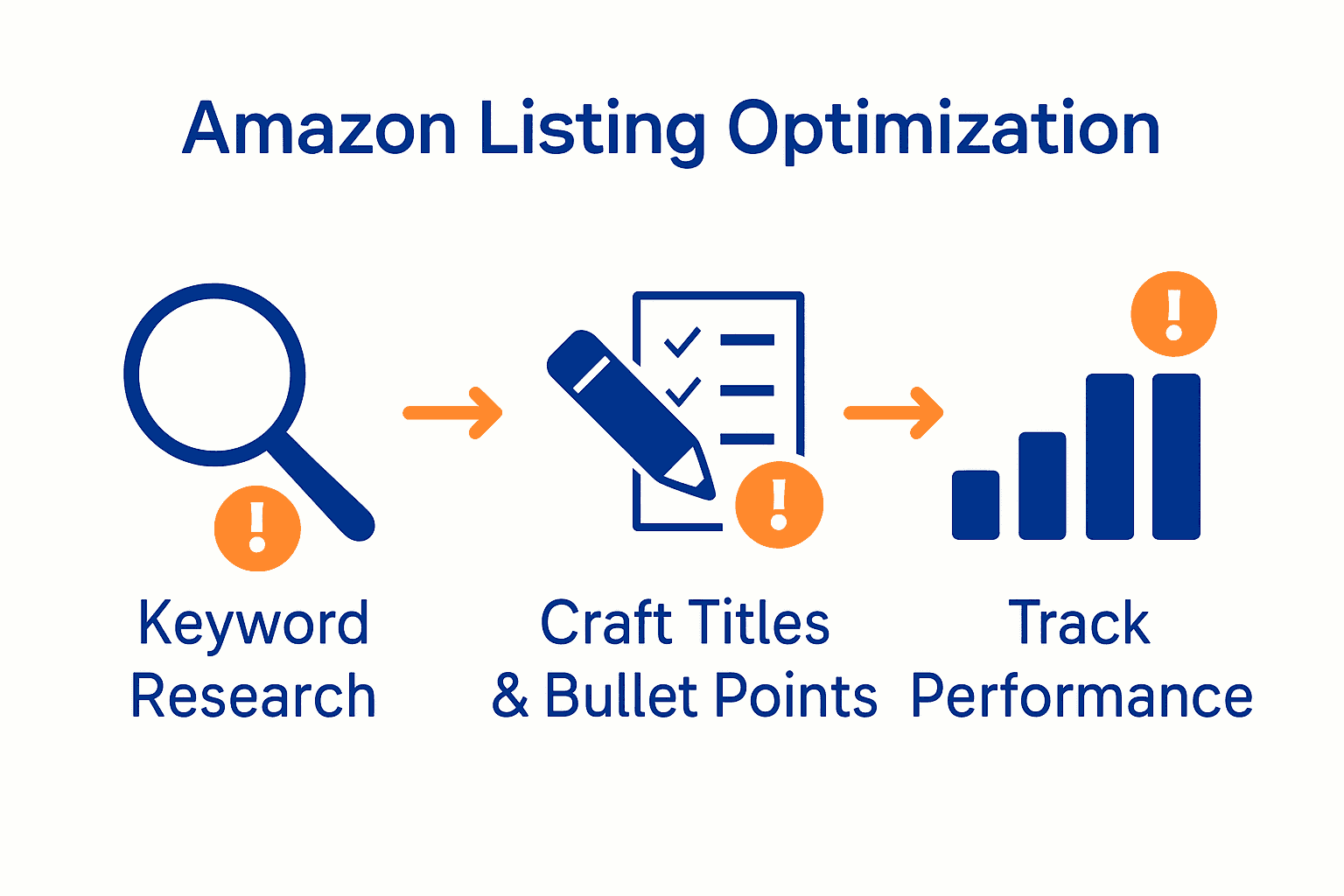
- Step 1: Conduct Keyword Research And Competitive Analysis
- Step 2: Craft High-Converting Titles And Bullet Points
- Step 3: Optimize Product Descriptions And Images
- Step 4: Apply Backend Keyword And Seo Strategies
- Step 5: Verify Listing Quality And Track Performance
Quick Summary
| Key Point | Explanation |
|---|---|
| 1. Conduct keyword research thoroughly | Start with core product terms and expand using tools for impactful search visibility. |
| 2. Craft engaging titles and bullet points | Use vital keywords and narrate your product’s benefits clearly to attract and retain buyers. |
| 3. Optimize product descriptions and images | Create compelling narratives and high-quality visuals that resonate with customer needs and desires. |
| 4. Implement strategic backend keywords | Utilize unique and relevant keywords to enhance search visibility without cluttering the main listing. |
| 5. Monitor performance and refine listings | Regularly track metrics and adjust your content based on analytics to maintain competitive edge. |
 |
|
Step 1: Conduct Keyword Research and Competitive Analysis
Keyword research and competitive analysis are your roadmap to creating powerful Amazon listings that attract buyers and outperform competitors. This critical step will help you understand exactly what potential customers are searching for and how to strategically position your product.
Starting with keyword research means diving deep into the search terms your target customers use. According to research from arxiv.org, successful marketplace listings require balancing revenue potential with product relevance. Begin by brainstorming core product terms then expand using Amazon’s search suggestions, competitor listings, and keyword research tools. Focus on long tail keywords that demonstrate specific buyer intent.
Competitive analysis goes hand in hand with keyword research. As insights from arxiv.org indicate, understanding how sponsored results impact marketplace search means examining top performing listings in your product category. Look closely at their titles, bullet points, and descriptions. What keywords are they targeting? How are they structuring information? Analyze their strengths and identify gaps you can exploit.

A pro tip for keyword selection is to prioritize terms with high search volume but moderate competition. This sweet spot allows your listing to be discoverable without getting lost in a sea of identical products. Track your keyword performance regularly and be prepared to adjust your strategy as market dynamics shift.
Next up? Transforming these keywords into a compelling listing that converts browsers into buyers.
Step 2: Craft High-Converting Titles and Bullet Points
Transforming your keyword research into compelling product titles and bullet points is the make or break moment for your Amazon listing. Your goal is to create content that not only ranks in search results but convinces potential buyers to click and purchase.
According to research from arxiv.org, understanding user preferences is critical when crafting product information. Your title should lead with the most important keywords while telling a concise product story. Start with your primary keyword, include key features, and highlight unique selling points. For example, instead of “Blue Wireless Headphones” write “Noise Cancelling Bluetooth Wireless Headphones Premium Sound Long Battery Life for Work and Travel”.
Bullet points are your opportunity to dive deeper into product benefits. arxiv.org emphasizes the importance of semantic search and metadata filtering in improving search relevance. Write each bullet point to address a specific customer need or answer a potential question. Focus on solving problems and explaining how your product improves the user’s life. Use clear language, avoid technical jargon, and prioritize the most compelling features first.
Pro Tip: Read your title and bullets out loud. If it sounds awkward or doesn’t flow naturally, rewrite it.
Next up? Crafting a product description that seals the deal and turns browsers into buyers.
Step 3: Optimize Product Descriptions and Images
Your product description and images are the final persuasion tools that transform interested browsers into committed buyers. This step is about creating a visual and narrative experience that makes your product irresistible.
Research from arxiv.org emphasizes the importance of tailoring product information to user preferences. Your product description should tell a story that goes beyond basic features. Start with a compelling opening that addresses the customer’s core problem. Then walk through how your product uniquely solves that problem. Use emotionally resonant language that helps customers imagine using your product in their daily lives.
Image optimization is equally critical. According to research from arxiv.org, high quality images with relevant attributes significantly impact product discoverability. Include multiple images that showcase your product from different angles. Your primary image should be a clean professional shot with a pure white background. Follow this with lifestyle images showing the product in use. Include close-up detail shots that highlight unique features. Ensure all images are high resolution and accurately represent your product.
Pro Tip: Think like a customer. Would these images and description make you want to buy this product?
Next up? Implementing strategic backend keywords to boost your listing’s search visibility.
Step 4: Apply Backend Keyword and SEO Strategies
Backend keywords are your secret weapon for Amazon listing optimization. These hidden keywords help Amazon understand your product and match it with relevant customer searches without cluttering your visible listing.
According to research from arxiv.org, strategic backend optimization plays a crucial role in balancing product relevance and search ranking. Start by gathering keywords that didnt fit naturally in your title or bullet points. Include synonyms misspellings and alternative product descriptions. Amazon gives you 250 bytes to work with so be strategic. Use variations like singular and plural forms product features alternate names and related search terms.
The goal is semantic richness without redundancy. Research from arxiv.org highlights the importance of maintaining competitive positioning through smart keyword strategies. Avoid repeating words already in your title or bullets. Focus on unique terms that expand your product’s searchability. Separate keywords with spaces not commas and use lowercase. Prioritize relevance over volume.
Pro Tip: Think like a customer searching for your product. What unexpected terms might they use?
Next up? Understanding how to monitor and continuously improve your Amazon listing performance.
Step 5: Verify Listing Quality and Track Performance
Verifying your Amazon listing quality and tracking performance are crucial steps to ensure your product continues to attract and convert potential buyers. This final stage is about understanding how your listing performs and making data driven improvements.
Research from arxiv.org highlights the importance of using linear programming techniques to optimize listing performance. Start by monitoring key metrics like click through rate conversion rate search ranking and customer reviews. Amazon provides a comprehensive seller central dashboard where you can track these critical performance indicators. Pay close attention to your product visibility impressions and sales velocity. Are customers finding your product? Are they clicking but not buying? These insights will help you pinpoint exactly where your listing might need refinement.
According to research from arxiv.org, analyzing sponsored result impact is essential for understanding search quality. Regularly review your backend analytics to identify trends. Look for patterns in customer search terms that lead to your listing. Are there unexpected keywords driving traffic? Are some keywords underperforming? Use this data to continuously optimize your title bullet points and backend keywords. Set a schedule to review and update your listing every 30 to 45 days.
Pro Tip: Treat your Amazon listing like a living document. What works today might need adjustment tomorrow.
Congratulations. You now have a comprehensive strategy for creating high converting Amazon listings.
Unlock Your Amazon Listing Potential for Maximum Sales
Struggling to translate your meticulous keyword research and optimized content into real sales Can you confidently say your Amazon listings capture every opportunity to convert browsers into buyers Understanding how to strategically structure titles bullet points descriptions and backend keywords can feel overwhelming but it is key to outperforming competitors and boosting product visibility Our insights on crafting high-converting listings are just the first step toward mastering this challenge

Take control of your Amazon success today by exploring expert strategies in E-commerce Tips & Strategies to Grow Your Online Business. At SearchOneers we specialize in Amazon Listing Optimization and SEO backed by data-driven analytics designed to evolve as the marketplace changes. Don’t let your hard work go unnoticed Learn how to enhance every element of your listing so customers find you first and choose you every time Start your transformation now and watch your sales grow with targeted support you can trust.
Frequently Asked Questions
How can I conduct effective keyword research for my Amazon listing?
To conduct effective keyword research, brainstorm core product terms and expand using Amazon’s search suggestions and competitor listings. Use keyword research tools to identify long-tail keywords that reflect specific buyer intent and have moderate competition.
What should I include in my Amazon product title to maximize sales?
Your product title should start with the primary keyword and clearly convey key features and unique selling points. Aim for a structure that tells a concise product story, like “Noise Cancelling Bluetooth Wireless Headphones Premium Sound Long Battery Life for Work and Travel.”
How can I write compelling bullet points for my Amazon listing?
Craft bullet points that address specific customer needs and highlight how your product solves problems. Use clear, engaging language and prioritize the most compelling features to persuade buyers.
What are the best practices for creating product descriptions that convert?
Your product description should tell a compelling story that emphasizes how the product addresses customer pain points. Begin with a strong opener that engages the reader, then detail how your product improves their daily life.
How can I optimize my Amazon listing with backend keywords?
To optimize with backend keywords, gather synonyms, misspellings, and alternative product descriptions that didn’t fit in your title or bullet points. Focus on unique terms that enhance searchability without repeating keywords from other sections, using the full 250 bytes provided.
How often should I review and update my Amazon listing performance?
Regularly review your listing’s performance every 30 to 45 days to monitor key metrics like conversion rate and search ranking. Use these insights to adjust your keywords and content strategy for ongoing optimization.

Comments
2 responses to “How to Structure Amazon Listings for Maximum Sales Success”
[…] must adopt a holistic approach that combines technical optimization with persuasive storytelling. How to Structure Amazon Listings for Maximum Sales Success provides advanced insights into creating listings that not only appear in search results but also […]
[…] refine your approach to creating high-converting listings, explore our comprehensive guide on structuring Amazon listings for maximum sales success. By mastering these core components, sellers can significantly improve their product’s visibility […]