

Best Seller Rank is everywhere on Amazon and it shapes which products you see first. Some sellers move up and down the rankings every single hour and this matters more than you might think. The wild part is that a product ranked #1 can sell hundreds or even thousands more units compared to an item sitting at #500 in the same category. So while everyone obsesses over reviews and ratings, it turns out this ever-changing number could be the ultimate driver of sales success.
Table of Contents
- Defining Best Seller Rank: What Is It?
- The Importance Of Best Seller Rank In Sales
- How Best Seller Rank Is Calculated
- Factors Influencing Best Seller Rank
- Best Seller Rank Trends And Their Implications
Quick Summary
| Takeaway | Explanation |
|---|---|
| Lower BSR Indicates Better Sales Performance | A product with a lower Best Seller Rank sells more units than those with higher ranks, crucial for visibility. |
| Dynamic Updates Reflect Sales Activity | Best Seller Rank metrics update frequently based on recent sales data, indicating real-time market trends. |
| Strategic BSR Management Boosts Sales | Sellers can improve product visibility and sales by understanding and optimizing their Best Seller Rank. |
| Consumer Trust Linked to BSR | High Best Seller Rankings create consumer perceptions of credibility and quality, influencing purchase decisions. |
| External Factors Affect BSR | Product reviews, pricing, and promotions, as well as market trends, significantly influence a product’s Best Seller Rank. |
Defining Best Seller Rank: What Is It?
Best Seller Rank is a dynamic metric that reveals the performance and popularity of a product within specific categories on e-commerce platforms, particularly on Amazon. This numerical ranking represents how well a product sells compared to other items in the same category, providing sellers and buyers with immediate insights into product demand and market positioning.
Understanding the Numerical Ranking System
The Best Seller Rank (BSR) is calculated using complex algorithms that evaluate sales volume, recency, and comparative performance. A lower number indicates better performance – meaning a product ranked #1 sells more units than a product ranked #500 within the same category.
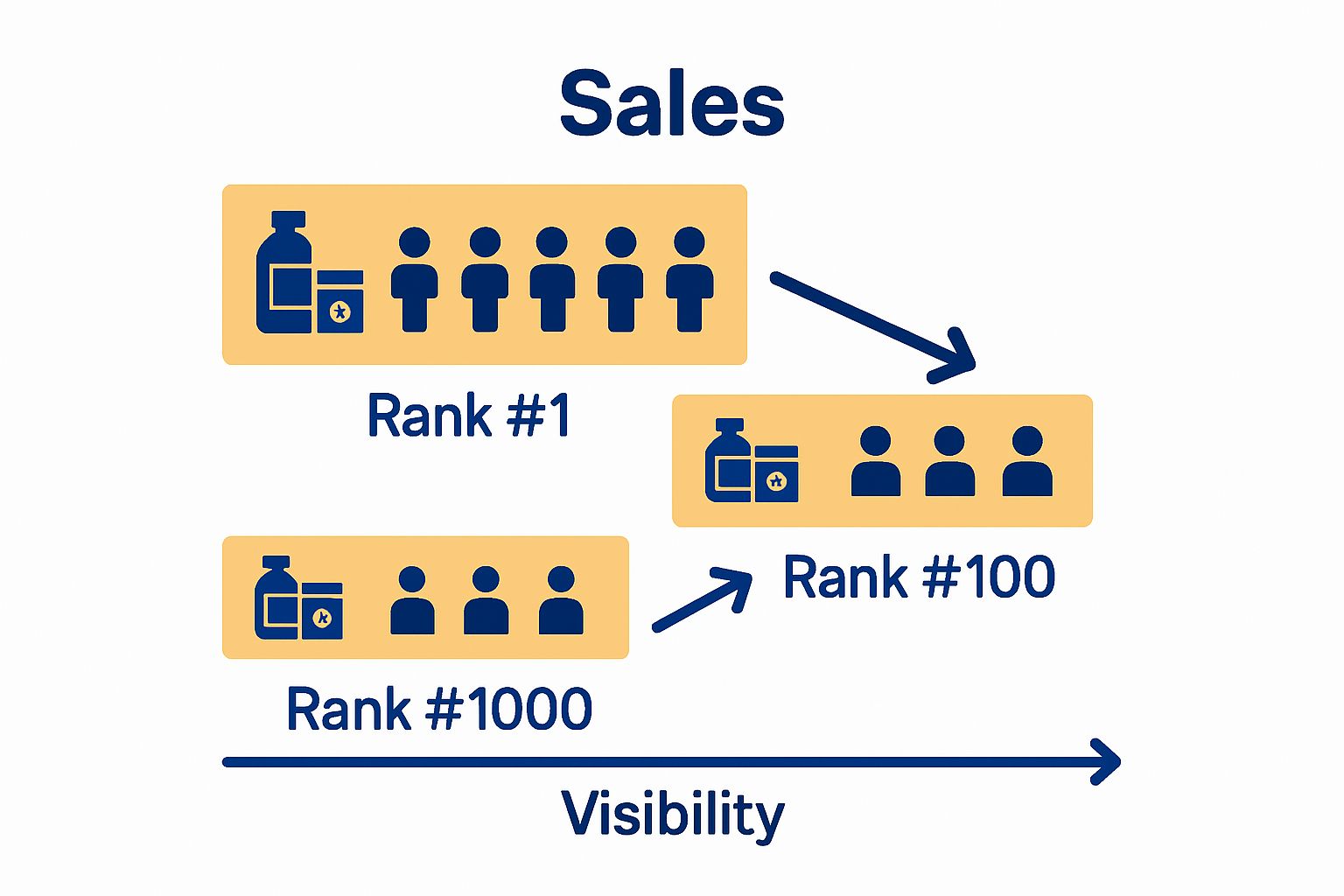 Amazon’s product performance metrics suggest that BSR updates frequently, sometimes multiple times per hour, reflecting real-time sales dynamics.
Key characteristics of Best Seller Rank include:
- Represents relative sales performance
- Updates dynamically based on recent sales history
- Specific to individual product categories
- Ranges from #1 to potentially hundreds of thousands
Significance for E-Commerce Sellers
For e-commerce sellers, Best Seller Rank is more than just a number. It serves as a critical indicator of product health and market positioning. Our guide on Amazon Inventory Ranking provides deeper insights into how these rankings impact overall seller strategy. A strong BSR can signal product popularity, attract more potential buyers, and potentially improve product visibility in search results.
The ranking system essentially creates a competitive ecosystem where sellers constantly strive to improve their product’s performance. A lower BSR not only indicates higher sales but can also trigger additional platform benefits like increased visibility and recommendation opportunities. Sellers who understand and strategically work to improve their Best Seller Rank can gain significant advantages in the highly competitive e-commerce marketplace.
The Importance of Best Seller Rank in Sales
Best Seller Rank (BSR) is not merely a numerical statistic, but a powerful indicator of product performance and market potential. Its significance extends far beyond a simple ranking, influencing consumer behavior, platform visibility, and ultimately, sales strategies for e-commerce sellers.
Consumer Perception and Trust Dynamics
Consumers inherently gravitate towards products with strong Best Seller Rankings, viewing them as reliable and popular choices. Consumer behavior research indicates that products with lower BSR numbers are perceived as more credible and trustworthy. This psychological phenomenon creates a self-reinforcing cycle where high rankings attract more potential buyers, further improving the product’s market position.
Key psychological factors influencing consumer choices include:
- Social proof through high sales volumes
- Perceived product quality based on ranking
- Increased confidence in purchasing decisions
- Enhanced visibility among competing products
Strategic Implications for Sellers
For e-commerce sellers, understanding BSR goes beyond simple number tracking. Our guide on Amazon Ranking Tips emphasizes how strategic optimization can transform product performance. A robust Best Seller Rank directly correlates with increased platform visibility, improved search result placements, and higher conversion rates.
Moreover, platforms like Amazon use BSR as a critical metric in their recommendation algorithms. Products with consistently strong rankings are more likely to be suggested to potential buyers, creating a virtuous cycle of increased exposure and sales. Sellers who comprehend and strategically manage their Best Seller Rank can effectively differentiate themselves in highly competitive marketplaces, turning this metric into a powerful competitive advantage.
This table provides a concise comparison of how Best Seller Rank impacts both consumers and e-commerce sellers, allowing you to understand its significance from both perspectives.
| Perspective | Importance of Best Seller Rank |
|---|---|
| Consumers | Indicates product popularity and trustworthiness, guiding purchase decisions |
| Sellers | Drives visibility, affects platform recommendations, and impacts sales volume |
| Platform | Helps determine search placements and featured product selections |
How Best Seller Rank Is Calculated
Calculating Best Seller Rank involves sophisticated algorithmic processes that transform sales data into a dynamic numerical representation of product performance. While the exact methodology remains proprietary, e-commerce platforms utilize complex computational models to generate these rankings with remarkable precision.
Sales Performance Weighted Metrics
Academic research on e-commerce algorithms reveals that Best Seller Rank calculation prioritizes recent sales volume and frequency over cumulative historical performance. The algorithm considers multiple critical factors to generate an accurate representation of product popularity.
Key components influencing BSR calculation include:
- Total number of units sold within a specific timeframe
- Recency and frequency of sales
- Comparative sales performance within product category
- Rate of sales acceleration or deceleration
Algorithmic Complexity and Real-Time Updates
Understanding Amazon’s Search Algorithm provides insights into the intricate mechanisms behind ranking systems. The calculation process is not a simple linear computation but a dynamic model that continuously adjusts based on near-instantaneous sales data. Each sale can potentially shift a product’s ranking, creating a highly responsive and competitive environment.
The algorithm essentially creates a relative performance metric that reflects current market dynamics.
A product’s Best Seller Rank is not just a static number but a real-time indicator of its competitive positioning. By continuously processing sales information, e-commerce platforms generate a nuanced representation of product popularity that helps both sellers and consumers make informed decisions.
Factors Influencing Best Seller Rank
Best Seller Rank is not a static metric but a complex, dynamic measurement influenced by multiple interconnected factors. E-commerce platforms evaluate product performance through a sophisticated lens that considers far more than simple sales volume.
Sales Performance and Velocity
Market research on e-commerce dynamics reveals that sales velocity remains the primary driver of Best Seller Rank. The speed and consistency of product sales create significant momentum in ranking calculations. Products that demonstrate steady, consistent sales tend to maintain more stable rankings compared to those with sporadic purchasing patterns.
Key sales performance factors include:
- Total units sold within recent timeframes
- Consistency of sales frequency
- Rate of sales acceleration
- Comparative performance within product categories
External Market Influences
Beyond direct sales metrics, multiple external factors substantially impact Best Seller Rank. Product reviews, customer ratings, pricing strategies, and promotional activities create nuanced interactions that can dramatically shift a product’s market positioning. Our guide on Amazon Ranking Tips highlights how strategic sellers leverage these complex dynamics.
Seasonal trends, marketing campaigns, and unexpected media exposure can create sudden shifts in product popularity. A single viral social media mention or positive press coverage can rapidly transform a product’s sales trajectory, consequently influencing its Best Seller Rank. Understanding these multifaceted influences allows sellers to develop more sophisticated, adaptive marketing strategies that respond dynamically to changing market conditions.
Below is a table summarizing the main factors that influence Best Seller Rank, helping readers quickly compare their relative importance and impact.
| Factor | Description |
|---|---|
| Sales Volume | Number of units sold within a specific recent timeframe |
| Sales Velocity | Speed and consistency of sales over time |
| Product Reviews & Ratings | Customer feedback that affects ranking through trust and credibility |
| Pricing & Promotions | Competitive pricing and promotional activities that can boost temporary sales |
| External Market Trends | Seasonal shifts, media coverage, and viral events influencing demand |
| Category Competition | Relative performance versus other products within the same category |
| Sales Acceleration/Deceleration | Sudden increases or drops in sales compared to historical trends |
Best Seller Rank Trends and Their Implications
Best Seller Rank trends represent more than statistical fluctuations they are strategic indicators of evolving marketplace dynamics. Understanding these trends provides critical insights for sellers seeking to navigate the competitive landscape of e-commerce platforms.
Evolution of Ranking Patterns
Global e-commerce research demonstrates that Best Seller Rank trends are increasingly reflecting complex market interactions beyond traditional sales metrics. Modern ranking systems integrate sophisticated algorithms that capture nuanced consumer behavior patterns, technological shifts, and emerging market preferences.
Significant trends in Best Seller Rank evolution include:
- Increasing importance of real-time data processing
- Growing impact of consumer engagement metrics
- Reduced lifecycle for product popularity
- Enhanced algorithmic complexity in ranking calculations
Strategic Implications for Sellers
Our guide on Amazon EU Seller Tips emphasizes the critical nature of understanding these ranking trends. Sellers who anticipate and adapt to these shifts can develop more resilient market strategies. The most successful e-commerce professionals recognize that Best Seller Rank is not just a performance metric but a dynamic ecosystem that rewards strategic innovation.
The implications extend beyond individual product performance. These trends reflect broader market transformations, indicating shifts in consumer preferences, technological capabilities, and competitive landscapes. By carefully analyzing Best Seller Rank trends, sellers can identify emerging opportunities, predict market movements, and position their products more effectively in an increasingly competitive digital marketplace.

Ready to Take Control of Your Best Seller Rank?
You have just learned how Best Seller Rank can either open new doors for your products or keep them hidden from potential customers. If you feel overwhelmed trying to decipher shifting algorithms or struggle to keep your listings visible amidst intense competition, you are not alone. Many sellers aim for that coveted low BSR number but find it tough to master the details. Real results require both expert optimization and ongoing strategy. Our E-commerce Tips & Strategies to Grow Your Online Business category is filled with practical insights to address these very challenges.
Imagine your listings rising in rankings with professional Amazon SEO, enhanced titles, and bullet points that convert browsers into buyers. That is not just a possibility when you work with Searchoneers. These are results delivered through our proven Amazon Listing Optimization solutions. Do not risk your next sales season or let rankings slip any further. Discover how we can drive growth by visiting Searchoneers and set your products on the path to true visibility today.
Frequently Asked Questions
What does Best Seller Rank (BSR) indicate in e-commerce?
Best Seller Rank (BSR) is a numerical indicator that reflects the sales performance and popularity of a product within its category on e-commerce platforms. To improve your product’s BSR, focus on increasing sales volume and frequency consistently.
How can I check my product’s Best Seller Rank?
You can usually check your product’s Best Seller Rank directly on the product page of e-commerce platforms. Review the rankings regularly to track changes and adjust your marketing strategies based on your product’s performance.
What factors affect Best Seller Rank?
Best Seller Rank is influenced by factors such as recent sales volume, sales frequency, and changes in consumer behavior. To enhance your BSR, ensure steady sales and engage actively with customers to boost reviews and ratings.
How often is Best Seller Rank updated?
Best Seller Rank is updated dynamically, sometimes multiple times per hour, based on recent sales data. Keep monitoring your BSR frequently to understand and react to shifts in product performance.
Why is a lower Best Seller Rank better for my product?
A lower Best Seller Rank indicates that your product sells more units than higher-ranked competitors in the same category. Aim to implement effective sales strategies to lower your BSR, thereby increasing your product’s visibility and appeal to customers.
How can I improve my Best Seller Rank over time?
To improve your Best Seller Rank, focus on increasing your sales velocity, get more positive reviews, and maintain competitive pricing. Implement promotional strategies and monitor your progress regularly to see improvements typically within 30–60 days.

Comments
One response to “Understanding What is Best Seller Rank in E-Commerce”
[…] What Is Amazon Best Seller Rank (BSR)? […]