Most American Amazon sellers overlook how complex customer feedback can truly be. More than half of experienced sellers misread emotional signals hidden in reviews, which means missed opportunities for strategic listing improvements. Understanding the real impact of buyer sentiment matters because it directly shapes sales performance and product visibility. This guide reveals proven insights about feedback types and dispels myths to help you make smarter decisions and enhance your product listings.
Table of Contents
- Defining Amazon Customer Feedback And Common Myths
- Types Of Feedback: Reviews, Ratings, And Questions
- How Feedback Shapes Product Listing Performance
- Analyzing Feedback For Actionable Insights
- Common Mistakes When Handling Customer Feedback
Key Takeaways
| Point | Details |
|---|---|
| Understanding Feedback Complexity | Amazon customer feedback encompasses nuanced emotions beyond simple ratings, impacting product perception significantly. |
| Diverse Feedback Channels | Reviews, star ratings, and seller feedback each offer unique insights that are critical for improving business performance. |
| Feedback’s Impact on Visibility | Positive feedback enhances product visibility and consumer trust, making it imperative for sellers to engage proactively. |
| Common Management Mistakes | Relying on manual processes for feedback analysis can hinder growth; automated systems are essential for timely responses and improvements. |
Defining Amazon Customer Feedback and Common Myths
Amazon customer feedback represents a complex ecosystem of consumer insights that goes far beyond simple star ratings. Multinomial sentiment analysis research reveals that customer feedback encompasses an intricate emotional spectrum, challenging simplistic interpretations many sellers traditionally hold.
Contrary to popular belief, customer feedback is not merely a binary positive or negative rating system. Sophisticated analyses demonstrate that consumer responses include nuanced emotional layers that can significantly impact product perception. Sentiment variations range from mild satisfaction to profound disappointment, with each review potentially containing multiple emotional threads that traditional metrics might overlook.
Some prevalent myths about Amazon customer feedback include the misconception that all reviews are equally weighted or that a few negative comments dramatically tank sales. In reality, Amazon’s algorithm considers review context, verified purchase status, and reviewer history. Sellers who understand these subtleties can more effectively manage their reputation and respond strategically to customer input.
Pro tip: Develop a systematic approach to monitoring customer feedback by setting up automated alerts and creating a standardized response protocol for different types of reviews.
Types of Feedback: Reviews, Ratings, and Questions
Amazon customer feedback comprises multiple nuanced communication channels that provide sellers with comprehensive insights into consumer perceptions and experiences. These channels include product reviews, star ratings, customer questions, and seller feedback, each serving a distinct purpose in the digital marketplace ecosystem.

Product reviews represent the most detailed form of feedback, allowing customers to share in-depth written experiences about a specific item. Star ratings offer a quick quantitative snapshot, ranging from one to five stars, which provides an immediate visual indicator of overall product satisfaction. Unlike generic ratings, these reviews often include specific details about product performance, quality, and potential improvements.
Customer feedback on Amazon can be categorized into two primary public types: seller feedback and product reviews. Seller feedback focuses on the transactional experience, evaluating aspects like shipping speed, packaging, and customer service. Product reviews, conversely, concentrate exclusively on the item’s features, functionality, and how well it meets consumer expectations. This distinction is crucial for sellers seeking to understand and improve different aspects of their business.
Pro tip: Create a systematic feedback tracking spreadsheet that categorizes reviews by type, sentiment, and actionable insights to help you rapidly identify and address potential product or service improvements.
Here’s a comparison of Amazon feedback channels and their business impact:
| Feedback Channel | Information Provided | Direct Business Impact | Seller Action Required |
|---|---|---|---|
| Product Reviews | Detailed user experiences | Influences trust, boosts SEO | Respond, address product issues |
| Star Ratings | Quick satisfaction metric | Affects visibility, sales | Track trends, improve quality |
| Seller Feedback | Service and fulfillment info | Shapes reputation, repeat buyers | Optimize shipping, communication |
| Customer Questions | Pre-sale concerns answered | Increases conversions | Accurate, prompt responses |
How Feedback Shapes Product Listing Performance
Machine learning techniques analyzing customer sentiment reveal profound connections between customer feedback and product listing performance on Amazon. These advanced analytical approaches demonstrate how reviews and ratings directly influence product visibility, consumer trust, and ultimately, sales conversion rates.
The Amazon algorithm strategically prioritizes product listings with consistent, high-quality feedback. Positive reviews act as social proof, signaling product reliability to potential buyers and improving organic search rankings. Listings with detailed, authentic customer experiences tend to receive preferential treatment, with the algorithm recognizing comprehensive feedback as an indicator of product value and customer satisfaction.
Customer feedback impacts multiple critical dimensions of product performance. Numerical star ratings provide an immediate visual assessment, while written reviews offer nuanced insights into product strengths and potential improvements. Sellers who actively engage with and strategically respond to feedback can incrementally enhance their listing’s perceived quality, creating a virtuous cycle of improved visibility and consumer confidence.
Pro tip: Implement a systematic review monitoring process that categorizes feedback by sentiment, product feature, and potential improvement areas to develop targeted optimization strategies.
Analyzing Feedback for Actionable Insights
Advanced graph-based ranking techniques transform raw customer feedback into strategic intelligence for Amazon sellers. These sophisticated analytical methods help sellers navigate complex feedback landscapes by identifying critical patterns and meaningful trends hidden within large volumes of customer comments.
The process of extracting actionable insights involves multiple strategic approaches. Sentiment analysis plays a crucial role in understanding the emotional undercurrents of customer experiences, while thematic clustering helps sellers recognize recurring issues or praise points. By systematically categorizing feedback across dimensions like product features, user experience, and performance, sellers can develop targeted improvement strategies that directly address customer expectations.
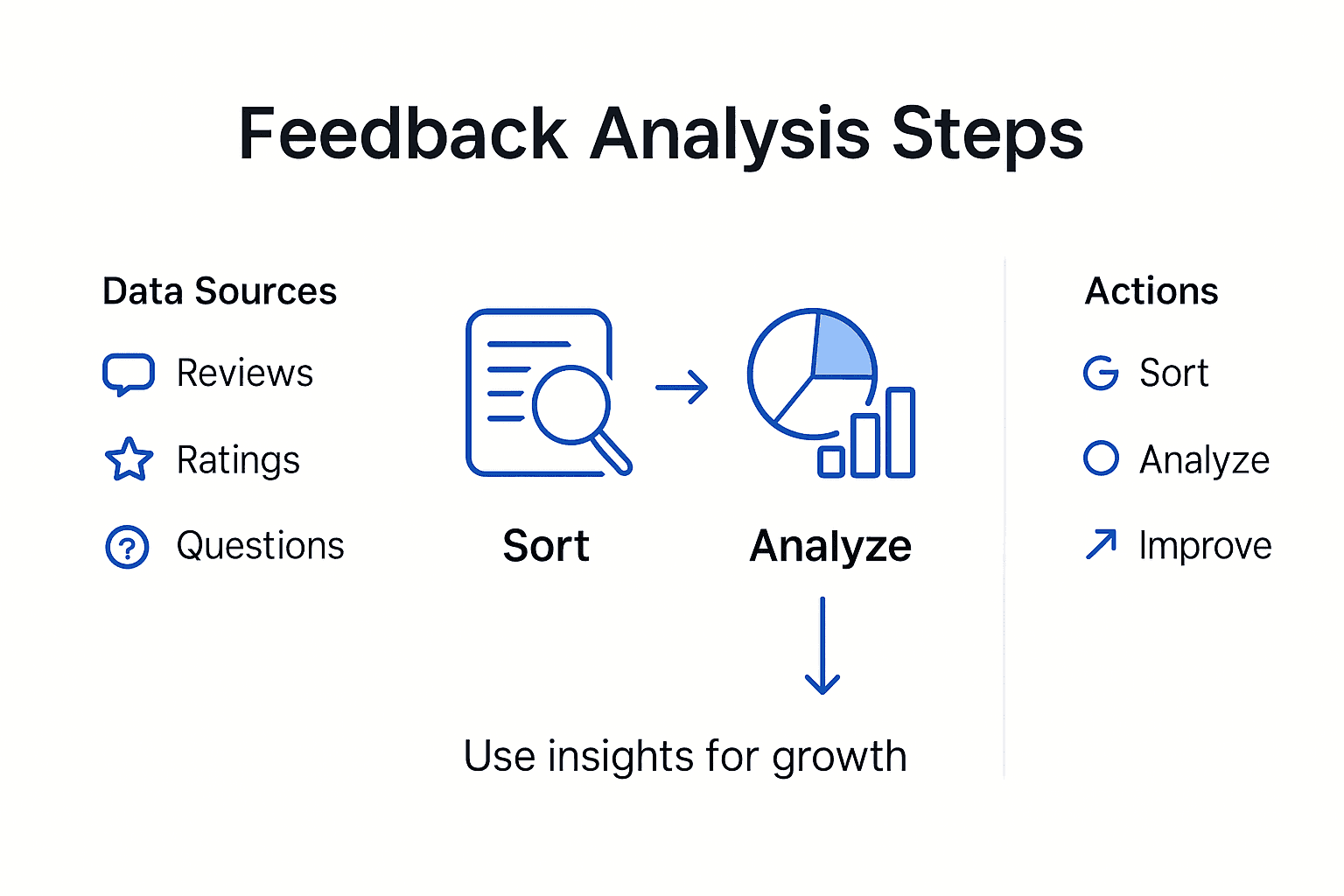
Successful feedback analysis requires more than simple data aggregation. Sellers must develop a nuanced approach that considers context, frequency, and emotional intensity of customer comments. Quantitative metrics like star ratings provide a broad overview, but qualitative analysis of written reviews reveals deeper insights about product strengths, potential improvements, and specific customer pain points that might not be immediately apparent through numerical ratings.
Pro tip: Create a structured feedback analysis framework that weights different review elements, prioritizing verified purchases and detailed written reviews to generate the most reliable product improvement recommendations.
Common Mistakes When Handling Customer Feedback
Research on Amazon review management reveals critical errors sellers consistently make when processing customer feedback. The most significant pitfall is relying on manual labeling techniques that create bottlenecks in understanding and responding to customer insights, ultimately limiting a seller’s ability to improve product performance and customer satisfaction.
Sellers often commit fundamental mistakes in their feedback management approach. Feedback response strategies frequently fall short by ignoring critical signals within customer comments. Common errors include failing to categorize feedback systematically, responding defensively or generically, and neglecting to create clear communication channels that encourage honest customer input. These missteps can significantly damage seller credibility and prevent meaningful product improvements.
The complexity of feedback analysis demands sophisticated approaches beyond surface-level interpretation. Effective feedback management requires sellers to develop nuanced systems that can quickly distinguish between genuine product concerns and isolated complaints. Machine learning and semi-supervised analysis techniques can help sellers automate pattern recognition, enabling more strategic and timely responses to customer experiences.
Pro tip: Implement a structured feedback tracking system that automatically flags high-priority reviews, categorizes sentiment, and generates actionable insights without manual intervention.
Below is a summary of common mistakes and recommended solutions for handling Amazon customer feedback:
| Mistake | Business Consequence | Recommended Solution |
|---|---|---|
| Manual feedback labeling | Slow response, missed patterns | Automate sentiment analysis |
| Generic or defensive review responses | Reduces customer trust | Personalize responses, address concerns |
| Neglecting systematic feedback categorization | Overlooked product issues | Implement structured tracking system |
| Failing to encourage honest input | Limited actionable insights | Create open communication channels |
Unlock the Power of Amazon Customer Feedback to Drive Sales Growth
Understanding the complexity behind Amazon customer feedback is key to overcoming the challenge of turning diverse reviews into actionable strategies. This article highlights the importance of detailed sentiment analysis and systematic feedback management to boost product visibility and consumer trust. If you want to move beyond generic responses and manual labeling, focusing on precise Amazon listing optimization and smart analytics can transform your approach and help your products stand out.
Take control of your Amazon presence today by exploring proven E-commerce Tips & Strategies to Grow Your Online Business that center on enhanced titles, bullet points, and SEO adjustments tailored to your unique feedback insights. Visit Searchoneers now to get personalized solutions that evolve with the marketplace and turn thoughtful customer feedback into real sales impact.
Frequently Asked Questions
What is Amazon customer feedback?
Amazon customer feedback includes product reviews, star ratings, seller feedback, and customer questions that provide sellers with insights into consumer perceptions and experiences.
How does customer feedback affect sales on Amazon?
Customer feedback impacts product visibility, consumer trust, and sales conversion rates. Positive reviews and high star ratings signal reliability to potential buyers, improving a product’s search ranking.
What are common mistakes sellers make when managing customer feedback?
Common mistakes include relying on manual feedback labeling, providing generic responses to reviews, neglecting systematic categorization of feedback, and failing to encourage honest input from customers.
How can sellers analyze customer feedback for actionable insights?
Sellers can analyze feedback using sentiment analysis and thematic clustering to identify patterns and trends in customer comments, enabling targeted product improvements and better responses to consumer needs.