TL;DR:
- Amazon’s dynamic pricing automatically adjusts product prices in real-time based on competitor activity and demand signals to stay competitive. Implementing strategic price floors and ceilings, considering full costs, and aligning pricing with advertising and listing quality enhances profitability. Proper understanding of Amazon’s algorithm and feedback loops helps sellers optimize long-term margins and market positioning.
Amazon dynamic pricing is the automatic, real-time adjustment of product prices based on competitor activity, demand signals, inventory levels, and Buy Box data. Amazon’s algorithms perform approximately 2.5 million price updates daily, driving a 25% increase in overall company revenue. That scale makes dynamic pricing the single most consequential force shaping what you earn on the platform. If you sell on Amazon without understanding how this system works, you are competing blind.
How does Amazon’s dynamic pricing algorithm work?
Amazon’s pricing algorithm is not a simple rule set. It is a continuous learning system that ingests multiple data streams and adjusts prices to maintain competitiveness without sacrificing long-term customer trust. Understanding the inputs gives you a real edge.
The algorithm pulls from these core data signals:
- Competitor prices: The system scans third-party sellers and external retailers constantly. Price updates can occur as frequently as every 10 minutes, meaning the market you see right now may look different in an hour.
- Buy Box engagement: Click-through rate and conversion rate on the Buy Box directly influence how the algorithm weights a given price point.
- Inventory levels: Low stock on a competing listing triggers upward price pressure. High inventory creates downward pressure.
- Demand signals: Search volume spikes, seasonal patterns, and recent sales velocity all feed the model.
- Historical pricing behavior: The algorithm tracks how competitors have responded to past price moves and builds predictive models from that data.
Amazon’s pricing philosophy is also worth understanding at a structural level. Amazon prioritizes competitive pricing over immediate profit, accepting short-term margin compression to build long-term customer loyalty and market dominance. This asymmetrical approach means the algorithm moves prices down faster than it raises them.
One of the more striking findings from recent research is that Amazon’s AI repricing systems can induce competitors to raise prices through feedback loops. When Amazon’s algorithm detects a competitor consistently matching its price cuts, it can strategically hold a price point that nudges that competitor upward. You are not just reacting to the market. You are participating in a system that shapes it.

Pro Tip: Use the Amazon algorithm overview from Searchoneers to map how pricing signals interact with visibility and ranking before you configure any repricing tool.
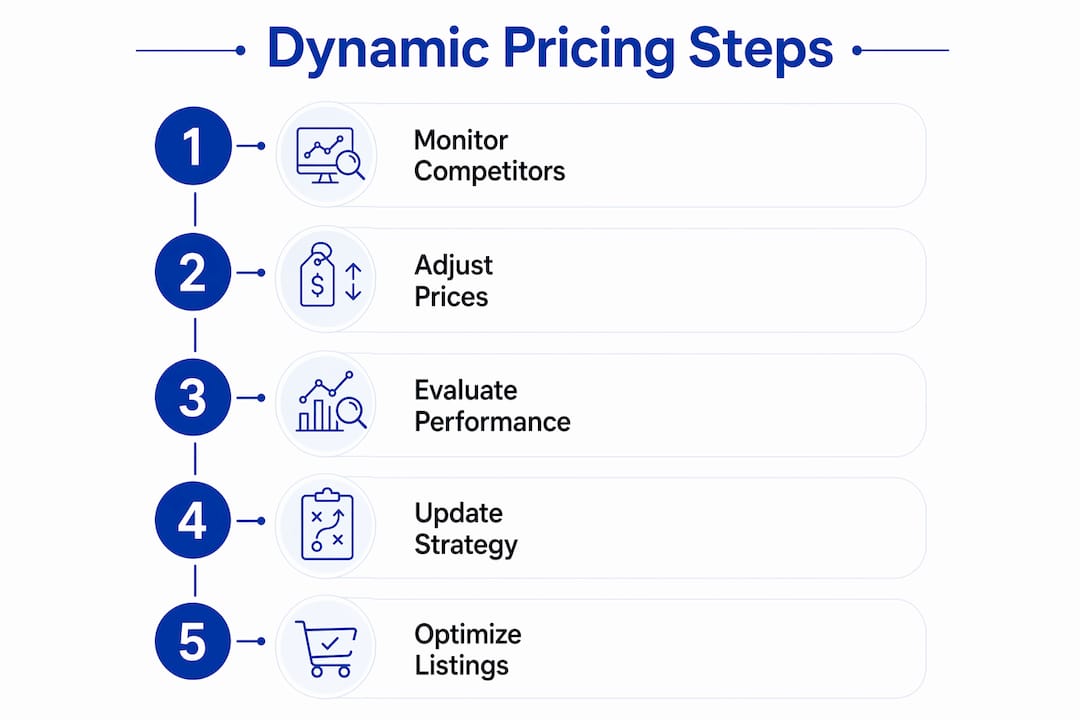
What are effective dynamic pricing strategies for sellers?
Knowing how Amazon’s system works is only useful if you build a strategy around it. The following approach moves from foundational setup to advanced execution.
Set accurate floor and ceiling prices. Floor and ceiling prices act as an active playing field, not just safety rails. A floor set too low does not protect you. It actively instructs the algorithm to compete at unprofitable price points. Your ceiling caps your upside during low-competition windows.
Build your floor price from full costs. A true break-even floor must include COGS, FBA fees, returns rates, allocated overhead, and ad spend. Most sellers skip returns and ad spend. That omission alone can make a “profitable” price point a losing one.
Prioritize contribution margin, not revenue. Focusing on contribution margin per unit leads to healthier profit optimization than chasing the highest revenue number. Temporarily losing the Buy Box is acceptable if your total profit per unit rises. Revenue is a vanity metric when margins are thin.
Start with scheduled pricing, then move to real-time. Sellers benefit from starting with scheduled pricing adjustments before transitioning to automated dynamic pricing. Scheduled pricing based on predictable factors, like weekend demand spikes or promotional windows, is easier to manage and easier to explain to your team.
Choose your operational mode deliberately. Pricing algorithm modes range from “observe and recommend” to fully autonomous execution. Start in observe mode. Review the recommendations for two to four weeks before switching to autonomous operation. This builds your understanding of how the system behaves with your specific catalog.
Pro Tip: Review your floor and ceiling prices every 30 days. Cost structures shift with FBA fee changes, supplier pricing, and ad spend fluctuations. A floor set in january may be wrong by april.
What are common pitfalls in algorithmic dynamic pricing on Amazon?
Most sellers who struggle with dynamic pricing are not making obvious mistakes. They are making subtle ones that compound over time.
Underestimating the full cost structure. Many sellers set floor prices using only COGS and FBA fees. Returns alone can add 3–8% to your effective cost depending on the category. Ad spend to maintain velocity adds more. A floor price that ignores these inputs is a floor price that loses money.
Confusing revenue optimization with profit optimization. These are not the same goal. A repricing tool set to win the Buy Box at all costs will maximize your sales volume and minimize your margin. The correct target is contribution margin per unit, not revenue per listing.
Setting ceiling prices too conservatively. Sellers often cap prices well below what the market would bear during low-competition windows. This leaves real money on the table. Your ceiling should reflect the highest price at which your conversion rate remains acceptable, not just a comfortable number above your floor.
Ignoring market shifts after initial setup. Effective dynamic pricing requires ongoing adjustment of price floors and ceilings in response to market and cost changes. A set-and-forget approach is the most common reason sellers see margins erode six months after launch.
Treating all SKUs identically. High-velocity, low-margin products need tighter floors and faster repricing cycles. Low-velocity, high-margin products need wider bands and more conservative automation. One configuration across your entire catalog is a blunt instrument.
The underlying pattern in all these pitfalls is the same. Sellers treat dynamic pricing as a technical tool rather than a strategic discipline. The tool executes your strategy. If the strategy is wrong, the tool executes it faster and at greater scale.
How to implement dynamic pricing alongside your full Amazon strategy
Dynamic pricing does not operate in isolation. It interacts directly with your advertising, inventory position, and listing quality. Getting those connections right is what separates sellers who see results from those who see chaos.
Coordinate your repricing cycles with your PPC campaigns. When your price drops into a more competitive range, your ad cost-per-click efficiency often improves because conversion rates rise. When your price rises, pull back on broad match spend to avoid paying for clicks that will not convert at the higher price point. These two levers work together, and ignoring that relationship wastes ad budget.
Inventory position changes your pricing power. When stock is low, raising your price protects margin and extends your runway. When stock is high, a more aggressive price accelerates velocity and reduces storage fees. Build a simple rule: if days of inventory drops below 30, your floor rises by a defined percentage. This is not complex to implement, but most sellers never formalize it.
Listing quality also affects how much pricing power you actually have. A listing with weak titles, thin bullet points, and no A+ content converts poorly at any price. Strong listing optimization raises your conversion rate, which gives your repricing algorithm more room to hold a higher price and still win the Buy Box. Pricing and listing quality are not separate decisions.
Pro Tip: Before activating any automated repricing tool, run a pricing strategies review to confirm your model fits your category margins and competitive density. Not every category rewards aggressive real-time repricing.
Dynamic pricing models supported by real-time market data can increase e-commerce profits by 5–8% on average. That gain comes from continuous visibility on competitor activity, Buy Box ownership, and promotions. Without that visibility, you are adjusting prices based on stale data, which is often worse than not adjusting at all.
Key Takeaways
Amazon dynamic pricing rewards sellers who treat price boundaries as strategic decisions, not technical defaults, and who coordinate repricing with advertising, inventory, and listing quality.
| Point | Details |
|---|---|
| Algorithm scale | Amazon executes 2.5 million price updates daily, making real-time repricing a baseline competitive requirement. |
| Floor price accuracy | Include COGS, FBA fees, returns, overhead, and ad spend to avoid setting a floor that loses money. |
| Margin over revenue | Optimize for contribution margin per unit, not total revenue, to build sustainable profitability. |
| Gradual automation | Start with scheduled pricing, then move to real-time automation after reviewing algorithm behavior for several weeks. |
| Listing quality matters | Higher conversion rates from strong listings give your repricing tool more room to hold competitive prices. |
Why I think most sellers underestimate dynamic pricing’s strategic depth
I have worked with enough Amazon sellers to see the same pattern repeat. A seller activates a repricing tool, sets a rough floor and ceiling, and expects the algorithm to handle the rest. Six months later, margins are thinner and they cannot explain why.
The uncomfortable truth is that dynamic pricing amplifies whatever strategy you already have. If your cost structure is wrong, the algorithm executes that mistake at scale. If your listing converts poorly, no price point will save you. The sellers who win with algorithmic pricing are the ones who treat it as one layer in a coordinated system, not a standalone fix.
I also think the industry underestimates how much Amazon’s own algorithm shapes competitor behavior. The feedback loop effect, where Amazon’s pricing nudges rivals to raise their prices, is real and measurable. Sellers who understand this can use it deliberately. Hold a price point long enough in a thin-competition window and you may find competitors drift upward, giving you margin without a single manual adjustment.
The future of Amazon selling belongs to sellers who combine clean data, accurate cost models, and coordinated execution across pricing, advertising, and listing quality. Automation is the accelerant. Strategy is the fuel.
— Goga
Searchoneers can sharpen your Amazon pricing and listing edge
Pricing strategy only delivers results when your listings are built to convert. A well-priced product on a weak listing loses to a well-optimized competitor every time.

Searchoneers specializes in Amazon listing optimization and SEO, building titles, bullet points, descriptions, and backend keywords that turn clicks into sales. When your listing converts at a higher rate, your repricing algorithm has more room to hold competitive prices and capture the Buy Box. Start with the Amazon listing enhancement guide to see exactly where your listings are leaving money behind. For a structured path forward, the listing optimization workflow walks you through every step Searchoneers uses to build high-performing Amazon listings.
FAQ
What is Amazon dynamic pricing?
Amazon dynamic pricing is the automatic adjustment of product prices in real-time based on competitor prices, demand signals, inventory levels, and Buy Box data. Amazon’s algorithms execute approximately 2.5 million price updates daily to maintain competitiveness.
How often does Amazon change prices?
Amazon’s pricing algorithm can update prices as frequently as every 10 minutes. The exact frequency depends on category competition, demand volatility, and the algorithm’s assessment of market conditions.
How do I set a floor price for dynamic pricing?
Your floor price must include COGS, FBA fees, return rates, allocated overhead, and ad spend required to maintain sales velocity. Sellers who exclude returns and ad spend routinely set floors that lose money at scale.
Does winning the Buy Box always mean higher profit?
No. Winning the Buy Box at a price below your contribution margin threshold reduces total profit even as it increases sales volume. The correct goal is margin per unit, not Buy Box ownership at any price.
How does dynamic pricing affect my Amazon SEO?
Price competitiveness influences conversion rate, which is a direct input into Amazon’s A10 ranking algorithm. A well-priced listing converts better, which improves organic ranking and reduces the cost of paid traffic over time.