Most successful american Amazon sellers rely on research rather than guesswork to gain an advantage in crowded marketplaces. With over 350 million products on Amazon, understanding what drives customer interest and sales is no longer optional. When you start with solid data, every step you take toward product listing optimization becomes smarter and more effective. This guide shows you exactly how to build a competitive advantage with a research driven approach.
Table of Contents
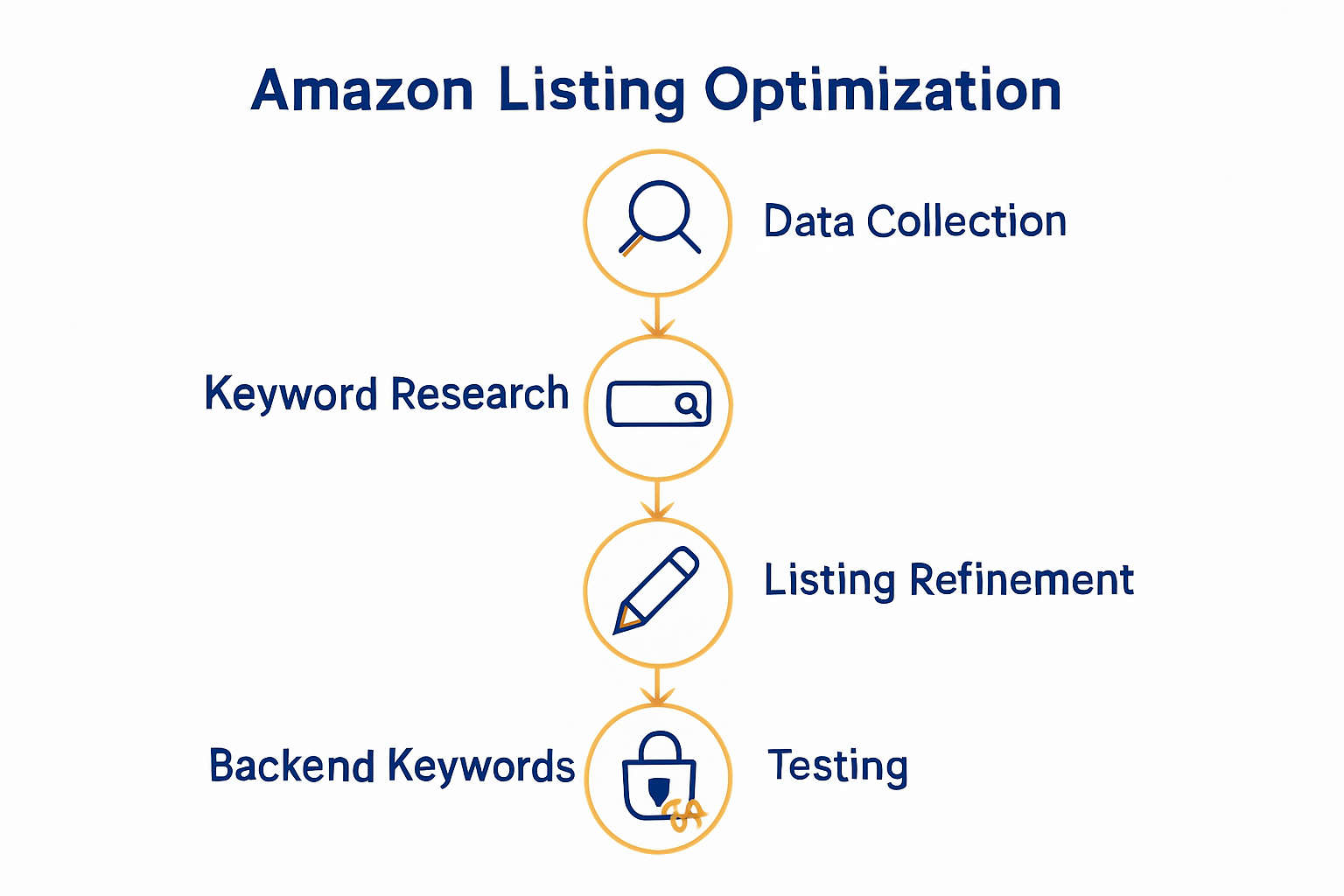
- Step 1: Gather Essential Product And Market Data
- Step 2: Research High-Converting Keywords Strategically
- Step 3: Refine Titles, Bullet Points, And Descriptions
- Step 4: Enhance Backend Keywords And Compliance
- Step 5: Validate Optimization With Data-Driven Testing
Quick Summary
| Key Insight | Explanation |
|---|---|
| 1. Conduct thorough market research | Collect data on customer preferences and competition to identify opportunities for your product. |
| 2. Focus on strategic keyword research | Identify high-converting keywords to enhance product visibility and align with customer search behaviors. |
| 3. Optimize titles and descriptions effectively | Use compelling copy that integrates keywords while addressing customer needs to drive conversions. |
| 4. Utilize backend keywords carefully | Include relevant search terms without cluttering your main listing to boost search discovery. |
| 5. Implement data-driven testing regularly | Track performance metrics and conduct A/B testing to refine your listing’s effectiveness over time. |
Step 1: Gather Essential Product and Market Data
Successful Amazon sellers know that robust market research forms the foundation of any winning listing strategy. In this critical first step, you will systematically collect data that reveals customer preferences, competitive landscapes, and potential opportunities for your product.
Start by conducting comprehensive market research methods which include both primary and secondary data collection techniques. This means diving into customer reviews, analyzing competitor listings, examining search volume metrics, and understanding buyer behavior patterns. Use tools like Amazon’s own search suggestions, keyword research platforms, and third party analytics services to uncover insights about search volume, pricing trends, and consumer interests.
When gathering data, prioritize reliable and repeatable collection methods that provide consistent and actionable information. Look for patterns in customer feedback, track seasonal trends, and pay close attention to negative reviews from competing products. These insights will help you understand exactly what improvements or unique selling points could distinguish your listing.
Pro tip: Create a structured spreadsheet to track your research findings. Organize data by categories like pricing, keyword relevance, customer pain points, and competitive advantages. This systematic approach transforms raw information into a strategic roadmap for optimizing your Amazon listing.
With your initial research complete, you are now ready to move into the next phase of listing optimization where you will transform these insights into compelling product positioning.
Step 2: Research High-Converting Keywords Strategically
Keyword research is the critical engine that drives visibility and sales for your Amazon product listing. In this step, you will systematically uncover the most powerful search terms that connect potential buyers directly to your product.
Begin by defining clear research goals that align with your target audience’s search behaviors. This means understanding not just what keywords exist, but how customers actually think and search when looking for products like yours. Utilize Amazon’s autocomplete suggestions, explore competitor listings, and analyze search volume metrics to build a comprehensive keyword strategy that goes beyond basic search terms.
When selecting keywords, focus on balancing broad and targeted keyword approaches that capture different stages of customer intent. Include both high volume generic terms and specific long tail keywords that demonstrate precise buyer interest. Look for keywords with strong commercial intent high search volume and lower competition where you can realistically rank and attract potential customers.
Pro tip: Create a keyword matrix that categorizes terms by relevance, search volume, and competitiveness. This strategic approach allows you to prioritize keywords that offer the best potential for driving traffic and conversions.
With your keyword research complete, you are now prepared to move into the next phase of crafting a compelling and strategically optimized product listing.
Step 3: Refine Titles, Bullet Points, and Descriptions
Your Amazon listing is your digital storefront where strategic copywriting transforms keyword research into compelling customer engagement. In this crucial optimization phase, you will craft a persuasive narrative that captures attention and drives conversions.

Start by strategically integrating high performance keywords into your product title, ensuring each word serves a specific purpose. Your title should balance searchability with readability by including primary keywords while maintaining a natural flow that speaks directly to customer needs. Focus on front loading the most important descriptive terms and benefits that differentiate your product from competitors.
When developing bullet points and descriptions, move beyond simple feature listings. Create concise, benefit driven statements that address specific customer pain points and highlight unique product advantages. Carefully select keywords that demonstrate strong commercial intent and align with customer search behaviors to maximize your listing’s visibility and relevance.
Pro tip: Always read your listing copy out loud. If it sounds awkward or forced, rewrite it until the language feels natural and engaging. Your goal is creating copy that sounds like a conversation with a knowledgeable friend recommending an exceptional product.
With your refined listing now optimized for both search algorithms and human readers, you are prepared to implement the next critical steps in your Amazon selling strategy.
Step 4: Enhance Backend Keywords and Compliance
Backend keywords represent your secret weapon for Amazon search optimization. These hidden search terms work behind the scenes to dramatically improve your product’s discoverability without cluttering your visible listing.
Strategically define research goals when selecting backend keywords by understanding precisely how potential customers might search for products similar to yours. Include alternative spellings, common misspellings, related product uses, and synonyms that capture broader search intent. Remember that Amazon allows approximately 250 characters in the backend keyword field so prioritize relevance and precision over quantity.
When curating backend keywords, focus on selecting terms with strong commercial potential that align with genuine customer search behaviors. Avoid repeating words already present in your title or bullet points and steer clear of competitor brand names or irrelevant terms that could trigger algorithm penalties. Think like a customer searching for a solution and anticipate the language they would naturally use.
Pro tip: Regularly audit and refresh your backend keywords based on performance analytics. Search trends evolve quickly and what works today might become less effective tomorrow.
With your backend keywords optimized and compliant, you have now completed a critical step in maximizing your Amazon listing’s search potential.
Step 5: Validate Optimization with Data-Driven Testing
Data driven testing transforms your Amazon listing optimization from guesswork into a strategic science. In this critical phase, you will systematically measure and validate the performance of your carefully crafted listing elements to ensure maximum visibility and conversion potential.
Define clear research goals by establishing specific performance metrics that will help you objectively evaluate your listing’s effectiveness. Track key indicators like click through rate, conversion rate, search ranking, and total impressions. Implement A B testing methodologies that allow you to compare different variations of titles, images, bullet points, and backend keywords to understand exactly what resonates with your target audience.
When conducting your analysis, select performance indicators with strong commercial insights that directly connect to your business objectives. Amazon provides robust analytics tools that reveal granular details about customer interactions with your listing. Pay special attention to search term reports, which show you the exact keywords customers use to find your product and help you continuously refine your optimization strategy.
Pro tip: Create a tracking spreadsheet that logs your listing variations, performance metrics, and optimization attempts. This documentation will become an invaluable resource for understanding long term trends and making data informed decisions.
With a comprehensive testing approach in place, you have now developed a repeatable system for continuously improving your Amazon product listings.
Take Your Amazon Listings to the Next Level Today
Optimizing your Amazon product listings can feel overwhelming with so many factors like keyword research, backend optimization, and data-driven testing to manage. This article highlights the critical challenges sellers face when trying to boost visibility and conversions while staying relevant to fast-changing search behaviors. If you want to stop struggling with guesswork and start implementing a proven, strategic workflow you can depend on, there is a clearer path forward.
Harness expert guidance for enhanced titles, bullet points, descriptions, and backend keywords to ensure your listing stands out. Discover smart, data-backed strategies tailored for Amazon SEO and analytics that keep your business competitive no matter how the marketplace evolves. Visit our E-commerce Tips & Strategies to Grow Your Online Business for practical advice and let us help you simplify complex listing challenges.

Unlock your product’s full potential right now by partnering with trusted professionals at https://searchoneers.com. Take control of your Amazon success and see measurable improvements starting today.
Frequently Asked Questions
What is the first step in the listing optimization workflow for Amazon sellers?
The first step is to gather essential product and market data. Focus on collecting customer preferences, competitor insights, and search volume metrics to understand the landscape. Organize your findings in a structured spreadsheet for easy reference.
How can I conduct effective keyword research for my Amazon listing?
Effective keyword research involves identifying both broad and targeted keywords that potential buyers use. Start by analyzing competitor listings and using autocomplete suggestions to build a comprehensive keyword strategy; aim to identify terms with strong commercial intent within 30-60 days.
What should I include in my product title to optimize it for Amazon?
Your product title should include high-performance keywords while maintaining readability. Ensure that primary keywords are front-loaded and that the title effectively communicates the key benefits of your product to attract customer attention.
How do I utilize backend keywords in my Amazon listing?
Backend keywords are essential for improving your product’s discoverability. Identify relevant terms, synonyms, and common misspellings that potential customers may use, ensuring they are distinct from those already in your title or bullet points for effective optimization.
What metrics should I track to validate my listing optimization efforts?
Track key performance indicators such as click-through rate, conversion rate, and total impressions to evaluate your listing’s effectiveness. Use this data to refine your strategies, aiming for noticeable improvements within the first few months.
How can I systematically test my Amazon listing for better performance?
Implement A/B testing by creating variations of your titles, images, and descriptions to see which performs better. Collect and analyze performance data over 30-60 days to make informed adjustments and improve your overall conversion rates.