

Nearly 70 percent of product searches on Amazon start with a keyword rather than a brand name, showing how vital the right words are for sellers who want to get noticed. Finding the perfect keywords can be the difference between a forgotten listing and one that flies off the digital shelf. Understanding how Amazon’s system treats keywords, from what buyers see to what’s hidden in the backend, gives you powerful insight into boosting product visibility and sales.
Table of Contents
- Defining Amazon Keywords Roles
- Differences Between Frontend And Backend Keywords
- Types Of Amazon Keywords Explained
- How Amazon Indexes Keywords
- Best Practices For Keyword Optimization
- Risks And Policy Restrictions
- Advanced Keyword Strategy Techniques
Key Takeaways
| Point | Details |
|---|---|
| Keyword Optimization is Strategic | Effective keyword use involves understanding Amazon’s algorithm, focusing on customer intent rather than just adding terms. |
| Frontend vs. Backend Keywords | Frontend keywords attract customers directly, whereas backend keywords enhance discoverability without cluttering visible content. |
| Ongoing Refinement is Essential | Successful keyword strategies require continuous analysis, adaptation, and replacement of underperforming terms. |
| Caution Against Manipulation | Avoid practices like keyword stuffing and using irrelevant terms to maintain compliance and product visibility. |
Defining Amazon Keywords Roles
Amazon keywords are strategic linguistic triggers that help potential buyers discover your products within the platform’s complex search ecosystem. Keyword optimization is not just about cramming search terms, but understanding how Amazon’s algorithm matches customer search intent with relevant product listings.
According to Amazon Seller Central forums, Amazon‑specific keywords function differently from traditional search engine optimization. These keywords play multiple critical roles in product visibility:
- Discovery: Help customers find your product through precise search matching
- Relevance: Signal to Amazon’s algorithm the specific attributes and use cases of your product
- Ranking: Improve your product’s placement in search result pages
- Categorization: Assist in properly categorizing your product for more accurate recommendations
As AWS Marketplace documentation recommends, successful keyword strategy involves using customers’ actual vocabulary and avoiding unnecessary word duplication. The goal is creating a natural, search-friendly description that speaks directly to potential buyers’ needs and search behaviors.
Differences Between Frontend And Backend Keywords
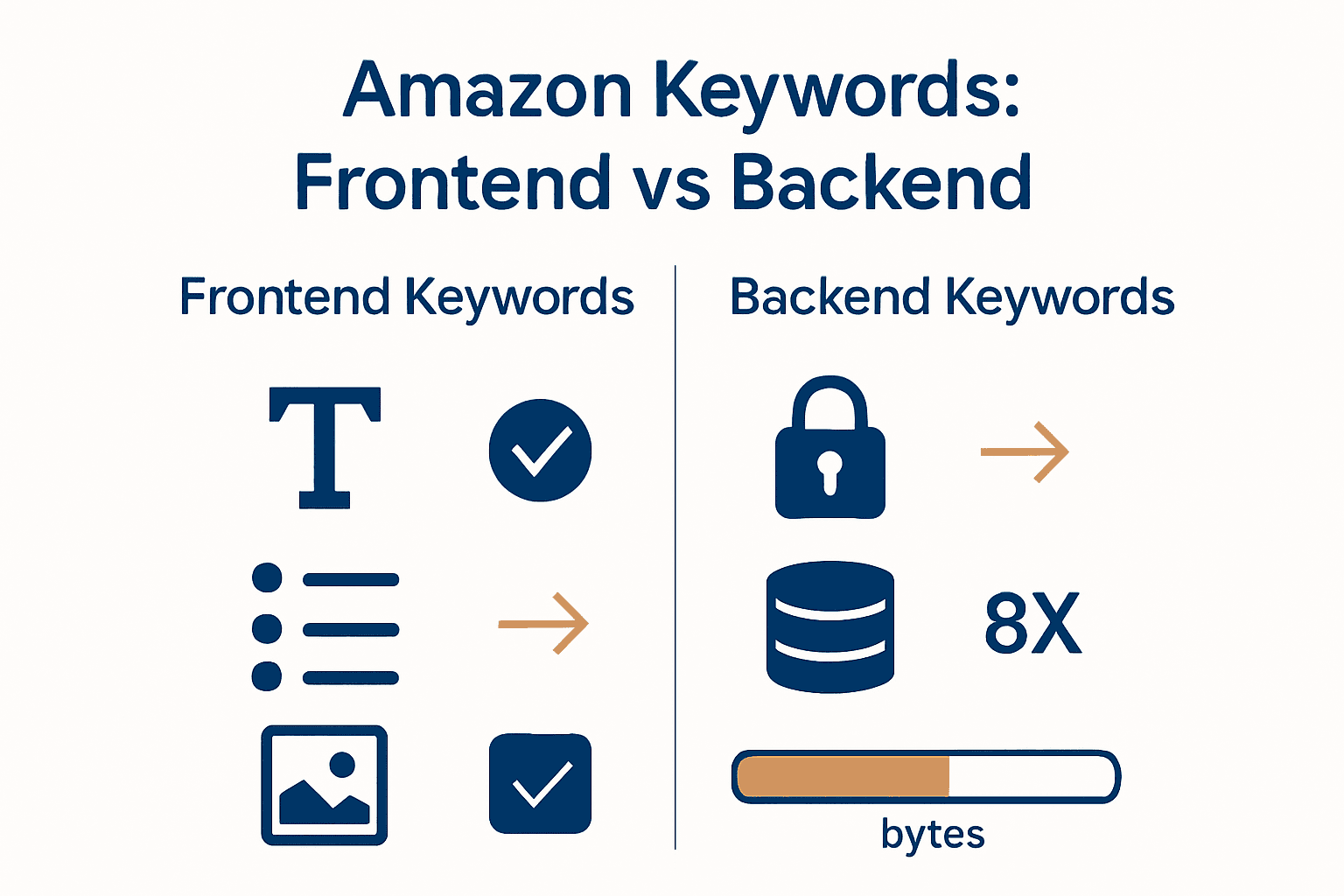
Frontend keywords are the visible search terms that customers directly see in your product title, bullet points, and description, while backend keywords operate behind the scenes to enhance product discoverability. These hidden search terms work silently to expand your product’s visibility without cluttering the customer-facing content.
According to Amazon Seller Central forums, backend keywords have crucial limitations and specific strategic purposes:
- Limited to 250 bytes of total character space
- Invisible to customers
- Complement visible frontend keywords
- Help broaden product search matching without keyword stuffing
As AWS Marketplace documentation indicates, these backend keywords function as additional specific terms that contribute to product discovery beyond visible metadata. They’re essentially your secret weapon for improving search rankings without compromising the readability of your product listings.

The key difference lies in their visibility and purpose: frontend keywords are customer-facing and designed to attract and inform, while backend keywords are algorithm-targeted and meant to maximize search algorithm matching and product discoverability.
Here’s a summary comparing frontend and backend Amazon keywords:
| Feature | Frontend Keywords | Backend Keywords |
|---|---|---|
| Visibility | Customer-facing | Hidden from buyers |
| Placement | Title Bullets Description | Backend search term fields |
| Purpose | Attract & inform customers | Expand search matching |
| Character Limit | Based on listing field limits | 250 bytes total |
| Best Practices | Use natural language | Avoid duplication Be concise |
| Example Terms | “Wireless headphones” | “Bluetooth audio, noise cancel” |
Types Of Amazon Keywords Explained
Amazon offers sellers multiple keyword placement strategies designed to maximize product visibility and search performance.
 These strategic keyword types work together to create a comprehensive approach to product discoverability, each serving a unique role in helping potential buyers find your products.
According to Amazon Seller Central forums, keyword types are strategically distributed across different product listing areas:
- Title Keywords: Highly visible and critically important for initial search ranking
- Description Keywords: Provide context and additional search opportunities
- Backend Search Terms: Hidden keywords that expand search matching without cluttering visible content
As AWS Marketplace documentation suggests, these keyword categories represent different metadata contexts that sellers must carefully optimize. How Amazon SEO Works in 2025 reveals that successful keyword strategy involves understanding how each type contributes to your product’s search visibility, ensuring that you’re not just adding keywords, but strategically positioning them to capture potential buyer searches.
How Amazon Indexes Keywords
Keyword indexing is Amazon’s complex process of organizing and understanding product search terms to match customer queries with the most relevant listings. Unlike traditional search engines, Amazon’s algorithm meticulously analyzes and categorizes keywords across multiple product listing areas to ensure precise search matching.
According to Amazon Seller Central forums, sellers should optimize keyword indexing by following critical guidelines:
- Remove unnecessary punctuation
- Eliminate filler words
- Focus on raw, searchable terms
- Maximize byte efficiency in backend keywords
As Understanding Amazon’s Search Algorithm reveals, the indexing process goes beyond simple word matching. The algorithm evaluates keyword relevance, search volume, and product performance to determine which listings appear in search results. AWS Marketplace documentation further confirms that different product fields are indexed separately, with unique keywords in each section contributing to overall search relevance.
The key takeaway is that successful Amazon keyword indexing requires a strategic approach—understanding how Amazon’s algorithm interprets and prioritizes search terms to connect products with potential buyers.
Best Practices For Keyword Optimization
Keyword optimization on Amazon requires a strategic, nuanced approach that goes beyond simply stuffing search terms into your product listing. Successful sellers understand that effective keyword strategy is about precision, relevance, and understanding how Amazon’s algorithm interprets product information.
According to Amazon Seller Central forums, sellers should focus on several critical optimization principles:
- Prioritize relevance over high-volume generic terms
- Place primary keywords in product titles
- Integrate secondary keywords in descriptions and backend fields
- Respect byte limit constraints for backend keywords
To Optimize for Amazon Search, sellers must think like their potential customers. AWS Marketplace documentation recommends selecting keywords based on actual customer vocabulary and product features, avoiding redundant terms, and maintaining the flexibility to update keywords as market dynamics shift.
The ultimate goal of keyword optimization is creating a comprehensive, customer-focused listing that speaks directly to search intent while satisfying Amazon’s complex indexing requirements.
Risks And Policy Restrictions
Keyword manipulation on Amazon comes with significant risks that can seriously impact a seller’s account standing and product visibility. Understanding these potential pitfalls is crucial for maintaining a compliant and successful selling strategy.
According to Amazon Seller Central forums, sellers must be extremely cautious about several key risks:
- Avoid keyword stuffing at all costs
- Never use irrelevant or subjective search terms
- Steer clear of misleading or exaggerated descriptions
- Prevent intentional attempts to game the search algorithm
AWS Marketplace documentation explicitly warns against using competitors’ product names or duplicating existing title words in keywords. These practices can trigger Amazon’s strict policy enforcement mechanisms, potentially resulting in:
- Listing suppression
- Reduced search rankings
- Account warnings or suspension
- Permanent removal of problematic listings
The core principle is simple: create genuine, customer-focused keyword strategies that prioritize accurate product representation over short-term visibility tricks. How to Optimize Amazon Listings emphasizes that sustainable success comes from authentic, value-driven keyword optimization that genuinely helps customers find exactly what they need.
Advanced Keyword Strategy Techniques
Keyword evolution on Amazon is not a static process but a dynamic, data-driven approach that requires continuous refinement and strategic adaptation. Successful sellers understand that keyword optimization is an ongoing journey of analysis, experimentation, and precision.
According to Amazon Seller Central forums, advanced keyword strategies involve critical monitoring and rotation techniques:
- Regularly track keyword performance metrics
- Identify and replace underperforming search terms
- Analyze competitor keyword strategies
- Adapt keywords based on seasonal trends and market shifts
To develop a truly sophisticated approach, Amazon Keyword Strategy emphasizes the importance of data-driven decision making. AWS Marketplace documentation supports this by highlighting the ability to edit keywords post-listing, enabling sellers to implement iterative optimization strategies.
The most advanced sellers treat keywords like living, breathing assets—constantly monitoring, testing, and refining to maintain maximum visibility and relevance in an ever-changing marketplace.
Unlock the Power of Amazon Keywords to Boost Your Sales
Mastering the role of keywords on Amazon is no small feat. You need to balance precise frontend keywords with hidden backend terms while steering clear of risks like keyword stuffing or irrelevant phrases. This guide highlights the challenge sellers face in creating a smart, customer-focused keyword strategy that drives visibility and ranks well. If you want to take your listings beyond guesswork and guess the impact of keywords with confidence, it is time to move from learning to doing.
Discover actionable insights and proven techniques by exploring E-commerce Tips & Strategies to Grow Your Online Business.
Ready to elevate your Amazon keyword game and achieve lasting results? Visit SearchOneers today for expert Amazon Listing Optimization and SEO strategies tailored to help your products stand out. Don’t wait to transform your listings into powerful tools that connect with buyers and maximize your sales potential.
Frequently Asked Questions
What are Amazon keywords and why are they important?
Amazon keywords are strategic terms that help potential buyers discover products on the platform. They play crucial roles in product visibility, relevance, ranking, and categorization, directly impacting the likelihood of a product being found by customers.
What is the difference between frontend and backend keywords on Amazon?
Frontend keywords are visible to customers in product titles, bullet points, and descriptions, while backend keywords are hidden and work behind the scenes to enhance discoverability. Both serve unique purposes, with frontend keywords attracting attention and backend keywords broadening search matching without cluttering the visible content.
How does Amazon index keywords for product listings?
Amazon indexes keywords by analyzing and categorizing search terms from various product listing areas to match customer queries with relevant products. This process considers keyword relevance, search volume, and product performance to determine search result placements.
What are some best practices for optimizing keywords on Amazon?
Best practices include prioritizing relevance, placing primary keywords in titles, integrating secondary keywords in descriptions and backend fields, and avoiding keyword stuffing. Sellers should aim to create a customer-focused listing that speaks to their needs while complying with Amazon’s indexing requirements.

Comments
4 responses to “Role of Keywords Amazon: Complete Guide for Sellers”
[…] selected phrases that match customer search behaviors and product characteristics. According to Amazon Keywords Role Guide, understanding these keywords is fundamental to successful product […]
[…] Learn more about optimizing backend keywords for Amazon SEO to take your product visibility to the next level. Your final step will involve monitoring and refining your listing to ensure maximum searchability and customer engagement. […]
[…] maximize your product’s visibility, sellers should leverage Amazon Keywords Role Guide which offers comprehensive strategies for selecting and implementing search terms that align with […]
[…] Amazon Keywords Role Guide: Why They Matter […]