TL;DR:
- Amazon Lens uses AI to let shoppers find products through photos, screenshots, or live camera feeds. It changes how products are discovered by emphasizing high-quality, clearly lit images that AI can recognize and match accurately. Sellers must optimize images with multiple angles, clean backgrounds, and visual details to succeed in visual search.
Amazon Lens is Amazon’s AI-powered visual search technology that lets shoppers find products using photos, screenshots, or a live camera feed instead of typing keywords. For sellers, this shift is not cosmetic. The amazon lens suite, formally expanded in june 2026 with features like Lens Live and Circle to Search, changes how your listings get discovered, matched, and purchased. If your product images are not built for AI recognition, you are invisible to a growing segment of buyers who never type a single word into the search bar. Searchoneers breaks down exactly what this technology does and how you can use it to your advantage.
How does Amazon Lens work?
Amazon Lens is a suite of AI-powered visual search tools built into the Amazon Shopping app. Its core job is to match what a shopper sees in the real world to a product on Amazon, without requiring any text input. Amazon expanded Lens technology in june 2026 to include three major features: Lens Live, Circle to Search, and a dedicated iPhone lock screen widget.

Lens Live: real-time product matching
Lens Live activates the phone camera and uses AI to identify objects in the frame instantly. Matching products appear in a swipeable carousel at the bottom of the screen, so shoppers can compare prices, save items, or add to cart without ever leaving the camera view. Alexa for Shopping is integrated directly into Lens Live, letting users ask product questions in real time. When the AI cannot identify an item, it generates descriptive captions to guide the shopper toward relevant product categories. That fallback mechanism is a direct signal to sellers: if your image lacks clear visual cues, the AI writes its own description of your product, and that description may not favor your listing.
Circle to Search: precision item isolation
Circle to Search lets a shopper draw a circle around one specific object inside a photo. The bounding box isolates that item and searches for it independently, even when the image contains multiple products or a busy background. This is especially powerful for lifestyle images. A shopper who sees a lamp in a room photo can circle just the lamp and find it on Amazon in seconds.
iPhone lock screen widget
iPhone users can access Amazon Lens directly from the lock screen via a dedicated widget, introduced in june 2026. The widget requires manual setup alongside Search and Orders widgets. The result is that a shopper can point their phone at a product and begin searching before they even unlock their device. That is a new category of impulse discovery, and your listing needs to be ready for it.
Pro Tip: Test your hero image by cropping it to just the product against a plain background. If the item is still immediately recognizable at thumbnail size, it will perform well in Lens Live carousels and Circle to Search results.
Why Amazon Lens changes product discovery
Amazon’s shift toward AI-powered visual search reflects a fundamental change in how customers find products. The technology is designed to make shopping less about guessing keywords and more about intuitive, real-time discovery. That distinction matters enormously for sellers who have built their entire visibility strategy around text-based SEO.
“Visual search is designed to make shopping less about guessing keywords and more about intuitive discovery, blurring the lines between offline exploration and digital purchasing. AI-powered product previews and style recommendations reduce the friction of online shopping in ways that text search simply cannot match.”
The practical implication is significant. A shopper who spots a product in a magazine, on a friend’s shelf, or in a social media video no longer needs to describe it in words. They photograph it and buy it. That behavior lowers shopping friction in a way that text search cannot replicate. For sellers, this means a buyer who would never have found your listing through keyword search can now land directly on your product page.
Lens Live’s swipeable carousel also changes the competitive dynamic. Shoppers see multiple matching products side by side, with prices visible immediately. Visual impact and price clarity now drive the first click, not keyword ranking position. Sellers who invest in high-quality imagery gain a direct conversion advantage in this format. The blend of offline discovery and online purchasing that Lens enables also expands your potential customer base beyond shoppers who already know what to search for. You can now capture buyers who are inspired, not just buyers who are searching.
Understanding how AI is reshaping e-commerce broadly helps sellers contextualize why Amazon Lens is not a niche feature. It is part of a platform-wide move toward image-driven commerce.
How to optimize your listings for Amazon Lens
Optimizing for visual search requires a different mindset than keyword optimization. Your images are now search signals, not just sales assets. The AI reads your photos the same way it reads a real-world object, so every detail in your image either helps or hurts your discoverability.
Here is a practical framework for sellers:
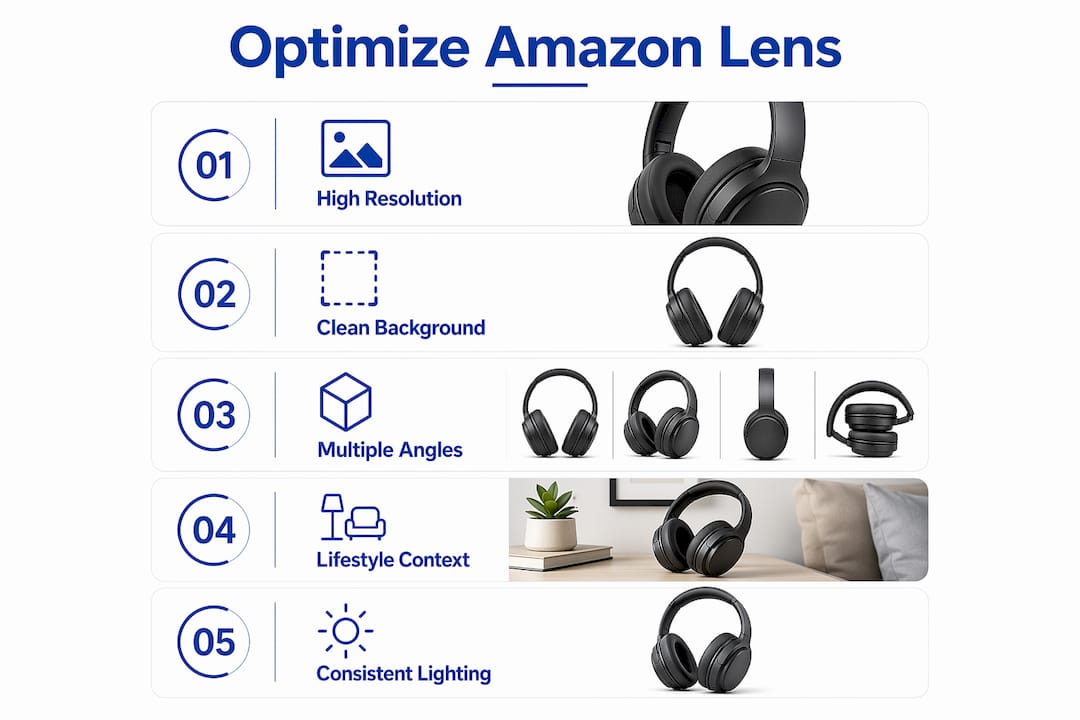
Use high-resolution images with clean backgrounds. The AI needs to distinguish your product from its surroundings. White or neutral backgrounds give the recognition algorithm the clearest possible signal. Photos must remain sharp even when cropped or isolated by a bounding box.
Show the product from multiple angles. Lens Live matches products based on visual shape, color, texture, and proportion. A single front-facing shot limits the AI’s ability to match your product to varied real-world photos that shoppers upload.
Highlight distinctive visual attributes. Color, material finish, hardware details, and proportions are the features the AI uses to classify your product. If your item is matte black aluminum, make that obvious in the image. Do not let shadows or poor lighting obscure it.
Add text instructions to your image-based search strategy. Amazon Lens now allows users to pair uploaded images with text instructions specifying brand, color, material, and dimensions. Your listing title and backend keywords should mirror those exact descriptors so the combined search surfaces your product.
Create isolated product shots for Circle to Search compatibility. Lifestyle images are valuable for conversion, but you also need clean, isolated shots. When a shopper circles your product in a lifestyle photo, the AI crops and searches that specific item. A blurry or cluttered isolated shot will fail that match.
Pro Tip: Add a secondary image that shows your product in a real-world context alongside a lifestyle setting. Shoppers using Circle to Search often upload social media photos or screenshots. If your product appears in those contexts, your isolated shot gives the AI a clean reference to match against.
The comparison below shows how image quality affects AI recognition performance across two listing approaches:
| Image attribute | Low-quality listing | High-quality listing |
|---|---|---|
| Background | Cluttered or colored | White or neutral |
| Resolution | Under 1,000 pixels | 2,000+ pixels on longest side |
| Product angles | Single front shot | 3+ angles including detail shots |
| Visual detail clarity | Shadows obscure features | Lighting reveals texture and color |
| Circle to Search readiness | Product blends into background | Product is immediately isolatable |
For a deeper look at how visual search is reshaping the seller’s toolkit, the seller’s visual guide from Searchoneers covers the full spectrum of image-driven discovery strategies.
Integrating Amazon Lens into your overall Amazon SEO strategy
Visual search does not replace text-based SEO. It adds a second discovery channel that rewards sellers who treat images as indexed content. The strongest listings in 2026 combine both approaches.
Here is how to align your existing SEO work with Lens optimization:
Sync backend keywords with visual descriptors. When a shopper uses Lens with a text instruction, Amazon matches both the image and the text against your listing. Backend keywords that include color names, material types, and style descriptors (such as “brushed nickel,” “linen texture,” or “minimalist silhouette”) directly support visual search matches.
Use product videos as a secondary visual signal. Amazon now supports product videos in listing previews. Videos give the AI additional frames of your product from multiple angles, increasing the surface area for visual recognition.
Monitor search term reports for image-driven traffic patterns. As Lens usage grows, you will see new search terms appear that describe your product visually rather than functionally. Terms like “silver round pendant” instead of “necklace” indicate visual search behavior. Capture those terms in your listing copy.
Align your product categorization with AI tagging. The AI classifies products by visual category before it matches them to listings. Accurate product categorization ensures your listing appears in the right visual search results pool from the start.
Track click-through rate changes after image updates. Visual search surfaces products in a carousel format where the image is the primary decision factor. A CTR increase after an image refresh is a direct signal that your visual content is performing better in Lens results.
The AI-driven search transformation happening across e-commerce platforms makes this integration work non-optional for sellers who want to stay competitive. Searchoneers builds these visual and text signals together into a single listing strategy, so neither channel works in isolation.
Key Takeaways
Amazon Lens rewards sellers who treat product images as search signals, not just sales assets. Listings with high-resolution, clearly lit, multi-angle photos outperform text-only optimized listings in visual search results.
| Point | Details |
|---|---|
| Lens Live requires image clarity | AI matches products visually, so blurry or cluttered photos reduce discoverability in real-time carousels. |
| Circle to Search needs isolated shots | Product photos must remain sharp and identifiable when cropped by a bounding box. |
| Text plus image search is live | Sellers should align backend keywords with visual descriptors like color, material, and style. |
| Lock screen widget drives impulse discovery | iPhone shoppers can search before unlocking, so first-impression image quality is critical. |
| Visual SEO complements text SEO | The strongest listings in 2026 combine keyword optimization with image-driven search signals. |
What I’ve learned watching Amazon Lens reshape seller strategy
The sellers I see winning with visual search are not the ones with the biggest budgets. They are the ones who stopped treating product photography as a one-time expense and started treating it as an ongoing SEO investment.
The most common mistake I observe is sellers uploading a single hero image and calling it done. Lens Live pulls from your full image gallery. Circle to Search isolates whatever the shopper circles, which could be any image in your listing. If your secondary images are low-resolution or inconsistently lit, you are handing matches to competitors whose images are cleaner.
The other shift I find underappreciated is the lock screen widget. Impulse discovery is not new, but the lock screen placement removes the last remaining friction point between “I see it” and “I search for it.” Sellers in visually driven categories, think home décor, fashion accessories, and kitchenware, should treat this as a new top-of-funnel channel and audit their images accordingly.
My practical advice: run a quarterly image audit. Compare your hero image against the top three products that appear when you photograph your own item with Lens Live. If competitors’ images are cleaner, sharper, or better lit, that is your next priority. Small image improvements translate directly into more carousel appearances, and more carousel appearances mean more clicks. This is not theory. It is the most direct connection between seller effort and visual search performance I have seen.
— Goga
Searchoneers and your Amazon visual search performance
Your listings are competing in a search environment where images now carry as much weight as keywords. Searchoneers specializes in Amazon listing enhancement that accounts for both text and visual search signals, from backend keyword alignment to image-driven discoverability strategies built for Lens Live and Circle to Search.

The Searchoneers team combines Amazon SEO expertise with an understanding of how AI visual recognition affects product ranking and click-through rates. Whether you need a full listing audit or a targeted image and keyword strategy, Searchoneers builds the kind of listings that perform across every discovery channel Amazon offers. Reach out to Searchoneers and put your products in front of buyers who are already looking, with or without words.
FAQ
What is Amazon Lens?
Amazon Lens is Amazon’s AI-powered visual search tool suite that lets shoppers find products using photos, screenshots, or a live camera feed instead of text. It includes features like Lens Live, Circle to Search, and an iPhone lock screen widget.
How does Lens Live work for shoppers?
Lens Live activates the phone camera and displays matching products in a swipeable carousel at the bottom of the screen in real time. Shoppers can compare, save, or add items to cart without leaving the camera view.
How should sellers optimize images for Amazon Lens?
Sellers should use high-resolution images with clean backgrounds, show the product from multiple angles, and highlight distinctive visual attributes like color and material. Photos must remain sharp even when cropped or isolated by Circle to Search’s bounding box.
Does Amazon Lens replace keyword SEO for sellers?
Amazon Lens adds a second discovery channel but does not replace text-based SEO. The strongest listings combine backend keywords that mirror visual descriptors with high-quality images that the AI can recognize and match accurately.
What is Circle to Search on Amazon?
Circle to Search lets shoppers draw a circle around a specific object in a photo to isolate and search for that item independently. Sellers need product photos that stay sharp and identifiable when cropped, making image resolution and background simplicity critical.