TL;DR:
- Keywords are essential signals that help search engines understand the content topics and match them to user queries.
- They now serve as anchors for topic clusters, building authority through semantic variants and related terms.
- Ongoing keyword research is crucial for adapting to changing trends, AI algorithms, and competitor strategies.
Keywords are the foundational signals that tell search engines what your content covers and which user queries it should answer. Understanding why keywords are important for SEO is not optional for digital marketers and small business owners. It is the difference between a page that ranks and a page that sits invisible on page five. Keywords define topic context for both users and search engines, and that role has only grown more precise as algorithms have matured.
Why are keywords important for SEO?
Keywords are defined as the words and phrases that users type into search engines to find information, products, or services. Search engines read those terms and match them to pages that best address the query. Without keywords placed deliberately in your content, a search engine has no reliable signal to connect your page to a relevant search.

The standard industry term for this practice is “keyword targeting,” and it sits at the center of every effective SEO strategy. Keywords act as a map of audience demand, guiding search engines to surface your content when it matches what a user needs. That mapping function has not changed, even as the technology around it has evolved significantly.
Keyword targeting also shapes your content architecture. When you build pages around specific terms, you signal topical depth to search engines. That depth builds authority, and authority drives rankings.
How have keywords evolved with semantic search?
Search engines no longer match keywords literally. Google and other engines now interpret the meaning and intent behind a query, not just the exact string of words. This shift, called semantic search, changed how keyword targeting works in practice.
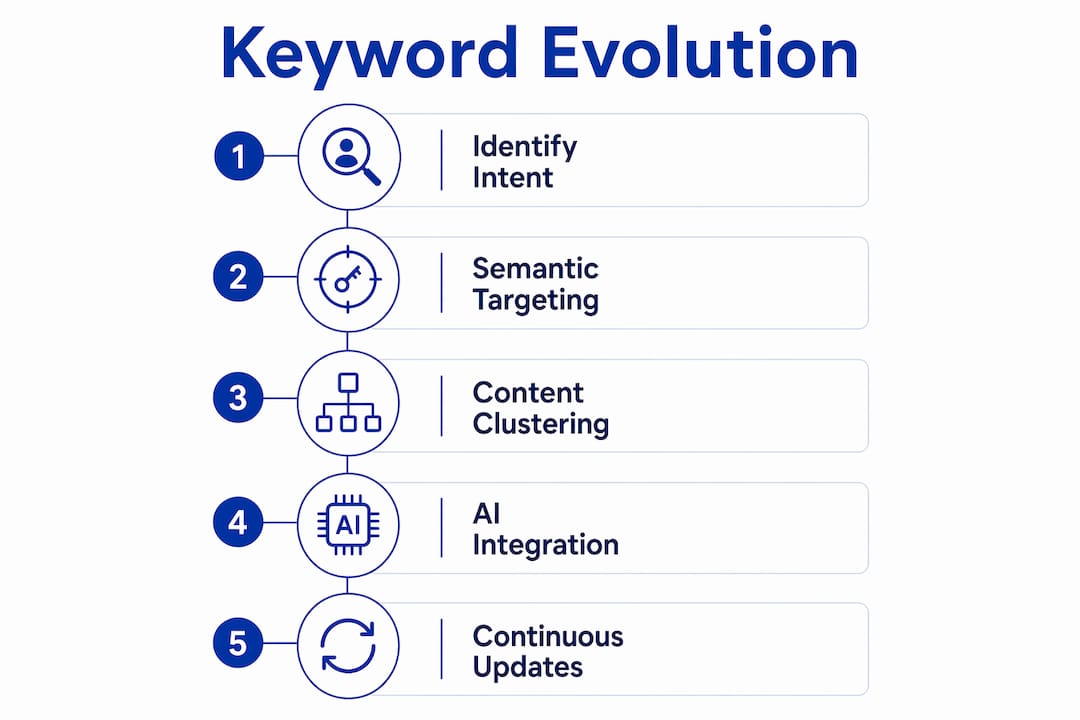
Keywords now function as anchors for topic clusters rather than isolated targets. A single primary keyword connects to a web of related terms, questions, and subtopics. Keywords underpin content cluster architecture that builds topical authority, which Google’s ranking algorithms weigh heavily today.
Here is what this means for your content strategy:
- Primary keywords define the core topic of a page and anchor the cluster.
- Supporting keywords cover related subtopics and signal depth to search engines.
- Semantic variants include synonyms and related phrases that reinforce meaning without repetition.
- Question-based keywords capture conversational queries and often trigger featured snippets.
- Long-tail keywords reflect specific user needs and connect to high-intent searches.
Topical authority has become a key ranking factor. A site that covers a subject thoroughly across multiple pages outranks a site with one keyword-stuffed article. Keywords are the thread that holds that architecture together.
Pro Tip: Before writing any new page, map it to a cluster. Identify the primary keyword, three to five supporting keywords, and at least two question-based terms. This single habit builds topical authority faster than any other tactic.
Why does keyword research still matter in the age of AI?
Keyword research identifies the exact words your audience uses when they search. AI tools and semantic algorithms are impressive, but they cannot replace the insight that comes from seeing real search volume data. You need to know what people actually type, not what you assume they type.
Effective keyword research requires solving for three variables at once:
- Search volume tells you how many people search a term monthly. High volume sounds attractive, but volume without intent is wasted traffic.
- Keyword difficulty relative to domain authority determines whether you can realistically rank. Targeting keywords beyond your backlink equity leads to wasted effort and poor results.
- Search intent confirms whether the content format you plan matches what searchers actually want. A listicle will not rank for a query that Google consistently answers with a product page.
Long-tail keywords deserve special attention. Over 94% of keywords receive 10 or fewer monthly searches. That statistic sounds discouraging until you realize those low-volume terms are where qualified buyers live. A shopper searching “best waterproof hiking boots for wide feet under $150” is far closer to a purchase than someone searching “hiking boots.” Long-tail keywords convert better because they reflect specific user needs with clear intent.
Pro Tip: Use a keyword research checklist to evaluate each term against all three variables before committing to a content piece. Skipping this step is the most common reason new content fails to rank.
Keyword research is also not a one-time task. Continuous keyword monitoring helps you adjust to changing trends, AI-driven search behavior, and competitor activity. Markets shift. Search behavior shifts. Your keyword strategy must shift with them.
Common keyword misconceptions and how to fix them
The biggest misconception in SEO is that keywords are dead. They are not dead. Their role has changed from blunt triggers to precise topic identifiers. Keywords are crucial labels that maintain control over your search visibility by clearly communicating your content topic to both users and search engines.
The second biggest misconception is that keyword density has a magic number. It does not. Keyword stuffing actively hurts rankings and has been penalized for over a decade. Chasing an arbitrary percentage is a distraction from the actual goal: writing content that serves the reader.
“Keywords are not about tricking search engines. They are about speaking the same language as your audience. Place them where they help readers understand your content, and search engines will follow.”
The right approach to keyword placement is strategic and natural:
- Page title and H1 heading: Include the primary keyword once, naturally.
- URL slug: Keep it short and include the core term.
- First 100 words: Use the primary keyword early to establish topic context.
- H2 and H3 subheadings: Use supporting keywords and question-based variants.
- Image alt text: Describe the image accurately and include a relevant keyword where it fits.
- Anchor text for internal links: Use descriptive, keyword-rich phrases rather than “click here.”
- Body content: Use related terms, synonyms, and questions to enrich semantic context throughout.
Building content clusters around a primary keyword multiplies the impact of each individual page. One strong pillar page supported by five to ten related articles signals far more authority than ten disconnected pages each targeting a different term.
How to prioritize keywords for maximum SEO efficiency
Choosing the right keywords is a business decision, not just an SEO decision. The terms you target determine the audience you attract, the content you create, and the conversions you generate.
| Keyword type | Search intent | Best use case | Priority level |
|---|---|---|---|
| Informational | Research and learning | Blog posts, guides, FAQs | Early funnel |
| Navigational | Finding a specific brand or page | Brand pages, product pages | Brand protection |
| Commercial | Comparing options before buying | Review posts, comparison guides | Mid funnel |
| Transactional | Ready to purchase | Product pages, landing pages | High priority |
Mapping keywords to the correct funnel stage ensures your content matches search intent and drives meaningful conversions rather than just attracting traffic. A transactional keyword on an informational blog post creates a mismatch that frustrates users and signals poor relevance to search engines.
For small business owners with limited resources, the priority order is clear. Start with low-difficulty, high-relevance keywords where your domain can realistically compete. Build authority in a narrow topic area before expanding. Keyword difficulty relative to domain authority is the single most important filter when selecting targets early in an SEO program.
For digital marketers managing multiple clients or channels, balance the keyword portfolio across funnel stages. Informational keywords build traffic and brand awareness. Transactional keywords drive revenue. You need both, but the ratio depends on business goals and competitive position.
Proper keyword research serves as a compass for all content decisions. Every article, product page, and landing page should begin with a keyword brief that defines the primary term, the intent, the target audience, and the content format that intent demands. This discipline separates teams that rank consistently from teams that publish and hope.
Key takeaways
Keywords remain the primary signals that connect your content to the right audience at the right moment in their search.
| Point | Details |
|---|---|
| Keywords define topic context | Search engines use keywords to match your content to relevant user queries. |
| Semantic search changed keyword use | Keywords now anchor topic clusters and build topical authority, not just trigger rankings. |
| Long-tail keywords drive conversions | Over 94% of keywords have low search volume, making specific terms the highest-converting targets. |
| Keyword stuffing hurts rankings | Natural placement in titles, headings, URLs, and alt text outperforms density-focused tactics. |
| Keyword research is ongoing | Continuous monitoring keeps your strategy aligned with shifting search behavior and AI impacts. |
What I’ve learned after years of watching keyword strategies succeed and fail
Most SEO clients I’ve worked with fall into one of two traps. The first group obsesses over high-volume keywords they have no realistic chance of ranking for. The second group avoids keyword research entirely, convinced that “just writing good content” is enough. Both groups struggle.
The truth I’ve seen play out repeatedly is this: keyword research is not about finding the most popular terms. It is about finding the terms where your content can win and where winning actually matters to your business. A small business ranking number one for a precise, low-competition term will outperform a large site ranking number eight for a broad, high-volume term every single time in terms of qualified traffic and conversions.
The other thing I’ve learned is that patience is non-negotiable. Keyword-driven SEO compounds over time. The role of keywords in search is not to produce overnight results. It is to build a foundation that gets stronger with every piece of content you add to the cluster. Sellers and marketers who understand this stay consistent. Those who don’t keep chasing shortcuts that never deliver.
My honest advice: commit to a keyword strategy for six months before judging it. Track rankings, traffic, and conversions by keyword cluster. Adjust based on data, not impatience.
— Goga
How Searchoneers can sharpen your keyword strategy
Keyword strategy works the same way whether you are optimizing a website or an Amazon listing. The principles of search intent, topical authority, and strategic placement apply across both channels.

Searchoneers specializes in Amazon listing optimization and data-driven SEO strategies built around exactly these principles. From enhanced titles and bullet points to backend keyword architecture, the Searchoneers team applies proven keyword research workflows to help sellers rank higher and convert more. If you want a clear, structured path to better search visibility, the Amazon SEO optimization guide at Searchoneers is the right place to start. Every recommendation is grounded in real search data, not guesswork.
FAQ
What are SEO keywords?
SEO keywords are the words and phrases that users type into search engines to find content, products, or services. They signal to search engines what a page is about and which queries it should rank for.
Why do keywords still matter in 2026?
Keywords remain the primary way search engines connect content to user queries. Algorithms now interpret intent and meaning, but keywords still define the topic context that makes ranking possible.
What is the difference between short-tail and long-tail keywords?
Short-tail keywords are broad, high-volume terms with heavy competition. Long-tail keywords are specific, lower-volume phrases that attract users with clear intent and convert at higher rates.
How often should I update my keyword research?
Keyword research requires continuous monitoring. Search behavior, competitor activity, and AI-driven search changes shift regularly, so reviewing your keyword strategy at least quarterly keeps your content competitive.
Does keyword density still affect rankings?
Keyword density has no magic number and has not been a direct ranking factor for years. Natural keyword placement in titles, headings, URLs, and body content produces better results than targeting any specific percentage.