

TL;DR:
- Amazon’s fee structure includes referral, subscription, fulfillment, storage, and optional charges, which all impact profit margins. Understanding these layered fees and modeling them accurately before listing a product is essential for sustainable selling.
Amazon’s seller fee structure is a multi-layered system that combines referral fees, subscription fees, fulfillment fees, storage fees, and optional service charges on every sale. Understanding how much Amazon charges for selling is the first step toward building a profitable business on the platform. The Amazon seller fee structure covers everything from a flat monthly plan cost to percentage-based cuts on each transaction. Miss one layer, and your margins disappear fast. This guide breaks down every fee category so you can calculate your true cost before you list a single product.
What are Amazon’s selling plans and their costs?
Amazon offers two selling plans, and your choice directly shapes your fee structure. The Individual vs. Professional plan decision is the first cost decision every new seller faces.
- Individual plan: Costs $0.99 per item sold, with no monthly subscription fee. This plan suits sellers moving fewer than 40 units per month.
- Professional plan: Costs $39.99 per month regardless of how many items you sell. There is no per-item fee on top of the subscription.
The math is straightforward. If you sell more than 40 units a month, the Professional plan costs less per unit than the Individual plan. At exactly 40 sales, both plans cost the same. Below 30 units, the Individual plan is more cost-effective because the fixed $39.99 monthly fee outweighs the per-item savings.
The Professional plan also unlocks features the Individual plan does not offer. These include Buy Box eligibility, access to Amazon Advertising, bulk listing tools, and advanced reporting. For any seller with growth ambitions, those features alone justify the upgrade.
Pro Tip: Amortize the $39.99 monthly fee across your unit sales to get a true per-unit cost. At 100 units sold, the subscription adds only $0.40 per item. At 20 units, it adds $2.00 per item. That math changes your pricing strategy significantly.
How do referral fees work on Amazon?
Referral fees are Amazon’s commission on every sale, and they apply to every seller regardless of plan. Amazon calculates the referral fee as a percentage of the total transaction amount, which includes the item price, buyer-paid shipping, and gift wrap charges. That last detail catches many new sellers off guard.
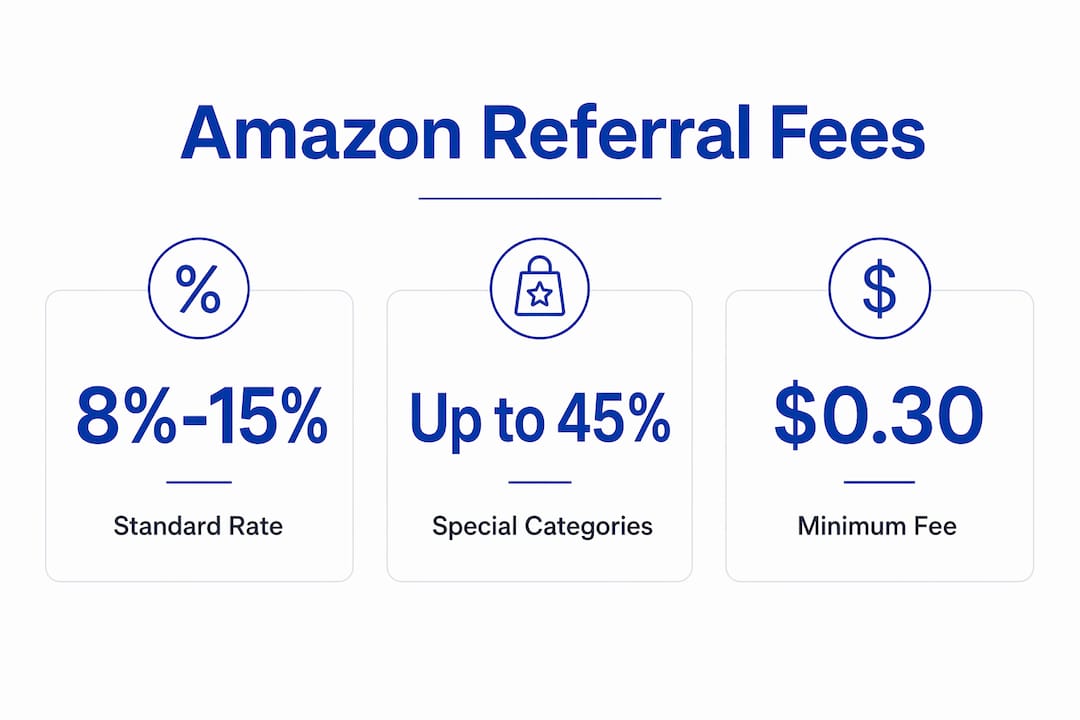
Referral fees range from 8% to 15% in most product categories. Specialized or high-margin categories can reach up to 45%. A $0.30 minimum referral fee applies per unit, meaning low-priced items still carry a floor cost.
Here is how referral fees look across common categories:
| Category | Referral fee rate | Minimum fee |
|---|---|---|
| Electronics | 8% | $0.30 |
| Clothing and accessories | 17% | $0.30 |
| Home and kitchen | 15% | $0.30 |
| Beauty and personal care | 8%–15% | $0.30 |
| Jewelry | Up to 20% | $0.30 |
The referral fee applies to the full transaction, including shipping. If you sell a $25 product with $5 shipping, Amazon calculates the referral fee on $30, not $25. On a 15% rate, that difference costs you an extra $0.75 per sale. Across hundreds of transactions, it adds up.
Pro Tip: When pricing your product, always calculate the referral fee on the full amount a buyer pays, including shipping. Use Amazon’s fee calculator to model exact costs before you set your price.
What additional fees apply when using FBA?
Fulfillment by Amazon, known as FBA, adds a second major layer of fees on top of referral costs. FBA handles picking, packing, shipping, and customer service, but each of those services carries a price.

Fulfillment fees
FBA fulfillment fees range from about $3.06 for small standard items to over $35 for large extra-large products. The fee tier depends on the product’s size and weight after packaging. A small, lightweight item like a phone case sits in the lowest tier. A large, heavy item like a piece of furniture lands in the highest tier.
Storage fees
Amazon charges monthly storage fees based on the cubic footage your inventory occupies in their warehouses. Standard-size items cost $0.78 per cubic foot from january through september, rising to $2.40 per cubic foot in october through december. That Q4 spike is not a minor adjustment. Storage fees can triple in Q4 compared to the rest of the year, which hits sellers who stock up for the holiday season hardest.
Additional FBA charges to know
- Long-term storage fees: Apply to inventory stored for more than 365 days. These fees accelerate quickly and punish slow-moving products.
- Inbound placement fees: Range from $0.21 to $0.58 per unit and cover the cost of Amazon distributing your inventory across its fulfillment network.
- Fuel surcharge: A 3.5% surcharge on fulfillment fees, introduced in 2026, applies to all FBA orders. It is small per unit but compounds across volume.
- Low-inventory fees: Apply when your stock falls below Amazon’s recommended levels, reducing your fulfillment efficiency score.
Pro Tip: Send inventory to Amazon in quantities that match your realistic 60-to-90-day sell-through rate. Overstocking in Q4 means paying $2.40 per cubic foot on unsold units. Understocking triggers low-inventory fees. Tight inventory management is where FBA sellers protect their margins.
How do optional and variable fees affect your total costs?
Beyond the core fees, Amazon offers a range of optional services that carry their own charges. These fees are easy to overlook during initial planning, but they can meaningfully reduce net profit, especially in high-return categories.
- Returns processing fees: For certain categories like apparel and shoes, Amazon charges a returns processing fee equal to the original fulfillment fee. High return rates in these categories can wipe out profit on a significant portion of sales.
- Refund administration fees: When a buyer returns an item and Amazon refunds the order, Amazon keeps 20% of the original referral fee, up to $5 per item. This fee applies even after you have already paid the referral fee on the original sale.
- Labeling fees: If your products do not arrive with compliant barcodes, Amazon charges a labeling fee. Prep and labeling fees typically range from $0.50 to $2.20 per unit, depending on the service required.
- Removal and disposal fees: If you want unsold inventory back or removed from a warehouse, Amazon charges per-unit removal fees. These fees vary by item size.
- Advertising costs: Amazon Advertising, including Sponsored Products and Sponsored Brands, is technically optional but practically necessary for most sellers. Ad spend commonly adds 10%–20% on top of base fees, depending on category competition and your target Advertising Cost of Sales (ACoS).
The impact of optional fees is most visible in categories with high return rates, like electronics or fashion. A seller in the apparel category can face referral fees, fulfillment fees, and returns processing fees on the same unit, all before accounting for advertising. Modeling these costs before sourcing a product is not optional. It is the difference between a profitable SKU and a money-losing one.
How much do total Amazon fees add up to?
The total fee burden for a typical FBA product, including referral, fulfillment, storage, and subscription fees, runs between 25% and 38% of the sale price before advertising. Add advertising spend, and total Amazon-adjacent costs can reach 35%–50% of revenue. That means for every $100 in sales, you may keep as little as $50 after fees, before your own product cost.
Sellers who protect their margins follow a clear process:
- Model fees before sourcing. Build a full fee stack for every product before you commit to inventory. Use a fee calculation tool to estimate referral, fulfillment, storage, subscription, and advertising costs together.
- Choose the right fulfillment method. FBA adds convenience but layers on fulfillment and storage fees. Fulfilled by Merchant (FBM) avoids those fees but requires you to handle logistics. For heavy or bulky items, FBM often produces better margins.
- Manage inventory tightly. Maintaining appropriate inventory levels avoids long-term storage fees and low-inventory penalties. Aim for a 60-to-90-day supply based on your actual sales velocity.
- Reduce return rates. Accurate listings, clear product images, and detailed descriptions reduce buyer confusion and return rates. Fewer returns mean fewer returns processing fees and refund administration deductions.
- Audit fees regularly. Amazon updates its fee schedule, often in january or february each year. A fee that was $3.06 last year may be higher today. Build a quarterly fee audit into your business routine.
Pro Tip: Run your fee model on your worst-case scenario, not your best. If the product is still profitable when storage fees triple in Q4 and your return rate hits 15%, you have a product worth sourcing.
Key Takeaways
The total cost of selling on Amazon typically runs between 25% and 50% of revenue, depending on fulfillment method, category, and advertising spend.
| Point | Details |
|---|---|
| Selling plan choice | Sellers moving more than 40 units monthly save money with the $39.99 Professional plan. |
| Referral fee range | Referral fees run 8%–15% in most categories, calculated on the full transaction amount including shipping. |
| FBA fee layers | FBA adds fulfillment, storage, inbound placement, and fuel surcharge fees on top of referral costs. |
| Q4 storage spike | Standard-size storage fees triple in Q4, from $0.78 to $2.40 per cubic foot. |
| Total fee burden | Total fees including advertising can consume 35%–50% of revenue before product costs. |
What I’ve learned about Amazon fees the hard way
I have seen sellers build solid product ideas and then watch their margins collapse because they modeled fees on the item price alone. The referral fee on shipping charges is the most common blind spot. A seller charging $6.99 for shipping on a 15% referral fee category is giving Amazon an extra $1.05 per sale they never planned for.
The second trap is the Q4 storage fee. New sellers stock up in september to capture holiday demand, then get hit with $2.40 per cubic foot on everything that does not sell by december. The math on a slow-moving product in Q4 can turn a break-even SKU into an active loss.
My honest advice: treat the FBA fee structure as a living document, not a one-time calculation. Amazon adjusts fees annually, and the 2026 fuel surcharge is a perfect example of a new cost that did not exist in prior years. Sellers who audit their fee stack every quarter catch these changes before they erode profitability.
The sellers who thrive long-term are not the ones with the lowest fees. They are the ones who understand every fee, price accordingly, and use Amazon SEO to drive enough volume that fixed costs like the Professional plan subscription become negligible per unit.
— Goga
How Searchoneers helps you sell smarter on Amazon
Understanding fees is only half the equation. The other half is making sure your listings convert well enough to make those fees worth paying.

Searchoneers specializes in Amazon listing optimization and SEO strategies that put your products in front of buyers who are ready to purchase. From enhanced titles and bullet points to backend keyword strategies, every element of your listing affects your conversion rate and your effective cost per sale. A listing that converts at 20% instead of 10% cuts your advertising cost per unit in half. Start with the Amazon listing enhancement guide to see exactly where your listings can improve. You can also follow the listing optimization workflow to build a repeatable process that keeps your listings competitive as the marketplace evolves.
FAQ
What is the minimum fee Amazon charges per sale?
Amazon charges a minimum referral fee of $0.30 per unit sold, regardless of the item’s sale price or category.
Does the Professional plan make sense for new sellers?
The Professional plan at $39.99 per month becomes cost-effective once you sell more than 40 units monthly. Below 30 units, the Individual plan’s $0.99 per-item fee is typically cheaper.
How do I calculate Amazon fees before listing a product?
Add your referral fee percentage applied to the full transaction amount, your FBA fulfillment fee based on size and weight, estimated monthly storage fees, and your amortized subscription cost per unit. Use a dedicated fee calculator tool to model all layers together.
Why do storage fees spike in Q4?
Amazon raises storage fees for october through december to manage warehouse capacity during peak demand. Standard-size items go from $0.78 to $2.40 per cubic foot, which can triple your monthly storage cost on unsold inventory.
What happens to the referral fee when a buyer returns an item?
Amazon refunds the referral fee to the seller but retains a refund administration fee equal to 20% of the original referral fee, capped at $5 per item. High return rate categories like apparel and electronics feel this deduction most acutely.

Comments
One response to “How Much Amazon Charges for Selling: 2026 Guide”
[…] How Much Amazon Charges for Selling: 2026 Guide – Searchoneers […]