

TL;DR:
- FBA simplifies logistics but involves fees that can significantly impact profit margins.
- Managing inventory effectively and optimizing listings are crucial for FBA success in 2026.
- Sellers should consider hybrid fulfillment models to balance costs, control, and Prime eligibility.
Many Amazon sellers assume that listing a product and letting FBA do the rest is all it takes to build a profitable business. That assumption costs them dearly. FBA is a powerful fulfillment engine, but it comes with a fee structure that can quietly erode margins, inventory requirements that penalize the unprepared, and listing optimization demands that determine whether any of it works at all. This guide breaks down exactly how FBA operates, what it costs in 2026, how to manage inventory like a pro, and when alternatives like SFP or FBM might serve you better.
Table of Contents
- What is Amazon FBA and how does it work?
- Breaking down Amazon FBA fees and costs
- Smart inventory management for Amazon FBA success
- FBA vs SFP vs FBM: Which is right for your business?
- Our perspective: Navigating FBA in 2026, what most sellers miss
- Level up your FBA strategy with expert resources
- Frequently asked questions
Key Takeaways
| Point | Details |
|---|---|
| FBA automates fulfillment | Amazon FBA handles your storage, shipping, and returns for a fee, letting you focus on sales. |
| Know your true costs | FBA fees can eat 28% or more of revenue, so detailed planning is essential for profitability. |
| Monitor inventory health | Consistently managing inventory and your IPI score avoids costly limits and optimizes cash flow. |
| Choose the right fulfillment model | Each Amazon fulfillment option has trade-offs in control, costs, and customer experience—pick what fits your strategy. |
What is Amazon FBA and how does it work?
FBA stands for Fulfillment by Amazon. The premise is simple: you send your products to Amazon’s warehouses, and Amazon does the heavy lifting from there. When a customer places an order, Amazon picks, packs, and ships orders for sellers, and handles returns too. That means your customer service burden drops significantly, and your products automatically qualify for Prime two-day delivery.
Here is the basic FBA workflow every seller should know:
- You create product listings on Seller Central and prep your inventory.
- You ship inventory to designated Amazon fulfillment centers.
- Amazon stores your products in their warehouse network.
- A customer orders your product. Amazon picks, packs, and ships it.
- Amazon handles post-sale support, including returns and refunds.
The FBA process explained in full reveals just how much operational weight Amazon absorbs, which is part of its appeal for scaling sellers.
Key FBA benefits and challenges:
- Prime badge eligibility instantly boosts your product’s visibility and buyer trust
- Hands-off logistics free up time for sourcing, marketing, and strategy
- Multi-channel fulfillment lets you use Amazon’s network for orders placed elsewhere
- Returns are automated, reducing seller time spent on disputes
- Storage fees accumulate if inventory moves slowly or sits past 365 days
- Limited control over packaging and branding touches
- Fee complexity makes margin calculation essential before launching SKUs
The Prime badge is not just a nice-to-have. It signals trustworthiness to buyers who filter search results by Prime availability, which directly impacts how often your listing converts. To get the most from that Prime traffic, your Amazon FBA listing optimization work needs to be airtight.
Pro Tip: Listings paired with FBA and strong keyword-rich titles convert 2 to 3 times better than unoptimized listings. The Prime badge drives traffic but your listing copy closes the sale.
Breaking down Amazon FBA fees and costs
With a grasp of FBA’s basics, understanding the financial side is crucial. FBA fees include fulfillment, referral, storage, inbound placement, returns, aged inventory, and more, making margin math a real exercise in detail.
Here is a realistic breakdown for a standard-size product priced at $30:
| Fee Type | Estimated Cost |
|---|---|
| Referral fee (15%) | $4.50 |
| Fulfillment fee | $3.22 |
| Monthly storage fee | $0.48 |
| Inbound placement fee | $0.34 |
| Total FBA fees | ~$8.54 |
| % of sale price | ~28% |
That 28% figure is not an outlier. For typical standard-size retail products, all-in FBA fees regularly land around that mark. This is before your cost of goods, advertising, or platform promotions.
In 2026, Amazon introduced an updated fuel and inflation surcharge component within its rate cards. While incremental, these add up across high-volume SKUs and catch sellers off guard if they are working from last year’s numbers. Revisiting your fee projections quarterly is now a baseline practice, not optional.
Pro Tip: Products priced under $15 or with thin margins are very difficult to run profitably through FBA. The fixed fulfillment fee eats a disproportionate share of revenue at lower price points.
For sellers who want to reduce fee exposure, strategies around product bundling, size-tier targeting, and storage rotation are covered in the optimizing FBA fees guide. If you are trying to improve overall cost structure, the full breakdown in minimizing FBA costs gives a solid starting framework.
Understanding each fee type, referral, fulfillment, storage, inbound placement, returns processing, and aged inventory surcharges, lets you make intelligent SKU-level decisions rather than hoping the numbers work out.
Smart inventory management for Amazon FBA success
Once you know your numbers, effective inventory control becomes the next lever for profit and Prime eligibility. Your IPI score, the Inventory Performance Index, is Amazon’s scorecard for how efficiently you manage stock. Maintaining IPI above 550 keeps you competitive and helps you avoid inventory limits Amazon can impose on underperforming accounts.
Amazon requires a minimum IPI score of 400 before imposing storage restrictions. Falling below this threshold can limit how much inventory you can send in, throttling your ability to stay in stock and keep Prime eligibility active.
Here is a practical sequence for maintaining healthy inventory in FBA:
- Audit aged and stranded inventory monthly. Products sitting over 180 days trigger higher storage fees. Fix stranded listings immediately.
- Use a reorder point formula. Calculate: average daily sales multiplied by lead time, plus safety stock. Set reorder alerts in Seller Central.
- Segment your catalog by velocity. Fast movers need buffer stock. Slow movers need sell-through promotions before sending more.
- Run removal orders for dead inventory. Paying removal fees is almost always cheaper than long-term storage charges.
- Sync forecasting with sales calendar. Q4 volumes require early inventory planning, often 8 to 10 weeks ahead.
Pro Tip: Reviewing your inventory performance metrics weekly instead of monthly gives you enough lead time to respond before Amazon flags your account or storage costs compound.
These habits connect directly to your key seller strategies for sustaining long-term FBA performance without costly surprises. The IPI management best practices resource is worth bookmarking as a periodic reference.

FBA vs SFP vs FBM: Which is right for your business?
Now that you can manage FBA, how do its alternatives stack up, and should you diversify? The three main fulfillment models each have real trade-offs.
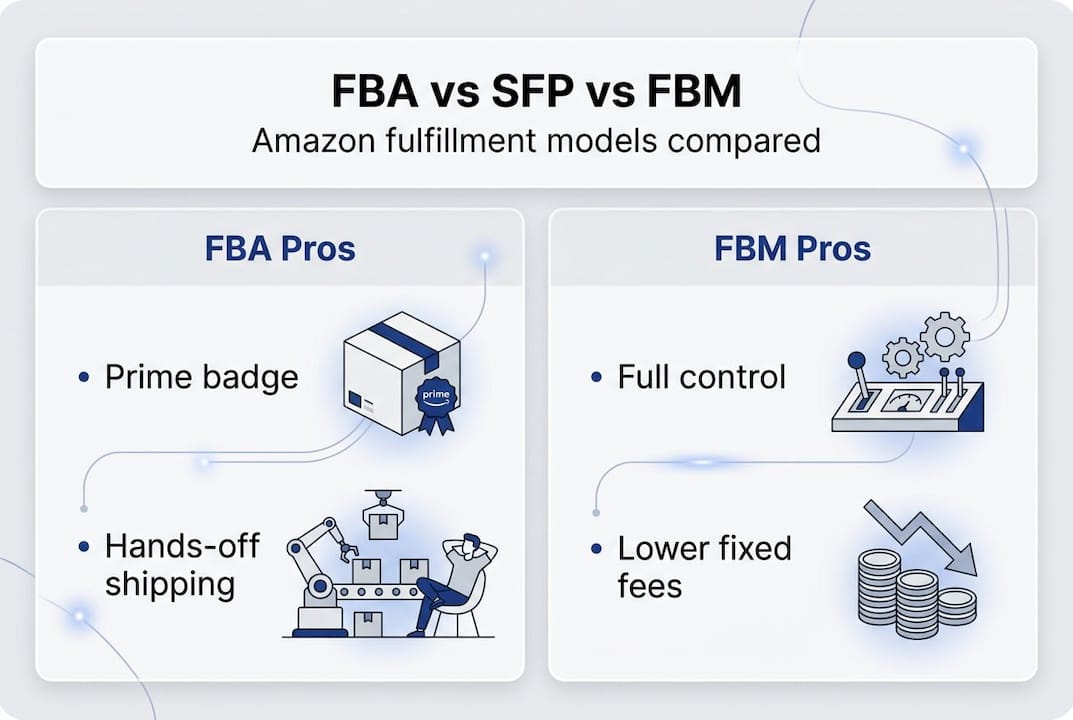
| Feature | FBA | SFP | FBM |
|---|---|---|---|
| Prime eligible | Yes | Yes | No (unless SFP) |
| Fulfillment control | Amazon | Seller | Seller |
| Fees | Higher | Moderate | Lower |
| Requirements | Inventory at Amazon | 99% SLA + volume min | None |
| Branding flexibility | Low | Medium | High |
| Best for | Scale, automation | Established ops teams | Niche, custom products |
FBA vs alternatives comes down to a core question: do you want Amazon’s infrastructure or do you want control? FBA gives you scale with less operational overhead. SFP (Seller Fulfilled Prime) lets you keep Prime status while shipping from your own warehouse, but only if you meet Amazon’s strict 99% on-time shipping SLA and minimum order volume thresholds.
Typical use cases for each model:
- FBA works best for high-volume, standard-size products where automation and Prime badge ROI outweigh fees
- SFP suits sellers with existing 3PL relationships or warehouse operations who want Prime without surrendering storage control
- FBM is ideal for oversized products, custom items, or low-volume sellers where FBA fees destroy margins
- Hybrid models use FBA for top SKUs and FBM as backup during stockouts or fee spikes
For sellers exploring less conventional options, the Vendor Flex alternative outlines another fulfillment path worth considering. The right answer is rarely one model exclusively. Strategic sellers treat fulfillment as a lever, not a locked-in commitment.
Our perspective: Navigating FBA in 2026, what most sellers miss
Here is what the standard FBA guides leave out: FBA is not a passive income machine. It is an operational system that rewards sellers who treat every input, listings, pricing, inventory depth, as a strategic decision. We have seen too many sellers use FBA as a crutch, assuming that Prime eligibility alone will drive sales. It does not.
The data is sobering. Only about 58% of new FBA sellers turn a profit in year one. The gap between those who do and those who do not almost always traces back to listing quality and fee awareness, not product selection alone. Prime lifts conversion rates meaningfully, but only when the listing itself earns the click and communicates value clearly.
The real opportunity in 2026 is the hybrid model. Using FBA for your top-performing, high-margin SKUs and FBM or SFP for everything else creates a leaner cost structure without sacrificing Prime visibility where it counts. Sellers who apply FBA selectively, rather than defaulting to it for every product, tend to sustain better margins over time.
The approach we recommend starts with optimizing FBA listings before scaling inventory. Automation amplifies whatever inputs you give it. Give it strong listings and clean inventory, and FBA works. Give it weak inputs, and it scales your losses just as efficiently.
Level up your FBA strategy with expert resources
The frameworks in this guide give you a working foundation, but the difference between knowing FBA and mastering it lives in execution. Listing quality, keyword strategy, and inventory discipline are ongoing practices, not one-time fixes.

At Searchoneers, we build the resources sellers need to take action on what they learn. Our Amazon listing enhancement guide walks through every element of a high-converting product page. If inventory and listings feel disconnected, optimizing inventory listings ties both together in a practical workflow. And for sellers ready to sharpen their search visibility, SEO for Amazon products covers the keyword and backend fundamentals that drive sustainable organic rank.
Frequently asked questions
What is the difference between FBA and FBM?
FBA lets Amazon handle storage, shipping, and customer service, while FBM means the seller manages these tasks and typically does not get Prime eligibility unless enrolled in Seller Fulfilled Prime.
How do I calculate Amazon FBA fees for my product?
Add referral, fulfillment, storage, and other applicable FBA fees together. For a typical standard-size product priced at $30, total all-in fees run approximately $8.54, or about 28% of the sale price.
What is a good IPI score for Amazon FBA sellers?
Aim to keep your IPI score above 550 to stay competitive. Scores below 400 trigger Amazon-imposed storage limits that can disrupt your supply chain.
Can I switch between FBA, SFP, and FBM on Amazon?
Yes, sellers can switch between fulfillment methods or run them in parallel. Many experienced sellers use a hybrid approach, choosing the best model for each SKU based on margin, volume, and operational capacity.

Comments
2 responses to “Amazon FBA Explained: Boost Efficiency and Visibility”
[…] the seller level, FBA auto-replenishment is powered by AWD. This service monitors your FBA inventory and, when stock drops below a threshold […]
[…] price to see an estimate of your total FBA costs before you commit inventory. You can explore FBA fee specifics and FBA listing optimization strategies to make your FBA operation leaner and more […]