

Many Amazon vendors struggle to balance inventory control with Prime delivery speed, often sacrificing one for the other. Amazon Vendor Flex promises to solve this dilemma by offering flexible fulfillment options, but navigating the 2026 policy landscape requires strategic precision. This guide explains how Vendor Flex works, how recent changes affect your margins, and practical optimization strategies to maintain profitability while meeting Amazon’s increasingly strict performance standards.
Table of Contents
- What Is Amazon Vendor Flex And How Does It Work?
- Navigating Amazon Vendor Central Policy Changes In 2026
- Optimizing Logistics And Inventory With Amazon Vendor Flex
- Amazon Vendor Flex Vs Seller Flex: Choosing The Best Fit
- Enhance Your Amazon Vendor Flex Success With Expert Tools
- Frequently Asked Questions
Key takeaways
| Point | Details |
|---|---|
| Fulfillment flexibility | Amazon Vendor Flex gives vendors choices between FBA and Direct Fulfillment for better inventory control. |
| 2026 policy impact | New Vendor Central policies reduced net margins by 2–8% through higher fees and stricter compliance metrics. |
| Performance demands | Fill rate targets reached 98–99% and on-time delivery requirements hit 99% measured at line-item level. |
| Forecast challenges | Amazon forecasts often deviate 30–80%, making supplementary analytics and safety buffers essential. |
| Optimization focus | Balancing Amazon data with your own forecasting tools prevents costly stockouts and maximizes profitability. |
What is Amazon Vendor Flex and how does it work?
Amazon Vendor Flex represents a strategic fulfillment solution that gives vendors operational choices many don’t realize exist. Unlike the rigid FBA-only approach many assume is mandatory, Vendor Flex offers fulfillment choices including Amazon’s Fulfillment by Amazon network or Direct Fulfillment from your own facilities. This flexibility fundamentally changes how you manage inventory, control costs, and meet customer expectations.
With FBA, Amazon handles the entire fulfillment chain: receiving inventory, storing products, picking orders, packing shipments, and managing customer service. You send bulk inventory to Amazon’s warehouses and they handle everything else. Direct Fulfillment flips this model by letting you maintain inventory control in your own facilities while still leveraging Amazon’s delivery infrastructure to offer Prime-eligible shipping speeds.
The distinction matters enormously for your operations. FBA simplifies logistics but reduces your control over inventory timing and storage costs. Direct Fulfillment preserves control but demands you meet Amazon’s rigorous performance standards for shipping speed and accuracy. Your choice impacts everything from working capital requirements to customer satisfaction scores.
Vendor Flex differs fundamentally from Seller Flex, which targets third-party sellers rather than first-party vendors. While both programs enable warehouse flexibility, they serve different Amazon account types with distinct requirements and benefits. Understanding your Amazon vendor status clarifies which programs you qualify for and how to leverage them strategically.
Key operational considerations when choosing your fulfillment approach:
- Inventory velocity and turnover rates determine whether FBA storage fees outweigh Direct Fulfillment operational costs
- Product dimensions and weight affect FBA fee structures differently than your own shipping expenses
- Seasonal demand fluctuations may favor Direct Fulfillment’s inventory flexibility over FBA’s committed storage
- Customer return rates influence which fulfillment method minimizes your total cost per unit
Your fulfillment decision directly impacts profit margins, compliance responsibilities, and inventory management complexity. The right choice depends on your specific product mix, operational capabilities, and strategic priorities. Many vendors find hybrid approaches work best, using FBA for high-velocity items and Direct Fulfillment for slower-moving or bulky products. Effective Amazon FBA listing optimization becomes critical regardless of your chosen fulfillment path.
Navigating Amazon Vendor Central policy changes in 2026
The 2026 policy landscape transformed vendor economics in ways that caught many suppliers unprepared. Net margins fell 2–8 percentage points for most vendors as Amazon implemented aggressive fee structures and tightened compliance standards. These changes weren’t announced with fanfare but rolled out gradually through updated vendor agreements and performance metric adjustments.
Fill rate requirements jumped to 98–99% consistency, with Amazon imposing retroactive rebate penalties for vendors who fail to maintain these levels across consecutive reporting periods. This represents a significant escalation from previous 95–96% targets that gave vendors more breathing room for supply chain disruptions. Missing these targets now triggers automatic financial penalties that compound monthly until performance improves.
On-time delivery standards reached 99% measured at the individual line-item level rather than order level, meaning a single delayed item in a multi-product order counts as a failure. This granular measurement dramatically increases your risk exposure compared to older order-based metrics. Even vendors with strong overall performance found themselves hit with unexpected penalties from occasional delayed shipments.
Perhaps most financially damaging, shortage recovery fees now charge 10–25% of goods’ cost when out-of-stocks cause lost sales opportunities. Amazon calculates these fees based on estimated demand during stockout periods, often using forecasts that significantly exceed actual historical sales patterns. Vendors report these fees sometimes surpass the profit margin on the products themselves.
Critical 2026 policy changes impacting Vendor Flex operations:
- Co-op marketing allowances increased to 8–12% for most categories, with premium brands facing demands above 15%
- Damage allowances expanded to include broader definitions of unsellable inventory with faster processing timelines
- Chargebacks for non-compliance now apply retroactively to recent shipments when patterns emerge
- Vendor Central now requires monthly business reviews with performance scorecards affecting future purchase order volumes
Key statistic: Vendors experienced margin compression of 2–8 percentage points in 2026, with shortage recovery fees representing the single largest new cost category for many suppliers.
These policy shifts make vendor relationships with Amazon significantly more transactional and performance-driven. The days of relationship-based flexibility have largely disappeared, replaced by automated systems that apply penalties with little human oversight or appeal process. Strategic Amazon vendor consulting helps navigate these complex requirements and negotiate more favorable terms where possible.
Optimizing logistics and inventory with Amazon Vendor Flex
Successful Vendor Flex management starts with rejecting Amazon’s forecasts as your sole planning tool. Vendor Central forecasts deviate 30–80% from actual demand, creating either costly overstock or expensive stockouts depending on which direction the error falls. You need parallel forecasting systems that blend Amazon’s data with your own sales history, market intelligence, and category-specific insights.

Safety stock buffers become non-negotiable when shortage recovery fees punish stockouts so severely. Calculate buffers based on category volatility rather than applying uniform percentages across your catalog. Fast-moving consumer goods might need 2–3 weeks of buffer inventory, while seasonal or promotional items require 4–6 weeks to account for demand spikes and supply chain variability. These buffers protect against both forecast errors and unexpected demand surges.
Monitoring fill rate and on-time delivery metrics requires daily attention rather than weekly reviews. The 98–99% fill rate threshold leaves virtually no margin for error, meaning a few days of delayed shipments can trigger penalties that take weeks to reverse. Set internal alerts at 97% thresholds to catch declining performance before it crosses into penalty territory.
Leveraging Vendor Flex options strategically means matching fulfillment methods to product characteristics and business priorities. High-margin, fast-moving products often justify FBA’s premium fees because the sales velocity and customer satisfaction benefits outweigh costs. Slower-moving or bulky items frequently perform better through Direct Fulfillment where you avoid long-term storage fees and maintain tighter inventory control.
Pro Tip: Create a quarterly fulfillment audit that reviews each product’s performance under its current method. Products that shifted from profitable to marginal under FBA might thrive with Direct Fulfillment, while Direct Fulfillment items missing sales due to shipping speed might benefit from FBA migration. This systematic review prevents complacency and optimizes your fulfillment mix as market conditions evolve.
Practical steps to optimize Vendor Flex operations:
- Build forecasting models that weight your historical data at 60–70% and Amazon’s forecasts at 30–40% to balance perspectives
- Establish category-specific reorder points based on lead times, demand volatility, and penalty risk rather than universal thresholds
- Implement automated alerts when inventory levels approach reorder points or performance metrics decline toward penalty thresholds
- Review top 20% of SKUs by revenue monthly to ensure optimal fulfillment method and adequate inventory buffers
- Document all Amazon communication regarding forecasts, orders, and policy changes to support dispute resolution when needed
Consistent listing optimization directly impacts your Vendor Flex success by maximizing sales velocity and reducing stranded inventory risk. Better listings convert more traffic into sales, which improves your inventory turnover and justifies the operational complexity of maintaining multiple fulfillment channels. Focus on Amazon seller performance metrics growth to identify optimization opportunities that compound over time.
The Amazon customer experience impact of your fulfillment choices extends beyond shipping speed to include product availability and consistency. Vendors who maintain high in-stock rates through strategic buffering and accurate forecasting see measurably higher customer lifetime value and repeat purchase rates. This creates a virtuous cycle where better inventory management drives better customer metrics, which improves your standing with Amazon and increases purchase order volumes.
| Optimization Area | Metric to Track | Target Range | Impact on Profitability |
|---|---|---|---|
| Fill Rate | % orders fulfilled completely | 98–99% | Avoids retroactive rebate penalties |
| On-Time Delivery | % line items shipped on-time | 99%+ | Prevents chargeback fees |
| Inventory Turnover | Days of inventory on hand | 30–45 days | Reduces storage costs and obsolescence |
| Forecast Accuracy | % deviation from actual sales | <20% | Minimizes stockouts and overstock |
| Safety Stock Buffer | Weeks of buffer inventory | 2–6 weeks by category | Protects against shortage recovery fees |
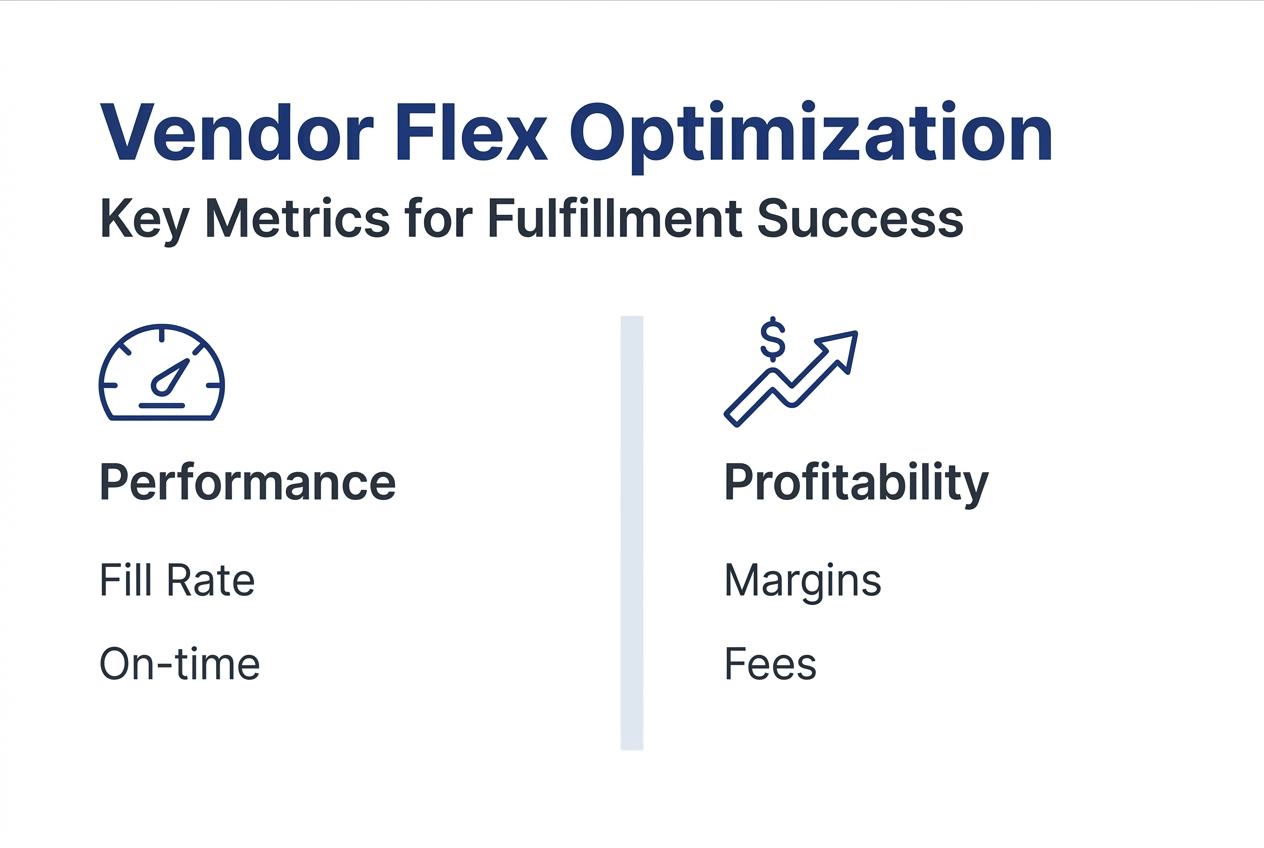
Regularly optimizing your Amazon inventory listings ensures your fulfillment investments translate into maximum sales performance. Well-optimized listings reduce the cost per acquisition for new customers and improve conversion rates on existing traffic, making your entire fulfillment operation more profitable regardless of which Vendor Flex options you choose.
Amazon Vendor Flex vs Seller Flex: choosing the best fit
Understanding the fundamental differences between Vendor Flex and Seller Flex prevents costly misalignment between your account type and fulfillment strategy. Seller Flex is invite-only, targeting high-performing third-party sellers who want to fulfill Prime-eligible orders from their own warehouses while maintaining seller account status. Vendor Flex serves first-party vendors who sell directly to Amazon and need flexibility in how they fulfill Amazon’s purchase orders.
Seller Flex eligibility requires strong seller performance history, high customer satisfaction ratings, and demonstrated ability to meet Amazon’s strict preparation and shipping standards. Amazon evaluates your order defect rate, late shipment rate, and customer feedback scores before extending invitations. Even high-volume sellers may not qualify if their performance metrics fall below Amazon’s thresholds, making Seller Flex a privilege rather than a right.
Vendor Flex operates under different rules because you’re fulfilling purchase orders from Amazon as a customer rather than selling directly to end consumers. This distinction affects everything from payment terms to liability for unsold inventory. Vendors receive payment from Amazon on net terms, typically 60–90 days, while sellers receive customer payments within two weeks. Vendors also face chargebacks and allowances that sellers don’t encounter.
Pro Tip: Your account type determines which program you access, so switching from seller to vendor or vice versa requires careful consideration of how it affects your fulfillment options, payment terms, and overall business model. Many brands maintain both seller and vendor accounts to maximize flexibility, though this creates operational complexity requiring dedicated resources.
| Feature | Seller Flex | Vendor Flex |
|---|---|---|
| Account Type | Third-party seller account | First-party vendor account |
| Eligibility | Invite-only based on performance | Available to qualified vendors |
| Fulfillment Options | Own warehouse with Prime shipping | FBA or Direct Fulfillment |
| Payment Terms | Bi-weekly customer payments | Net 60–90 day vendor payments |
| Inventory Ownership | Seller owns until customer purchase | Amazon owns after purchase order |
| Fee Structure | Seller fees plus Seller Flex costs | Vendor chargebacks and allowances |
| Performance Standards | Seller metrics (ODR, LSR) | Vendor metrics (fill rate, OTD) |
Category restrictions differ significantly between programs. Seller Flex excludes certain hazardous materials, oversized items, and products requiring special handling that don’t align with seller warehouse capabilities. Vendor Flex typically allows broader product ranges because Amazon assumes more responsibility for regulatory compliance and handling requirements as the direct purchaser.
Preparation and listing requirements create additional complexity for Seller Flex participants. You must follow Amazon’s detailed packaging standards, labeling protocols, and inventory management systems to maintain Prime eligibility. Vendor Flex transfers some of these responsibilities to Amazon when using FBA, though Direct Fulfillment maintains similar requirements to ensure consistent customer experience.
The 2026 Vendor Central policy changes discussed earlier apply specifically to vendors using Vendor Flex, creating margin pressures that sellers don’t face through Seller Flex. However, sellers deal with their own challenges including increased competition, advertising costs, and algorithm changes that affect visibility. Neither path offers easy profits; both require strategic management and continuous optimization.
Critical considerations when choosing between programs:
- Cash flow needs favor Seller Flex with faster payments versus Vendor Flex extended terms
- Operational control preferences lean toward Seller Flex for maximum flexibility or Vendor Flex FBA for minimal handling
- Scale requirements often push larger operations toward Vendor Flex for bulk purchase orders and streamlined logistics
- Category characteristics like perishability or fragility may favor one program’s handling capabilities over the other
Understanding your Seller Central complete guide provides essential context for evaluating Seller Flex, while reviewing Amazon vendor status implications clarifies Vendor Flex fit. Most successful Amazon businesses choose their program based on strategic priorities rather than perceived prestige, recognizing both paths offer distinct advantages depending on your operational strengths and market position.
Enhance your Amazon Vendor Flex success with expert tools
Optimizing your Vendor Flex operations requires more than understanding policies and choosing fulfillment methods. You need systematic approaches to listing enhancement, inventory management, and performance optimization that compound over time. Our Amazon listing enhancement guide provides step-by-step frameworks for improving product visibility and conversion rates across your catalog.

Effective inventory optimization demands category-specific strategies tailored to Vendor Flex fulfillment setups. Our guide to optimizing Amazon inventory listings shows you how to align listing quality with inventory decisions to maximize sales velocity while minimizing stockout risk. These techniques help you balance Amazon’s forecasts with your own analytics to maintain optimal stock levels.
Implementing a proven listing optimization workflow designed for Amazon marketplace sellers creates consistency across your catalog and ensures every product receives the optimization attention it deserves. This systematic approach prevents the ad hoc improvements that leave money on the table and creates sustainable competitive advantages through superior listing quality and inventory management.
Frequently asked questions
What is Amazon Vendor Flex?
Amazon Vendor Flex is a fulfillment program giving first-party vendors choice between using Amazon’s FBA network or their own Direct Fulfillment capabilities. This flexibility allows vendors to balance inventory control with fast Prime shipping speeds based on product characteristics and business priorities. Vendor Flex differs from standard FBA by offering Direct Fulfillment options that let vendors maintain inventory in their own facilities while still leveraging Amazon’s delivery infrastructure for Prime-eligible orders.
How do Amazon Vendor Central policy changes in 2026 affect Vendor Flex vendors?
The 2026 policy updates typically reduced vendor net margins by 2–8 percentage points through increased fees and stricter compliance standards. Vendors must now meet 98–99% fill rate targets and 99% on-time delivery measured at line-item level to avoid penalties. Shortage recovery fees charging 10–25% of goods’ cost for stockout-related lost sales create additional financial pressure requiring precise inventory management.
What are the benefits of using Vendor Flex for inventory management?
Vendor Flex provides fulfillment flexibility that improves control over inventory timing, storage costs, and shipping methods. The ability to choose between FBA and Direct Fulfillment lets you optimize each product’s fulfillment based on margin, velocity, and operational considerations. Offering Prime delivery through either method enhances customer satisfaction and sales potential while maintaining the inventory control many vendors need for effective operations.
How can vendors mitigate forecast inaccuracies with Vendor Flex?
Build your own forecasting systems that blend Amazon data with historical sales patterns, market intelligence, and category-specific insights rather than relying solely on Vendor Central forecasts. Apply safety stock buffers of 2–6 weeks tailored to each category’s demand volatility and supply chain variability. Monitor inventory levels daily and negotiate flexible terms with Amazon when possible to adjust purchase orders based on actual demand patterns rather than algorithmic forecasts.
Recommended
- Amazon Seller Tips 2025: Essential Strategies for Success
- Amazon listing fee guide 2026: Optimize costs, boost profits – Searchoneers
- Amazon SEO Workflow 2025: Complete Step-by-Step Guide – Searchoneers
- Selling on Amazon Step-by-Step – Boost Sales in 2026
- Voice Search SEO: The Hidden Secrets Smart Business Owners Use
- ecommerce seo package: Boost Rankings and Drive Sales Fast – Jarrod Harman

Comments
One response to “Amazon Vendor Flex guide 2026: optimize fulfillment”
[…] Vendor Flex: A hybrid model where Amazon operates a fulfillment station inside your own warehouse, primarily for large vendors. […]