

Most Amazon sellers think the $39.99 monthly subscription is their only predictable cost. Yet pro sellers routinely discover a maze of referral fees ranging from 8% to 45%, plus hidden FBA costs that can quietly erode 15% to 25% of expected profits. Mastering these fee structures is no longer optional in 2026. This guide breaks down every fee component, reveals the hidden costs most sellers miss, and shows you exactly how to optimize your fee burden for maximum profitability.
Table of Contents
- Understanding The Components Of Amazon Pro Seller Fees
- How Referral Fees Vary By Category And Impact Profitability
- Hidden Costs And Uncertainties In Amazon FBA Affecting Fees
- Practical Tips To Optimize Your Amazon Pro Seller Fees In 2026
- Optimize Your Amazon Selling Strategy With Searchoneers
- FAQ
Key takeaways
| Point | Details |
|---|---|
| Referral fees vary dramatically | Fees range from 8% to 45% depending on product category, directly impacting your profit margins. |
| Professional plan costs $39.99 monthly | This flat subscription fee applies regardless of your sales volume. |
| Hidden FBA costs can surprise you | Inbound logistics errors, inventory imbalances, and customer experience issues trigger indirect fees. |
| 2026 brings minor fee increases | Small rate adjustments require updated pricing strategies to maintain margins. |
| Optimization reduces total fee burden | Strategic listing improvements and inventory management lower your overall costs. |
Understanding the components of Amazon pro seller fees
Amazon’s fee structure for professional sellers includes three distinct layers that work together to determine your total cost of doing business on the platform.
The most visible cost is the referral fee, which Amazon charges as a commission on every item you sell. These fees fluctuate wildly based on your product category, ranging from as low as 8% for computers to as high as 45% for certain Amazon device accessories. Each sale triggers this percentage-based charge, making it your most significant variable expense.
Your monthly subscription of $39.99 remains constant whether you sell 10 units or 10,000 units. This predictable cost gives you unlimited listing privileges and access to advanced selling tools, advertising options, and bulk operations that individual sellers cannot access.
The third layer involves indirect costs tied to Fulfillment by Amazon operations. These include inbound shipping preparation fees when your cartons arrive inconsistent, inventory storage charges that accumulate monthly, and customer experience costs from returns or complaints. Unlike referral fees, these charges often appear weeks after the triggering event, making them harder to anticipate and budget for in your cash flow planning.
Pro Tip: Review your Seller Central fee reports weekly rather than monthly to catch fee anomalies before they become budget problems.
How referral fees vary by category and impact profitability
Category selection directly determines your fee burden and potential profit margins on Amazon. The referral fee structure creates dramatic cost differences between product types, with most categories carrying a minimum $0.30 per-item charge.
| Category | Referral Fee | Minimum Fee | Impact on $50 Sale |
|---|---|---|---|
| Computers | 8% | $0.30 | $4.00 |
| Home & Kitchen | 15% | $0.30 | $7.50 |
| Toys & Games | 15% | $0.30 | $7.50 |
| Jewelry | 20% | $0.30 | $10.00 |
| Amazon Device Accessories | 45% | $0.30 | $22.50 |
These percentage differences compound quickly at scale. A seller moving 1,000 units monthly at $50 each pays $4,000 in referral fees for computers versus $22,500 for device accessories. That $18,500 monthly difference ($222,000 annually) directly impacts your ability to reinvest in inventory, advertising, or business growth.

Amazon adjusts its fee structure periodically to align with underlying operational costs. The 2026 updates include slight increases across several categories, typically 0.5% to 1.5% higher than 2025 rates. While individually small, these adjustments require you to revisit your pricing strategy to maintain target margins.
Pro Tip: Before expanding into new product categories, calculate your break-even point with category-specific referral fees to avoid margin surprises.
Hidden costs and uncertainties in Amazon FBA affecting fees
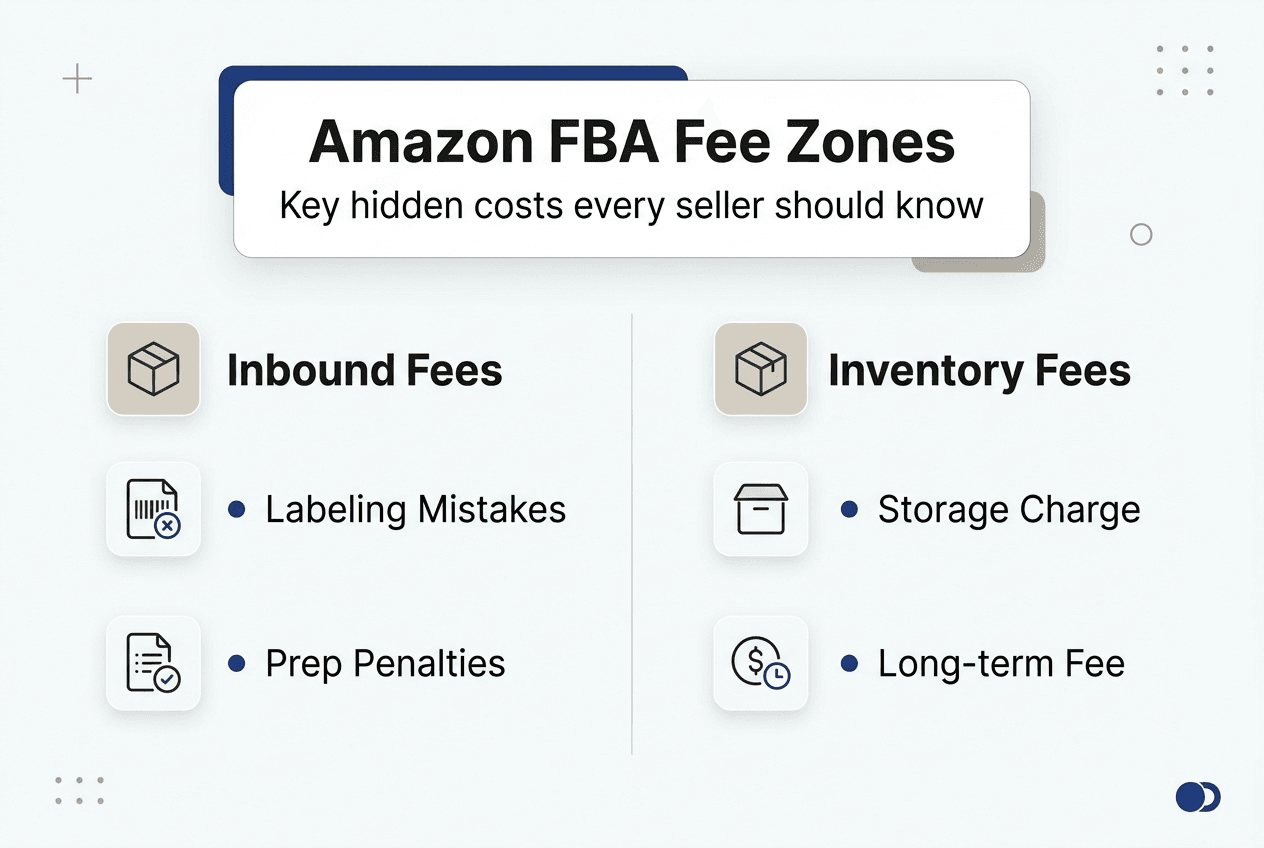
Beyond the transparent fees Amazon publishes, trigger-based charges lurk in three operational uncertainty zones that catch sellers off guard.
Inbound uncertainty creates fees when your shipments fail to meet Amazon’s preparation standards. Mixed SKUs in a single carton trigger manual sorting fees. Missing or incorrect labels generate re-labeling charges. Inconsistent box dimensions cause dimensional weight penalties. These fees only appear on your invoice 2-3 weeks after the shipment arrives, making it difficult to connect the charge to the specific operational mistake.
Inventory uncertainty stems from storage decisions that impact both fees and sales velocity. Overstocking triggers monthly long-term storage fees after products sit for 365 days, plus additional charges during peak seasons like October through December. Understocking avoids storage fees but creates stockout losses that cost you both sales and ranking momentum. The uncertainty lies in predicting demand accurately enough to avoid both extremes.
Experience uncertainty involves customer-driven costs that Amazon passes through to you. High return rates in certain categories trigger disposal or return processing fees. A-to-Z guarantee claims that Amazon decides against you result in refunds plus administrative charges. Negative feedback about shipping or product quality can lead to account health penalties that indirectly increase your costs through lost Buy Box eligibility.
Pro Tip: Set up automated alerts in Seller Central when any fee type exceeds 5% of your weekly sales to catch problematic patterns before they become systemic issues.
Practical tips to optimize your Amazon pro seller fees in 2026
Reducing your total fee burden requires systematic attention to both obvious and hidden cost drivers across your selling operations.
Audit category assignments quarterly to ensure products sit in the lowest appropriate referral fee category. Amazon’s taxonomy allows some flexibility, and a single category shift can save 5% to 10% per sale when your product legitimately fits multiple classifications.
Implement strict inbound preparation standards with your suppliers or prep centers. Create checklists that mirror Amazon’s requirements for labeling, box dimensions, and carton contents. One hour spent preventing errors saves weeks of fee recovery disputes.
Balance inventory using velocity metrics rather than intuition. Calculate your daily sell-through rate for each SKU, then stock 45 to 60 days of inventory to minimize both stockout risk and long-term storage fees. Products that slow below 0.5 units per day need immediate price adjustments or removal.
Optimize listings to increase conversion rates and sales velocity. Higher conversion means you move inventory faster, reducing storage time and associated fees. Focus on listing enhancements that address the specific objections or questions your category buyers typically have.
Monitor 2026 fee updates monthly during Q1 when Amazon typically announces changes. Build 2% to 3% fee increases into your annual budget as a buffer, then adjust prices strategically across your catalog to maintain target net margins.
Use Amazon’s Fee Preview tool before launching new products to model total costs including referral, FBA, and storage fees. This upfront calculation prevents you from committing to products that cannot achieve your minimum acceptable margin after all fees.
Establish inventory optimization workflows that automatically flag slow-moving SKUs for price reductions or removal before they accumulate six months of storage fees. Automated systems catch these issues faster than manual monthly reviews.
Optimize your Amazon selling strategy with Searchoneers
Understanding Amazon’s complex fee structures is only half the battle. You need a partner who can help you implement optimization strategies that actually reduce costs while boosting your visibility and sales performance.
Searchoneers specializes in helping pro sellers like you master the operational and strategic elements that determine profitability on Amazon.

Our listing enhancement services focus on the specific elements that drive conversion and sales velocity, helping you move inventory faster and reduce storage-related fees. We combine data-backed keyword strategies with persuasive copywriting that addresses buyer objections and highlights your competitive advantages.
When you work with our team, you gain access to proven optimization workflows that systematically improve every element of your Amazon presence. From backend keyword optimization to inventory management strategies that minimize fee exposure, we deliver actionable improvements that show up in your bottom line within 30 to 60 days.
FAQ
What is the monthly cost for an Amazon professional seller plan?
The professional selling plan costs $39.99 per month as a flat subscription fee. This amount stays the same whether you sell 10 items or 10,000 items, giving you unlimited listing capacity and access to advanced selling features that individual plan sellers cannot use.
How do Amazon referral fees differ by product category?
Referral fees range from 8% to 45% depending on which product category Amazon assigns to your listing. For example, computers carry an 8% referral fee while Amazon device accessories incur a 45% fee on each sale. Most categories also include a minimum $0.30 per-item fee that applies even on low-priced products.
What are some hidden fees that Amazon pro sellers often overlook?
Hidden costs stem from operational uncertainties in three main areas: inbound logistics problems like incorrect labeling, inventory management issues such as long-term storage fees, and customer experience costs from returns or complaints. These charges are trigger-based and often appear weeks after the event, making them difficult to predict in your monthly budgeting. Managing these uncertainties through better operational discipline is essential for protecting your profit margins.
How much did Amazon increase fees for 2026?
Amazon implemented minor increases averaging 0.5% to 1.5% across various referral fee categories for 2026. While individually small, these adjustments require sellers to update their pricing strategies to maintain target margins. The increases reflect Amazon’s ongoing efforts to align fee structures with actual operational costs.
Can I switch between product categories to reduce referral fees?
You can only place products in categories where they legitimately belong according to Amazon’s taxonomy guidelines. However, some products fit multiple valid categories, and choosing the lowest-fee option when legitimate can save significant costs. Regularly auditing your category assignments ensures you are not overpaying due to outdated or incorrect classifications.
Recommended
- Amazon listing fee guide 2026: Optimize costs, boost profits – Searchoneers
- Amazon advertising fees 2026: Cut CPC costs by 25% with smart bids – Searchoneers
- Amazon Vendor Flex guide 2026: optimize fulfillment – Searchoneers
- Amazon Seller Tips 2025: Essential Strategies for Success
- Why prioritize marketing efficiency in 2026: maximize ROI

Comments
2 responses to “Amazon pro seller fees 2026: optimize costs, boost profit”
[…] you can enroll in Brand Registry and access its full suite of protections. Consider consulting professional services to optimize your brand strategy while waiting for trademark […]
[…] Amazon pro seller fees requires tracking each component separately. The professional selling plan costs $39.99 monthly but […]