

Amazon sellers often assume listing fees are straightforward and negligible, but 2026 brings subtle yet impactful changes that can erode your profit margins if ignored. While the average fee increase is only $0.08 per unit, the real complexity lies in low-inventory-level fees, placement charges, and defect penalties that together can silently drain thousands annually. Understanding these nuanced fee structures and implementing strategic optimizations is essential for protecting and growing your Amazon business in 2026.
Table of Contents
- Understanding Amazon Listing Fees: What Changes In 2026 Mean
- The Low-Inventory-Level Fee: Hidden Costs And How To Avoid Them
- Managing Placement And Defect Fees To Protect Your Profits
- Strategies For Reducing Total Amazon Fees Through Listing Optimization
- Boost Your Amazon Sales With Expert Listing Optimization
- Frequently Asked Questions
Key takeaways
| Point | Details |
|---|---|
| Fee increases are modest on average | Amazon raised fulfillment fees by approximately $0.08 per unit in 2026, but category-specific variations exist. |
| Low-inventory fees hit unprepared sellers hard | Maintaining stock below 28-day supply in both windows triggers costly per-unit penalties. |
| Placement fees accumulate fast for volume sellers | High-volume operations face $30,000 to $50,000 annually in placement fees if not optimized. |
| Defect fees skyrocketed in 2026 | Some inbound defect categories increased 1,600%, reaching up to $5.72 per unit. |
| Strategic optimization reduces total fee burden | Proper inventory management, listing enhancements, and packaging controls minimize fee exposure. |
Understanding Amazon listing fees: what changes in 2026 mean
Amazon’s fee structure includes referral fees, fulfillment fees, storage charges, and selling plan subscriptions. Each component plays a distinct role in your total cost of doing business on the platform. In 2026, Amazon implemented fee adjustments that, while modest on the surface, carry significant implications when scaled across thousands of units.
The average fulfillment fee increased $0.08 per unit for standard-size items priced between $10 and $50. That may sound trivial until you multiply it by your monthly sales volume. A seller moving 5,000 units monthly now pays an additional $400 monthly, or $4,800 annually, from this single adjustment alone.
Fee triggers depend on multiple variables:
- Product category and referral fee percentage
- Item size tier and dimensional weight
- Price point and fulfillment method
- Storage duration and inventory velocity
- Compliance with packaging and shipment standards
Each fee type activates based on specific product attributes and operational choices. Referral fees range from 8% to 45% depending on category. Fulfillment fees scale with size and weight classifications. Storage fees accumulate monthly, with higher rates during Q4 peak season. Understanding these mechanics allows you to model costs accurately and identify optimization opportunities.
Even seemingly small fee increases compound rapidly at scale. Sellers who ignore these updates risk margin erosion that quietly undermines profitability. The key is treating fee management as an active component of your pricing and operations strategy, not a passive cost to accept. You need to track fee changes, analyze their impact on your specific catalog, and adjust accordingly.
Pro Tip: Run quarterly fee audits comparing actual charges against projected costs to catch anomalies early and identify categories where fee optimization delivers the highest ROI.
Integrating advertising fee management with your listing fee strategy creates a comprehensive cost control framework. When you optimize both simultaneously, you maximize profitability across all revenue and expense lines.
The low-inventory-level fee: hidden costs and how to avoid them
The low-inventory-level fee applies when inventory drops below 28 days supply in both the trailing 30-day and 90-day windows. This dual-window requirement catches many sellers off guard. You might maintain healthy stock for the past month but still trigger fees if your 90-day average dips too low.

This fee calculates at the FNSKU level, meaning each product variant counts separately. If you sell the same item in three colors, each color variant needs sufficient inventory to avoid fees. In 2026, Amazon expanded coverage to include bulky items like furniture and oversized products, significantly broadening the fee’s reach.
For small standard-size items with 0 to 13 days of supply, the fee hits $0.89 per unit. That charge applies to every unit sold while inventory remains critically low. If you sell 200 units before restocking, you pay $178 in avoidable fees from that single stockout period. Multiply this across multiple SKUs and it becomes a substantial profit leak.
The fee structure uses historical sales velocity to determine supply days. Amazon calculates your average daily sales over the trailing windows and divides current inventory by that rate. If the result falls below 28 days in either window, fees activate. This makes demand forecasting and replenishment timing critical operational competencies.
Avoiding low-inventory-level fees requires three core practices:
- Maintain rolling inventory forecasts based on sales velocity trends
- Set reorder points well above the 28-day threshold to account for lead time variability
- Monitor inventory health metrics in Seller Central daily, not weekly
- Build safety stock buffers for high-velocity SKUs and seasonal demand spikes
Pro Tip: Use Amazon’s Inventory Performance Dashboard to track your days of supply across all active listings and set automated alerts when any FNSKU approaches the 28-day threshold.
Many sellers underestimate the compounding effect of low-inventory fees across their catalog. A $0.89 fee per unit seems minor until you realize it applies to dozens of SKUs simultaneously during peak selling periods. Strategic inventory optimization directly addresses this vulnerability.
Improving your listing performance through better keyword targeting and conversion optimization also helps by making sales velocity more predictable, which improves forecasting accuracy and reduces stockout risk.
Managing placement and defect fees to protect your profits
Placement fees represent a significant cost center for high-volume sellers. These fees can reach $30,000 to $50,000 annually for operations shipping large quantities to Amazon fulfillment centers. The fees vary based on shipment volume, product type, and how widely inventory must distribute across Amazon’s network.
Amazon uses placement fees to incentivize sellers to distribute inventory according to network needs. When you ship everything to a single location and force Amazon to redistribute, placement fees apply. The more Amazon must move your products internally, the higher your fees climb. This creates a direct financial incentive to optimize inbound shipment planning.
Defect fees saw dramatic increases in 2026. Inbound defect fees jumped 1,600% for some categories, with certain errors now costing up to $5.72 per unit. These fees penalize shipment inaccuracies, labeling errors, packaging defects, and non-compliance with Amazon’s prep requirements.
The severity of these increases reflects Amazon’s push for operational excellence across its fulfillment network. Every defect creates downstream inefficiencies that slow processing and increase costs. By shifting those costs to sellers who generate defects, Amazon motivates higher shipment quality.
| Fee Type | Typical Range | Primary Trigger | Optimization Strategy |
|---|---|---|---|
| Placement Fee | $0.30 to $2.50 per unit | Single-destination shipments | Use Amazon’s partnered carrier program with distributed destinations |
| Box Content Fee | $0.10 to $0.40 per unit | Improper box labeling | Implement strict shipment labeling protocols |
| Preparation Defect Fee | $0.50 to $5.72 per unit | Missing or incorrect prep | Train staff on category-specific prep requirements |
| Shipment Defect Fee | $0.25 to $1.50 per unit | Inaccurate shipment creation | Use shipment reconciliation tools before sending |
Pro Tip: Invest in quality control checkpoints at your prep facility where staff verify labeling, prep compliance, and box contents against shipment plans before pallets leave your dock.
Reducing placement fees requires working with Amazon’s network optimization tools. When creating shipments, choose options that distribute inventory to multiple fulfillment centers based on Amazon’s recommendations. The small increase in shipping costs from sending to multiple locations typically costs far less than consolidated placement fees.
Defect fee mitigation demands process discipline. Create standard operating procedures for each product category’s prep requirements. Use checklists to verify compliance before shipment creation. Implement receiving audits to catch errors before Amazon does. The investment in prevention drastically undercuts the cost of defect fees.
Enhanced listing quality also plays a role by ensuring accurate product dimensions and attributes, which reduces measurement discrepancies that can trigger defect flags. Comprehensive optimization checklists help maintain the operational standards that minimize fee exposure.
Strategies for reducing total Amazon fees through listing optimization
Reducing your total fee burden requires a multi-faceted approach that addresses inventory management, operational excellence, and strategic listing enhancements. Amazon provides optimization options to align fees with actual operational costs, but you must actively use these tools to benefit.
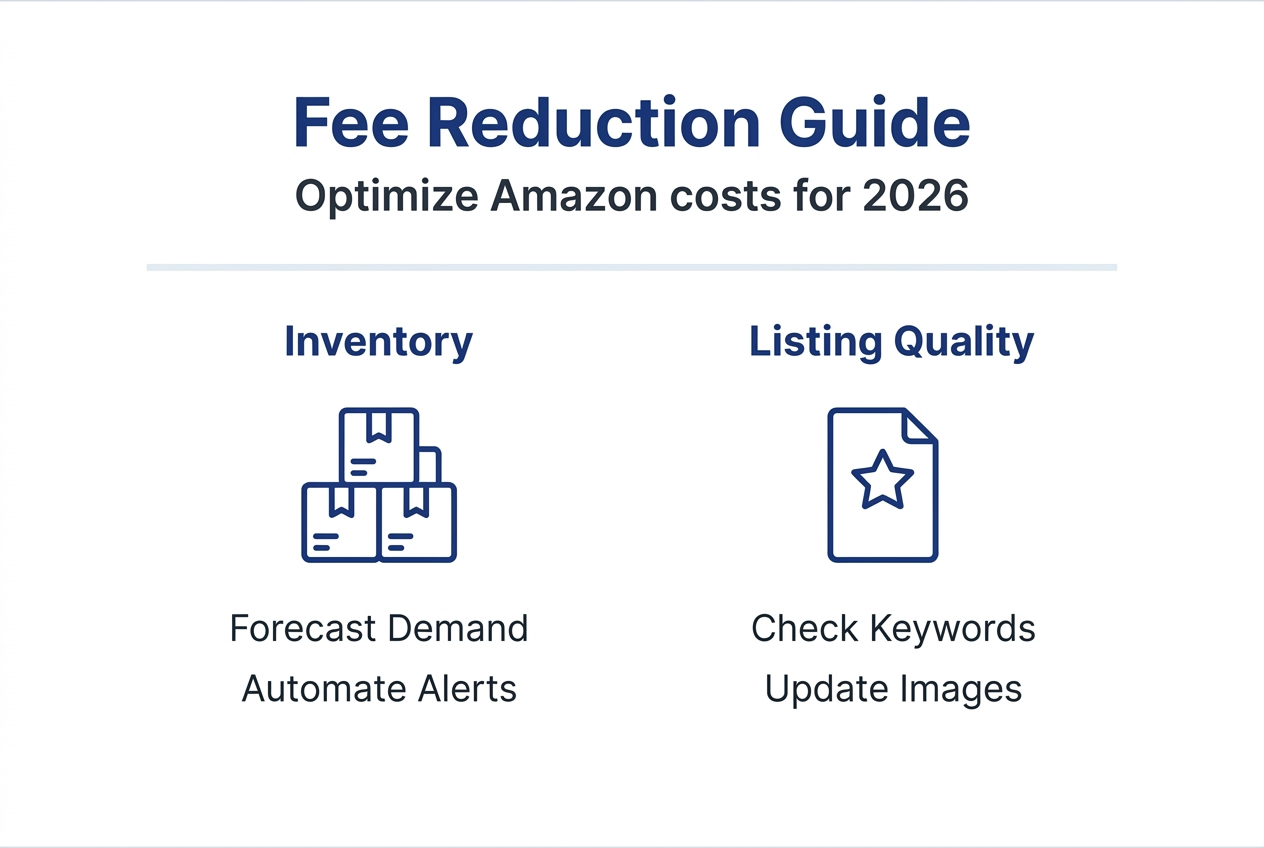
Inventory optimization sits at the foundation of fee reduction. Use demand forecasting tools that analyze historical sales data, seasonality patterns, and market trends to predict future needs accurately. Set dynamic reorder points that adjust based on current velocity rather than static thresholds. This approach prevents both low-inventory fees and excess storage charges.
Choosing the right selling plan impacts your per-unit economics. The Individual plan charges $0.99 per sale with no monthly fee, making it suitable for low-volume sellers. The Professional plan costs $39.99 monthly but eliminates per-sale charges, becoming cost-effective above 40 units monthly. Evaluate your volume monthly and switch plans when economics shift.
Implement these tactical optimizations:
- Audit product dimensions and weight to ensure accurate size tier classification, as misclassification inflates fulfillment fees
- Optimize packaging to minimize dimensional weight while maintaining protection standards
- Review category selection to confirm you are in the lowest appropriate referral fee tier
- Consolidate variations when possible to reduce the number of FNSKUs requiring separate inventory management
- Schedule shipments to arrive during low-fee periods rather than peak season when storage costs spike
Real-time analytics enable proactive fee management. Monitor key metrics daily:
- Inventory Performance Index (IPI) score
- Days of supply across all active listings
- Fee-to-revenue ratio by product category
- Storage utilization and aging inventory levels
- Defect rate trends from quality control audits
Pro Tip: Create custom reports in Seller Central that flag any listing approaching low-inventory thresholds or accumulating excess storage fees, then set calendar reminders to review these reports twice weekly.
Sellers should model fee triggers against packaging choices, pricing strategies, and sales plans to identify cost-saving opportunities. Run scenario analyses comparing different approaches. For example, test whether slightly larger packaging that reduces damage rates saves more in defect fees than it costs in higher fulfillment charges.
Advertising fee controls complement listing optimization by managing your cost per click and total ad spend. Target high-converting keywords that deliver sales at acceptable ACoS levels. Pause underperforming campaigns that drive clicks without conversions. This integrated approach reduces both listing fees and marketing costs simultaneously.
Implementing systematic optimization workflows ensures consistency across your catalog. Standard processes prevent errors that trigger fees and create repeatable systems for maintaining compliance. Combining these workflows with performance maximization techniques delivers compounding benefits that improve both revenue and margin.
Boost your Amazon sales with expert listing optimization
Navigating Amazon’s complex fee structure while maximizing sales requires specialized expertise and systematic processes. Professional listing optimization directly addresses fee challenges by ensuring accurate product data, optimal inventory levels, and compliance with Amazon’s evolving requirements.

Custom workflows and detailed checklists ensure every fee trigger receives proper management across your entire catalog. Expert guidance helps you balance inventory investment against carrying costs while maintaining the stock levels that prevent low-inventory penalties. Strategic advertising management controls your marketing spend while supporting organic ranking growth.
When you combine enhanced listing quality with proven optimization workflows and comprehensive performance checklists, you create a sustainable competitive advantage. Your listings rank higher, convert better, and operate more efficiently, delivering superior profitability even as Amazon’s fee structure evolves.
Frequently asked questions
What is the low-inventory-level fee and how is it calculated?
The low-inventory-level fee applies when your inventory falls below 28 days of supply in both the trailing 30-day and 90-day windows simultaneously. Amazon calculates it per FNSKU, including all variants, bulky items, and oversized products, with fees ranging from $0.63 to $0.97 per unit depending on size tier and supply level.
How can I reduce Amazon placement fees effectively?
Optimize your shipment distribution by sending inventory to multiple fulfillment centers based on Amazon’s network recommendations rather than consolidating to a single location. Partner with Amazon’s carrier program for better rates and monitor placement fee estimates during shipment creation to adjust your distribution strategy before finalizing sends.
What impact do defect fees have on seller profitability in 2026?
Defect fees increased up to 1,600% in 2026, with certain inbound errors now costing up to $5.72 per unit. For sellers shipping thousands of units monthly, these fees can reduce net margins by 2% to 5% if quality control processes are not rigorous enough to prevent labeling, prep, and packaging defects.
Are there strategies to control Amazon advertising fees alongside listing fees?
Yes, integrate smart bidding strategies that focus ad spend on high-converting keywords with acceptable ACoS targets. Use dayparting to concentrate budget during peak conversion hours and regularly audit search term reports to eliminate wasteful spend on irrelevant queries, creating a comprehensive advertising cost control approach that complements listing fee optimization.

Comments
2 responses to “Amazon listing fee guide 2026: Optimize costs, boost profits”
[…] 2026 fee updates monthly during Q1 when Amazon typically announces changes. Build 2% to 3% fee increases into your […]
[…] Amazon listing fee guide provides detailed breakdowns of how fulfillment choices impact total costs. Products weighing over […]