

Amazon’s Catalog AI is projected to increase seller sales by $7.5 billion through enhanced listing accuracy alone. Yet many U.S. sellers struggle with catalog optimization, missing critical opportunities for visibility and conversions. Professional Amazon cataloging services transform product listings through expert keyword integration, compelling content, and algorithm-aligned strategies. This guide reveals how to leverage cataloging expertise to dominate search rankings and maximize your marketplace performance in 2026.
Table of Contents
- Introduction To Amazon Cataloging Services
- How Amazon’s A9 Algorithm Influences Cataloging Requirements
- Comprehensive Components Of Amazon Cataloging Services
- The Evolution Of Amazon Cataloging: AI And Automation In 2026
- How To Choose The Right Amazon Cataloging Service Provider
- Common Misconceptions About Amazon Cataloging
- Benefits Of Professional Amazon Cataloging Services
- Conclusion And Practical Next Steps
- Optimize Your Amazon Listings With Searchoneers
- FAQ
Key Takeaways
| Point | Details |
|---|---|
| Professional cataloging increases visibility | Expert optimization of titles, keywords, and content drives 15-25% sales growth. |
| AI transforms catalog workflows | Automation reduces errors and accelerates updates while maintaining compliance. |
| Keyword precision matters most | Strategic placement beats volume; stuffing triggers Amazon penalties. |
| Provider expertise delivers results | Experienced services combine AI tools with human insight for maximum impact. |
| Continuous optimization sustains advantage | Regular updates keep listings competitive as marketplace dynamics shift. |
Introduction to Amazon Cataloging Services
Amazon cataloging services encompass the complete optimization of product listings to maximize search visibility and conversion rates. These services include title enhancement, bullet point refinement, backend keyword strategy, categorization accuracy, image optimization, and A+ Content creation. Professional cataloging addresses the complex interplay between Amazon’s search algorithm, customer behavior, and marketplace policies.
For sellers navigating the 2026 Amazon marketplace, cataloging quality directly impacts discoverability. Poorly optimized listings languish on page five while competitors capture sales. The challenge intensifies as Amazon’s algorithm grows more sophisticated, demanding precision in keyword usage, category selection, and content structure.
Sellers commonly face several pain points:
- Uncertainty about which keywords drive actual conversions versus vanity metrics
- Difficulty balancing keyword density with natural, compelling copy
- Confusion over backend search terms and their proper application
- Frustration with listing suppression due to policy violations
- Time constraints preventing thorough competitive research and testing
Professional cataloging services solve these challenges through specialized expertise and proven Amazon listing optimization workflow methodologies. Expert providers combine technical SEO knowledge with marketplace experience, ensuring listings meet algorithmic requirements while resonating with human buyers. This dual focus transforms product pages from simple descriptions into conversion engines.
How Amazon’s A9 Algorithm Influences Cataloging Requirements
Understanding Amazon’s A9 algorithm is essential for effective cataloging because it determines which products appear in search results. Amazon’s A9 algorithm ranks products based on relevance and performance metrics, heavily relying on well-optimized catalog data. The algorithm evaluates dozens of signals to match customer queries with the most appropriate products.
Key ranking factors include:
- Keyword relevance in titles, bullet points, descriptions, and backend search terms
- Sales velocity and conversion rate history
- Customer review ratings and quantity
- Click-through rate from search results
- Pricing competitiveness and availability
Titles carry the most algorithmic weight, making them prime real estate for your most important keywords. Backend search terms provide additional indexing opportunities without cluttering visible content. Product categorization determines which browse nodes display your listing, directly affecting discoverability for category browsers.
Customer engagement metrics create a performance feedback loop. Higher click-through rates signal relevance to Amazon, improving rankings. Better conversion rates indicate that your listing matches buyer intent, further boosting visibility. This makes catalog optimization a continuous cycle rather than a one-time task.
Amazon aggressively penalizes manipulation tactics. Keyword stuffing, irrelevant search terms, and misleading content trigger suppression or removal. The 2026 algorithm uses machine learning to detect unnatural language patterns, making authentic, value-driven content more critical than ever. Our comprehensive Amazon SEO guide walks through compliant optimization strategies that satisfy both algorithms and customers.
Comprehensive Components of Amazon Cataloging Services
Professional cataloging addresses every element that influences listing performance. Each component serves a specific purpose in the customer journey from search to purchase.
Title optimization balances keyword inclusion with readability. Effective titles place primary keywords at the beginning while incorporating brand, key features, and size or quantity details. They avoid special characters and excessive capitalization that violate Amazon’s style guidelines.

Bullet points communicate core benefits and address common customer questions. Strong bullet points start with capitalized feature names followed by explanatory details. They prioritize information hierarchy, placing the most compelling benefits first. Enhanced descriptions expand on bullet points with storytelling elements and deeper product context.
Backend keyword strategy captures alternative search terms, misspellings, and synonyms without visible clutter. Proper backend optimization avoids redundancy with visible content, maximizes character limits, and excludes restricted terms like competitor names.
High-quality images can increase click-through rates by up to 30%, enhancing visibility significantly. Professional images showcase products from multiple angles, demonstrate scale, and highlight unique features. Lifestyle photography helps customers visualize product use.
A+ Content boosts conversion rates 3-10% through richer visuals and enhanced descriptions. This premium feature allows brand-registered sellers to create immersive product stories with comparison charts, detailed specifications, and brand narratives. Our Amazon listing enhancement guide explores A+ Content strategies in depth.
| Cataloging Component | Visibility Impact | Conversion Impact |
|---|---|---|
| Optimized Titles | High (primary ranking factor) | Medium (sets expectations) |
| Strategic Keywords | High (determines indexing) | Low (invisible to customers) |
| Compelling Bullets | Medium (influences CTR) | High (communicates value) |
| Professional Images | High (drives clicks) | Very High (reduces uncertainty) |
| A+ Content | Low (not a ranking factor) | High (builds trust) |
Understanding how to optimize Amazon listings requires coordinating all these elements into a cohesive strategy that guides customers from discovery to purchase.
The Evolution of Amazon Cataloging: AI and Automation in 2026
Artificial intelligence has fundamentally transformed cataloging workflows, making sophisticated optimization accessible to sellers of all sizes. Amazon’s Catalog AI is projected to increase sales by $7.5 billion by improving listing accuracy and customer experience across millions of products.
Amazon’s proprietary AI tools now assist sellers with automatic content generation, image enhancement, and keyword suggestions. These systems analyze top-performing listings in each category, identifying patterns that drive conversions. They flag potential policy violations before submission, reducing suppression risks.
Approximately 89% of top Amazon sellers automate at least one workflow, making automation standard practice in 2026. Common automation applications include:
- Bulk listing updates across catalogs
- Competitive price monitoring and adjustment
- Inventory synchronization across channels
- Review response and sentiment analysis
- Keyword rank tracking and reporting
AI excels at data processing tasks that would consume hours manually. It identifies keyword opportunities by analyzing search volume trends, competition levels, and relevance scores simultaneously. Automated tools detect listing errors like missing attributes or non-compliant content, triggering immediate corrections.
The technology’s benefits extend beyond speed. AI reduces human error in repetitive tasks, maintains consistency across large catalogs, and adapts recommendations as marketplace conditions change. It processes customer feedback at scale, surfacing insights about desired features or common concerns.
Pro Tip: While AI dramatically improves efficiency, the best results come from combining automation with expert human review. AI suggests optimizations, but experienced professionals evaluate strategic fit, brand voice consistency, and nuanced competitive positioning. This hybrid approach, detailed in our Amazon listing optimization workflow, delivers superior outcomes compared to either method alone.
How to Choose the Right Amazon Cataloging Service Provider
Selecting a cataloging partner significantly impacts your optimization results and return on investment. The right provider combines technical expertise, proven methodologies, and transparent communication to deliver measurable improvements.
Evaluate potential providers using this systematic approach:
- Verify their demonstrated experience with Amazon SEO best practices and current policy compliance requirements
- Assess their integration of AI tools and automation while maintaining human oversight for strategic decisions
- Review their pricing structure for transparency, ensuring no hidden fees or unclear deliverables
- Request case studies showing measurable sales improvements for sellers in your product category
- Test their customer support responsiveness through initial consultations and question handling
- Confirm they offer ongoing optimization rather than one-time setup, as marketplace conditions constantly evolve
Experienced providers understand category-specific nuances that generic services miss. Cataloging strategies for electronics differ dramatically from those for apparel or consumables. Category expertise ensures your listings resonate with your specific buyer demographic and competitive environment.
Transparency separates professional services from unreliable operators. Clear service agreements outline exactly what optimization tasks are included, revision policies, and performance expectations. Avoid providers making unrealistic guarantees like “page one rankings in 30 days” since Amazon rankings depend on multiple factors beyond catalog quality.
The best providers focus on education alongside implementation. They explain their optimization rationale, helping you understand why specific changes improve performance. This knowledge transfer empowers you to maintain listing quality between professional updates.
Pro Tip: Before committing to a provider, request references from current clients in similar product categories. Direct seller feedback reveals how well the provider delivers on promises and handles challenges. Explore various Amazon cataloging service options to understand the range of approaches and pricing models available.
Common Misconceptions About Amazon Cataloging
Several persistent myths undermine seller cataloging efforts, leading to wasted resources and missed opportunities. Understanding the reality behind these misconceptions helps you avoid costly mistakes.
Myth: More keywords always improve ranking. Reality: Keyword stuffing triggers Amazon’s spam filters, resulting in suppressed listings and lost visibility. The algorithm prioritizes relevance over quantity. Strategic placement of highly relevant keywords in titles and bullets outperforms cramming dozens of marginally related terms.
Myth: AI tools alone suffice without expert input. Reality: While AI handles data processing brilliantly, it lacks strategic judgment about brand positioning, competitive differentiation, and emotional appeal. Automated suggestions require human evaluation to ensure they align with your broader marketing strategy and brand voice.
Myth: Only visible content matters. Reality: Backend keywords and precise categorization significantly impact discoverability. Backend search terms capture alternative phrasings and related concepts without cluttering customer-facing content. Proper category and browse node selection determines where your product appears in category searches.
Sellers frequently make these avoidable mistakes:
- Copying competitor listings verbatim, which creates duplicate content issues and fails to differentiate
- Neglecting mobile optimization, despite most Amazon browsing occurring on smartphones
- Ignoring seasonal keyword trends that could capture timely search volume
- Failing to update listings after receiving customer questions or negative reviews about missing information
- Using technical jargon that confuses average buyers instead of benefit-focused language
Our guide to common Amazon SEO mistakes provides detailed strategies for identifying and correcting these issues before they impact sales. Remember that Amazon rewards listings serving customer needs, not those trying to game the system.
Benefits of Professional Amazon Cataloging Services
Investing in expert cataloging services delivers quantifiable returns that justify the cost through increased revenue and operational efficiency. Professional optimization typically produces sales improvements ranging from 15% to 25% within the first quarter after implementation.
These gains result from multiple compounding factors. Better keyword targeting increases impressions for high-intent searches. Improved titles and images boost click-through rates. Enhanced bullet points and descriptions raise conversion rates. Together, these improvements create exponential growth in units sold.
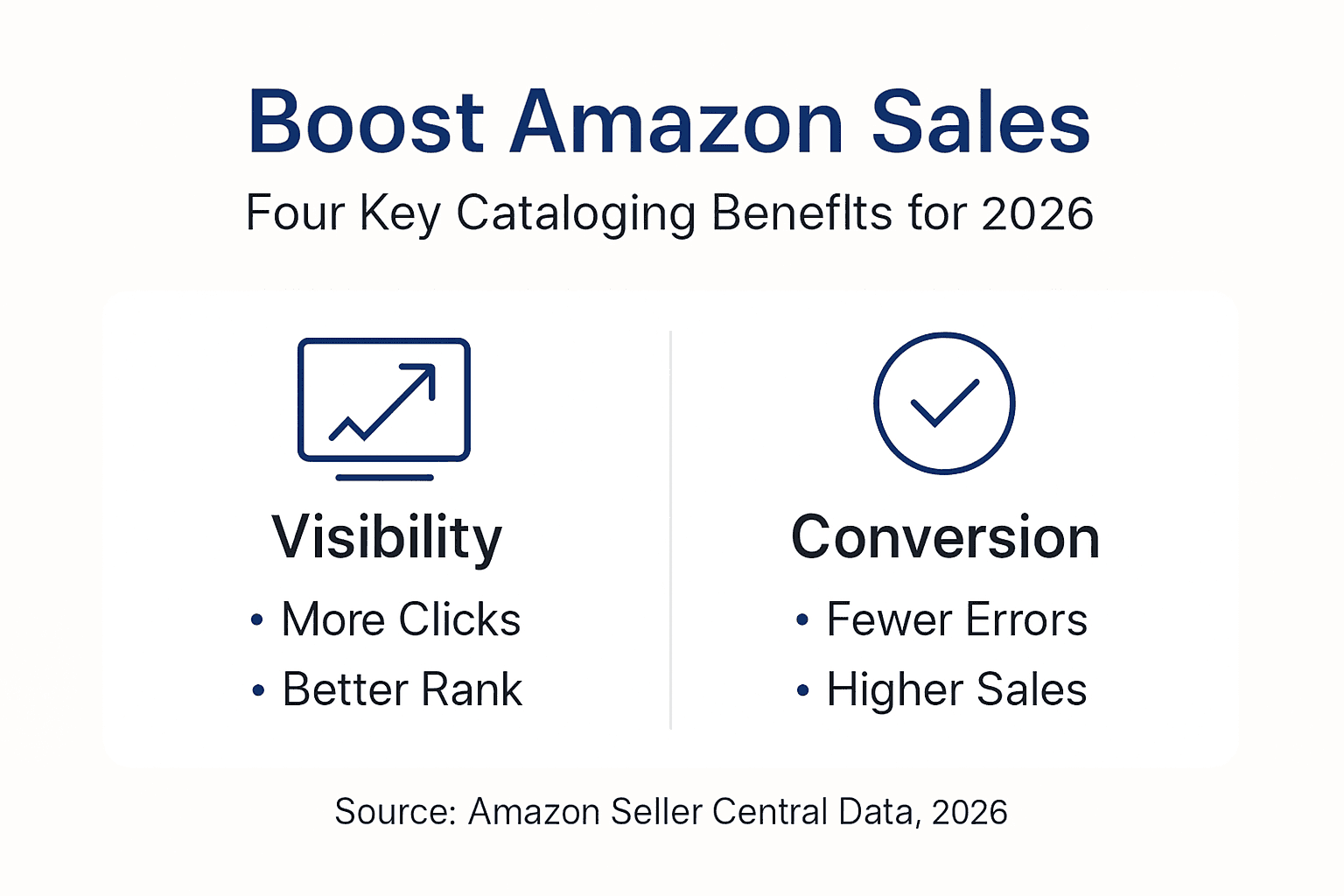
Professional services also reduce listing errors and policy violations that generate customer complaints. Clean, accurate product information decreases return rates by setting proper expectations. Comprehensive specifications answer common questions, reducing the support burden on your team.
Long-term listing stability represents another significant advantage. Expert catalogers understand Amazon’s evolving policies, proactively adjusting content to maintain compliance. This prevents the revenue disruption of suppressed listings requiring emergency fixes.
| Approach | Initial Cost | Time Investment | Sales Impact | Compliance Risk |
|---|---|---|---|---|
| DIY Cataloging | $0 direct cost | 20-30 hours per product | Variable, often minimal | High (policy misunderstanding) |
| Professional Service | $200-500 per product | 2-3 hours coordination | 15-25% increase typical | Low (expert guidance) |
| Hybrid (AI + Expert Review) | $300-700 per product | 5-8 hours oversight | 20-35% increase typical | Very Low (dual verification) |
The time savings alone often justify professional services. Hours spent researching keywords, writing copy, and troubleshooting issues could instead focus on sourcing, inventory management, or business expansion. Cataloging specialists work more efficiently through experience and specialized tools.
Pro Tip: View professional cataloging as an investment rather than an expense. Calculate potential revenue from a 20% sales increase versus service costs. For most products, the payback period spans just weeks, with ongoing benefits accruing indefinitely. Learn more about professional Amazon cataloging benefits and their impact on your bottom line.
Conclusion and Practical Next Steps
Amazon cataloging represents the foundation of marketplace success in 2026. Optimized listings capture search visibility, convert browsers into buyers, and maintain compliance with evolving policies. The integration of AI tools with expert human strategy has made sophisticated optimization more accessible while raising performance standards across the platform.
Your immediate action steps include auditing current listings against best practices, identifying underperforming products with optimization potential, and researching qualified cataloging service providers. Prioritize products with strong review ratings but low sales, as these typically respond best to catalog improvements. Focus initial efforts on your highest-volume SKUs for maximum revenue impact.
Establish a routine for continuous monitoring and updates. Review keyword rankings monthly, adjust based on seasonal trends, and incorporate customer feedback into product descriptions. The most successful sellers treat cataloging as an ongoing process rather than a completed task.
Consider engaging professional services for comprehensive optimization while learning best practices to maintain quality independently. This balanced approach accelerates initial improvements while building internal capabilities for long-term success.
Optimize Your Amazon Listings with Searchoneers
Ready to transform your product visibility and sales performance? Searchoneers specializes in data-driven Amazon catalog optimization that delivers measurable results. Our team combines advanced AI analysis with deep marketplace expertise to create listings that rank higher and convert better.
We develop customized strategies for your product category and competitive landscape. Our services include complete title and content optimization, strategic keyword research, backend search term refinement, and ongoing performance monitoring. Whether you need to optimize your Amazon inventory listings or implement a comprehensive listing optimization workflow, we deliver solutions tailored to your growth goals. Contact us today to discover how our Amazon listing enhancement services can boost your marketplace performance.
FAQ
What are Amazon cataloging services?
Amazon cataloging services optimize every element of product listings including titles, descriptions, bullet points, backend keywords, images, and categorization. Professional providers use data analysis and marketplace expertise to improve search visibility and conversion rates. These services ensure listings comply with Amazon policies while effectively communicating product value to potential buyers.
How does AI improve Amazon cataloging in 2026?
AI automates time-consuming tasks like keyword research, competitive analysis, and error detection across large catalogs. Machine learning algorithms identify high-performing content patterns and suggest optimizations based on millions of data points. AI reduces manual effort while maintaining consistency, though human expertise remains essential for strategic decisions and brand voice.
Can I optimize my Amazon listings without professional help?
Sellers can perform basic optimization independently using Amazon’s seller tools and publicly available resources. However, professional services provide specialized expertise, advanced analytics tools, and proven methodologies that typically deliver superior results. The time investment required for self-optimization often exceeds the cost of professional services when considering opportunity costs.
What is the biggest mistake sellers make in cataloging?
Keyword stuffing remains the most damaging cataloging mistake, triggering Amazon penalties that suppress listings and destroy visibility. Sellers mistakenly believe more keywords improve rankings, but the algorithm prioritizes relevance and natural language. Strategic placement of targeted, high-relevance keywords in appropriate fields outperforms quantity-focused approaches every time.

Comments
2 responses to “Amazon Cataloging Services 2026: Boost Sales 25% Fast”
[…] Amazon Cataloging Services 2026: Boost Sales 25% Fast – Searchoneers […]
[…] Brand Registry is a program that helps brand owners protect their intellectual property while selling on the platform. It grants enrolled brands greater control over product listings, […]