Over half of new American entrepreneurs on Amazon FBA report missing out on sales due to poorly optimized listings. For sellers eager to break into international markets, skipping proven listing and SEO strategies means stalling your product’s success. This guide breaks down FBA fundamentals while revealing actionable, data-driven SEO techniques tailored for entrepreneurs who want their Amazon listings to generate stronger global results.
Table of Contents
- Amazon FBA Basics And How It Works
- Different FBA Models And Seller Types
- FBA Workflow: From Inventory To Delivery
- Listing Optimization And SEO Essentials
- Common Mistakes And What To Avoid
Key Takeaways
| Point | Details |
|---|---|
| Leverage Amazon’s FBA Services | Use Fulfillment by Amazon to enhance distribution efficiency and scale operations without heavy investments in logistics. |
| Understand Seller Models | Choose the right FBA seller model based on your resources and business goals to optimize sales potential. |
| Optimize Product Listings | Implement strategic SEO techniques in product listings to improve visibility and conversion rates on Amazon. |
| Avoid Common Mistakes | Conduct thorough market research and adhere to Amazon’s guidelines to mitigate risks and protect your seller account. |
Amazon FBA Basics and How It Works
Fulfillment by Amazon (FBA) represents a strategic solution for online sellers seeking streamlined product distribution and enhanced market reach. This service allows entrepreneurs to leverage Amazon’s extensive logistics network, transforming how products move from inventory to customer doorstep. Sellers can outsource order fulfillment completely, enabling them to focus on product development and business growth.
The FBA process operates through a straightforward workflow. Sellers first create an Amazon seller account and list their products. Then, they prepare inventory shipments according to Amazon’s specific packaging and labeling requirements. Products are transported to Amazon’s strategically located fulfillment centers, where they are stored, managed, and processed. When a customer places an order, Amazon’s team handles picking, packing, shipping, and even customer service support.
Key advantages of Amazon FBA include global shipping capabilities, Prime eligibility, and reduced operational complexity. Sellers benefit from Amazon’s advanced logistics infrastructure, which manages inventory storage, handles returns, and provides customer support. This model allows businesses to scale rapidly without investing heavily in warehousing, shipping equipment, or dedicated fulfillment staff. By outsourcing these critical logistics functions, entrepreneurs can allocate more resources toward product innovation, marketing, and strategic business development.
Pro tip: Before sending inventory to Amazon fulfillment centers, carefully review their packaging and labeling guidelines to prevent potential delays or additional fees.
Different FBA Models and Seller Types
Amazon offers multiple FBA seller models designed to accommodate diverse business strategies and product types. Different seller types have unique approaches to leveraging Amazon’s marketplace, ranging from individual entrepreneurs to established brands seeking expanded distribution channels. Understanding these models helps sellers select the most appropriate strategy for their specific business goals.
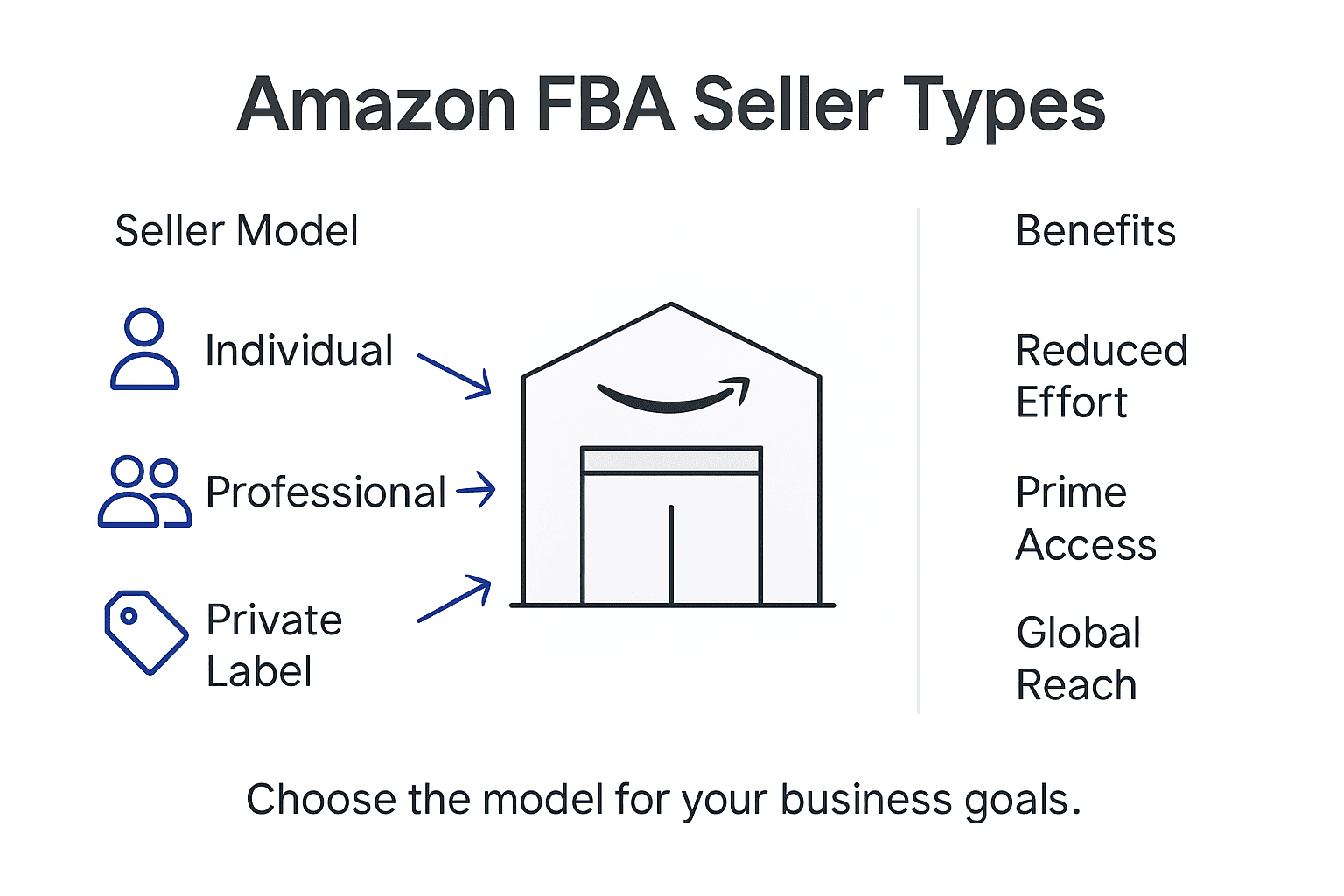
The primary FBA seller categories include individual sellers, professional sellers, and private label sellers. Individual sellers typically operate with lower sales volumes and pay per-item fees, making this model ideal for hobbyists or those testing market potential. Professional sellers invest in a monthly subscription, gaining access to advanced selling tools, bulk listing capabilities, and reduced per-item transaction costs. Private label sellers differentiate themselves by creating branded products manufactured by third-party suppliers, allowing for higher profit margins and brand control.
Beyond basic categories, specialized FBA models emerge for specific business approaches. Wholesale sellers purchase products in bulk from manufacturers and resell them on Amazon, while online arbitrage sellers identify price disparities between platforms to generate profit. Dropshipping represents another unique model where sellers list products without maintaining physical inventory, with suppliers directly shipping to customers. Each model presents distinct advantages and challenges, requiring sellers to carefully evaluate their resources, market knowledge, and long-term business objectives.
Here is a comparison of primary Amazon FBA seller types and their business implications:
| Seller Type | Fee Structure | Business Focus | Best For |
|---|---|---|---|
| Individual Seller | Per item sold fee | Small-scale selling | Hobbyists, market testing |
| Professional Seller | Monthly subscription | High-volume operations | Growing businesses |
| Private Label | Variable costs | Brand control, margins | Brand builders |
| Wholesale | Bulk purchasing | Reselling established brands | Volume resellers |
| Online Arbitrage | Low upfront costs | Profit on price gaps | Deal hunters |
| Dropshipping | Supplier payments | No inventory handling | Low-capital businesses |
Pro tip: Carefully analyze your product portfolio, available capital, and operational capacity before selecting an Amazon FBA seller model to maximize your potential for sustainable success.
FBA Workflow: From Inventory to Delivery
The Amazon FBA workflow transforms complex ecommerce logistics into a streamlined, efficient process that empowers sellers to focus on business growth. Sellers can optimize their inventory management by understanding the precise steps from product sourcing to customer delivery, ensuring smooth operations and maximized sales potential. The journey begins with comprehensive market research and strategic product selection, setting the foundation for successful Amazon selling.
Once products are sourced, sellers must meticulously prepare inventory for Amazon’s fulfillment centers. This preparation involves precise packaging, labeling, and shipping requirements that meet Amazon’s strict guidelines. Sellers ship their products to designated Amazon warehouses, where advanced inventory tracking systems monitor stock levels and performance. Effective inventory management involves carefully monitoring stock levels to prevent costly stockouts and overstocking, which can negatively impact sales and incur additional storage fees.

The fulfillment process kicks into high gear when a customer places an order. Amazon’s sophisticated system immediately identifies the product in its warehouse, picks the item, carefully packages it, and initiates shipping. This end-to-end process happens with remarkable speed and efficiency, leveraging Amazon’s extensive logistics network. The seller benefits from Amazon handling all aspects of order processing, including customer service, returns, and shipping, allowing them to scale their business without managing complex logistics infrastructure.
Pro tip: Develop a proactive inventory management strategy by regularly analyzing sales trends, maintaining optimal stock levels, and using Amazon’s Inventory Performance Index as a key performance benchmark.
Listing Optimization and SEO Essentials
Amazon product listings represent the critical interface between sellers and potential customers, making strategic optimization essential for driving visibility and sales. Successful sellers understand that a well-crafted listing goes far beyond basic product descriptions, incorporating sophisticated SEO techniques that align with Amazon’s complex search algorithms and customer search behaviors.
The core components of an optimized Amazon listing include a compelling title, strategic bullet points, detailed product descriptions, high-quality images, and carefully selected backend keywords. Sellers must craft titles that balance descriptive clarity with targeted keyword integration, ensuring that each word serves both customer understanding and search ranking purposes. Bullet points should highlight unique product features, address potential customer questions, and incorporate relevant search terms that improve discoverability without sacrificing readability.
Search engine optimization for Amazon requires a nuanced approach that differs from traditional web search strategies. Amazon SEO focuses on precise keyword placement, relevance, and conversion potential, prioritizing factors like sales velocity, customer reviews, and product relevance. Successful sellers continuously analyze their listing performance, monitoring metrics such as click-through rates, conversion rates, and search ranking positions to refine their optimization strategy. This dynamic approach ensures that product listings remain competitive in Amazon’s rapidly evolving marketplace.
Pro tip: Conduct regular competitive analysis by examining top-performing listings in your product category, identifying keyword patterns, and incrementally updating your listing to improve search visibility and customer engagement.
Common Mistakes and What to Avoid
Navigating potential pitfalls is critical for Amazon FBA sellers, as seemingly minor errors can result in significant financial losses or account suspension. New entrepreneurs often underestimate the complexity of Amazon’s marketplace, making strategic awareness essential for sustainable success. Understanding common mistakes allows sellers to proactively develop robust business practices that protect their investments and reputation.
One of the most critical areas of potential failure involves product selection and inventory management. Inexperienced sellers frequently make costly mistakes such as selecting oversaturated product categories, failing to conduct comprehensive market research, or sourcing low-quality inventory without understanding demand dynamics. Successful FBA sellers meticulously analyze market trends, competitor landscapes, and potential profit margins before committing significant resources. They recognize that product selection requires more than intuition, demanding data-driven decision making and continuous market evaluation.
Compliance represents another crucial area where sellers frequently stumble. Amazon maintains stringent policies governing seller behavior, product listings, and account management. Violations can range from minor listing inaccuracies to serious infractions like manipulating reviews or operating multiple seller accounts without authorization. Sellers must develop a comprehensive understanding of Amazon’s Terms of Service, staying updated on policy changes and maintaining transparent, ethical business practices. This approach not only prevents potential account penalties but also builds long-term credibility within the Amazon ecosystem.
Below is a summary of common FBA mistakes and how they can impact a seller’s business:
| Mistake | Impact on FBA Business | Prevention Strategy |
|---|---|---|
| Poor product research | Unsellable inventory, losses | Use market data for decisions |
| Ignoring Amazon guidelines | Account suspension or penalties | Study updated policies regularly |
| Overstocking or stockouts | Lost sales, higher fees | Monitor inventory performance |
| Low-quality listings | Reduced visibility, fewer sales | Invest in SEO and images |
| Neglecting compliance review | Unnoticed rule violations escalate | Run quarterly account audits |
Pro tip: Implement a quarterly compliance and strategy review, systematically auditing your Amazon seller account for potential policy violations, listing optimization opportunities, and emerging market trends.
Maximize Your Amazon FBA Success with Expert Listing Optimization and SEO
Struggling to boost your product visibility and sales on Amazon FBA? This article highlights critical challenges like crafting optimized listings, understanding Amazon SEO, and managing inventory efficiently. If you want to overcome common pitfalls such as poor keyword use or low-quality listings, our specialized services can give you the edge you need. We focus on creating enhanced titles, bullet points, product descriptions, and intelligent backend keywords that align perfectly with Amazon’s search algorithms.
Take control of your Amazon sales growth today by exploring proven strategies in our E-commerce Tips & Strategies to Grow Your Online Business category. Let our team at SearchOneers help you navigate the complexities of Amazon SEO and analytics with smart, data-backed tactics tailored to your business goals. Don’t wait—visit us now and start optimizing your Amazon listings to stand out from the competition!
Frequently Asked Questions
How does Amazon FBA work?
Amazon FBA allows sellers to store their products in Amazon’s fulfillment centers. When a customer orders a product, Amazon handles the picking, packing, shipping, and customer service on behalf of the seller, streamlining the entire fulfillment process.
What are the advantages of using Amazon FBA?
The key advantages of Amazon FBA include global shipping capabilities, eligibility for Amazon Prime, reduced operational complexity, and the ability for sellers to focus on business growth rather than logistical challenges by leveraging Amazon’s logistics network.
What types of sellers can benefit from Amazon FBA?
Various seller types benefit from Amazon FBA, including individual sellers, professional sellers, private label sellers, wholesale sellers, online arbitrage sellers, and dropshippers. Each type has unique business models and advantages suited to different market needs.
How can I optimize my product listings on Amazon to increase visibility?
To optimize product listings on Amazon, focus on crafting compelling titles, using strategic bullet points, writing detailed descriptions, and incorporating high-quality images. Additionally, use relevant backend keywords and analyze listing performance to refine your optimization strategy.