

Most advice about selling on Amazon overlooks one key fact—over 60 percent of American shoppers begin their product searches right on the platform. Competing in such a crowded online marketplace means understanding not just what you sell, but how you present and position your products. This guide breaks down the crucial American approach to Amazon product strategy, uncovering essential tactics for stronger visibility, smarter pricing, and sustained sales.
Table of Contents
- Defining Amazon Product Strategy Basics
- Key Types of Amazon Product Strategies
- Essential Elements For Optimizing Listings
- Workflow: From Research To Optimization
- Risks, Pitfalls, And Avoiding Listing Errors
Key Takeaways
| Point | Details |
|---|---|
| Comprehensive Product Strategy | Amazon sellers must adopt a holistic approach that integrates product positioning, competitive pricing, and content optimization to enhance visibility and sales. |
| Dynamic Optimization Process | Listing optimization is an ongoing effort that requires continuous monitoring and adaptation to consumer preferences and market changes. |
| Strategic Frameworks | Leveraging strategic models like the Delta Model and Blue Ocean Strategy can provide competitive advantages through unique product offerings and market positioning. |
| Risk Management | Awareness of common pitfalls, like inaccurate categorization and keyword stuffing, is crucial for maintaining effective and high-performing listings on Amazon. |
Defining Amazon Product Strategy Basics
Amazon product strategy represents a comprehensive approach to successfully positioning, marketing, and selling products within the world’s largest ecommerce marketplace. At its core, this strategy involves understanding and strategically leveraging the marketing mix principles that drive product visibility and sales performance.
Successful Amazon sellers recognize that their product strategy must encompass more than simply listing an item. It requires a holistic approach that integrates key elements like product positioning, competitive pricing, compelling content, and strategic optimization. The traditional marketing mix framework provides a foundational blueprint, focusing on four critical dimensions: product, price, place, and promotion. When applied to Amazon’s ecosystem, these principles translate into specific tactical considerations that can dramatically impact sales potential.
The Profit Impact of Market Strategy research highlights that strategic decisions directly correlate with market performance. For Amazon sellers, this means developing a multifaceted strategy that goes beyond basic product listing. Key strategic components include:
- Product Selection: Identifying market gaps and high-demand niches
- Pricing Optimization: Developing competitive yet profitable pricing models
- Content Enhancement: Creating persuasive, keyword-rich product descriptions
- Performance Tracking: Continuously monitoring sales metrics and customer feedback
To thrive on Amazon, sellers must view their product strategy as a dynamic, data-driven process. It’s not just about what you sell, but how strategically you present, price, and promote your offerings within this complex digital marketplace. Comprehensive content strategies can transform an average listing into a high-converting product page that attracts and converts potential customers.
Key Types of Amazon Product Strategies
Amazon sellers can leverage multiple strategic approaches to differentiate themselves and maximize marketplace success. The Delta Model provides a sophisticated framework for understanding these strategic positioning opportunities, highlighting three fundamental approaches that sellers can adopt to create competitive advantage.
The first strategic approach focuses on system lock-in, where sellers create products or services that make it challenging for customers to switch to alternative offerings. This might involve developing unique product bundles, creating complementary product lines, or implementing loyalty programs that incentivize repeat purchases. By building intricate ecosystems around their products, sellers can establish strong customer relationships and reduce competitive vulnerability.
Blue Ocean Strategy offers another compelling framework for Amazon product strategies, encouraging sellers to create uncontested market spaces through radical differentiation. Key strategic types include:
- Best Product Strategy: Focusing on superior product quality and features
- Customer Solution Strategy: Developing comprehensive product experiences
- System Lock-in Strategy: Creating integrated product ecosystems
- Niche Domination Strategy: Targeting specific, underserved market segments
Successful Amazon sellers often blend these strategic approaches, recognizing that marketplace dynamics require flexibility and continuous innovation. Amazon seller strategies must evolve rapidly to address changing consumer preferences and technological advancements. By understanding these strategic frameworks, sellers can develop nuanced approaches that go beyond simple product listing, transforming their marketplace presence into a robust, adaptable business model.
Essential Elements for Optimizing Listings
Successful Amazon sellers understand that product listing optimization is a critical strategy for driving visibility and sales. Product listing research reveals that comprehensive optimization involves multiple strategic elements designed to capture potential buyer attention and improve search rankings.

The foundation of an effective Amazon listing begins with crafting a compelling product title that incorporates key information. Keyword optimization plays a crucial role in this process, requiring sellers to strategically include relevant search terms while maintaining readability. Listing enhancement techniques demand careful consideration of Amazon’s character limits and algorithmic preferences.
Research on listing optimization highlights several critical elements that sellers must master:
- Product Title: Include brand name, key features, and primary keywords
- Bullet Points: Start with capital letters to enhance readability
- Product Images: Use high-quality, multiple-angle product photographs
- Backend Keywords: Strategically utilize Amazon’s backend keyword fields
- Detailed Description: Create comprehensive, benefit-driven content
Optimizing Amazon listings is an ongoing process that requires continuous refinement and strategic thinking. Sellers must balance technical optimization with compelling storytelling, ensuring that their product not only appears in search results but also converts browsers into buyers. By understanding and implementing these essential elements, sellers can significantly improve their marketplace performance and drive sustainable growth.
Workflow: From Research to Optimization
Multi-modal product research provides the foundational framework for developing successful Amazon product strategies. The workflow from initial research to final optimization represents a critical path that demands strategic thinking and systematic approach, transforming raw market insights into compelling product listings.
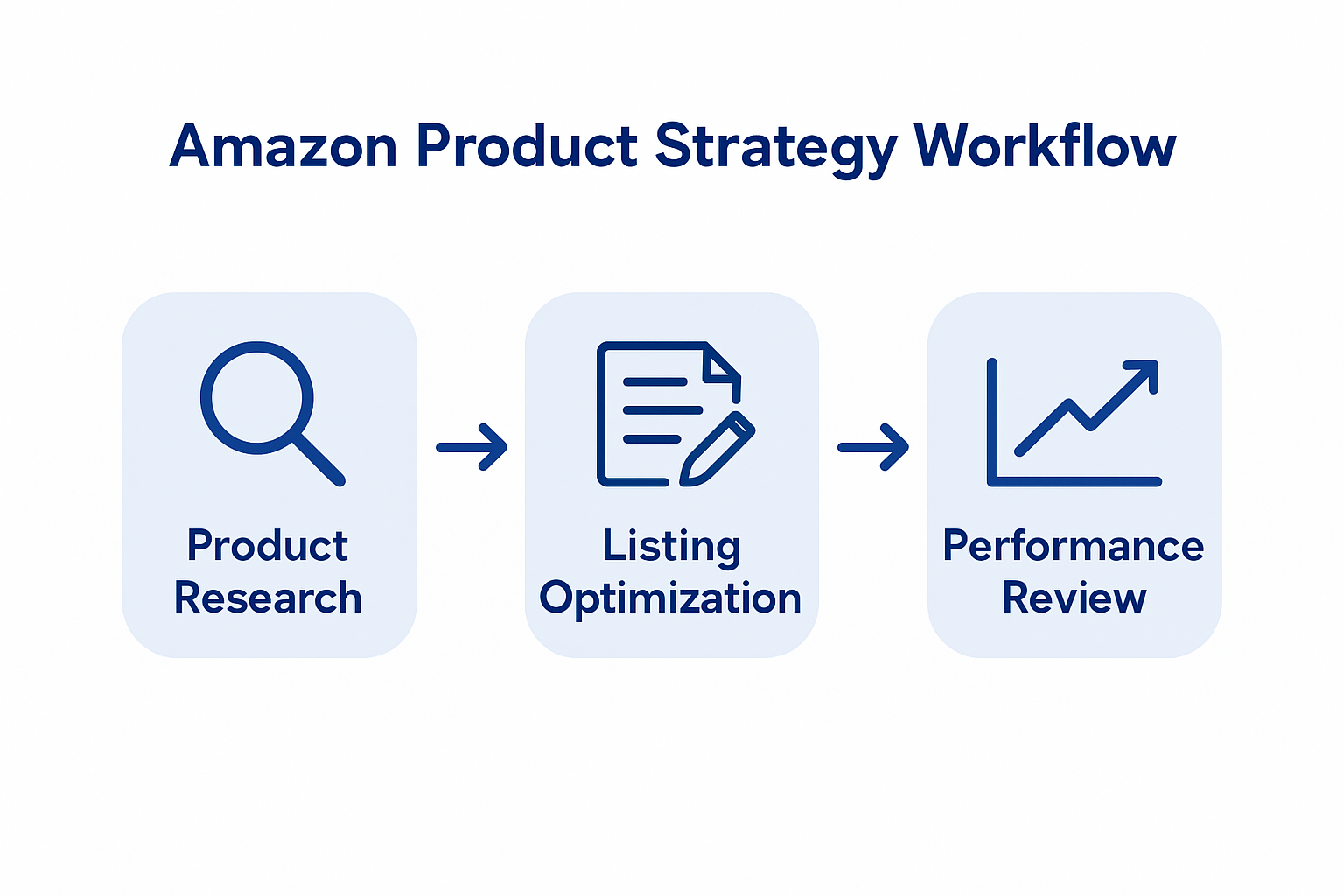
The initial research phase requires sellers to conduct comprehensive market analysis, identifying potential product opportunities through careful examination of consumer trends, competitive landscapes, and emerging market segments. Data-driven decision making becomes paramount, with sellers leveraging advanced analytics to understand nuanced customer preferences and market dynamics.
Personalized product search models highlight the importance of understanding user preferences throughout the optimization workflow. Key steps in this strategic process include:
- Market Research: Analyze competitive landscapes and consumer trends
- Product Validation: Assess market demand and potential profitability
- Keyword Research: Identify high-performing search terms
- Listing Optimization: Craft compelling titles, descriptions, and images
- Performance Tracking: Monitor and refine listing performance
Amazon content workflow strategies emphasize continuous refinement as the cornerstone of marketplace success. Sellers must approach their product strategy as an iterative process, consistently adapting to changing market conditions and consumer behaviors. By implementing a systematic, data-driven workflow, Amazon sellers can transform initial research into optimized listings that drive visibility, engagement, and ultimately, sales performance.
Risks, Pitfalls, and Avoiding Listing Errors
Lean supply chain principles offer critical insights into minimizing risks and avoiding common listing errors that can derail Amazon seller success. Understanding these potential pitfalls becomes essential for maintaining a competitive and profitable marketplace presence.
The most significant risks emerge from misalignment between product representation and actual market demand. Strategic error prevention requires sellers to develop a comprehensive understanding of their product ecosystem, carefully analyzing potential vulnerabilities that could compromise listing performance. This involves meticulously examining product descriptions, pricing strategies, and keyword optimization to ensure maximum visibility and accuracy.
Product relationship research highlights the complex dynamics that can lead to listing errors. Common pitfalls sellers must navigate include:
- Inaccurate Product Categorization: Misplacing products in incorrect marketplace categories
- Keyword Stuffing: Overloading listings with irrelevant or repetitive search terms
- Incomplete Product Information: Failing to provide comprehensive product details
- Poor Image Quality: Using low-resolution or non-compliant product images
- Pricing Inconsistencies: Misaligning prices across different marketplace platforms
Comprehensive listing error guides emphasize that successful sellers treat listing optimization as an ongoing process. By developing a proactive approach to identifying and mitigating potential risks, Amazon sellers can create robust product listings that minimize errors, maximize visibility, and ultimately drive sustainable marketplace success.
Elevate Your Amazon Product Strategy with Expert Optimization
Struggling to turn your Amazon listings into high-converting sales? This article highlights common challenges like pricing missteps, keyword stuffing, and incomplete content that hold many sellers back from achieving visibility and growth. If you want to master product positioning, content enhancement, and data-driven listing optimization, our specialized solutions are designed to tackle these exact pain points. We focus on enhancing titles, bullet points, descriptions, and backend keywords to boost your discoverability and sales performance.

Ready to transform your Amazon presence today Discover proven strategies and hands-on support at SearchOneers. Explore our insights on E-commerce Tips & Strategies to Grow Your Online Business to stay ahead of marketplace changes and drive sustainable growth. Don’t wait let’s optimize your Amazon listings with smart, data-backed methods that evolve with the marketplace now.
Frequently Asked Questions
What are the key components of an effective Amazon product strategy?
An effective Amazon product strategy includes product selection, pricing optimization, content enhancement, and performance tracking. These elements work together to drive visibility and sales on the platform.
How can I optimize my Amazon product listings for better visibility?
To optimize your Amazon product listings, focus on crafting compelling titles, using high-quality images, writing detailed descriptions, and strategically incorporating relevant keywords. Regularly monitoring performance metrics also helps in making necessary adjustments.
What common pitfalls should I avoid when creating Amazon product listings?
Common pitfalls include inaccurate product categorization, keyword stuffing, incomplete product information, and poor image quality. Addressing these errors can significantly improve your listings’ performance and visibility.
How does Amazon’s market strategy impact seller success?
Amazon’s market strategy emphasizes data-driven decision-making and dynamic product positioning. Sellers who understand and implement these principles can enhance their competitive advantage and achieve sustainable growth on the platform.
Recommended
- Understanding Amazon Growth Strategies – Scale Your Business
- 10 Effective Ways to Increase Amazon Sales in 2025
- 7 Key Digital Marketing Trends 2025 for Malaysian Buyers – Projector Display

Comments
2 responses to “Amazon Product Strategy: Driving Growth and Visibility”
[…] Amazon Product Strategy: Driving Growth and Visibility – Searchoneers […]
[…] Amazon Product Strategy: Driving Growth and Visibility – Searchoneers […]