Managing a mid-sized brand’s presence on the Amazon Marketplace often means untangling the differences between vendor and seller relationships. For North American e-commerce managers, understanding the Amazon vendor model is key to unlocking new wholesale opportunities and scaling operations efficiently. This article brings clarity to the distinct features, relationship types, and operational demands of becoming an Amazon vendor, helping you build a stronger, more profitable brand strategy.
Table of Contents
- Amazon Vendor Definition And Core Concepts
- Types Of Amazon Vendor Relationships
- Key Features And Operational Mechanics
- Vendor Requirements And Onboarding Process
- Risks, Costs, And Loss Of Control
- Amazon Vendor Versus Seller Comparison
Key Takeaways
| Point | Details |
|---|---|
| Understanding Vendor Relationships | Amazon vendors sell products directly to Amazon, which manages pricing and inventory, unlike sellers who retain control over their stock. |
| Types of Vendor Models | Amazon vendor relationships can be transactional, collaborative, or strategic, each with differing engagement and business impacts. |
| Vendor Onboarding Requirements | To become an Amazon vendor, companies must meet stringent qualifications, including operational excellence and robust data management capabilities. |
| Vendor vs. Seller Comparison | Vendors have limited pricing control and rely on Amazon for logistics, while sellers maintain ownership of inventory and have more control over pricing and branding. |
Amazon vendor definition and core concepts
In the complex world of e-commerce, Amazon Vendor represents a specific business relationship with one of the largest online marketplaces. First-party sellers supplying goods directly to Amazon operate through a distinct model compared to third-party marketplace sellers, offering unique opportunities and challenges.
Amazon vendors are wholesale suppliers who sell their products in bulk directly to Amazon, distinguishing themselves from independent sellers who list and manage their own inventory. Unlike marketplace sellers who interact through Seller Central, vendors use Vendor Central – a specialized platform for managing wholesale relationships. Key characteristics of Amazon vendors include:
- Sell entire product inventory directly to Amazon as a wholesaler
- Receive purchase orders from Amazon’s buying teams
- Pricing and inventory managed primarily by Amazon
- Access to specialized vendor support and marketing programs
- Ability to distribute products across Amazon’s extensive retail network
The vendor relationship involves a more integrated partnership with Amazon, where the platform essentially becomes the retailer. Product information is typically synchronized through global data networks, ensuring standardized and accurate catalog information for consumers.
Pro tip: Understand the nuanced differences between vendor and seller status before committing to a specific Amazon sales strategy, as each model offers distinct advantages and operational requirements.
Types of Amazon vendor relationships
Amazon vendor relationships are complex and multifaceted, characterized by different levels of supply chain integration. These relationships range from basic transactional interactions to deeply strategic partnerships that transform traditional wholesale models.
Vendor relationship types can be broadly categorized into three primary models:
- Transactional Vendors: Minimal engagement, standard wholesale relationship
- Collaborative Vendors: Enhanced communication and joint planning
- Strategic Vendors: Long-term, deeply integrated partnerships with mutual growth objectives
Each relationship type offers unique advantages and requires different levels of operational commitment. Strategic vendor partnerships emphasize inclusive growth by supporting diverse businesses and creating mutually beneficial economic opportunities.
To help clarify Amazon vendor relationship types, here’s a summary of their business impact:
| Vendor Type | Typical Engagement | Business Impact |
|---|---|---|
| Transactional | Standard purchasing | Reliable wholesale sales |
| Collaborative | Joint planning efforts | Improved supply chain efficiency |
| Strategic | Ongoing partnership | Accelerated growth and innovation |
The strategic vendor model represents the most advanced relationship, where Amazon works closely with suppliers to develop innovative products, optimize supply chains, and create sustainable business ecosystems. These vendors often receive preferential treatment, including dedicated account management, marketing support, and potential long-term contract opportunities.
Pro tip: Carefully evaluate your company’s capabilities and growth objectives before selecting an Amazon vendor relationship model, as each requires distinct operational strategies and resource investments.
Key features and operational mechanics
Amazon vendor operations rely on sophisticated product data synchronization systems that streamline inventory management and listing optimization. These systems enable real-time tracking, inventory updates, and comprehensive product information management across the Amazon marketplace.
Operational mechanics for Amazon vendors encompass several critical components:
- Vendor Central Platform: Primary interface for managing product listings
- Global Data Synchronization Network (GDSN): Standardized data exchange mechanism
- Performance Monitoring: Regular evaluation of vendor metrics and compliance
- Catalog Attribute Management: Detailed product information requirements
- Inventory Integration: Real-time stock level and pricing updates
Vendor management practices involve strategic approaches to procurement, relationship development, and ongoing performance optimization. Vendors must navigate complex systems that require continuous adaptation to Amazon’s evolving marketplace requirements.
Successful vendors understand that operational excellence goes beyond basic product listing. They must develop robust systems for inventory management, pricing strategy, and continuous performance improvement. This involves maintaining detailed product catalogs, responding quickly to Amazon’s purchase orders, and consistently meeting performance benchmarks that determine future business opportunities.

Pro tip: Invest in robust data management systems and dedicated personnel who can navigate Vendor Central’s complex requirements and maintain real-time synchronization of product information.
Vendor requirements and onboarding process
Becoming an Amazon vendor requires navigating a comprehensive vendor qualification process designed to ensure only high-quality suppliers enter the marketplace. The rigorous screening involves multiple layers of verification and compliance checks that evaluate a company’s operational capabilities and market readiness.
Key vendor qualification requirements include:
- Registered business entity with valid tax identification
- Proven product quality and manufacturing credentials
- Financial stability and credit worthiness
- Compliance with Amazon’s product standards
- Ability to meet inventory and shipping requirements
- Strong customer service capabilities
- Robust product data management systems
Vendor management practices involve a systematic approach to evaluating potential partners. The onboarding process typically encompasses detailed steps including initial application, document submission, performance assessment, and contractual negotiations.
Successful vendors must demonstrate not just product quality, but also operational excellence. Amazon conducts thorough background checks, reviews business history, and assesses the potential vendor’s capacity to meet marketplace performance standards. This comprehensive evaluation ensures that only vendors with strong operational capabilities and commitment to customer satisfaction are approved.
Pro tip: Prepare a comprehensive vendor application package with detailed documentation, financial statements, and clear evidence of your operational capabilities before initiating the Amazon vendor application process.
Risks, costs, and loss of control
Vendors must carefully evaluate the complex landscape of vendor management risks when considering an Amazon vendor relationship. The partnership involves significant financial and operational considerations that can dramatically impact a company’s strategic positioning.
Primary risks and potential costs include:
- Substantial financial investment in compliance and systems
- Reduced pricing control and margin compression
- Potential inventory write-offs and return penalties
- Limited brand positioning and marketing autonomy
- Performance metric-driven relationship management
- High operational complexity and administrative overhead
- Potential exclusion from future vendor opportunities
Vendor management control mechanisms become critical in mitigating potential operational vulnerabilities. Amazon’s vendor ecosystem demands continuous performance monitoring, sophisticated data management, and stringent compliance with evolving marketplace requirements.
The loss of control extends beyond mere transactional interactions. Vendors essentially become dependent on Amazon’s algorithmic decision-making, which can unexpectedly change purchasing patterns, pricing strategies, and product visibility. This dynamic creates a high-stakes environment where vendors must remain agile and responsive to maintain their marketplace standing.
Pro tip: Develop robust financial modeling and contingency planning that accounts for potential marketplace volatility before committing to an Amazon vendor relationship.
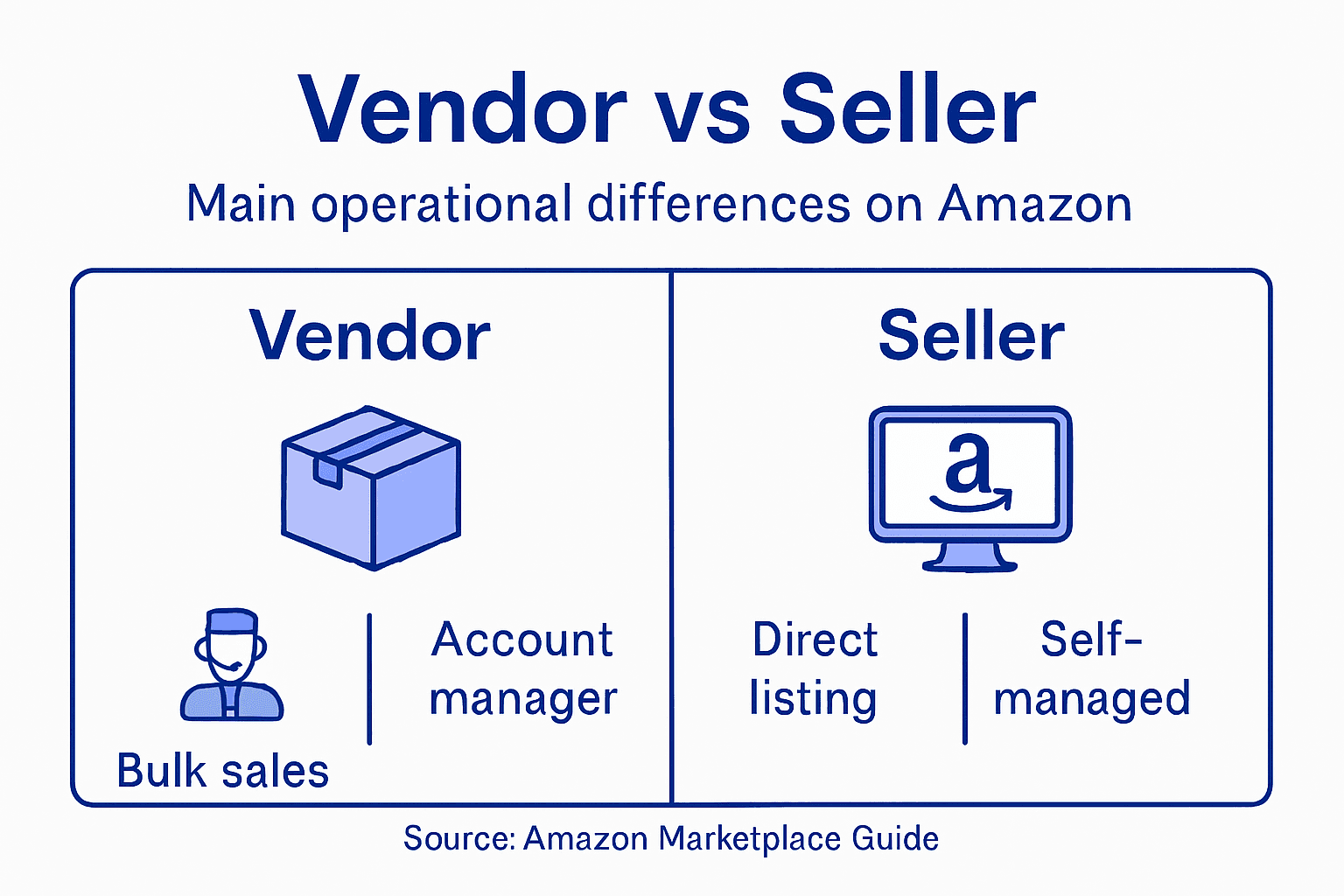
Amazon vendor versus seller comparison
The Amazon marketplace fundamentally distinguishes between two primary business models: vendors and sellers, each with unique operational characteristics and strategic implications for businesses. Understanding these differences is crucial for making informed marketplace participation decisions.
Key distinctions between vendors and sellers include:
- Inventory Ownership:
- Vendors: Amazon purchases inventory directly
- Sellers: Retain ownership, manage their own stock
- Platform Interaction:
- Vendors: Use Vendor Central
- Sellers: Utilize Seller Central
- Fulfillment Responsibilities:
- Vendors: Amazon handles logistics
- Sellers: Choose between self-fulfillment or Fulfillment by Amazon (FBA)
- Pricing Control:
- Vendors: Limited pricing influence
- Sellers: Direct pricing management
The marketplace provider dynamics create complex operational ecosystems where tax responsibilities, transaction management, and regulatory compliance vary significantly between vendors and sellers.
Comparing vendors and sellers on Amazon reveals strategic differences:
| Aspect | Amazon Vendor | Amazon Seller |
|---|---|---|
| Control Over Pricing | Minimal, Amazon sets prices | Full, seller decides prices |
| Inventory Risk | Amazon bears stock risk | Seller is responsible for inventory |
| Branding Opportunity | Limited, Amazon controls presentation | Broad, seller customizes listings |
| Marketing Support | Access to Amazon-managed programs | Self-driven, limited Amazon promotion |
Beyond operational mechanics, the choice between vendor and seller status represents a strategic decision affecting brand positioning, financial control, and marketplace visibility. Vendors benefit from Amazon’s direct purchasing power, while sellers maintain greater autonomy in inventory and pricing strategies.
Pro tip: Conduct a comprehensive cost-benefit analysis considering your product portfolio, operational capabilities, and long-term growth objectives before selecting between vendor and seller models.
Enhance Your Amazon Vendor Presence with Expert Listing Optimization
Navigating the complexities of Amazon Vendor status requires precision in listing optimization to overcome challenges like limited pricing control and strict data synchronization demands. This article highlights how operational excellence and robust product information management are critical for vendors aiming to boost visibility and maintain competitive advantage. If you struggle with the intricacies of Vendor Central or want to ensure your product listings truly stand out, focusing on enhanced titles, bullet points, and backend keywords is essential.
Unlock strategic insights through our E-commerce Tips & Strategies to Grow Your Online Business where we specialize in crafting optimized Amazon content alongside data-backed SEO and analytics services that evolve with the marketplace.
Don’t let complex vendor requirements limit your growth. Visit SearchOneers now to take control of your Amazon listings with proven strategies designed specifically for vendor sellers. Empower your listings today and stay ahead in this competitive landscape.
Frequently Asked Questions
What is Amazon Vendor Status?
Amazon Vendor Status refers to a relationship where sellers act as wholesale suppliers, selling products directly to Amazon, which in turn becomes the retailer. This contrasts with third-party sellers who manage their own inventory on the marketplace.
How does Vendor Central differ from Seller Central?
Vendor Central is the platform used by Amazon vendors to manage wholesale relationships and inventory, while Seller Central is used by third-party sellers to list and manage their own products.
What are the benefits of being an Amazon vendor?
Amazon vendors enjoy benefits such as dedicated account management, marketing support, and access to Amazon’s extensive retail network. They also have the potential for increased sales through Amazon’s purchasing power.
What risks are associated with Amazon Vendor Status?
Vendors face several risks including reduced pricing control, dependence on Amazon for sales and marketing, potential financial investments in compliance, and complexities in inventory management due to Amazon’s operational requirements.