

Many Amazon sellers believe stuffing listings with keywords guarantees top rankings. That approach fails in 2026. Amazon’s AI-driven search now prioritizes semantic relevance and user intent over keyword density. This shift, combined with tougher Annual Vendor Negotiations, demands specialized consulting. This guide reveals proven SEO strategies, negotiation tactics, and consulting benefits that drive measurable vendor success in 2026.
Table of Contents
- Introduction To Amazon Vendor Consulting
- Understanding Amazon Listing Optimization
- Annual Vendor Negotiations (AVNs) In 2026
- Common Misconceptions And Mistakes In Amazon Vendor Consulting
- Practical Strategies For Amazon Vendor Success
- Bridging Understanding To Application: Choosing The Right Consulting Partner
- Conclusion And Next Steps
- Optimize Your Amazon Vendor Strategy With Expert Consulting
- Frequently Asked Questions
Key Takeaways
| Point | Details |
|---|---|
| Sales Growth Potential | Consulting improves sales by 30-60% through optimized listings and strategic negotiations. |
| SEO Evolution | Semantic optimization beats keyword stuffing for Amazon visibility in 2026. |
| Negotiation Preparation | Data-driven AVN prep and relationship-building accelerate outcomes and improve terms. |
| Continuous Optimization | Regular listing audits and AI tools sustain Amazon ranking performance. |
| Partner Selection | Choosing expert consulting ensures ongoing vendor success and competitive advantage. |
Introduction to Amazon Vendor Consulting
Amazon vendor consulting encompasses specialized services that optimize your listings, navigate complex negotiations, and implement data-backed strategies to grow your vendor business. In 2026, North American sellers face unprecedented challenges: AI-powered algorithms that rewrite search rules overnight, intense competition requiring sophisticated SEO tactics, and tougher vendor negotiations demanding margin defense. Without expert guidance, you risk falling behind competitors who leverage advanced optimization and strategic negotiation support.
The marketplace complexity has exploded. Amazon’s Rufus AI assistant and semantic search capabilities render traditional keyword tactics obsolete. Simultaneously, Annual Vendor Negotiations now focus on profitability rather than revenue growth, pressuring margins with extended payment terms and higher trade contributions. Sellers struggle to keep pace with algorithm updates, interpret performance data, and negotiate favorable terms without leaving money on the table.
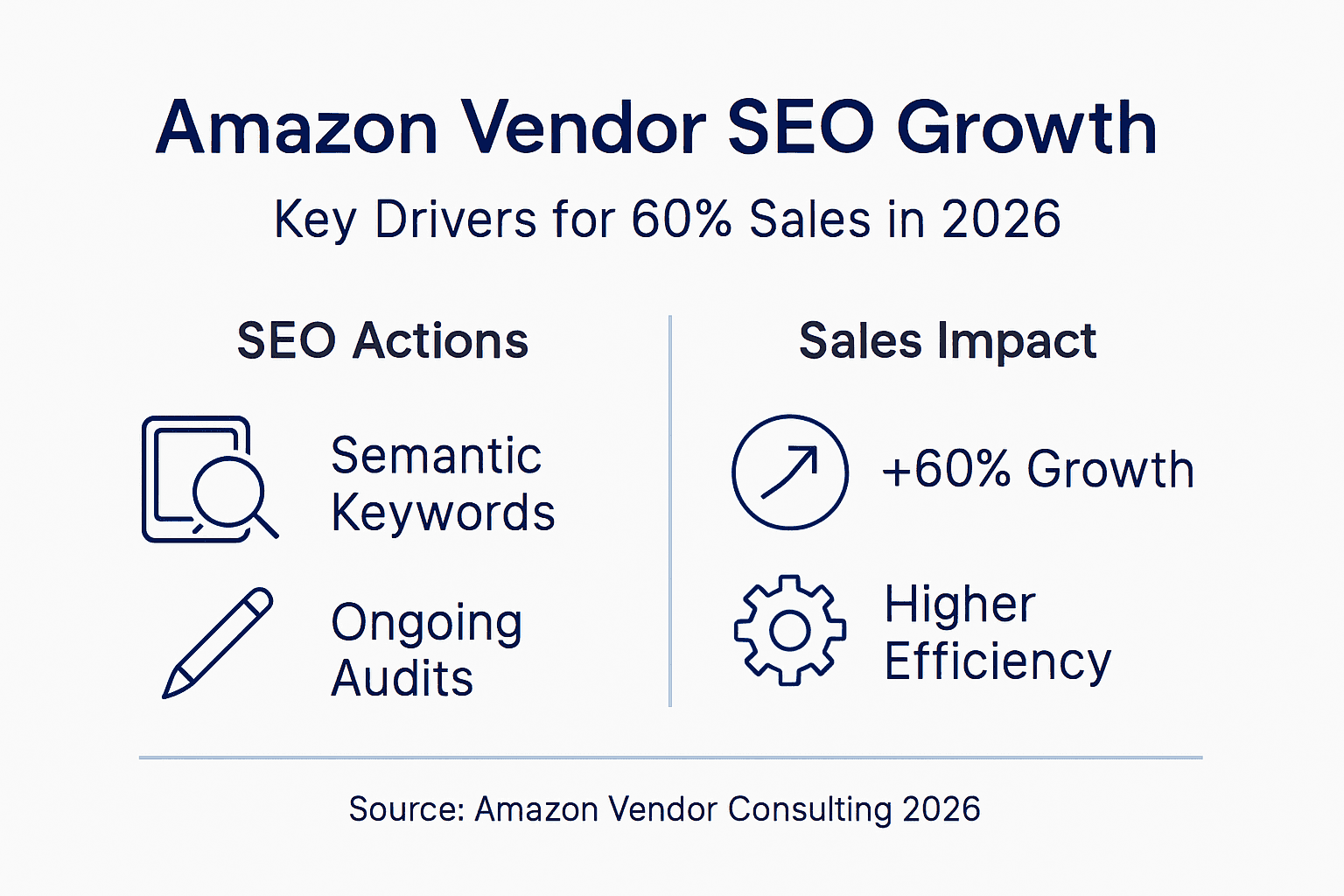
Consulting delivers measurable impact: operational efficiency improves by 40-70%, sales increase by 30-60%, and profitability can double through execution optimization. These results stem from systematic approaches to listing enhancement, negotiation strategy, and ongoing performance management. Expert consultants bring specialized knowledge of Vendor Central, proven SEO frameworks, and negotiation experience that individual sellers rarely possess.
Core consulting services include:
- Comprehensive listing optimization covering titles, bullets, descriptions, and backend keywords
- Annual Vendor Negotiation preparation and strategic support
- Advanced data analysis identifying growth opportunities and cost inefficiencies
- AI tool implementation for semantic keyword research and competitor tracking
- Vendor Manager relationship building to accelerate negotiations and secure better terms
Having understood why Amazon vendor consulting is vital, next explore the core SEO mechanisms sellers must master.
Understanding Amazon Listing Optimization
Amazon’s 2026 search ecosystem revolves around AI assistants like Rufus that understand customer intent, not just keywords. Your listings must speak the language of your buyers, addressing their questions and pain points naturally. The algorithm evaluates semantic relevance, examining how well your content matches the complete context of search queries rather than counting keyword repetitions.
Optimizing listings requires focusing on five critical components. Your title must balance discoverability with readability, incorporating primary keywords while remaining clear to human shoppers. Bullet points should highlight benefits using natural language that resonates with customer needs. Product descriptions provide space for comprehensive information including use cases and specifications. Enhanced Brand Content allows visual storytelling that engages browsers. Backend keywords capture variations and synonyms without cluttering customer-facing copy.

The fundamental shift is from keyword density to semantic relevance and intent matching. In 2024, sellers stuffed listings with exact-match phrases. In 2026, Amazon’s algorithm penalizes this approach, favoring content that naturally incorporates related concepts, answers questions, and provides genuine value. Search queries like “waterproof hiking boots for winter” trigger listings that discuss weather resistance, traction, and insulation, not just those repeating the exact phrase.
Best practices for semantic optimization:
- Research customer questions and pain points to guide content creation
- Use synonym variations and related terms throughout listing sections
- Structure Enhanced Brand Content to answer common buyer questions visually
- Populate backend keywords with misspellings, abbreviations, and alternate phrasings
- Test listing performance and iterate based on conversion and ranking data
| Approach | Traditional Keyword Stuffing | Semantic SEO |
|---|---|---|
| Focus | Exact keyword repetition | Intent and context matching |
| Content Quality | Often repetitive and unnatural | Natural, valuable, customer-focused |
| Algorithm Response | Penalized in 2026 | Rewarded with higher rankings |
| Conversion Impact | Lower due to poor readability | Higher through improved engagement |
| Long-term Results | Declining visibility | Sustained performance |
Pro Tip: Use AI-powered optimization tools to analyze customer reviews and search query patterns, revealing the exact language your target buyers use. These tools interpret intent and suggest semantic improvements that traditional keyword research misses, giving you a competitive edge in 2026’s AI-driven marketplace.
Understanding SEO mechanics prepares you to tackle Amazon listing optimization workflows systematically. However, listing excellence alone won’t guarantee vendor success. You must also master negotiations that protect your margins while maintaining strong Amazon partnerships. Comparing available listing tools helps identify solutions matching your optimization needs and budget constraints.
With essential SEO knowledge established, explore Amazon vendor negotiations’ evolving landscape impacting vendor success.
Annual Vendor Negotiations (AVNs) in 2026
Amazon’s negotiation priorities have shifted dramatically. Where 2024 AVNs emphasized revenue growth targets, 2026 negotiations center on profitability and margin defense. Amazon pressures vendors to accept tougher terms while maintaining or increasing sales volumes. This creates tension: you need to protect your business viability while preserving access to Amazon’s massive customer base.
Common Amazon demands include extending payment terms from 30 to 60 days, straining your cash flow. Trade contributions now average 35% of revenue, up from previous years. Chargebacks for compliance issues have become stricter. Co-op marketing investments face scrutiny with demands for measurable ROI. Vendors without solid data backing their positions face difficult choices between accepting unfavorable terms or risking account termination.
Successful AVN preparation requires systematic effort:
- Conduct comprehensive cost-to-serve analysis documenting your true profitability by SKU
- Build detailed margin models showing impact of proposed term changes
- Establish regular communication with your Vendor Manager months before formal negotiations
- Prepare alternative proposals offering Amazon value through operational improvements
- Document your performance metrics highlighting reliability and growth
AVNs now last an average of 3.2 months, creating extended uncertainty that disrupts planning. Payment term extensions compound cash flow challenges. Vendors lacking negotiation expertise often accept initial demands without exploring alternatives. The financial impact can eliminate profitability for entire product lines, forcing difficult decisions about continuing vendor relationships.
Pro Tip: Building strong relationships with Vendor Managers throughout the year, not just during AVN season, dramatically shortens negotiation timelines and improves final terms. Regular communication demonstrates your commitment to partnership while positioning you as a reliable, strategic vendor worth accommodating.
Preparing for Amazon vendor negotiations requires understanding your leverage points and Amazon’s priorities. Broader seller negotiation strategies apply to vendor contexts with modifications for the unique dynamics of first-party relationships.
Understanding negotiation dynamics prepares you to avoid common pitfalls in vendor consulting, detailed next.
Common Misconceptions and Mistakes in Amazon Vendor Consulting
Myth 1: More keywords equal better rankings. Reality: Amazon’s 2026 algorithm prioritizes semantic relevance and natural language over keyword density. Stuffing listings with repetitive terms triggers penalties, reducing visibility rather than improving it. Focus on comprehensive content that addresses customer intent using varied, natural phrasing.
Myth 2: Pushing back aggressively is the main negotiation tactic. Reality: Data and relationship-building drive better outcomes. Vendors who enter AVNs with documented cost analysis and partnership history secure favorable terms faster than those relying on confrontation. Amazon respects preparation and mutual value creation.
Myth 3: Listing optimization is a one-time project. Reality: Continuous optimization is essential. Algorithm updates, competitor actions, and seasonal trends require regular audits and adjustments. Listings that performed well in Q1 may underperform in Q3 without updates reflecting changing search patterns and customer preferences.
Myth 4: AI has limited impact on vendor success. Reality: AI tools are critical in 2026. Semantic keyword research, intent analysis, and automated performance monitoring provide competitive advantages that manual methods cannot match. Vendors ignoring AI capabilities fall behind competitors leveraging these technologies.
Myth 5: All vendors have equal negotiation power. Reality: Preparation and strategic partnerships significantly influence outcomes. Vendors with strong performance data, clear value propositions, and consultant support negotiate better terms than those entering AVNs unprepared.
Frequent errors to avoid:
- Neglecting backend keywords that capture search variations
- Ignoring AI optimization tools that reveal customer language patterns
- Entering negotiations without detailed cost-to-serve analysis
- Failing to maintain year-round communication with Vendor Managers
- Treating listing optimization as set-and-forget rather than ongoing
- Competing solely on price instead of demonstrating unique value
Understanding common listing optimization myths helps you avoid wasted effort on outdated tactics. Frequent SEO mistakes often stem from applying 2024 strategies to 2026’s evolved marketplace without adjusting for AI-driven search changes.
Armed with correct understanding, you are ready to apply practical, effective Amazon vendor strategies next.
Practical Strategies for Amazon Vendor Success
Driving measurable vendor performance requires systematic application of proven techniques. Start with comprehensive listing audits examining every element: titles, bullets, descriptions, backend keywords, images, and Enhanced Brand Content. Compare your listings against top competitors, identifying gaps in keyword coverage, content quality, and visual presentation. Use AI tools to analyze customer search patterns and review sentiment, revealing optimization opportunities invisible to manual research.
Semantic keyword research forms the foundation of 2026 SEO success. Move beyond simple keyword lists to understand the questions customers ask and problems they need solved. Map keywords to buyer journey stages, using awareness-stage terms in broader content and decision-stage phrases in conversion-focused elements. Incorporate long-tail variations that capture specific customer needs with lower competition.
Negotiation preparation follows a structured process:
- Calculate true cost-to-serve for each product line including all fees, logistics, and overhead
- Model margin impact of Amazon’s proposed terms across various scenarios
- Identify non-negotiable elements where you cannot compromise profitability
- Develop alternative proposals offering Amazon value through improved fill rates or expanded assortment
- Prepare documentation supporting your position with performance metrics and industry benchmarks
- Schedule pre-negotiation discussions with your Vendor Manager to align on priorities
Building vendor relationships year-round accelerates AVN outcomes. Regular communication demonstrates reliability and commitment. Share performance wins and operational improvements proactively. Address issues quickly before they become negotiation obstacles. Position yourself as a strategic partner invested in mutual success rather than a transactional supplier focused solely on your margins.
| Consulting Action | Sales Impact | Efficiency Gain | Margin Improvement |
|---|---|---|---|
| Comprehensive listing optimization | 30-45% increase | 25-35% | 15-20% |
| Semantic SEO implementation | 20-30% increase | 15-25% | 10-15% |
| Strategic AVN preparation | 10-20% increase | 40-50% | 25-35% |
| AI tool integration | 15-25% increase | 30-40% | 12-18% |
| Ongoing relationship management | 10-15% increase | 20-30% | 15-25% |
Pro Tip: AI tools provide ongoing listing optimization by monitoring performance, suggesting keyword adjustments, and alerting you to competitor changes. These same tools support negotiation preparation by analyzing market trends and benchmarking your terms against industry standards.
Competitor analysis refines your SEO and pricing tactics. Track how top performers structure listings, which keywords they target, and how their content addresses customer concerns. Identify pricing patterns and promotional strategies. Use these insights to differentiate your offerings while matching or exceeding competitors on critical ranking factors. Your Amazon listing checklist should include regular competitor reviews alongside performance monitoring.
Competitor analysis workflows systematize this research, ensuring you capture actionable intelligence without drowning in data. Focus on competitors with similar product lines and target customers rather than attempting to track the entire category.
After mastering strategies, learn how to select the best consulting partner to sustain Amazon vendor success.
Bridging Understanding to Application: Choosing the Right Consulting Partner
Selecting a consulting partner determines whether you achieve the results discussed or waste resources on generic advice. Expertise in Vendor Central is non-negotiable. Many agencies focus exclusively on Seller Central, lacking the specialized knowledge required for vendor negotiations, chargebacks, and first-party dynamics. Your consultant must understand the unique challenges of vendor relationships.
Integrated SEO and negotiation support provides maximum value. Listing optimization affects your negotiating position by demonstrating sales potential. Negotiation outcomes impact your ability to invest in optimization. Partners who address both elements create synergies that specialists focused on single areas cannot match. AI adoption separates modern consultants from those stuck in 2024 tactics. Ask potential partners how they use AI tools for semantic research, performance monitoring, and competitive intelligence.
North American market experience matters. Amazon’s operations, competitive landscape, and customer preferences vary significantly by region. Consultants with proven success in your market understand local nuances affecting listing performance and negotiation dynamics. Request case studies and references from vendors with similar products and scale.
Comparing service offerings:
- Comprehensive SEO optimization including semantic research and AI implementation
- AVN negotiation preparation with cost modeling and strategic positioning
- Ongoing account management providing continuous optimization and issue resolution
- Transparent reporting with clear performance metrics and ROI documentation
- Strategic guidance on product assortment, pricing, and growth opportunities
Assess ROI through concrete examples. Request case studies showing specific results: sales increases, margin improvements, negotiation outcomes. Examine their performance metrics and reporting frequency. Understand how they measure success and what benchmarks they use. Strong partners provide transparent data demonstrating their impact on your business.
Set clear expectations upfront. Define communication frequency, reporting formats, and decision-making authority. Establish performance goals with specific timelines. Agree on how you’ll handle strategy adjustments if initial approaches underperform. Selecting Amazon vendor consulting services requires evaluating not just expertise but also cultural fit and communication styles.
Comparing consulting services reveals significant variation in scope, pricing, and specialization. Choose partners who align with your specific vendor goals rather than generalists offering one-size-fits-all solutions.
Summarize the guide and motivate the reader to take steps engaging expert consulting for Amazon vendor success.
Conclusion and Next Steps
Thriving as an Amazon vendor in 2026 demands advanced SEO expertise and strategic negotiation capabilities that most individual sellers lack. The shift to AI-driven semantic search renders traditional keyword tactics obsolete. Tougher AVN terms threaten margins for vendors unprepared with data-backed positions. However, consulting unlocks measurable sales growth, improved profitability, and competitive advantages through systematic optimization and strategic partnership.
Start with a comprehensive listing audit identifying optimization opportunities. Invest in semantic keyword research using AI tools that reveal customer intent. Prepare for negotiations by calculating your true costs and building Vendor Manager relationships. Engage expert consulting services tailored to your vendor goals, ensuring you leverage proven frameworks rather than experimenting with untested approaches. The marketplace evolves rapidly. Sustained success requires ongoing optimization, data analysis, and strategic adaptation that specialized consultants deliver systematically.
Optimize Your Amazon Vendor Strategy with Expert Consulting
Searchoneers delivers comprehensive consulting services integrating advanced SEO, strategic negotiation support, and continuous optimization tailored to Amazon vendors. Our proven frameworks drive sales growth, margin improvement, and faster negotiation outcomes through data-backed strategies and AI-powered tools. We specialize in semantic optimization that aligns with 2026’s AI-driven search while preparing you for AVNs with detailed cost modeling and strategic positioning.
Explore our Amazon listing enhancement guide for detailed optimization tactics. Review our listing optimization workflow to understand our systematic approach. Learn Amazon SEO optimization basics that form the foundation of our strategies. Contact our consulting experts to develop customized solutions matching your unique vendor needs and growth objectives in 2026’s competitive marketplace.
Frequently Asked Questions
What are the main benefits of Amazon vendor consulting?
Consulting delivers 30-60% sales increases and up to 70% efficiency improvements through optimized listings and strategic negotiations. You gain expert guidance on semantic SEO, AI tool implementation, and AVN preparation that individual sellers rarely possess. Consultants accelerate results by applying proven frameworks rather than trial and error.
How frequently should I update my product listings for optimal SEO?
Conduct comprehensive listing audits quarterly to address algorithm updates and competitive changes. Make minor adjustments monthly based on performance data and search trend analysis. Seasonal products require updates before peak periods to capture shifting customer intent and search patterns.
What preparation is essential before Annual Vendor Negotiations?
Calculate detailed cost-to-serve analysis for each product line at least three months before negotiations start. Build margin models showing impact of proposed term changes. Establish regular communication with your Vendor Manager to build relationship capital. Prepare alternative proposals offering Amazon value through operational improvements or expanded assortment.
Can AI tools really improve my Amazon listing visibility?
AI tools dramatically improve visibility by analyzing customer language patterns and semantic relationships that manual research misses. They identify intent-based keywords, suggest content improvements, and monitor competitor actions automatically. Vendors using AI tools gain competitive advantages in 2026’s semantic search environment where traditional keyword tactics fail.
How do I choose the best consulting agency for my vendor needs?
Prioritize agencies with proven Vendor Central expertise, not just Seller Central experience. Verify they integrate SEO and negotiation support rather than treating them separately. Confirm AI adoption in their methodology. Request case studies from North American vendors with similar products demonstrating measurable sales, margin, and efficiency improvements.
Recommended
- 7 Key Amazon SEO Trends 2025 Every Seller Should Know – Searchoneers
- SEO Best Practices: Advanced Tactics for Amazon Sellers – Searchoneers
- Amazon SEO Step by Step: Boost Your Product Visibility
- 7 Essential SEO Trends for Amazon 2025 Every Seller Must Know – Searchoneers
- Fashion Shopping Workflow 2026: 25% Faster, 30% Fewer Returns – 16th Avenue

Comments
2 responses to “Amazon Vendor Consulting: 60% Sales Growth via SEO in 2026”
[…] by automated systems that apply penalties with little human oversight or appeal process. Strategic Amazon vendor consulting helps navigate these complex requirements and negotiate more favorable terms where […]
[…] Amazon Vendor Consulting […]