

Most Amazon sellers believe a great product sells itself. It doesn’t. With over 350 million products listed on Amazon, even a genuinely superior item can sit invisible on page eight while a weaker competitor dominates page one. The gap between those two outcomes almost always comes down to optimization. Amazon optimization consultants provide services including product listing optimization, keyword research, PPC management, account audits, and fulfillment strategy to improve search rankings, conversions, and sales. This guide breaks down exactly how they do it, what results you can expect, and how to choose the right expert for your business.
Table of Contents
- Why expert Amazon optimization matters
- Core processes: The consultant’s optimization playbook
- Beyond basics: Nuances and pro secrets for outperforming competitors
- What works: Real-world results and benchmarks
- How to choose the right Amazon optimization consultant
- Ready to optimize? Unlock your Amazon growth potential
- Frequently asked questions
Key Takeaways
| Point | Details |
|---|---|
| Expertise drives results | Consultants help sellers achieve higher rankings and more sales with proven strategies. |
| Process matters | A structured approach—audits, keyword targeting, and ongoing testing—beats guesswork every time. |
| Avoid common pitfalls | Over-optimization, keyword stuffing, and set-and-forget listings can hurt your performance. |
| Data powers decisions | Successful sellers leverage data-backed improvements, from imagery to reviews to A/B testing. |
| Choose consultants wisely | The right expert will tailor strategies to your needs and show measurable improvement rapidly. |
Why expert Amazon optimization matters
Selling on Amazon without a structured optimization strategy is like opening a store with no signage and no lighting. You might get lucky, but you’re mostly invisible. An Amazon optimization consultant changes that by systematically improving every element that Amazon’s A9 algorithm uses to rank and convert products.
Consultants deliver a wide range of services that most sellers underestimate:
- Product listing optimization: Titles, bullet points, descriptions, and backend keywords rewritten for both search and conversion
- Keyword research: Identifying high-volume, high-intent search terms your buyers actually use
- PPC management: Running and refining Sponsored Product campaigns to drive sales velocity
- Account audits: Diagnosing suppressed listings, policy violations, and missed opportunities
- Fulfillment strategy: Advising on FBA vs. FBM decisions that affect your Buy Box eligibility
The Amazon growth strategy a consultant builds is data-driven, not guesswork. They use tools, benchmarks, and iterative testing to move your listing up the rankings and keep it there.
“The biggest mistake DIY sellers make is optimizing once and walking away. Amazon’s algorithm is dynamic. What ranked you six months ago may not rank you today.”
Professional help delivers the clearest ROI when your listing has stalled, when you’re launching in a competitive category, or when you’re scaling to multiple SKUs. Trying to manage all of this manually while running a business is where most sellers fall behind. A solid Amazon listing optimization guide can show you the scope of what’s involved, and it’s substantial.
The Amazon SEO consultant methodology used by top professionals involves a structured audit first, followed by prioritized fixes, then ongoing monitoring. DIY sellers typically skip the audit and jump straight to tweaking titles, which means they’re solving the wrong problems.
Core processes: The consultant’s optimization playbook
Understanding the “why” is just the start. The real difference lies in the structured, proven systems consultants bring to every engagement.
The industry-standard framework is called TFSD: Title, Features (bullet points), Search Terms (backend keywords), and Description. Core methodologies involve keyword research using Amazon autocomplete, Helium 10, and Jungle Scout, with primary keywords front-loaded in titles and benefit-first language in bullet points. This framework ensures every element of your listing works together rather than in isolation.
Here’s how a consultant typically executes an optimization project:
- Audit the existing listing for keyword gaps, policy compliance, and conversion blockers
- Build a keyword master list using multiple tools and competitor reverse-engineering
- Rewrite the title with the primary keyword in the first 80 characters
- Craft benefit-first bullet points that address buyer objections and highlight differentiators
- Optimize backend search terms using all available byte space without repetition
- Rewrite the description or build A+ Content for brand-registered sellers
- Review and refresh images to align with keyword-driven messaging
- Monitor performance and iterate based on click-through rate and conversion data
This optimization workflow for sellers is repeatable and scalable, which is why it outperforms ad-hoc DIY efforts every time.
| Element | DIY approach | Consultant approach |
|---|---|---|
| Keyword research | Basic Amazon search bar | Helium 10, Jungle Scout, competitor analysis |
| Title writing | Feature-focused | Keyword-first, benefit-driven |
| Bullet points | Generic descriptions | Objection-handling, benefit-led copy |
| Backend keywords | Often incomplete | Byte-optimized, no repetition |
| A/B testing | Rarely done | Systematic via Manage Your Experiments |
| Ongoing updates | Infrequent | Quarterly audits minimum |
Using this optimization checklist as a baseline, consultants then layer in competitive intelligence to push listings further. The listing optimization checklist from industry leaders confirms that most sellers miss at least three to five critical elements on every listing.
Pro Tip: Use Amazon’s native Manage Your Experiments tool (available to brand-registered sellers) to A/B test two versions of your title or main image. Even a 5% lift in click-through rate compounds significantly over time.
Beyond basics: Nuances and pro secrets for outperforming competitors
With core processes in mind, real success is found in the nuances. These are the difference-makers only experienced pros know.
One of the most misunderstood areas is backend search terms. Amazon measures backend keywords in bytes, not characters. A standard ASCII character is one byte, but special characters or accented letters can use two or more bytes. Expert nuances include avoiding keyword stuffing, using bytes not characters for backend terms, running quarterly audits, and iterative A/B testing. Sellers who fill their backend with repeated keywords waste valuable space that could capture entirely new search queries.
Here are the advanced tactics that separate good listings from dominant ones:
- Avoid keyword stuffing: Amazon’s algorithm penalizes unnatural repetition. Use each keyword once across your listing.
- Mine PPC data for organic wins: Your Sponsored Products search term reports reveal which keywords actually convert. Move those into your organic listing copy.
- Run quarterly audits: Amazon’s catalog, competitor landscape, and algorithm weights shift constantly. A listing optimized in January may need a refresh by April.
- Leverage A+ Content strategically: Don’t just add images. Use A+ modules to answer the top three buyer questions your reviews reveal.
- Track your Amazon visibility optimization metrics weekly: Impressions, click-through rate, and conversion rate tell you exactly where your listing is leaking revenue.
A+ Content is one of the highest-leverage tools available. A+ Content boosts sales by 8 to 20% on average, making it one of the best free tools brand-registered sellers consistently underuse. Pair that with strong listing enhancement strategies and you have a compounding advantage over competitors who set it and forget it.
Pro Tip: Pull your Search Query Performance report from Seller Central weekly. If your impression share on a top keyword drops, that’s your signal to audit and refresh before rankings slip further.
What works: Real-world results and benchmarks
Proven processes matter because measurable results drive business decisions. Let’s quantify what optimization actually delivers.
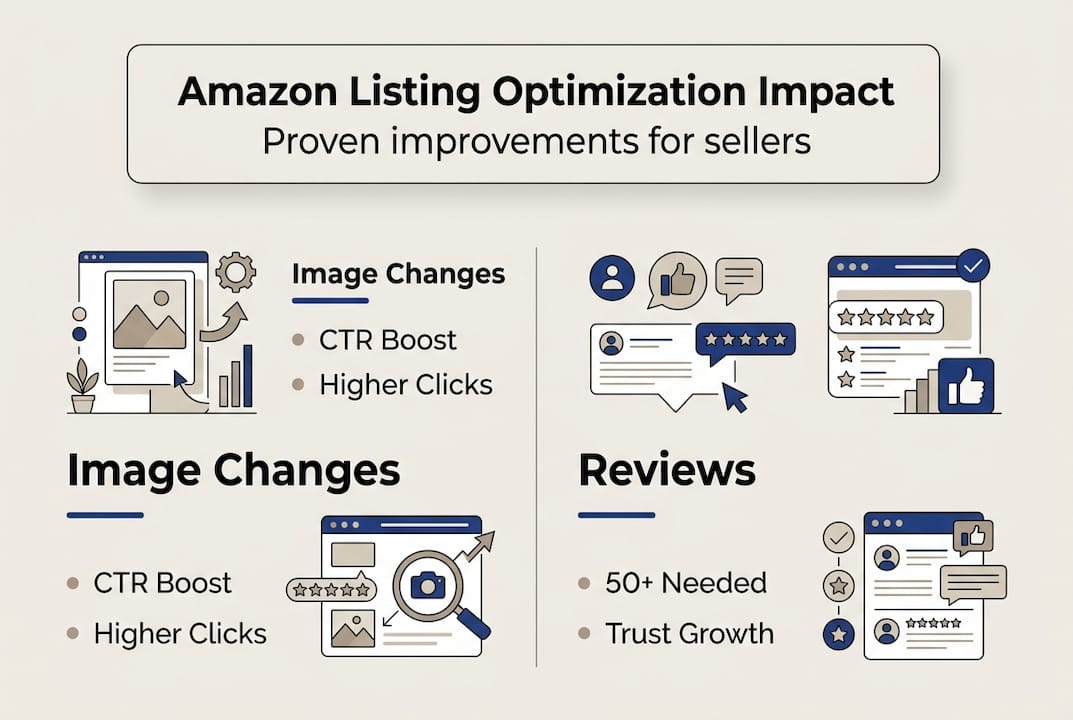
The numbers are hard to ignore. Optimized images lift CTR by 10 to 59%, and sellers need at least 50 reviews to compete effectively in most categories. The average Amazon conversion rate sits between 10 and 15%, which is already far above most e-commerce benchmarks. But optimized listings push well beyond that average.
| Metric | Before optimization | After optimization |
|---|---|---|
| Conversion rate | 4 to 6% | 12 to 18% |
| Click-through rate | Low impression share | 10 to 59% improvement |
| Organic ranking | Page 3 to 5 | Page 1 to 2 |
| Revenue (case study) | $50,000/month | $170,000/month |
| A+ Content sales lift | Baseline | 8 to 20% increase |
That revenue case study is real. A 240% revenue growth from $50,000 to $170,000 was achieved by combining PPC and SEO optimization with a 21% TACoS (Total Advertising Cost of Sale), meaning the advertising spend remained efficient even as revenue tripled.
“Optimization isn’t a one-time event. The sellers who win long-term treat it as an ongoing investment, not a launch checklist.”
Imagery plays a bigger role than most sellers realize. Your main image determines whether a shopper clicks at all. Investing in professional photography and then using your image optimization gains to test variants can be the single highest-ROI action you take this quarter. Combine that with a guide to high-converting listings and you have a repeatable system for every new product you launch.

How to choose the right Amazon optimization consultant
The impact is clear, but how do you ensure you pick the right expert for your goals?
Not all consultants are equal. Some specialize in launch strategy, others in PPC, and others in full-service account management. The best fit depends on where your biggest gap is. Data-driven, iterative processes are the hallmark of quality consultants: audit first, optimize listings for conversion, integrate PPC, and maintain account health throughout.
Ask these questions before signing any agreement:
- Can you show me case studies in my product category?
- What tools do you use for keyword research and rank tracking?
- How do you measure success, and what KPIs will we track together?
- What does your audit process look like before you start optimizing?
- How often will you communicate results and recommend changes?
Watch for these red flags:
- Guaranteed rankings: No one can guarantee Amazon rankings. Anyone who does is overselling.
- No audit phase: Jumping straight to rewrites without diagnosing the real problem is a waste of your budget.
- Vague deliverables: You should know exactly what you’re getting, by when, and how it will be measured.
- No niche experience: A consultant who has never worked in your category may miss critical competitive dynamics.
Setting clear expectations upfront protects both sides. Define your target keywords, your conversion rate goal, and your revenue benchmark before work begins. A strong strategy for Amazon products starts with alignment on what success looks like. Explore seller consulting options to compare service models and find the structure that fits your stage of growth.
Ready to optimize? Unlock your Amazon growth potential
You now understand what separates a stagnant listing from a top-ranked, high-converting product page. The frameworks, the benchmarks, and the pro-level tactics are all within reach.

At Searchoneers, we put every one of these strategies to work for Amazon sellers who are serious about growth. From building your enhancement guide for higher sales to executing a full workflow for Amazon sellers, our team handles the research, the writing, the testing, and the ongoing refinement. We specialize in Amazon listing optimization and data-backed SEO, so every decision we make is tied to your actual performance metrics. If you’re ready to stop guessing and start ranking, explore how we approach boosting product visibility and let’s build your growth plan together.
Frequently asked questions
What does an Amazon optimization consultant actually do?
They analyze, optimize, and manage your product listings using proven frameworks to boost your rankings, conversions, and sales. Consultants provide product listing optimization, keyword research, PPC management, account audits, and fulfillment strategy as part of a full-service engagement.
When should I hire an Amazon optimization consultant?
If your listings aren’t ranking or converting, or you need to scale efficiently, a consultant can drive measurable improvement. Professional input delivers ROI especially when your listing has stability in reviews, inventory, and pricing but still isn’t gaining traction.
Does PPC help organic Amazon rankings?
PPC ads don’t directly improve organic rank, but the sales velocity they generate can push your organic placement higher. Sales velocity from ads signals relevance to Amazon’s algorithm, which rewards it with better organic positioning over time.
What’s the fastest way to see results on Amazon after optimizing?
Optimized listings backed by targeted PPC usually result in improved visibility and sales within weeks. Case studies show 240% revenue growth using a combined PPC and SEO approach, with results beginning to compound quickly after launch.
What’s the most important part of Amazon listing optimization?
Titles and bullet points have the biggest impact since they influence both your ranking and your conversion rate. The TFSD framework prioritizes the title as the highest-weight element, followed by bullets, backend keywords, and description.

Comments
One response to “Boost Sales with an Amazon Optimization Consultant”
[…] Boost Sales with an Amazon Optimization Consultant – Searchoneers […]