Most Amazon sellers assume the top search results are reserved for whoever spends the most on ads. That assumption is costing you sales. Organic ranking, where your product appears in search results based on relevance and performance rather than paid placement, is the engine behind sustainable Amazon growth. Organic ranking outpaces paid promotion in long-term impact for sellers who know how to work the algorithm. This guide breaks down exactly how organic ranking works, what drives it in 2026, and the specific steps you can take to climb higher without burning through your ad budget.
Table of Contents
- What is organic ranking on Amazon?
- The two pillars of organic ranking: Relevance and performance
- Key performance signals that move the organic ranking needle
- 2026 algorithm updates: What has changed for organic ranking?
- Step-by-step: How to improve your organic ranking in 2026
- Why organic ranking is every seller’s competitive advantage
- Accelerate your organic ranking with Amazon experts
- Frequently asked questions
Key Takeaways
| Point | Details |
|---|---|
| Organic ranking defined | It’s where your product appears in search results without paid ads, and is critical for Amazon success. |
| Two ranking pillars | Combine keyword relevance with strong performance (sales, conversion, reviews) to climb results. |
| Algorithm updates matter | 2026 changes favor behavioral signals, external traffic, and seller authority over just backend keywords. |
| Practical optimization steps | Focus on conversion drivers, image quality, competitive pricing, indexation, and strategic PPC for momentum. |
| Long-term advantage | A high organic rank delivers ongoing sales and competitive strength at zero ad cost. |
What is organic ranking on Amazon?
Organic ranking is your product’s position in Amazon’s search results when no paid promotion is involved. When a shopper types “wireless earbuds” into the search bar, the listings that appear based on Amazon’s algorithm, not sponsored placements, are organically ranked. The higher your product sits, the more clicks and sales you capture.
This matters more than most sellers realize. The majority of Amazon purchases originate from organic listings, not sponsored ads. Shoppers trust organic results more, click them more often, and convert at higher rates. Paid ads are visible, but they stop working the moment your budget runs out.
Organic ranking depends on both relevance and performance signals, which means any seller, regardless of brand size, can compete if they optimize correctly. Understanding Amazon SEO meaning is the first step toward building that competitive position.
Here is what separates organic from sponsored placements at a glance:
- Organic listings appear based on algorithm signals and require no per-click spend
- Sponsored listings are paid placements that disappear when the campaign ends
- Organic rank builds over time and compounds with each sale and positive review
- Paid rank can spike quickly but does not transfer to organic position on its own
“The brands winning on Amazon in 2026 are not just the ones with the biggest ad budgets. They are the ones who have built listings that convert, earn reviews, and stay in stock.”
Now that you have seen how important organic ranking is, let’s break down what actually drives it on Amazon.
The two pillars of organic ranking: Relevance and performance
Amazon’s algorithm evaluates every listing on two core dimensions. Get both right, and your product climbs. Neglect either one, and even a well-funded ad campaign will not save your position.
Two pillars drive ranking: Relevance (keywords in title, bullets, description, backend; indexation) and Performance (sales velocity, conversion rate, CTR, reviews, pricing, fulfillment). Think of relevance as getting your product into the right conversations, and performance as proving to Amazon that shoppers actually want what you are selling.

Understanding the roles of keywords in listings is critical for the relevance side. Your title carries the most weight, followed by bullet points, the product description, and backend search terms. For Amazon search optimization, every field in your listing is an opportunity.
| Pillar | Key components | Impact level |
|---|---|---|
| Relevance | Title keywords, bullet points, description, backend terms | High |
| Performance | Sales velocity, conversion rate, CTR | Very High |
| Performance | Reviews and ratings, pricing, fulfillment speed | High |
| Relevance | Indexation status (is Amazon reading your keywords?) | Medium |
Both pillars must be strong. A listing stuffed with keywords but lacking reviews will not convert. A product with great reviews but a poorly written title will not get found. The algorithm rewards listings that do both well.
With the basics in place, it is critical to understand how each performance signal works in practice.
Key performance signals that move the organic ranking needle
Not all ranking factors carry equal weight. Here are the six performance signals that matter most in 2026, and what you can do about each one.
Sales velocity, conversion rate, CTR, reviews, pricing, and fulfillment are the core performance ranking inputs. Amazon interprets each of these as evidence that your product satisfies shoppers.
- Sales velocity: Products that sell faster climb rankings. More daily sales signal demand, and Amazon rewards that with better placement.
- Conversion rate: If 100 people visit your listing and 12 buy, that 12% conversion rate tells Amazon your product matches what shoppers want. Higher is better.
- Click-through rate (CTR): Your main image and price determine whether shoppers click at all. A weak image kills your CTR before anyone reads a single bullet point.
- Reviews and ratings: Social proof drives conversions. A product with 500 reviews at 4.5 stars will almost always outperform a similar product with 20 reviews.
- Price and deals: Competitive pricing and limited-time deals generate sales momentum. Use price tracking strategies to stay sharp without racing to the bottom.
- Fulfillment type and speed: Amazon prioritizes Prime-eligible products. FBA (Fulfilled by Amazon) listings consistently outrank merchant-fulfilled equivalents for the same keywords.
Follow Amazon SEO best practices to align your listing with each of these signals systematically.
Pro Tip: Even a perfectly keyword-optimized listing will lose organic rank if your main image is low quality or your ratings drop below 4.0. Fix conversion problems before adding more keywords.
Stat to know: Listings in the top 3 organic positions on Amazon capture the majority of clicks on any given search page. Position 1 alone can account for over 30% of all clicks for high-volume keywords.
But not all ranking factors influence your listing equally. Let’s go deeper on the unique technical considerations in 2026.
2026 algorithm updates: What has changed for organic ranking?
Amazon’s algorithm, often referred to as A10, has shifted significantly. If you are still optimizing the way you did two or three years ago, you are leaving rank on the table.
The A10 shift prioritizes behavioral signals, external traffic, and seller authority. Backend keywords are still indexed but carry less weight than they once did. What shoppers do after seeing your product now matters more than what words you buried in the backend.
Here is how the algorithm has changed:
| Ranking factor | Pre-2024 weight | 2026 weight |
|---|---|---|
| Backend keywords | High | Medium |
| Behavioral signals (clicks, purchases) | Medium | Very High |
| Seller authority and account health | Low | High |
| External traffic (off-Amazon) | Low | Medium-High |
| Images and price | Medium | High |
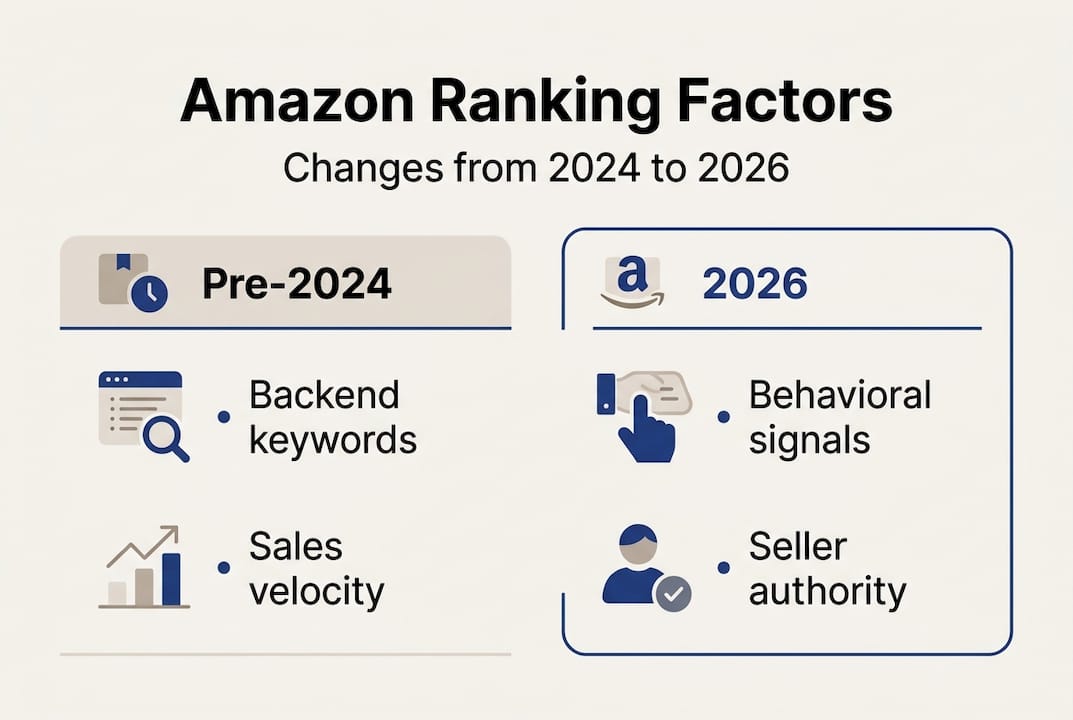
Seller authority is a newer weighted factor. Your account health score, positive seller feedback, and history of policy compliance now influence how Amazon treats your listings in search. A seller with a strong track record gets a ranking edge over a newer or lower-rated account selling the same product.
External traffic from social media, email lists, and influencer content now signals genuine demand to Amazon. Driving shoppers from outside the platform to your listing is no longer just a bonus strategy. Review the latest Amazon algorithm changes and understand how backend search terms changes affect your indexation strategy. You can also use a reliable price tracker to monitor competitive pricing shifts that affect your conversion rate.
Pro Tip: If your listing suddenly drops in rank, the first thing to check is indexation. Use Amazon’s search bar to confirm your ASIN still appears for your primary keywords. If it does not, your backend terms or listing content may have triggered a suppression.
With the latest changes in mind, here is how to reliably boost your organic rankings in the current landscape.
Step-by-step: How to improve your organic ranking in 2026
Optimization is not a one-time task. It is a monthly practice. Here is a clear action sequence that works with the current algorithm.
- Audit your keyword indexation. Use Amazon’s search bar or a third-party tool to confirm your ASIN is indexed for your top keywords. If you are not indexed, you are invisible. Learn how to optimize keywords on Amazon to fix gaps fast.
- Upgrade your main image. This is the single highest-leverage change most sellers can make. A professional, high-contrast image on a white background with a clear product view will lift CTR immediately.
- Make your price competitive. You do not need to be the cheapest, but you need to be in range. Use monitoring product prices tools to track competitor shifts weekly.
- Improve your reviews. Request feedback through Amazon’s “Request a Review” button after confirmed delivery. Never incentivize reviews. Volume and recency both matter.
- Ensure Prime eligibility. If you are not using FBA, evaluate whether the ranking benefit justifies the switch. Prime eligibility directly affects both CTR and conversion.
- Use PPC tactically. Run targeted sponsored ads on your primary keywords to generate short-term sales velocity. That velocity feeds organic rank. It is not cheating the system. It is how the system works.
Use the Amazon SEO keywords guide to build a keyword strategy that supports both relevance and performance.
Your ongoing optimization checklist:
- Review keyword indexation monthly
- A/B test main images every 60 days
- Monitor competitor pricing weekly
- Track conversion rate by ASIN in Seller Central
- Respond to negative reviews professionally and promptly
- Check account health score regularly
Prioritize conversion levers like images, price, and reviews over keyword stuffing. The algorithm rewards listings that sell, not listings that just contain the right words.
To summarize, let’s recap why organic ranking matters most for long-term Amazon success.
Why organic ranking is every seller’s competitive advantage
Paid ads are a tool. Organic ranking is an asset. The difference matters enormously when you are planning for sustainable growth.
Organic ranking outpaces paid promotion in long-term impact because it generates continuous, cost-free visibility. Every sale you earn organically is a sale you did not pay per-click for. That margin difference compounds over months and years.
Here is why every seller should prioritize organic rank:
- Cost efficiency: Organic clicks cost nothing. Ad clicks cost more every year as competition increases.
- Ad cost protection: A strong organic position means you are not held hostage by rising CPC (cost per click) rates.
- Brand trust: Shoppers perceive organically ranked products as more credible. They convert better and generate more repeat purchases.
- Scalability: Organic rank scales without proportionally increasing spend. Ads do not.
You do not need a massive budget to compete. You need a better listing, a stronger conversion rate, and a consistent optimization practice. Explore the difference between organic vs sponsored results to understand exactly where your effort pays off most.
“Sellers who invest in organic ranking build an asset. Sellers who only run ads are renting visibility they do not own.”
Ready to put these strategies into practice and go further? Here is where to get expert help.
Accelerate your organic ranking with Amazon experts
Understanding organic ranking is one thing. Executing it consistently across a growing catalog is another challenge entirely. That is where having the right resources and expertise makes the difference between slow progress and real momentum.

At Searchoneers, we help Amazon sellers build listings that rank, convert, and grow without relying entirely on ad spend. Start with our Amazon listing enhancement guide to see exactly what a high-performing listing looks like, then follow our proven optimization workflow to apply those principles to your own catalog. If you are ready to take a broader approach, our strategies to increase Amazon visibility cover the full picture from keyword research to conversion rate improvement.
Frequently asked questions
How long does it take to improve my organic ranking on Amazon?
Sellers typically see movement within 1 to 2 weeks when listings are optimized and sales velocity improves, but reaching top positions for competitive keywords can take several months of consistent effort.
Do paid ads (PPC) directly impact organic rankings?
PPC does not directly boost organic rank, but the sales velocity from PPC feeds performance signals that do. Sustained organic results require sustained performance, not just ad spend.
What factors can hurt my organic ranking the fastest?
Low conversion rates, a poor main image that kills CTR, negative reviews, going out of stock, and losing Prime eligibility are the fastest ways to drop your organic position.
Is it possible to rank organically without any ads?
Yes. Products with strong relevance, high conversion rates, and solid customer feedback can achieve top organic rankings without running a single sponsored ad, especially in less competitive niches.
How does seller account health affect organic ranking?
In 2026, Amazon weights seller authority more heavily than before. A healthy account with positive feedback and no policy violations gives your listings a measurable ranking advantage over competitors with weaker account standing.