

Finding the right keywords for your Amazon business can feel like solving a complex puzzle, especially when the market keeps shifting. North American and European sellers need a clear roadmap to stay visible and competitive. By mastering smart tools and regularly refining keyword strategies, you will uncover hidden opportunities that drive real sales and keep your products in front of shoppers who matter most.
Table of Contents
- Step 1: Analyze Current Keyword Performance And Market Trends
- Step 2: Identify High-Impact Keywords Using Amazon-Specific Tools
- Step 3: Integrate Targeted Keywords Into Listing Elements
- Step 4: Refine Backend Keyword Strategy For Enhanced Discoverability
- Step 5: Monitor And Adjust Keywords Based On Real-Time Analytics
Quick Summary
| Key Insight | Explanation |
|---|---|
| 1. Analyze keyword performance regularly | Use the Search Term Report to understand how your keywords drive sales and visibility. Focus on click-through and conversion rates. |
| 2. Integrate keywords strategically | Place relevant keywords in product titles, bullet points, and descriptions to improve visibility and customer appeal without compromising readability. |
| 3. Use dedicated Amazon tools for research | Leverage Amazon’s native tools like Brand Analytics and Product Opportunity Explorer to discover high-impact keywords with purchase intent. |
| 4. Optimize backend keywords effectively | Maximize the character space for invisible search terms by including synonyms and variations to enhance organic search ranking. |
| 5. Continuously monitor and refine strategies | Track keyword performance regularly to adapt to market trends and improve engagement based on real-time analytics. |
Step 1: Analyze current keyword performance and market trends
Effective keyword optimization on Amazon requires a strategic approach to understanding how your current keywords are performing and identifying emerging market trends. When diving into keyword analysis, you’ll want to evaluate your existing product listings’ search visibility and competitive positioning.
Start by accessing your Amazon Seller Central account and reviewing the Search Term Report. This detailed report reveals how customers are discovering your products and which keywords are driving actual sales. Pay special attention to metrics like click-through rates and conversion rates for each search term. Additionally, utilize Amazon’s keyword research strategies to uncover hidden opportunities within your product’s market segment.
To comprehensively analyze keyword performance, consider these critical evaluation steps:
- Review search term frequency and ranking positions
- Compare your keyword performance against top-competing listings
- Identify low-performing keywords that can be replaced
- Track seasonal keyword variations and emerging trends
- Analyze long-tail keyword opportunities with lower competition
Market trend analysis involves monitoring shifts in customer search behavior and emerging product interests. Tools like Amazon’s Brand Analytics and third-party keyword research platforms can provide deeper insights into search volume trends and competitive keyword landscapes.
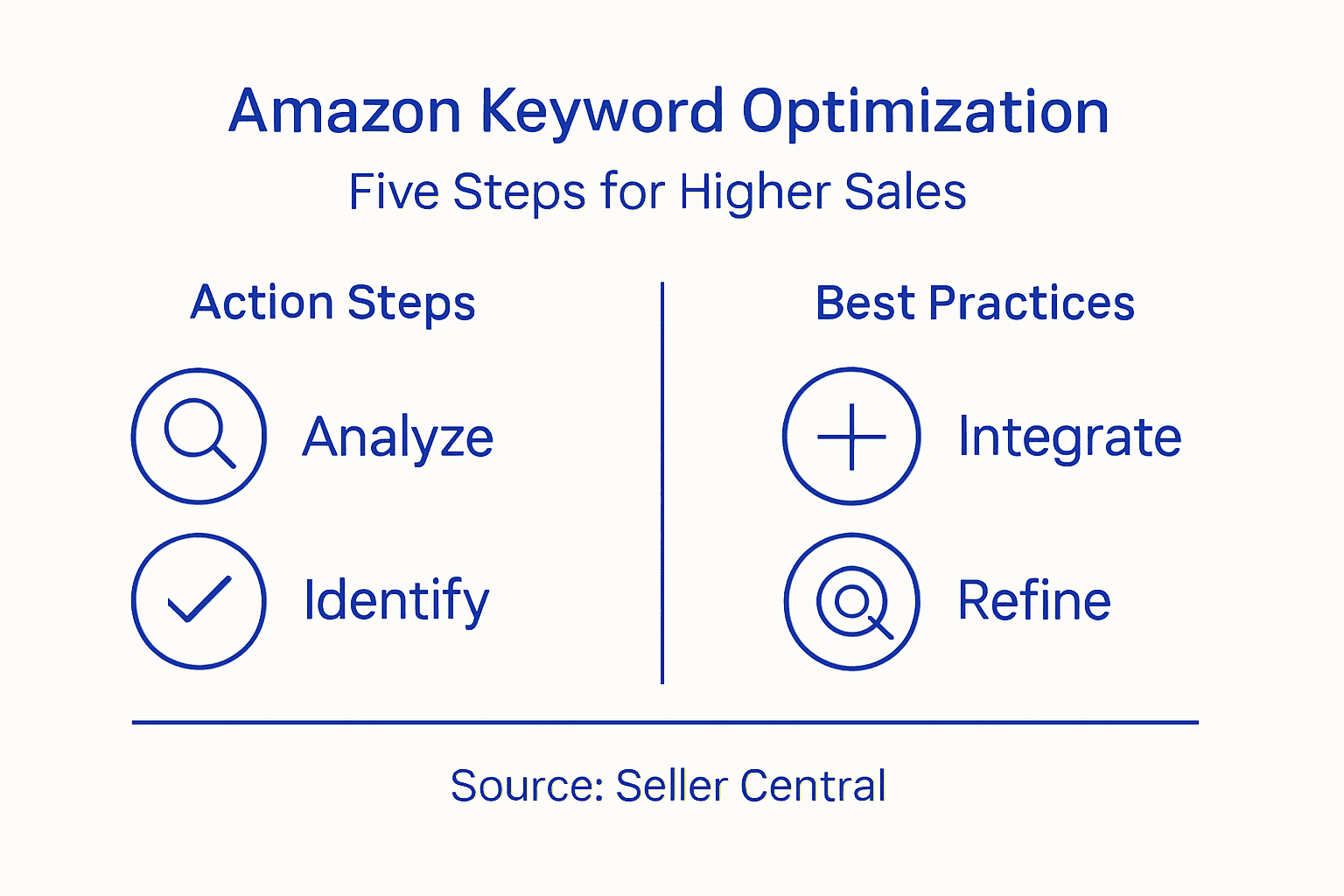
Pro tip: Always maintain a dynamic keyword strategy by regularly updating and testing your search terms to stay ahead of market changes.
Step 2: Identify high-impact keywords using Amazon-specific tools
Discovering powerful keywords that drive sales on Amazon requires a strategic and systematic approach using specialized research tools. Your goal is to uncover search terms that not only have high volume but also demonstrate clear purchase intent for your specific product category.
Amazon offers several powerful native tools for keyword research. The Product Opportunity Explorer provides critical insights into keyword research strategies that can transform your product visibility. Begin by leveraging tools like Amazon’s autocomplete feature, which reveals real-time search queries customers are actively using. These suggestions offer genuine insights into current market language and consumer search behavior.
To maximize your keyword strategy, focus on these essential research techniques:
- Use Amazon’s Brand Analytics for comprehensive search term data
- Analyze competitor product listings for hidden keyword opportunities
- Explore long-tail keyword variations with lower competition
- Utilize reverse ASIN lookup to understand competitor keyword strategies
- Track seasonal and trending keyword performance
Effective Amazon keyword research goes beyond volume – it’s about understanding genuine customer search intent and matching your product’s unique value proposition.
Prioritize keywords that demonstrate high relevance, reasonable competition, and clear alignment with your product’s features and benefits. Cross-reference multiple tools to validate your keyword selections and ensure you’re capturing the most impactful search terms.
Pro tip: Regularly refresh your keyword strategy every 60-90 days to stay aligned with evolving market trends and consumer search behaviors.
Here’s a comparison of Amazon keyword tools to help you select the right resource for each stage:
| Tool Name | Main Function | Ideal Use Case | Unique Benefit |
|---|---|---|---|
| Search Term Report | Shows actual customer search terms | Evaluating current performance | Direct insight from sales data |
| Brand Analytics | High-level search and competitor data | Trend discovery | Competitive and trending keyword info |
| Product Opportunity Explorer | Market research and keyword discovery | Finding new opportunities | Uncovers demand gaps |
| Reverse ASIN Lookup | Discovers competitor-used keywords | Spying on competition | Maps ranking keywords from rivals |
| Autocomplete Suggestions | Real-time customer search behavior | Identifying current language | Captures trending queries |
Step 3: Integrate targeted keywords into listing elements
Successfully incorporating keywords into your Amazon product listing requires a strategic and nuanced approach that balances searchability with compelling product communication. Your goal is to seamlessly weave targeted keywords into various listing components without compromising readability or customer appeal.

Focus on optimizing key listing elements to maximize keyword effectiveness. Essential roles of keywords dictate precise placement across your product title, bullet points, description, and backend search terms. Each section demands a careful balance between keyword density and natural language that resonates with potential buyers.
Prioritize keyword integration in these critical listing areas:
- Product Title: Include primary keywords near the beginning
- Bullet Points: Highlight key features using strategic keyword placement
- Product Description: Incorporate keywords naturally within descriptive text
- Backend Search Terms: Use additional relevant keywords not visible to customers
- Image Alt Text: Subtly include descriptive keywords for enhanced SEO
Effective keyword integration is an art of balance – prioritize customer comprehension while strategically improving search visibility.
Remember that Amazon’s algorithm values relevance and natural language. Avoid keyword stuffing by focusing on creating a clear, informative listing that genuinely helps customers understand your product’s unique value proposition.
Pro tip: Conduct periodic listing audits to ensure your keywords remain aligned with current search trends and evolving customer language.
The table below summarizes how effective keyword integration influences Amazon listing success:
| Listing Element | Impact of Strong Integration | Common Pitfall If Overlooked |
|---|---|---|
| Product Title | Boosts primary search rankings | Poor ranking, lower visibility |
| Bullet Points | Highlights features for more conversions | Missed selling points |
| Product Description | Improves readability and conversion rates | Customers confused or disengaged |
| Backend Search Terms | Enhances discoverability through algorithm | Reduced organic reach |
Step 4: Refine backend keyword strategy for enhanced discoverability
Mastering backend keywords is a critical yet often overlooked strategy for improving your Amazon product’s search visibility. Your goal is to strategically optimize these hidden search terms that directly influence how Amazon’s algorithm indexes and surfaces your product.
Understand the nuanced world of Amazon backend search terms by focusing on precise, relevant keyword selection. Backend keywords are invisible to customers but play a crucial role in determining your product’s searchability. These keywords should include synonyms, alternative spellings, related product uses, and descriptive variations that potential buyers might use when searching.
Implement a comprehensive backend keyword strategy through these key techniques:
- Use all available character space (250-byte limit) strategically
- Include misspellings and common search variations
- Incorporate regional language differences and synonyms
- Avoid repetitive terms already used in product title or bullets
- Prioritize most relevant and high-volume search terms
Backend keywords are your secret weapon for improving organic search ranking – use them wisely and precisely.
When selecting backend keywords, think like your potential customer. Consider the various ways someone might describe or search for your product, including technical specifications, functional uses, and colloquial language. Regularly update these keywords based on performance analytics and emerging search trends.
Pro tip: Conduct quarterly backend keyword audits to ensure your search terms remain current and competitive.
Step 5: Monitor and adjust keywords based on real-time analytics
Successful Amazon keyword optimization requires continuous monitoring and strategic adjustments based on performance data. Your ultimate goal is to develop an agile approach that allows you to quickly respond to shifts in search behavior and competitive dynamics.
Utilize keyword tracking tools for Amazon analytics to gain comprehensive insights into your product’s search performance. These platforms provide critical metrics like impressions, click-through rates, conversion rates, and ranking positions that enable data-driven keyword refinement.
Implement a systematic approach to keyword performance tracking:
- Review search term performance weekly
- Identify top-performing and underperforming keywords
- Track changes in search volume and competitive landscape
- Analyze conversion rates for each keyword
- Remove keywords with consistently low engagement
Real-time analytics are your strategic compass – use them to navigate the complex Amazon marketplace with precision.
Understand that keyword optimization is not a one-time task but an ongoing process. Amazon’s algorithm continuously evolves, and consumer search behaviors change rapidly. Stay flexible and be prepared to make quick, informed adjustments to your keyword strategy based on the most recent performance data.
Pro tip: Set up automated reporting and schedule monthly deep-dive reviews to ensure your keyword strategy remains dynamic and responsive.
Unlock Your Amazon Sales Potential with Expert Keyword Optimization
Struggling to optimize your keywords for higher sales on Amazon is a common challenge. This article reveals key pain points like selecting the right search terms, integrating keywords naturally into listings, and constantly adapting to market trends. You want your listings to be visible and compelling without falling into the trap of keyword stuffing or missing out on backend search term opportunities.
That is where our expertise comes in. At SearchOneers, we specialize in Amazon Listing Optimization that fine-tunes your titles, bullet points, descriptions, and backend keywords to maximize visibility. Our data-driven Amazon SEO & Analytics services ensure your keyword strategy evolves with real-time insights. Discover actionable strategies and tips within our E-commerce Tips & Strategies to Grow Your Online Business category designed to keep your listings competitive and aligned with current customer search behavior.
Take control of your Amazon keyword strategy today. Visit SearchOneers to transform your listings into powerful sales drivers with expert optimization that adapts as your market changes. Start increasing your visibility and conversions now.
Frequently Asked Questions
How can I analyze my current keyword performance on Amazon?
To analyze your current keyword performance, access the Search Term Report in your Amazon Seller Central account. Review key metrics like click-through rates and conversion rates for each keyword to identify which ones are driving sales.
What tools can I use to find high-impact keywords for my Amazon listings?
You can use Amazon’s native tools, such as Brand Analytics and the Product Opportunity Explorer, to discover high-impact keywords. Begin by leveraging these tools to uncover search terms with high volume and clear customer purchase intent.
How do I effectively integrate keywords into my Amazon product listings?
To integrate keywords effectively, place them strategically in your product title, bullet points, and product description without compromising readability. Aim to create an informative listing that naturally incorporates relevant keywords to enhance both search visibility and customer understanding.
What should I include in my backend keywords for Amazon listings?
When selecting backend keywords, focus on including synonyms, alternative spellings, and related terms that potential buyers may use. Use the full character limit available to ensure you capture as many relevant search variations as possible.
How often should I review and adjust my keyword strategy?
You should review and adjust your keyword strategy every 60-90 days to stay aligned with changing market trends and search behaviors. Regularly analyze performance data to remove underperforming keywords and capitalize on new opportunities.
What metrics are essential for monitoring keyword performance on Amazon?
Key metrics for monitoring keyword performance include impressions, click-through rates, conversion rates, and ranking positions. Track these metrics weekly to identify trends and make informed adjustments to your keyword strategy.
Recommended
- Optimize for Amazon Search: Boost Your Product Visibility
- Amazon Keywords Explained: Strategies for Success – Searchoneers
- Copywriting for Amazon Listings: Tips & Best Practices
- How to Optimize Amazon Listings: Complete Guide
- Order Tracking Optimization That Actually Works: Reduce Support Calls and Drive Revenue – WISMOlabs

Comments
One response to “How to Optimize Keywords on Amazon for Higher Sales”
[…] every sentence count. Enhanced Brand Content or A+ Content offers even richer opportunities for optimize keywords on Amazon while showcasing your […]