

Turning marketplace data into clear business insights is a daily challenge for American and Canadian Amazon FBA sellers. With so many metrics to review, knowing which ones matter most often feels confusing. Mastering descriptive analytics and related techniques is the key to unlocking actionable strategies that drive better decisions for your listings and marketing. This guide will clarify core analytics categories and reveal how using the right tools separates thriving sellers from those simply tracking basic numbers.
Table of Contents
- Defining Amazon Analytics And Its Core Concepts
- Key Metrics And Data Amazon Sellers Track
- How Analytics Tools Optimize Listings And Sales
- Common Pitfalls When Ignoring Analytics Data
- Choosing The Right Analytics Solution For FBA
Key Takeaways
| Point | Details |
|---|---|
| Understanding Core Analytics Types | Familiarize yourself with descriptive, diagnostic, predictive, and prescriptive analytics to effectively analyze seller performance and make data-driven decisions. |
| Focus on Key Metrics | Track essential performance, traffic, competitive, and customer engagement metrics to inform strategic decision-making and optimize product positioning. |
| Utilize Effective Analytics Tools | Invest in analytics solutions that offer real-time data visualization and predictive capabilities to enhance listings and improve sales strategies. |
| Avoid Common Data Mistakes | Be cautious of misinterpreting data correlations and biases, ensuring comprehensive analysis to drive sustainable marketplace growth. |
Defining Amazon Analytics and Its Core Concepts
Amazon Analytics represents a comprehensive data ecosystem that enables sellers to transform raw marketplace information into strategic business intelligence. At its core, analytics provides a systematic approach to understanding performance metrics, customer behaviors, and sales dynamics within the Amazon ecosystem. By leveraging key analytics techniques, sellers can move beyond basic reporting and develop nuanced insights that drive meaningful growth strategies.
The framework of Amazon Analytics encompasses several critical dimensions, including descriptive analytics (what happened), diagnostic analytics (why it happened), predictive analytics (what might happen), and prescriptive analytics (what actions should be taken). Each dimension offers unique perspectives on seller performance. Descriptive analytics might reveal total sales volume, while diagnostic analytics could uncover specific factors contributing to sales fluctuations—such as seasonal trends, pricing adjustments, or competitive landscape changes.

Understanding these analytical categories helps Amazon sellers transition from reactive to proactive business management. By systematically analyzing data across multiple metrics—including conversion rates, click-through rates, inventory turnover, and customer engagement—sellers can make informed decisions that optimize listing performance, pricing strategies, and overall marketplace positioning. The goal is not just to collect data, but to transform that data into actionable strategies that drive sustainable growth.
Pro tip: Start by mastering one analytical dimension at a time, focusing first on descriptive analytics before progressing to more complex predictive and prescriptive approaches.
Here is a comparison of Amazon analytics types and how each drives business value:
| Analytics Type | Primary Question Answered | Typical Use Case | Strategic Impact |
|---|---|---|---|
| Descriptive Analytics | What happened? | Reviewing sales history | Identifies trends and patterns |
| Diagnostic Analytics | Why did it happen? | Analyzing sales drops | Reveals causes behind results |
| Predictive Analytics | What might happen next? | Forecasting inventory needs | Enables proactive planning |
| Prescriptive Analytics | What should we do? | Optimizing pricing strategies | Recommends actions for growth |
Key Metrics and Data Amazon Sellers Track
Successful Amazon sellers understand that data is the foundation of strategic decision-making. Amazon Brand Analytics provides sellers with a comprehensive view of marketplace performance, offering critical insights that go far beyond basic sales tracking. These analytics empower sellers to understand complex customer behaviors, optimize product positioning, and develop targeted marketing strategies.
The key metrics Amazon sellers typically monitor fall into several critical categories. Performance metrics include conversion rates, click-through rates, and total sales volume. Traffic metrics reveal how customers discover products, tracking impressions, search query rankings, and organic versus sponsored visibility. Competitive metrics offer insights into market positioning, including share of voice, competitor pricing, and comparative performance within specific product categories. Customer engagement metrics such as review ratings, response times, and return rates provide deeper understanding of product perception and customer satisfaction.
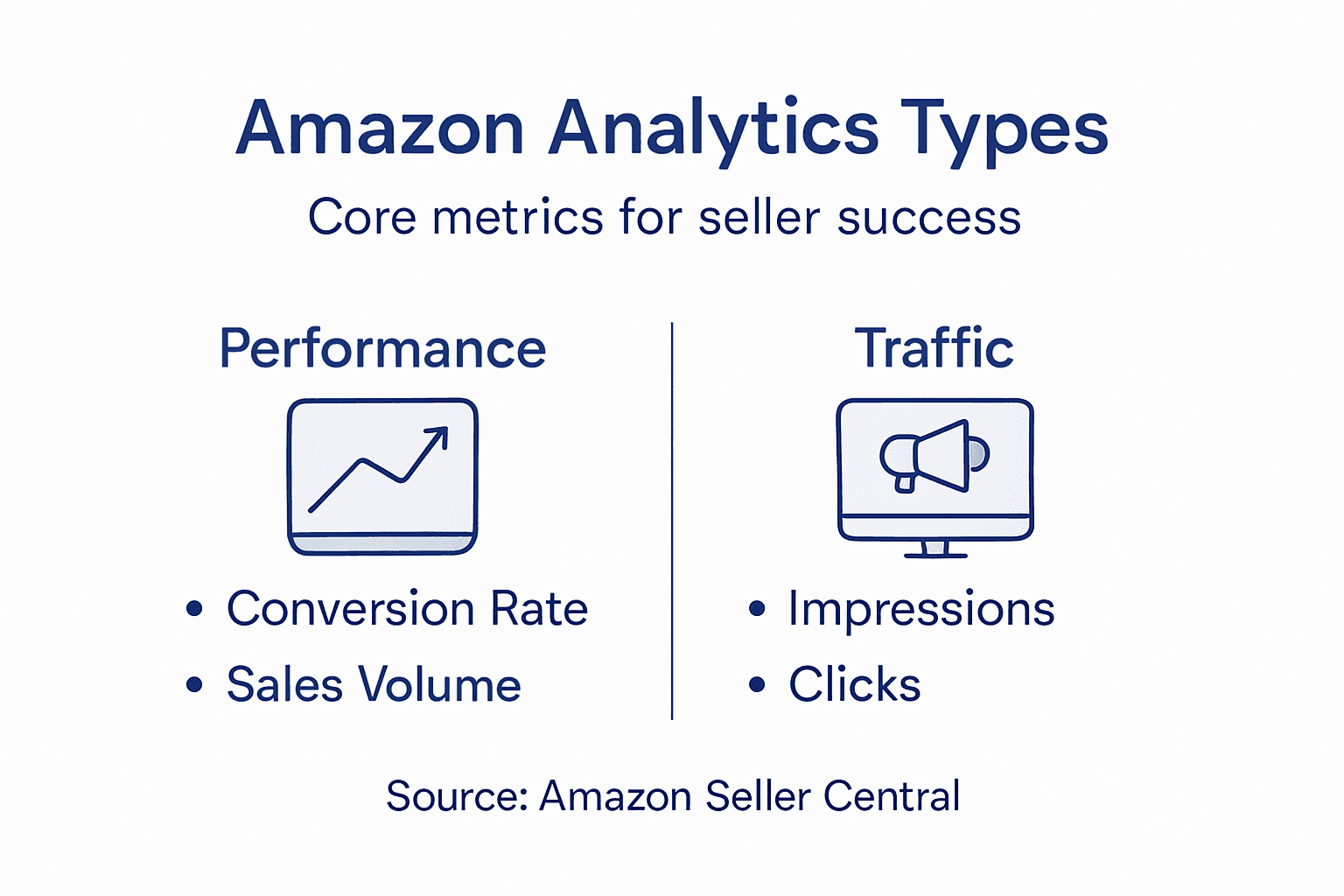
Beyond surface-level data, advanced sellers dive into granular analytics that reveal nuanced marketplace dynamics. This includes analyzing customer search behaviors, understanding seasonal trends, tracking keyword performance, and identifying emerging competitive threats. By combining multiple data points—such as conversion rates with search query data—sellers can develop sophisticated strategies that optimize listing performance, pricing, and advertising approaches. The goal is transforming raw data into actionable intelligence that drives sustainable marketplace growth.
Pro tip: Create a weekly dashboard consolidating your most critical metrics, allowing you to quickly assess performance trends and make data-driven adjustments.
Below is a summary of key data categories sellers should track and how they inform business decisions:
| Data Category | Example Metrics | Role in Decision-Making |
|---|---|---|
| Performance Metrics | Conversion rate, sales | Evaluates offer effectiveness |
| Traffic Metrics | Impressions, search rank | Determines product visibility |
| Competitive Metrics | Market share, pricing | Assesses position versus competitors |
| Customer Engagement | Reviews, return rates | Informs satisfaction and loyalty efforts |
How Analytics Tools Optimize Listings and Sales
Analytics tools have revolutionized how Amazon sellers approach marketplace optimization, transforming raw data into strategic insights. Product listing optimization represents a critical process where sellers systematically refine every aspect of their product presentation to maximize visibility and conversion potential. These sophisticated tools dissect complex marketplace dynamics, revealing hidden opportunities for improvement that manual analysis could never uncover.
The optimization process involves multiple strategic layers. Analytics tools evaluate comprehensive funnel metrics, tracking customer interactions from initial impressions through final purchase. This includes analyzing click-through rates, add-to-cart behaviors, conversion rates, and drop-off points in the customer journey. By identifying precise moments where potential buyers disengage, sellers can make targeted improvements to titles, images, descriptions, and pricing strategies. Advanced tools also provide competitive benchmarking, allowing sellers to understand their market positioning relative to similar products and identify strategic advantages.
Modern analytics platforms go beyond simple data reporting, offering predictive capabilities that help sellers anticipate market trends and customer preferences. These tools leverage machine learning algorithms to provide recommendations on keyword optimization, pricing adjustments, and inventory management. Sellers can now make data-driven decisions with unprecedented precision, understanding not just what happened, but why it happened and what actions will most likely drive future success. The integration of real-time analytics transforms product listings from static information pages into dynamic, responsive marketing assets that continuously adapt to marketplace conditions.
Pro tip: Dedicate at least one hour weekly to deep-diving into your analytics dashboard, focusing on understanding trend lines and anomalies rather than just surface-level numbers.
Common Pitfalls When Ignoring Analytics Data
Amazon sellers who neglect comprehensive data analysis expose themselves to significant strategic risks. Data interpretation challenges can lead to costly misunderstandings that undermine business performance. The most dangerous pitfall is making decisions based on incomplete or misunderstood marketplace insights, which can result in misallocated resources, ineffective marketing strategies, and missed growth opportunities.
Sellers often fall into several critical traps when analyzing their Amazon performance. One major mistake is conflating correlation with causation—assuming that because two metrics appear related, one directly causes the other. For instance, a spike in traffic might not necessarily translate to increased sales. Another common error involves using biased or insufficient data samples that do not represent the true marketplace dynamics. This can lead to skewed interpretations of product performance, pricing strategies, and customer behavior. Advanced sellers recognize that robust analytics require comprehensive data sets, statistical validation, and a nuanced understanding of underlying marketplace trends.
Moreover, ignoring analytics data can create broader strategic vulnerabilities. Without a systematic approach to data analysis, sellers become reactive instead of proactive, constantly playing catch-up with market changes. This approach prevents sellers from developing predictive strategies that anticipate customer preferences, competitive shifts, and emerging marketplace opportunities. The most successful Amazon sellers treat their analytics not as a periodic review, but as a continuous, dynamic process of learning and adaptation. They leverage data not just to understand past performance, but to make intelligent, forward-looking decisions that position their business for sustained growth.
Pro tip: Implement a monthly analytics review where you critically challenge your assumptions and look for unexpected patterns or contradictions in your data.
Choosing the Right Analytics Solution for FBA
Selecting an effective analytics solution can make or break an Amazon FBA seller’s growth strategy. Choosing the right business analytics tools requires careful consideration of multiple factors that align with a seller’s specific operational needs and growth objectives. The marketplace demands solutions that provide not just raw data, but actionable insights that can drive strategic decision-making and optimize overall business performance.
The ideal analytics platform for Amazon FBA sellers should offer a comprehensive suite of features. Critical capabilities include real-time data visualization, predictive sales forecasting, inventory management tracking, and competitive market analysis. Advanced sellers look for tools that can integrate seamlessly with Amazon’s ecosystem, providing granular insights into performance metrics such as conversion rates, click-through rates, customer acquisition costs, and product-level profitability. The most sophisticated platforms leverage machine learning algorithms to help sellers anticipate market trends and make proactive strategic adjustments.
Beyond technical capabilities, sellers must evaluate analytics solutions based on their personal skill level and business complexity. Smaller operations might benefit from more intuitive, user-friendly platforms with straightforward dashboards, while larger sellers may require more advanced tools with custom reporting and deeper analytical capabilities. The goal is finding a solution that balances sophistication with usability, enabling sellers to transform complex data into clear, actionable business strategies without requiring advanced technical expertise.
Pro tip: Before committing to an analytics platform, request a detailed demo and trial period to thoroughly test the tool’s compatibility with your specific Amazon business model and reporting needs.
Unlock Data-Driven Growth with Expert Amazon Analytics Support
Struggling to turn complex Amazon Analytics data into clear, actionable strategies can hold your business back from reaching its full potential. This article highlights how mastering descriptive, diagnostic, predictive, and prescriptive analytics is critical for proactive decision-making, optimized listings, and increased sales. At SearchOneers, we understand these challenges and specialize in breaking down intricate analytics into simple, effective solutions tailored for your brand’s growth.
Take control of your Amazon success today by exploring our E-commerce Tips & Strategies to Grow Your Online Business. Our expert Amazon Listing Optimization enhances your titles, bullet points, descriptions, and backend keywords to boost your product visibility. Paired with our smart, data-backed Amazon SEO & Analytics strategies, you receive a comprehensive approach that evolves alongside the marketplace. Visit SearchOneers now to transform your data challenges into profitable opportunities.
Frequently Asked Questions
Why is monitoring Amazon Analytics important for sellers?
Monitoring Amazon Analytics is crucial for sellers because it provides insights into performance metrics, customer behaviors, and sales dynamics. This data helps sellers make informed decisions that optimize product positioning, marketing strategies, and drive sustainable business growth.
What are the key metrics that Amazon sellers should track?
Key metrics include performance metrics like conversion rates and total sales volume, traffic metrics such as impressions and search rankings, competitive metrics that assess market positioning, and customer engagement metrics like review ratings and return rates.
How can analytics tools help optimize product listings on Amazon?
Analytics tools help sellers optimize product listings by providing insights into customer interactions, identifying drop-off points in the purchasing process, and offering recommendations for improvements in titles, images, and pricing strategies to maximize visibility and conversion potential.
What common pitfalls should sellers avoid when using Amazon Analytics?
Common pitfalls include making decisions based on incomplete data, conflating correlation with causation, and ignoring broader trends. These mistakes can lead to ineffective strategies and missed growth opportunities.
Recommended
- Amazon Analytics: Unlocking Sales Growth Globally – Searchoneers
- Understanding Amazon Growth Strategies – Scale Your Business
- How to Evaluate Amazon Data for Stronger Sales Results – Searchoneers
- Amazon Attribution Explained: Unlocking Smarter Campaigns – Searchoneers
- Ecommerce Analytics Explained: Complete Guide for 2025

Comments
2 responses to “Why Monitor Amazon Analytics: Data-Driven Growth”
[…] that keyword performance tracking is not a onetime task but an ongoing strategic process. Amazon analytics strategies provide critical insights into your listing’s search visibility and potential growth […]
[…] Unlock data-driven marketplace strategies that transform numbers into actionable intelligence. Amazon provides robust analytics tools that offer deep insights beyond surface-level performance indicators. […]