

Most American sellers know that the difference between a top-ranked Amazon listing and one that disappears in search often comes down to hidden strategy. Nearly 60 percent of purchases on Amazon are driven by search visibility, making backend keyword optimization a crucial skill every experienced seller should master. Understanding how these secret keywords work can transform how your products appear to potential buyers and open new opportunities for growth.
Table of Contents
- Amazon Backend Search Terms Defined
- Keyword Types And Their Strategic Roles
- Amazon’s Indexing Rules And Byte Limits
- Best Practices For Search Term Optimization
- Major Mistakes And Compliance Risks
Key Takeaways
| Point | Details |
|---|---|
| Backend Search Terms Enhance Visibility | Adding hidden keywords in the backend can significantly improve your product’s discoverability on Amazon. |
| Choose Keywords Strategically | Utilize a mix of seed, long-tail, and feature-specific keywords to target various customer search intents. |
| Adhere to Amazon’s Guidelines | Follow strict formatting and byte limit rules to avoid penalties and ensure effective optimization. |
| Continuous Optimization is Key | Regularly update and refine backend keywords based on performance analytics to align with customer behavior. |
Amazon Backend Search Terms Defined
Backend search terms are hidden keywords sellers strategically add in their Amazon product listings to improve search visibility without cluttering the public-facing product description. These keywords function like secret search signals, helping Amazon’s algorithm match products with relevant customer searches.
Unlike frontend keywords that customers can see, backend search terms are invisible to shoppers but critically important for product search optimization. Amazon allows sellers to input these strategic keywords in the backend of their product listing, typically with a maximum character limit of 250 bytes. Sellers must carefully select terms that potential customers might use when searching for products similar to theirs.
The primary purpose of backend search terms is expanding a product’s discoverability without compromising the readability of public listing content. This means sellers can include synonyms, alternative spellings, related product attributes, and even common misspellings that customers might accidentally type during searches. For instance, a yoga mat seller might include backend terms like “exercise mat”, “fitness mat”, “pilates surface”, and “workout pad” to capture a broader range of search queries.
Pro tip: Avoid repeating keywords already present in your title, bullets, or description, and focus on unique search variations that could potentially increase your product’s visibility.
Keyword Types and Their Strategic Roles
Keyword optimization on Amazon requires a strategic understanding of different keyword types that serve unique purposes in improving product visibility. Strategic keyword classification helps sellers maximize their product’s discoverability by targeting various customer search behaviors and intent levels.
Three primary keyword types play critical roles in backend search term strategies. Seed keywords represent high-volume, core search terms that capture broad product categories. These are typically competitive and form the foundation of a product’s searchability. Long-tail keywords offer more targeted approach, capturing niche search queries with lower competition but higher conversion potential. These specific phrases often reflect precise customer intent, such as “organic cotton yoga mat for hot yoga” instead of just “yoga mat”.
The third crucial keyword type is feature-specific keywords, which highlight unique product attributes and differentiate listings in crowded marketplaces. These keywords drill down into specific product characteristics like size, color, material, or special functionality that potential buyers might use in their search. For example, a laptop seller might include backend terms like “lightweight aluminum ultrabook”, “15-inch screen gaming laptop”, or “fingerprint reader notebook” to capture more specific search intents.
Pro tip: Rotate and refresh your backend keywords periodically by analyzing search term reports and tracking which variations generate the most impressions and clicks.
Here’s a summary of the three main Amazon backend keyword types and how each impacts product visibility:
| Keyword Type | Description | Business Impact |
|---|---|---|
| Seed Keywords | Broad, high-volume, core search terms | Capture wide audience, high traffic |
| Long-tail Keywords | Specific, multi-word niche phrases | Higher conversion, less competition |
| Feature-Specific | Highlights unique product attributes | Differentiates listings, attracts targeted buyers |
Amazon’s Indexing Rules and Byte Limits
Amazon’s backend search term indexing follows strict technical guidelines that sellers must understand to maximize their product visibility. Amazon keyword indexing strategies require precise management of character limitations and specific formatting requirements that directly impact search performance.
The most critical constraint for backend search terms is the 250-byte limit, which differs significantly from a character count. One byte does not equal one character, making strategic keyword selection crucial. Multibyte characters like accented letters or non-English symbols consume more bytes, reducing the total number of keywords sellers can include. This means sellers must carefully choose words that provide maximum search coverage while staying within the technical constraints.

Amazon’s indexing algorithm prioritizes relevance and specificity when processing backend keywords. The platform ignores certain elements to optimize search efficiency, including repeated keywords, articles like “the” and “a”, and duplicative terms already present in the product title or description. Sellers must therefore be strategic, focusing on unique variations, misspellings, synonyms, and alternative product descriptors that expand search potential without unnecessary redundancy.
Pro tip: Use online byte counting tools to precisely measure your backend keyword length and ensure you maximize your 250-byte allocation without exceeding Amazon’s technical limitations.
Best Practices for Search Term Optimization
Successful Amazon sellers understand that strategic backend keyword optimization requires more than simply stuffing random terms into available space. Amazon keyword strategies demand a nuanced approach that balances algorithmic requirements with genuine search relevance.
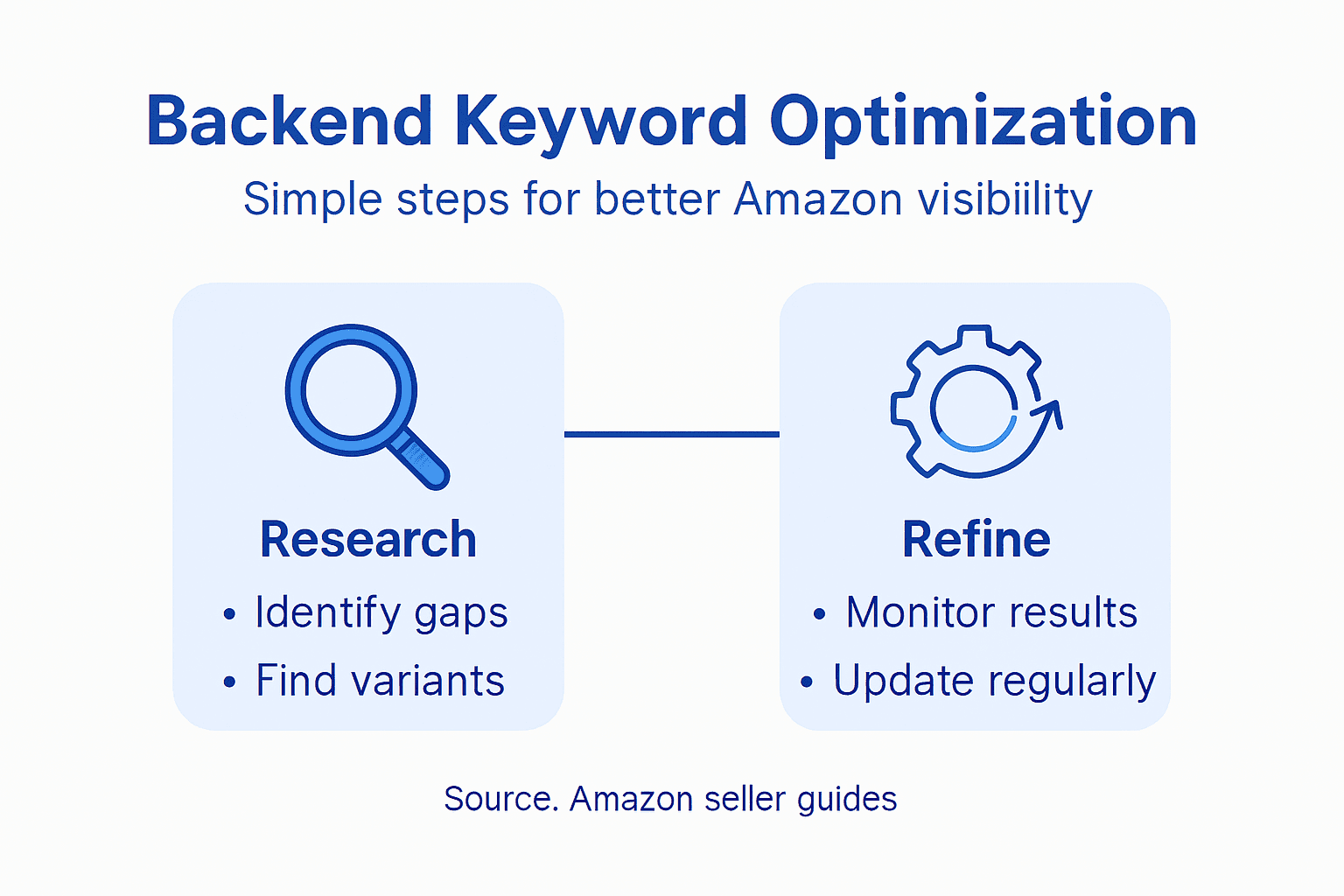
Effective search term optimization begins with comprehensive keyword research. Sellers should prioritize terms that reflect actual customer search behaviors, focusing on precise variations that capture different purchasing intents. This means incorporating synonyms, alternative product descriptions, common misspellings, and specific feature descriptors that potential buyers might use. For instance, a wireless headphone listing might include backend terms like “bluetooth earbuds”, “noise cancelling headset”, and “wireless ear speakers” to capture diverse search variations.
The most sophisticated sellers approach backend keyword optimization as a dynamic process of continuous refinement. Amazon’s algorithm rewards relevance and specificity, so sellers must avoid generic terms and focus on unique, descriptive keywords that genuinely represent their product’s distinctive qualities. This involves regularly analyzing search term reports, tracking which keywords generate impressions and clicks, and systematically replacing underperforming terms with more targeted alternatives that align with emerging customer search patterns.
Pro tip: Conduct monthly audits of your backend search terms, removing low-performing keywords and introducing new variations based on recent search analytics and customer feedback.
Major Mistakes and Compliance Risks
Amazon sellers must navigate a complex landscape of backend keyword regulations to maintain listing visibility and avoid potential account penalties. Navigating Amazon keyword compliance requires understanding the most common pitfalls that can trigger algorithmic restrictions or listing suppression.
One of the most critical compliance risks involves prohibited keyword practices. Sellers frequently make mistakes like including competitor brand names, using subjective marketing claims, or repeating keywords already present in visible listing content. Amazon’s algorithm is sophisticated in detecting these violations, which can result in immediate keyword de-indexing or more severe account warnings. For instance, claiming “best” or “top” in backend terms, using trademarked names, or stuffing redundant keywords will trigger automatic filtering and potential listing penalties.
Technical compliance represents another crucial area of risk management. Amazon enforces strict guidelines about backend keyword formatting, including prohibitions on punctuation, special characters, and exceeding byte limitations. Sellers must meticulously ensure their backend search terms use only alphanumeric characters, avoid duplicate words, and remain within the 250-byte constraint. Incorrect formatting can render keywords invisible to search algorithms, effectively negating any intended optimization strategy and reducing product discoverability.
Pro tip: Create a compliance checklist that includes verifying each backend keyword against Amazon’s guidelines before submission, ensuring no prohibited terms or formatting errors slip through.
Compare the consequences of non-compliance with backend keyword rules versus following best practices:
| Practice Type | Potential Result | Business Consequence |
|---|---|---|
| Violating Amazon guidelines | Keyword de-indexing, penalties | Reduced visibility, account risk |
| Adhering to best practices | Improved search indexing | Stable exposure, higher sales |
Unlock Your Amazon Listing’s Full Potential with Expert Backend Keyword Strategies
Struggling to master the complexities of backend search terms and Amazon’s strict indexing rules can leave your products buried and unseen in a competitive marketplace. This challenge calls for precision in keyword selection, compliance with byte limits, and smart inclusion of seed, long-tail, and feature-specific keywords to truly unlock visibility and attract targeted buyers. If you want to avoid costly mistakes like keyword de-indexing or ineffective keyword stuffing, you need a partner who understands these nuances deeply.
Discover how our specialized services at SearchOneers can revitalize your Amazon listings. From backend keyword optimization to enhanced titles and bullet points, we provide data-driven, compliant, and tailored solutions to elevate your product discoverability. Explore our E-commerce Tips & Strategies to Grow Your Online Business for actionable insights or start optimizing today with our proven Amazon SEO and analytics expertise. Don’t let hidden keywords hold back your sales—take control now and watch your product visibility soar.
Frequently Asked Questions
What are Amazon backend search terms?
Backend search terms are hidden keywords that sellers add to their Amazon product listings. They help improve search visibility without cluttering the public-facing product description.
How many characters can I use for backend search terms on Amazon?
Amazon allows sellers a maximum of 250 bytes for backend search terms. It’s essential to manage this limit by selecting effective keywords carefully.
What types of keywords should I use in my backend search terms?
You should use seed keywords for broad searches, long-tail keywords for specific queries, and feature-specific keywords to highlight unique attributes of your products. Combining these types can optimize visibility.
What are common mistakes to avoid when using backend search terms?
Common mistakes include using prohibited keywords (like competitor names), repeating keywords already in your product title, and exceeding the 250-byte limit. Following Amazon’s guidelines is crucial to avoid penalties.

Comments
3 responses to “Amazon Backend Search Terms: Visibility Unlocked”
[…] your backend keywords strategically. Understanding the role backend search terms play in visibility helps you allocate your character count wisely. Amazon typically allows 250 characters in each […]
[…] the nuanced world of Amazon backend search terms by focusing on precise, relevant keyword selection. Backend keywords are invisible to customers but […]
[…] Unlock advanced keyword strategies that transform how potential customers find your products. Backend keywords operate like an invisible search engine optimization layer working silently to connect your product with relevant customer searches. […]