

Most online shoppers never see the hidden words that determine which products show up first. Yet sellers who master Amazon search terms can boost their chances of being discovered among millions of listings. Almost 70 percent of Amazon sales start with a search, making these keywords a secret weapon for serious sellers. This guide unpacks how the right search terms work behind the scenes and reveals practical strategies to help your products rank higher in Amazon search results.
Table of Contents
- Amazon Search Terms Defined And Explained
- Primary Types Of Amazon Search Terms
- How Search Terms Influence Visibility
- Backend Keywords Vs Frontend Keywords
- Common Mistakes With Search Term Usage
Key Takeaways
| Point | Details |
|---|---|
| Optimize Search Terms | Leverage strategic keywords to enhance product discoverability and improve ranking on Amazon. |
| Understand Keyword Types | Utilize a mix of generic, descriptive, technical, alternate names, and misspellings for comprehensive search term strategies. |
| Differentiate Keywords | Recognize the importance of backend keywords (hidden) and frontend keywords (visible) for maximizing visibility and customer engagement. |
| Avoid Common Mistakes | Prevent keyword stuffing and ensure adherence to character limits to maintain relevance and improve search performance. |
Amazon Search Terms Defined and Explained
Amazon search terms are strategic keywords that sellers can use to enhance product discoverability and improve search ranking on the platform. These terms serve as critical backend metadata that help Amazon’s algorithm understand and categorize your product more effectively. Search terms are hidden from customers but play a significant role in matching products with relevant shopper queries.
According to Images NA, effective search term implementation requires sellers to focus on precise categorization and strategic keyword selection. The goal is to include relevant variations, synonyms, and alternative names that potential customers might use when searching for your product. This means thinking beyond obvious descriptors and considering how different consumers might describe or search for your item.
The primary types of Amazon search terms include:
- Generic Terms: Basic product descriptors like “shirt” or “laptop”
- Descriptive Terms: Specific attributes such as “blue cotton” or “wireless gaming”
- Alternate Names: Different ways consumers might refer to the product
- Misspellings: Common spelling variations customers might accidentally type
To maximize your product’s visibility, sellers should leverage Amazon Keywords Role Guide which offers comprehensive strategies for selecting and implementing search terms that align with Amazon’s search algorithm requirements. By understanding how these terms function, you can significantly improve your product’s chances of appearing in relevant customer searches.
Primary Types of Amazon Search Terms
Understanding the primary types of Amazon search terms is crucial for sellers looking to maximize their product visibility and improve search rankings. According to Images NA, strategic search term selection plays a pivotal role in ensuring products appear in relevant customer searches, making it essential to comprehend the different categories of keywords.
The most important types of Amazon search terms can be categorized into several key groups:
- Generic Terms
- Basic product descriptors
- Broad category identifiers
- Core product classification words
- Descriptive Terms
- Specific product attributes
- Material characteristics
- Color, size, and functional details
- Technical Specifications
- Model numbers
- Precise measurements
- Technical feature identifiers
- Alternate Names
- Synonyms
- Colloquial product references
- Alternative terminology customers might use
- Misspellings and Variations
- Common spelling errors
- Regional spelling differences
- Phonetic variations
To further refine your search term strategy, sellers can leverage the Complete Guide to Amazon Keyword Research which provides in-depth insights into selecting and implementing the most effective search terms. By understanding and strategically applying these different types of search terms, Amazon sellers can significantly enhance their product’s discoverability and potential to match customer search queries.
Proper implementation requires careful consideration of each term’s relevance and potential impact.
 The most successful sellers approach search terms as a nuanced art form, balancing specificity with broad appeal to capture the widest possible range of potential customer searches.
How Search Terms Influence Visibility
Search terms are the critical bridge connecting customer searches with product listings on Amazon. According to Images NA, strategic search term selection directly impacts a product’s visibility and ranking in search results, making them a powerful tool for sellers seeking to maximize their online presence.
The influence of search terms on product visibility can be broken down into several key mechanisms:
- Relevance Matching: Search terms help Amazon’s algorithm determine how closely a product matches a customer’s search query
- Ranking Algorithms: More precise and comprehensive search terms can improve a product’s position in search results
- Customer Discovery: Well-chosen search terms expand the potential ways customers can find your product
To truly optimize your product’s visibility, sellers must understand the nuanced relationship between search terms and Amazon’s complex ranking system. This means going beyond simple keyword stuffing and developing a strategic approach that considers customer language, product attributes, and search behavior.
Leveraging the insights from Optimize for Amazon Search, sellers can transform their search term strategy from a passive listing element to an active tool for increasing product discoverability. The most successful approach involves continuous refinement, analyzing search performance, and adapting terms to match evolving customer search patterns.
Ultimately, search terms are not just metadata – they are a sophisticated communication channel between your product and potential customers. By carefully selecting and strategically implementing search terms, sellers can significantly enhance their product’s chances of being found, clicked, and purchased in the competitive Amazon marketplace.
Backend Keywords vs. Frontend Keywords
Backend keywords and frontend keywords represent two distinct yet equally important strategies for improving product visibility on Amazon. According to Images NA, understanding the nuanced differences between these keyword types is crucial for sellers looking to maximize their product’s search performance.
Key differences between backend and frontend keywords include:
Backend Keywords
- Hidden from customer view
- Entered in seller central backend section
- Used purely for search algorithm matching
- Limited to 250 bytes of total characters
Frontend Keywords
- Visible in product title and bullet points
- Directly readable by customers
- Serve dual purpose of SEO and customer communication
- Impact both search ranking and customer decision-making
Sellers can strategically leverage both keyword types to create a comprehensive search optimization strategy.
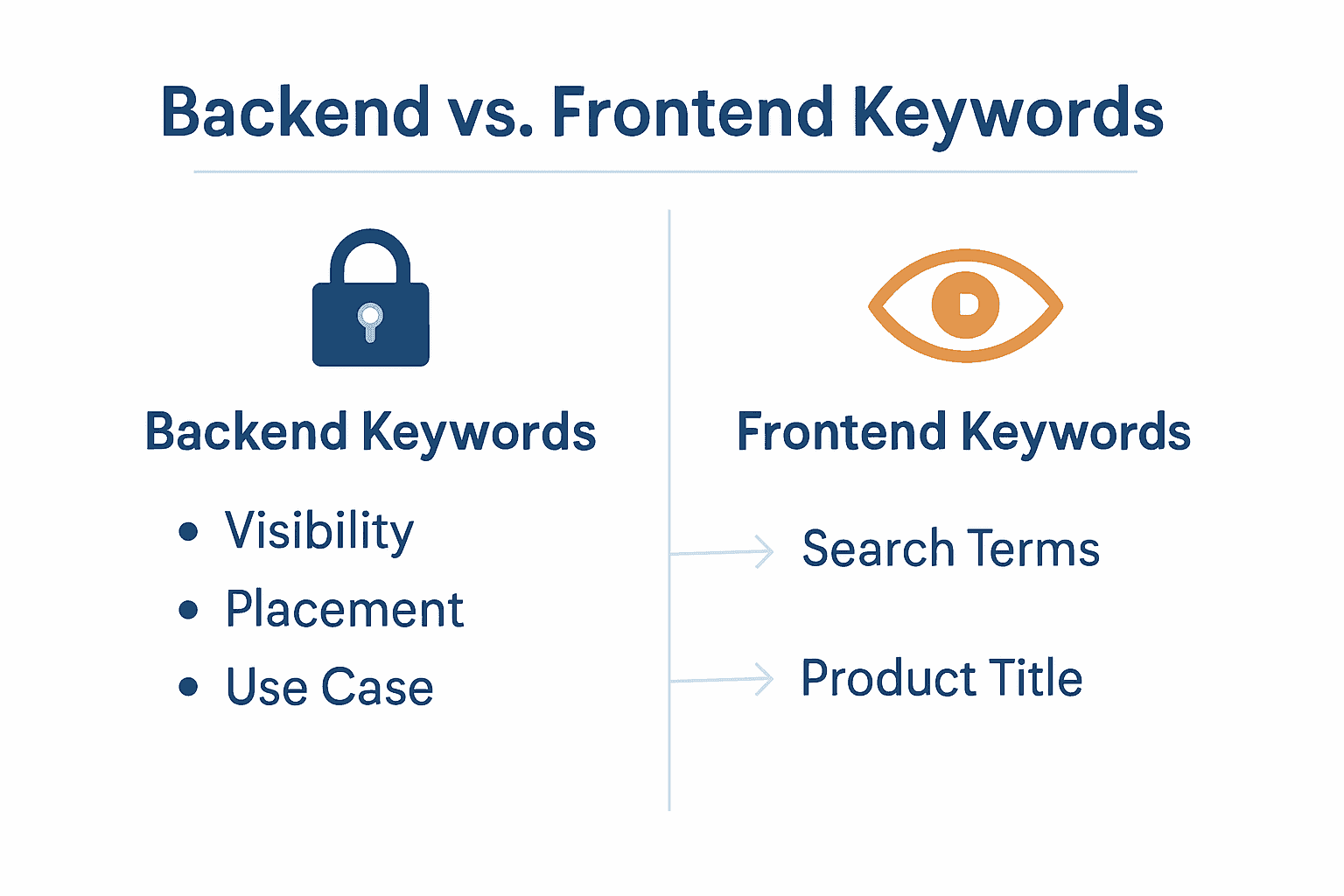 While backend keywords allow for including alternative search terms and misspellings discreetly, frontend keywords must balance readability with strategic keyword placement.
To refine your keyword approach, check out our Backend Keywords Amazon guide, which provides in-depth strategies for maximizing search visibility. The most successful Amazon sellers understand that effective keyword implementation is an art form – blending technical optimization with genuine, customer-focused communication.
Ultimately, the goal is not just to be found, but to convert searches into sales. By carefully crafting both backend and frontend keywords, sellers can create a powerful discoverability strategy that speaks both to Amazon’s search algorithm and potential customers’ specific needs and search behaviors.
Common Mistakes with Search Term Usage
Search term optimization is a delicate balance that many Amazon sellers struggle to master. According to Images NA, understanding and avoiding common search term mistakes can significantly impact a product’s visibility and search performance.
The most critical errors sellers frequently make include:
- Keyword Stuffing
- Repeating the same keywords multiple times
- Using irrelevant or unrelated search terms
- Attempting to manipulate the search algorithm
- Ignoring Character Limitations
- Exceeding the 250-byte backend keyword limit
- Using unnecessary spaces or punctuation
- Failing to prioritize the most relevant search terms
- Misunderstanding Relevance
- Using broad, generic terms instead of specific descriptors
- Neglecting long-tail keywords
- Failing to consider customer search behavior
To avoid these pitfalls, sellers must develop a strategic approach to keyword selection. This means carefully analyzing your product’s unique attributes, understanding your target audience’s search patterns, and selecting terms that genuinely reflect your product’s value proposition.
For sellers looking to refine their approach, the 7 Essential Amazon Keyword Types Every Seller Must Know provides comprehensive insights into effective keyword strategies. The most successful Amazon sellers treat search terms as a nuanced communication tool – balancing technical optimization with genuine customer-focused language.
Ultimately, effective search term usage is about quality over quantity. By carefully selecting relevant, specific, and targeted keywords, sellers can improve their product’s discoverability while avoiding the common traps that can render their listings invisible in Amazon’s competitive marketplace.
Unlock the Full Potential of Your Amazon Listings Today
Struggling with choosing the right Amazon search terms to boost your product visibility is a common challenge many sellers face. The key pain points include understanding how to balance generic and specific keywords, avoiding costly mistakes like keyword stuffing, and mastering the difference between backend and frontend keywords. This article highlighted the importance of strategic search term use to connect your products with potential customers effectively.
If you want to move beyond guesswork and leverage proven Amazon listing optimization techniques our team specializes in crafting enhanced titles, bullet points, descriptions, and backend keywords that drive superior visibility. Whether you need help refining your search term strategy or want data-backed insights to elevate your Amazon SEO our tailored solutions cover all bases.
Ready to transform your listings and see measurable growth? Explore our actionable advice and expert tips in E-commerce Tips & Strategies to Grow Your Online Business.

Take control of your product discoverability now with SearchOneers by your side. Visit our homepage to discover how our hands-on Amazon SEO & Analytics solutions make your products easier to find and impossible to ignore.
Frequently Asked Questions
What are Amazon search terms?
Amazon search terms are strategic keywords used by sellers to enhance product discoverability and improve search rankings on Amazon. These terms help the algorithm categorize products effectively, matching them with relevant shopper queries.
What types of Amazon search terms should I include for my products?
You should consider including generic terms, descriptive terms, technical specifications, alternate names, and common misspellings or variations to maximize your product’s visibility and match different customer search behaviors.
How do backend keywords differ from frontend keywords on Amazon?
Backend keywords are hidden from customer view and used for search algorithm matching, while frontend keywords are visible in product titles and descriptions and serve to attract customers as well as improve search ranking.
What common mistakes should I avoid when optimizing my Amazon search terms?
Common mistakes include keyword stuffing, ignoring character limits for backend keywords, and using broad terms instead of specific descriptors. It’s essential to select relevant keywords that reflect your product’s attributes and customer search behavior.

Comments
One response to “Types of Amazon Search Terms: Complete Seller Guide”
[…] these fundamental terms is crucial for navigating the types of Amazon search terms effectively and optimizing your selling strategy on this competitive […]