

Every American seller faces unique challenges when trying to stand out on Amazon. With more than 1.9 million active sellers competing on the platform, the battle for visibility is fierce. Mastering Amazon SEO is crucial because a single adjustment can lead to a significant difference in sales and rankings. This guide uncovers practical strategies and reveals essential mistakes to avoid, all tailored to help American sellers achieve real growth and success.
Table of Contents
- Defining Amazon SEO And Key Concepts
- Main Ranking Factors Shaping Listings
- Backend Keywords And Content Optimization
- Most Common Amazon SEO Mistakes
- Practical Applications For Amazon Sellers
Key Takeaways
| Point | Details |
|---|---|
| Understanding Amazon SEO | Amazon SEO focuses on optimizing product listings for better visibility and ranking, emphasizing sales performance, product relevance, and customer engagement. |
| Key Ranking Factors | Success on Amazon relies on understanding ranking components such as sales performance, click-through rates, and customer satisfaction metrics. |
| Backend Keyword Optimization | Leveraging backend keywords is essential for enhancing product discoverability without cluttering the visible content of listings. |
| Continuous Strategy Adaptation | Sellers must continuously monitor performance and adapt their strategies to align with changes in Amazon’s algorithm for sustained success. |
Defining Amazon SEO and Key Concepts
Amazon SEO is the strategic process of optimizing product listings to improve their visibility and ranking within Amazon’s search ecosystem. Unlike traditional search engine optimization, Amazon’s algorithm places unique emphasis on sales performance, product relevance, and customer engagement. Sellers must understand that Amazon’s search ranking prioritizes factors that directly impact the platform’s core mission: connecting buyers with the most relevant and appealing products.
The core mechanics of Amazon SEO involve meticulously optimizing multiple listing elements to signal product relevance and quality. These critical optimization areas include strategic keyword placement in product titles, bullet points, descriptions, and backend search terms. Sellers must craft content that not only includes relevant search terms but also compels potential buyers to click and purchase. Key ranking factors extend beyond keywords, encompassing elements like competitive pricing, product images, customer reviews, and fulfillment speed.
Successful Amazon SEO requires a holistic approach that balances technical optimization with genuine product value. While precise keyword targeting remains important, Amazon’s algorithm increasingly rewards listings that demonstrate real customer satisfaction. This means sellers must focus on creating high-quality product descriptions, using clear and compelling language, providing accurate product information, and maintaining competitive pricing. The ultimate goal is not just to rank higher in search results, but to convert those search rankings into actual sales and positive customer experiences.
To excel in Amazon SEO, sellers need to continuously monitor and adapt their strategies. The platform’s search algorithm evolves constantly, meaning what works today might not be as effective tomorrow. Successful sellers stay informed about the latest ranking factors, experiment with different optimization techniques, and remain committed to providing exceptional product value that meets customer needs.
Main Ranking Factors Shaping Listings
Amazon’s ranking algorithm is a complex system that evaluates multiple critical factors to determine product visibility and search positioning. Amazon ranking factors go far beyond simple keyword matching, creating a sophisticated ecosystem that rewards sellers who optimize their listings comprehensively. The platform prioritizes elements that demonstrate product relevance, customer satisfaction, and sales potential.
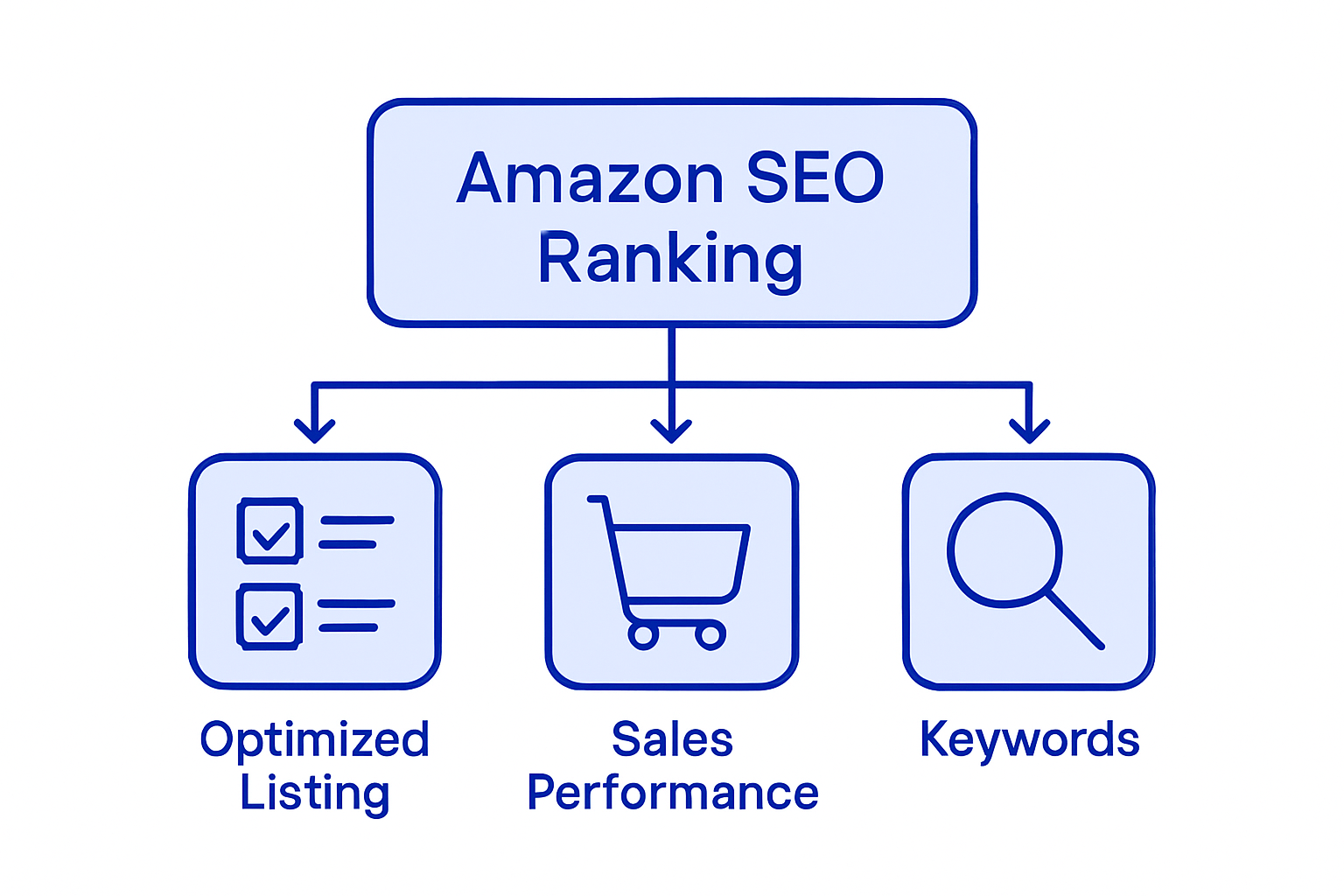
Key ranking components include sales performance, click-through rates, and conversion metrics. Research indicates that products with consistent sales velocity and strong customer interaction tend to achieve higher search rankings. Specific influential factors encompass precise keyword placement, competitive pricing, product image quality, customer review volume and sentiment, and the speed of order fulfillment. Sellers must recognize that Amazon’s algorithm actively tracks nuanced performance indicators that reflect a product’s overall marketplace effectiveness.

The dynamic nature of Amazon’s ranking system means sellers must continuously adapt their strategies. Factors like product click-through rates, conversion rates, and customer engagement play increasingly significant roles in determining search placement. Sellers who maintain high-quality listings, competitive pricing, and exceptional customer experiences are more likely to see sustained improvement in their product rankings. This holistic approach requires ongoing optimization, careful monitoring of performance metrics, and a commitment to meeting customer expectations.
Understanding the intricate relationship between listing optimization and ranking performance is crucial for Amazon sellers. While technical elements like keyword targeting remain important, the algorithm increasingly rewards listings that demonstrate genuine value and customer satisfaction. Successful sellers view ranking optimization as a comprehensive strategy that balances technical precision with authentic product presentation and customer-centric approaches.
Backend Keywords and Content Optimization
Backend keywords represent a critical yet often overlooked component of Amazon SEO strategy. Amazon keywords play a pivotal role in helping sellers enhance product discoverability without cluttering visible listing content. These hidden search terms provide sellers with a strategic opportunity to incorporate additional relevant phrases that might not naturally fit within the main product description or title.
Understanding backend keyword optimization requires careful attention to technical limitations and strategic placement. Sellers must navigate a 250-byte limit while maximizing keyword potential, which means selecting terms that capture alternative search variations, synonyms, and related product descriptors. Best practices include avoiding punctuation, using lowercase letters, and focusing on terms that potential customers might use when searching for similar products. Successful backend keyword implementation can significantly expand a product’s visibility across different search queries without appearing repetitive or forced.
The most effective backend keyword strategies go beyond simple term insertion. Sellers should conduct thorough research to identify less obvious search terms, including misspellings, alternative product descriptions, and context-specific language variations. This approach requires a deep understanding of customer search behaviors and the nuanced ways people describe products. Strategic sellers view backend keywords as a sophisticated tool for bridging the gap between their product’s actual features and the diverse ways customers might conceptualize or search for those features.
Ultimately, backend keyword optimization is an ongoing process of refinement and adaptation. The most successful Amazon sellers continuously analyze search term performance, experiment with different keyword combinations, and stay attuned to shifts in customer search behaviors. By treating backend keywords as a dynamic element of their SEO strategy, sellers can create more sophisticated and effective product listings that capture a broader range of potential customer searches.
Most Common Amazon SEO Mistakes
Amazon sellers frequently encounter critical SEO pitfalls that can dramatically reduce their product visibility and sales potential. Common listing optimization errors often stem from a fundamental misunderstanding of how Amazon’s search algorithm evaluates and ranks products. The most destructive mistakes are not always obvious, requiring sellers to develop a nuanced approach to listing management and optimization.
Keyword misuse represents one of the most prevalent strategic errors in Amazon SEO. Sellers commonly fall into two extreme traps: either keyword stuffing, which makes listings appear spammy and unprofessional, or underutilizing relevant search terms, which limits product discoverability. The key is striking a precise balance between natural, compelling language and strategic keyword placement. Effective optimization requires incorporating relevant terms seamlessly while maintaining readability and genuine product description.
Beyond keyword challenges, sellers frequently neglect critical technical aspects of listing optimization. Poor quality product images, incomplete product descriptions, and inconsistent pricing strategies can severely undermine a listing’s performance. Many sellers fail to understand that Amazon’s algorithm evaluates multiple interconnected factors, including click-through rates, conversion rates, and overall customer engagement. Successful sellers treat their product listings as dynamic assets that require continuous refinement and strategic attention.
The most successful Amazon sellers approach SEO as an ongoing learning process. They consistently analyze performance metrics, experiment with different optimization strategies, and remain adaptable to the platform’s evolving algorithmic requirements. By understanding that Amazon SEO is not a one-time task but a continuous optimization journey, sellers can develop more resilient and effective product listings that consistently attract and convert potential customers.
Practical Applications for Amazon Sellers
Amazon sellers must develop sophisticated strategies that extend far beyond basic product listing techniques. Optimizing Amazon listings requires a comprehensive approach that integrates technical optimization, strategic pricing, and exceptional customer experience. Success on the platform demands a multifaceted understanding of how different elements interconnect to drive product visibility and sales performance.
One critical practical application involves mastering Fulfillment by Amazon (FBA) and its strategic implications. FBA provides sellers with significant advantages, including improved shipping capabilities, enhanced Buy Box eligibility, and increased customer trust. By leveraging FBA, sellers can automatically qualify for Prime shipping, which dramatically improves product attractiveness. Successful sellers understand that FBA is not just a logistics solution, but a strategic tool for increasing product visibility and customer confidence.
Pricing and inventory management represent another crucial practical dimension of Amazon selling. Sellers must develop dynamic pricing strategies that remain competitive while maintaining profitability. This involves continuous market analysis, understanding competitor pricing, and using sophisticated repricing tools. Maintaining optimal stock levels is equally important, as frequent stockouts can negatively impact search rankings and customer perception. Sellers who consistently monitor and adjust their pricing and inventory strategies can create a more resilient and responsive sales approach.
Ultimately, the most successful Amazon sellers treat their online business as a continuously evolving ecosystem. They remain adaptable, regularly analyze performance metrics, and are willing to experiment with different optimization strategies. By viewing Amazon selling as a dynamic process that requires ongoing learning and refinement, sellers can develop more sophisticated approaches that consistently generate results in an increasingly competitive marketplace.
Unlock Your Amazon Success with Expert SEO Strategies
Struggling to boost your product visibility on Amazon despite having great products Discover how mastering Amazon SEO concepts like backend keyword optimization and balanced keyword placement can transform your listings and drive real sales growth Our solutions focus on the exact challenges highlighted such as improving click-through rates optimizing product descriptions and leveraging fulfillment advantages to win the Buy Box Stay ahead of Amazon’s constantly evolving algorithm by applying smart analytics and data-driven techniques
Take action now to elevate your Amazon business with proven strategies and comprehensive listing optimization Visit E-commerce Tips & Strategies to Grow Your Online Business for actionable insights Then partner with us at SearchOneers for expert Amazon Listing Optimization and SEO services that turn visibility into steady profits Your journey to better sales and happier customers starts here
Frequently Asked Questions
What is Amazon SEO and why is it important?
Amazon SEO is the process of optimizing product listings to enhance visibility and ranking within Amazon’s search ecosystem. It is crucial because higher visibility leads to increased sales and improved customer engagement on the platform.
What are the key ranking factors for Amazon listings?
Key ranking factors include sales performance, click-through rates, conversion metrics, competitive pricing, product image quality, customer review volume and sentiment, and fulfillment speed. Optimizing these elements is essential for improving search rankings.
How can I effectively use backend keywords for my Amazon listings?
To utilize backend keywords effectively, select relevant terms within the 250-byte limit, avoiding punctuation and using lowercase letters. Focus on synonyms, alternative descriptors, and potential misspellings that customers might use in their searches to enhance discoverability.
What common mistakes should I avoid in Amazon SEO?
Common mistakes in Amazon SEO include keyword misuse, such as keyword stuffing or underutilizing relevant search terms, and neglecting technical aspects like poor-quality images or incomplete descriptions. Continuous optimization and attention to performance metrics are essential for successful listings.

Comments
One response to “Amazon SEO Meaning: Boosting Product Visibility Online”
[…] Amazon SEO Meaning & Visibility Strategies […]