

Most American Amazon sellers miss out on buyer engagement by overlooking effective image SEO. With over 65 percent of product searches on Amazon starting with images, mastering technical requirements directly impacts your visibility and sales. Understanding how high-quality visuals, strategic filenames, and optimized metadata work together gives you the edge needed to stand out against competitors.
Table of Contents
- Step 1: Assess Amazon Image Requirements
- Step 2: Select High-Converting Main Images
- Step 3: Enhance Images with SEO-Focused Filenames
- Step 4: Optimize Alt Text and Metadata for Search
- Step 5: Test Image Performance and Compliance
Quick Summary
| Key Insight | Explanation |
|---|---|
| 1. Meet Amazon’s Image Standards | Ensure product images follow Amazon’s specific guidelines for resolution, background, and framing to enhance visibility and sales. |
| 2. Select Compelling Main Images | Choose high-quality main images that clearly showcase your product, filling 85% of the frame to attract customers. |
| 3. Use SEO-Optimized Filenames | Name image files using descriptive keywords to improve search visibility, avoiding generic terms. |
| 4. Optimize Alt Text and Metadata | Create detailed alt text and metadata to enhance image context and search rankings, incorporating essential product attributes. |
| 5. Test Image Performance Regularly | Continually assess image loading speed and visual compliance to ensure optimal performance and buyer engagement. |
Step 1: Assess Amazon Image Requirements
Navigating Amazon’s image standards is crucial for product visibility and sales success. Your product images serve as the primary visual communication tool with potential buyers, making precise compliance with Amazon’s technical specifications non-negotiable.
Amazon requires product images to meet specific digital image guidelines that ensure professional presentation and optimal display. These technical requirements include precise resolution, file format, color profile, and background specifications. Specifically, Amazon mandates that main product images must have a pure white background, be professionally photographed, and fill at least 85% of the image frame with the product. Each product listing allows up to nine images, with the first image serving as the primary thumbnail that attracts customer attention.
File types like JPEG, PNG, and TIFF are acceptable, but images must be high resolution (minimum 1000 pixels on the longest side) to enable zoom functionality. Understanding and implementing these technical standards transforms your product images from mere visuals to powerful sales conversion tools.
Pro tip: Always test your images on multiple devices to ensure they display correctly and maintain visual quality across different screen sizes and resolutions.
Here’s a quick reference comparing technical requirements and strategic image optimization for Amazon product images:
| Criterion | Amazon Technical Requirements | Strategic Optimization Impact |
|---|---|---|
| Resolution | Minimum 1000 pixels per side | Enables zoom, boosts user trust |
| File Type | JPEG, PNG, TIFF | Faster load, better compatibility |
| Background | Pure white for main image | Highlights product, appears cleaner |
| Framing | Product fills 85% of frame | Maximizes visibility, reduces clutter |
| SEO Filename & Metadata | Not mandated by Amazon | Improves discoverability, ranking |
This table highlights how meeting both baseline requirements and adding optimizations can enhance your product’s performance.
Step 2: Select High-Converting Main Images
Selecting the right main image for your Amazon product is a critical strategy that directly impacts your sales potential. Your primary image serves as the first visual touchpoint with potential customers, making it a pivotal element in capturing buyer attention and driving conversions.
To create high-converting main images, focus on product image standards that enhance visual appeal, which research shows can significantly influence consumer purchasing decisions. The most effective main images typically showcase the product from the most flattering angle, fill at least 85% of the frame, and present a clear, professional representation that highlights key features. Professional photography is essential here professional photographers understand how to create images that not only meet Amazon’s technical requirements but also communicate product value.
When designing your main image, prioritize clarity, professional lighting, and a clean white background. Avoid cluttered backgrounds, multiple products, or lifestyle scenes in your primary image. Instead, opt for a straightforward, high-resolution shot that allows potential buyers to immediately understand what they are purchasing. Consider creating multiple image variations and conducting A/B testing to determine which version generates the highest click through and conversion rates.

Pro tip: Invest in professional product photography or learn advanced product photography techniques to create images that make your product stand out in a crowded marketplace.
Step 3: Enhance Images with SEO-Focused Filenames
Creating strategic SEO-focused filenames for your Amazon product images can significantly improve your product’s discoverability and search performance. Your image filenames are more than just technical metadata they are an essential component of your product’s online visibility strategy.
When naming your images, follow image optimization best practices that maximize search engine recognition. Start by using descriptive, keyword rich filenames that accurately represent the product. For example, instead of generic names like “IMG_1234.jpg” or “product1.png,” use specific descriptive names like “blue-womens-running-shoes-size-8.jpg” or “stainless-steel-kitchen-knife-set.png.” This approach helps search algorithms understand your image content and improves the likelihood of your product appearing in relevant search results.
Ensure your filenames are concise, use lowercase letters, and separate words with hyphens rather than spaces or underscores. Include relevant product attributes such as color, size, material, or specific model numbers. Avoid keyword stuffing or using excessive characters. The goal is to create clear, informative filenames that provide immediate context about your product while maintaining a natural, readable format that search engines can easily interpret.
Pro tip: Create a consistent filename template for your product images to streamline your image optimization process and maintain a professional, systematic approach to SEO.
Step 4: Optimize Alt Text and Metadata for Search
Unlocking the full potential of your Amazon product images requires strategic optimization of alt text and metadata. These behind-the-scenes elements play a crucial role in improving your product’s search visibility and accessibility for potential customers.
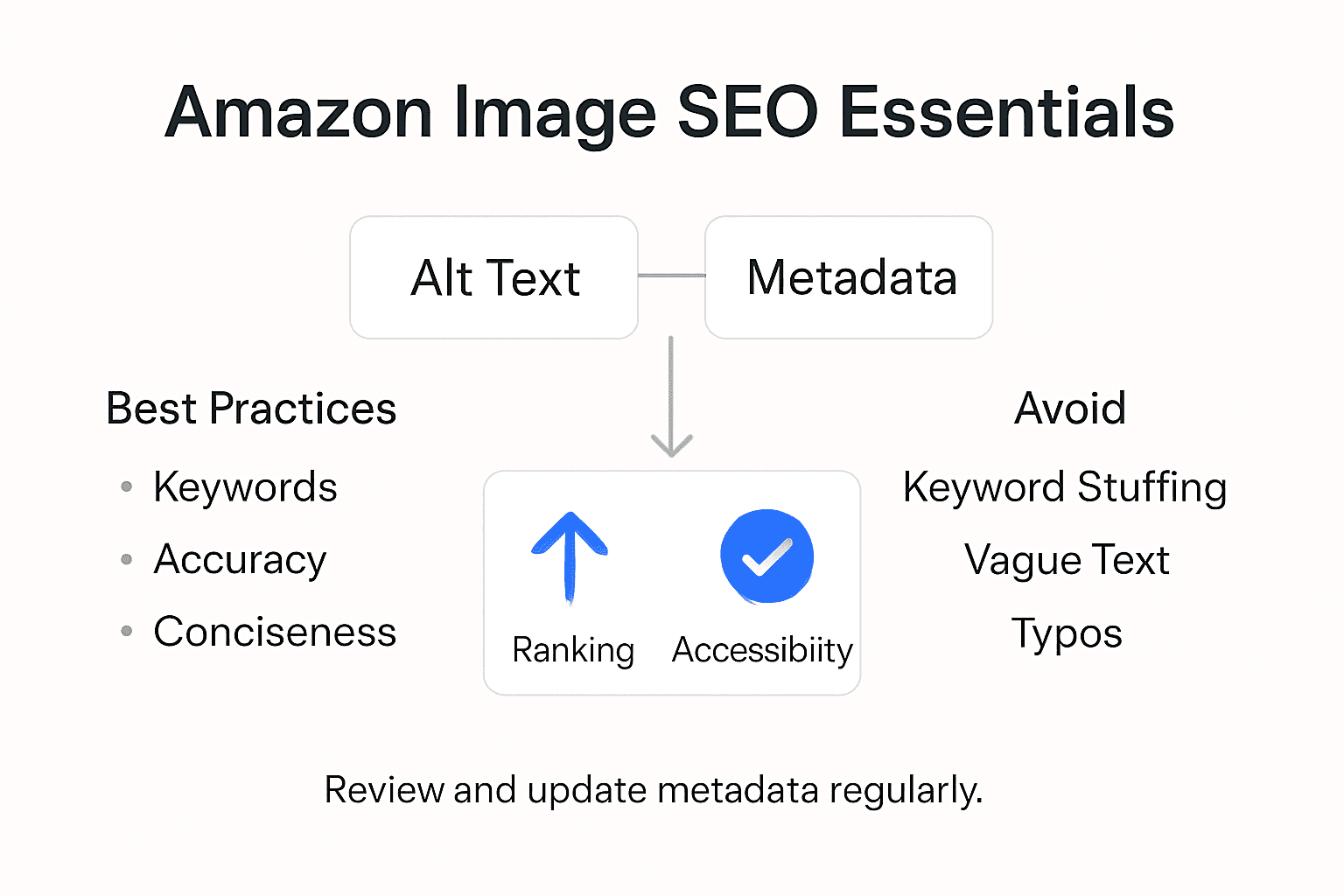
When crafting alt text, follow web accessibility guidelines that enhance image understanding for both search engines and users. Your alt text should be descriptive, concise, and accurately represent the image content. For Amazon product images, this means creating alt text that includes key product details like color, size, material, and primary features. For example, instead of generic text like “blue shirt,” use “navy blue cotton mens button down shirt size medium with chest pocket.” This approach provides rich context that helps search algorithms better index and display your product.
Metadata optimization extends beyond alt text. Include relevant keywords naturally within your image descriptions, ensuring they align with your product listing and search terms. Avoid keyword stuffing or using irrelevant terms. Focus on creating clear, informative metadata that genuinely describes your product. Consider the specific attributes that make your product unique and incorporate those details strategically. By treating alt text and metadata as valuable communication tools, you transform these technical elements into powerful marketing assets that can significantly improve your product’s online discoverability.
Pro tip: Regularly review and update your image alt text and metadata to maintain alignment with current product features and search trends.
Here is a summary of effective alt text and metadata features versus common mistakes:
| Approach | Effective Example | Common Mistake |
|---|---|---|
| Alt Text Description | “Navy blue cotton shirt, size medium, chest pocket” | “Blue shirt” |
| Keyword Usage | Uses relevant terms naturally | Keyword stuffed and unnatural |
| Metadata Keywords | “cotton, men’s, button down, medium” | Irrelevant or missing product details |
| Accessibility | Helps search engines and visually impaired users | Too generic or unclear |
This comparison clarifies strategies that help images rank better and inform buyers.
Step 5: Test Image Performance and Compliance
Testing your Amazon product images for performance and compliance is a critical final step in ensuring maximum visibility and buyer engagement. This process goes beyond simple visual appeal and requires a systematic approach to verifying technical standards and user experience.
Implement comprehensive image optimization strategies that evaluate multiple performance dimensions. Start by checking file size and loading speed to ensure quick rendering across different devices. Most Amazon shoppers will abandon product pages with slow loading images, so aim for files under 500 kilobytes without compromising visual quality. Use professional image compression tools that maintain image clarity while reducing file size. Verify that your images meet Amazon’s specific technical requirements such as minimum resolution (1000 pixels on the longest side), pure white background for primary images, and precise pixel dimensions for different image slots.
Beyond technical metrics, conduct visual compliance testing to guarantee your images represent your product accurately and professionally. This means checking for consistent lighting, true color representation, multiple product angle shots, and zoom capability. Confirm that your images showcase product details clearly and comprehensively. Consider running A/B tests with slightly different image variations to understand which visual presentations generate higher click through and conversion rates. By treating image testing as an ongoing optimization process, you create a dynamic approach that continuously improves your product’s visual marketing strategy.
Pro tip: Create a standardized image testing checklist that you review before uploading any product images to ensure consistent quality and compliance.
Elevate Your Amazon Sales with Expert Image and Listing Optimization
Optimizing your Amazon product images is only one piece of the puzzle. Many sellers struggle with not just meeting Amazon’s strict image requirements but also unlocking the full sales potential through strategic listing enhancements like optimized titles, bullet points, and backend keywords. This article highlights key challenges such as creating high-converting main images, crafting SEO-focused filenames, and ensuring alt text and metadata boost search visibility. These steps are essential but can feel overwhelming when trying to stay compliant and competitive.
To truly stand out in the crowded Amazon marketplace you need a comprehensive approach that combines superb image optimization with smart listing strategies. At SearchOneers, we specialize in helping sellers like you overcome these challenges by delivering Amazon Listing Optimization and data-driven Amazon SEO & Analytics solutions designed to increase your product visibility and conversions.
Discover actionable insights and proven methods in our E-commerce Tips & Strategies to Grow Your Online Business that complement image best practices discussed in the article.
Ready to transform your Amazon product listings into powerful sales engines? Visit SearchOneers today to explore how our expert team can simplify compliance, enhance your images, and optimize your entire listing for maximum growth. Don’t wait to boost your visibility and surpass your sales goals.
Frequently Asked Questions
How do I meet Amazon’s image requirements for product listings?
To meet Amazon’s image requirements, ensure that your main image features a pure white background and fills at least 85% of the frame with the product. Professional photography is recommended; this will enhance product visibility and engagement.
What type of images should I use as my main product image on Amazon?
Your main product image should showcase the product clearly and professionally, using a flattering angle and lighting. Use a high-resolution image and avoid cluttered backgrounds or multiple items to ensure focus on the product.
How can I optimize my Amazon product image filenames for SEO?
Optimize your image filenames by using descriptive, keyword-rich names that clearly represent your product. For instance, instead of generic names, use something like “blue-womens-running-shoes-size-8.jpg” to improve discoverability in search results.
What should I include in the alt text for my Amazon product images?
Your alt text should be concise but descriptive, accurately reflecting the image content. Include key product details such as color, size, and features to enhance search visibility and provide context for users.
How can I test the effectiveness of my product images on Amazon?
Test your product images by checking their performance through A/B testing, focusing on click-through and conversion rates. Regularly analyze and optimize based on these findings to improve image impact within 30–60 days.
What steps should I take to ensure my images comply with Amazon’s standards?
To ensure compliance with Amazon’s standards, check that your images meet the required resolution, file type, and background specifications. Create a checklist to consistently review these elements before uploading images.

Comments
2 responses to “How to Optimize Images Amazon for More Sales”
[…] by optimizing Amazon product images that highlight your product from multiple angles. Include high resolution images that demonstrate […]
[…] Optimizing product images for maximum sales impact involves understanding both the technical specifications Amazon requires and the psychological impact images have on buyer behavior. Invest in this element because images directly influence your conversion rate. A 10 percent improvement in image quality can translate to a 15 to 25 percent increase in sales. […]