Every experienced Amazon seller knows that a single missed performance metric can threaten your Buy Box eligibility and marketplace reputation. With Amazon using KPIs like Order Defect Rate, Late Shipment Rate, and Return Dissatisfaction Rate as a ‘report card,’ understanding these indicators is the foundation for account stability and growth. This guide explains how performance metrics shape your Amazon future and reveals why listing optimization is a direct lever for stronger sales and visibility.
Table of Contents
- Amazon Seller Performance Explained Clearly
- Key Performance Metrics And Their Role
- Common Performance Violations And Triggers
- How Listing Optimization Impacts Performance
- Strategies To Improve Account Health Metrics
Key Takeaways
| Point | Details |
|---|---|
| Comprehensive Seller Evaluation | Amazon seller performance metrics provide insight into effectiveness, reliability, and customer satisfaction, serving as a vital report card for sellers. |
| Proactive Performance Monitoring | Sellers should regularly track their performance metrics to identify issues early and avoid negative impacts on account standing. |
| Continuous Listing Optimization | Effective listing optimization is crucial for improving visibility and conversion rates, requiring ongoing refinement rather than a one-time effort. |
| Compliance and Account Health | Maintaining compliance with Amazon’s performance standards is essential to prevent account suspensions and ensure long-term success. |
Amazon Seller Performance Explained Clearly
Amazon seller performance represents a comprehensive evaluation system that tracks a seller’s effectiveness, reliability, and customer satisfaction within the marketplace. Key performance metrics provide sellers with crucial insights into their operational health and potential areas for improvement.
The performance assessment encompasses multiple critical indicators that directly impact a seller’s account standing and marketplace visibility. These metrics serve as Amazon’s comprehensive “report card” for evaluating seller quality and reliability. Important performance metrics include:
- Order Defect Rate: Measures product quality and customer satisfaction
- Late Shipment Rate: Tracks shipping timeliness and logistics efficiency
- Pre-Fulfillment Cancel Rate: Evaluates inventory management and order processing
- Valid Tracking Rate: Monitors shipping documentation and transparency
- Return Dissatisfaction Rate: Indicates product quality and customer experience
Understanding these metrics requires sellers to proactively monitor their Amazon Key Performance Indicators using Amazon’s analytical tools and dashboards. Each metric provides actionable insights into different aspects of seller performance, from customer satisfaction to operational efficiency.
Here’s how key Amazon seller metrics differ in focus and impact:
| Metric Type | Main Focus | Business Impact |
|---|---|---|
| Account Health Metric | Operational reliability | Prevents account suspension |
| Marketplace KPI | Strategic growth potential | Boosts sales opportunities |
| Listing Optimization | Visibility and conversion | Enhances product rankings |
| Compliance Indicator | Policy adherence | Reduces violation risk |
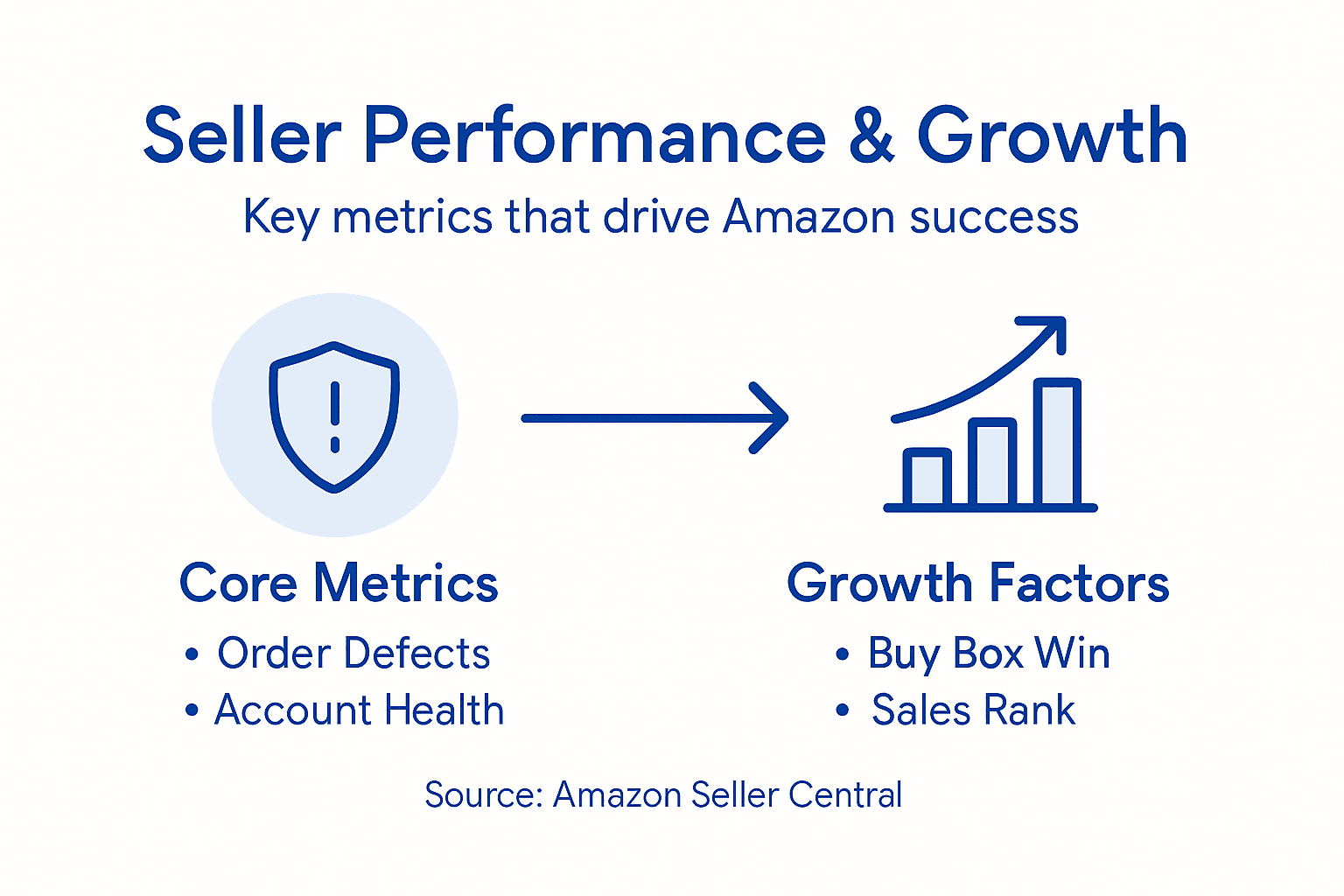
Performance metrics function as more than just measurements – they represent a seller’s reputation and potential for growth. Sellers who consistently maintain high standards across these metrics increase their chances of winning the Buy Box, achieving better search rankings, and building long-term customer trust.

Pro tip: Implement a daily performance tracking routine to quickly identify and address potential issues before they negatively impact your seller account standing.
Key Performance Metrics and Their Role
Amazon sellers rely on a comprehensive set of Key Performance Indicators (KPIs) to evaluate their business performance and strategic positioning within the marketplace. Amazon KPIs serve as critical diagnostic tools that provide actionable insights into various aspects of seller operations and market competitiveness.
These performance metrics encompass multiple dimensions of seller success, offering a holistic view of business health. The most significant KPIs include:
- Buy Box Ownership Rate: Indicates competitive pricing and seller reliability
- Sales Velocity: Measures product movement and market demand
- Conversion Rate: Tracks effectiveness of product listings and pricing strategy
- Customer Review Score: Reflects product quality and customer satisfaction
- Inventory Turnover: Demonstrates inventory management efficiency
- Return Rate: Signals product quality and customer experience
Understanding these metrics allows sellers to benchmark their performance against competitors and identify strategic opportunities for improvement. Each KPI provides a unique lens through which sellers can analyze their marketplace performance, helping them make data-driven decisions that enhance profitability and competitiveness.
Performance metrics are not just numbers – they are a roadmap for strategic growth. Successful Amazon sellers continuously monitor these indicators, using them to refine their approach, optimize product offerings, and stay ahead in a dynamic marketplace.
Pro tip: Create a weekly dashboard that tracks your most critical KPIs to quickly identify trends and make proactive adjustments to your Amazon selling strategy.
Common Performance Violations and Triggers
Amazon maintains stringent performance standards that sellers must consistently meet to remain active on the platform. Performance violations can quickly escalate from warnings to account suspensions, making proactive compliance crucial for sellers.
The most common performance violation categories include:
- Order Defect Rate Violations: Exceeding acceptable customer complaint thresholds
- Shipping Performance Issues: Consistent late shipments or missed delivery windows
- Product Authenticity Concerns: Selling counterfeit or misrepresented products
- Policy Non-Compliance: Breaching Amazon’s seller guidelines and operational standards
- Customer Communication Failures: Unresponsive or inadequate customer service
- Intellectual Property Violations: Selling products that infringe on trademark or copyright protections
Understanding these triggers requires sellers to develop a comprehensive compliance strategy. Seller compliance research indicates that Amazon’s monitoring systems are highly sophisticated, utilizing automated processes to detect and flag potential violations rapidly.
Performance violations are not just administrative issues – they represent direct threats to a seller’s marketplace presence. Amazon’s enforcement mechanisms are designed to protect consumer trust, meaning even minor infractions can result in significant account restrictions.
A quick reference to performance violation consequences on Amazon:
| Violation Category | Typical Consequence | Prevention Approach |
|---|---|---|
| Shipping Issues | Account warnings or limits | Monitor delivery speed |
| Product Authenticity | Listing removal, possible ban | Source verified suppliers |
| Policy Non-Compliance | Temporary suspension | Regular policy reviews |
| IP Violations | Legal action, permanent ban | Check trademark databases |
Pro tip: Implement a weekly self-audit of your seller account metrics to identify and address potential compliance issues before they trigger Amazon’s automated warning systems.
How Listing Optimization Impacts Performance
Listing optimization represents a critical strategy for Amazon sellers seeking to improve their marketplace performance and visibility. Listing optimization research demonstrates that strategic product presentation directly influences search rankings, consumer engagement, and overall sales potential.
The key components of effective listing optimization include:
- Product Title Optimization: Crafting compelling, keyword-rich titles that improve search visibility
- High-Quality Image Selection: Using professional, clear images that showcase product features
- Detailed Product Descriptions: Writing informative, benefit-focused descriptions
- Strategic Keyword Implementation: Incorporating relevant search terms naturally
- Backend Keyword Optimization: Utilizing hidden keyword fields for additional searchability
- Competitive Pricing Strategies: Aligning pricing with market expectations
Successful optimization goes beyond simple keyword stuffing. It requires a nuanced approach that balances searchability with genuine consumer value. Sellers who master this balance can significantly improve their product visibility, conversion rates, and overall marketplace performance.
Listing optimization is not a one-time task but an ongoing process of refinement and improvement. Continuous testing, monitoring, and adjusting are essential to maintain competitiveness in Amazon’s dynamic marketplace.
Pro tip: Conduct monthly listing audits, analyzing your product’s performance metrics and making incremental improvements to titles, descriptions, and keywords.
Strategies to Improve Account Health Metrics
Successful Amazon sellers must develop a comprehensive approach to maintaining and improving their account health metrics. Performance improvement strategies are critical for long-term marketplace success and sustained growth.
Key strategies for enhancing account health include:
- Proactive Inventory Management: Maintain optimal stock levels to prevent stockouts
- Accurate Product Listings: Ensure precise, detailed, and up-to-date product information
- Timely Order Fulfillment: Ship products quickly and within promised delivery windows
- Responsive Customer Service: Address customer inquiries and issues promptly
- Automated Performance Tracking: Use tools to monitor critical performance indicators
- Continuous Learning: Stay updated on Amazon’s evolving seller policies and best practices
Sellers can leverage multiple approaches to optimize their account performance. Amazon Seller Performance KPIs demonstrate that consistent, data-driven improvements can significantly reduce order defects, minimize late shipments, and enhance overall customer satisfaction.
Account health is not a destination, but a continuous journey of refinement and adaptation. Successful sellers view performance metrics as dynamic indicators that require constant attention and strategic adjustment.
Pro tip: Create a monthly performance dashboard that tracks your key metrics, allowing you to quickly identify and address potential areas of improvement before they impact your seller standing.
Boost Your Amazon Seller Performance with Expert Guidance
Struggling to improve your Amazon seller metrics like Buy Box ownership or account health This article highlights how crucial listing optimization and strategic monitoring are for sustained growth. If you want to tackle challenges like order defect rate violations or poor conversion rates our proven solutions can help you gain control and thrive. Get tailored enhancements for your product titles, bullet points, and backend keywords combined with smart data analysis to boost visibility and sales.
Discover actionable advice in our E-commerce Tips & Strategies to Grow Your Online Business. Visit searchoneers.com now to unlock the full potential of your Amazon listings and take decisive steps toward skyrocketing your seller performance and growth.
Frequently Asked Questions
What are the key performance metrics that Amazon sellers should monitor?
The key performance metrics for Amazon sellers include Order Defect Rate, Late Shipment Rate, Pre-Fulfillment Cancel Rate, Valid Tracking Rate, and Return Dissatisfaction Rate. Monitoring these metrics helps sellers understand their operational health and customer satisfaction levels.
How does listing optimization affect Amazon seller performance?
Listing optimization significantly impacts seller performance by improving product visibility, search rankings, and conversion rates. Key components include product title and description optimization, high-quality images, strategic keyword use, and competitive pricing.
What are common performance violations that can affect an Amazon seller’s account?
Common performance violations include Order Defect Rate violations, shipping performance issues, product authenticity concerns, policy non-compliance, and customer communication failures. These violations can lead to warnings or account suspensions, emphasizing the necessity for proactive compliance.
How can Amazon sellers improve their account health metrics?
Sellers can improve account health metrics by practicing proactive inventory management, ensuring accurate product listings, fulfilling orders timely, providing responsive customer service, and utilizing automated performance tracking tools.
Recommended
- Understanding Amazon Growth Strategies – Scale Your Business
- Amazon Inventory Ranking: What It Means & How to Improve
- Amazon Analytics: Unlocking Sales Growth Globally – Searchoneers
- Amazon Ranking Factor: Complete Guide to Amazon SEO – Searchoneers
- Print on Demand on Amazon: Boosting Tech Accessory Sales – Bettermockups