

Getting started with Amazon FBA can feel overwhelming as promises of quick wealth often cloud the real path to success. The Federal Trade Commission highlights that deceptive get-rich-quick schemes target new sellers, exaggerating what is truly required to build a profitable Amazon business. Clear understanding of the actual FBA process and awareness of common myths about easy earnings will help you set realistic goals and avoid costly missteps as you grow your business.
Table of Contents
- Amazon FBA Seller Explained And Common Myths
- Types Of Amazon FBA Sellers Today
- How The Amazon FBA Process Works
- Requirements And Costs For FBA Sellers
- Common Mistakes FBA Sellers Should Avoid
Key Takeaways
| Point | Details |
|---|---|
| Understanding FBA’s Complexity | Success in Amazon FBA requires significant effort and a deep understanding of the marketplace, not just product listing. |
| Beware of Common Myths | Many new sellers fall for misconceptions, like guaranteed profits, which can lead to financial risks. |
| Seller Types Vary | Different seller types require distinct strategies to succeed, from individual entrepreneurs to wholesale distributors. |
| Comprehensive Financial Planning | Potential FBA sellers must account for various fees and initial costs to ensure profitable operations. |
Amazon FBA Seller Explained and Common Myths
Amazon FBA (Fulfillment by Amazon) represents a powerful business model where entrepreneurs leverage Amazon’s extensive logistics network to sell products online. Unlike traditional ecommerce approaches, FBA sellers ship their inventory to Amazon’s warehouses, allowing the company to handle storage, packaging, shipping, and customer service for their products.
The core mechanics of Amazon FBA involve several critical steps:
- Sourcing product inventory from manufacturers or wholesalers
- Sending products to Amazon’s fulfillment centers
- Creating product listings on Amazon’s marketplace
- Amazon handling order processing, shipping, and returns
- Receiving sales revenue minus Amazon’s fees
While many entrepreneurs are attracted to FBA’s potential, the Federal Trade Commission warns that deceptive get-rich-quick schemes often misrepresent the actual complexity of running a successful Amazon business. Success requires significant effort, strategic product selection, and deep understanding of Amazon’s intricate marketplace dynamics.
Common myths about Amazon FBA frequently mislead new sellers. These misconceptions can create unrealistic expectations and potential financial risks. Key misconceptions include:
- Believing FBA guarantees instant profitability
- Assuming minimal work is required after initial setup
- Thinking any product will automatically sell
- Underestimating competition and marketing requirements
Realistic FBA sellers understand that success demands continuous learning, market research, competitive pricing strategies, and compliance with Amazon’s strict seller guidelines. The legal actions by the FTC highlight the importance of approaching Amazon FBA as a legitimate business, not a passive income shortcut.
Pro Tip: Before investing significant capital in FBA, conduct thorough market research, start with a small, low-risk inventory, and continuously educate yourself about Amazon’s evolving seller ecosystem.
Types of Amazon FBA Sellers Today
Amazon FBA attracts a diverse range of sellers, each with unique business strategies and operational approaches. Different seller types emerge based on their experience, capital investment, and professional goals, creating a complex marketplace ecosystem.
The primary categories of Amazon FBA sellers include:
- Individual Entrepreneurs: Small-scale sellers starting with limited inventory
- Small Business Owners: Established local businesses expanding online
- Professional Resellers: Experienced sellers with multiple product lines
- Wholesale Distributors: Large-scale sellers with extensive inventory networks
- Private Label Creators: Entrepreneurs developing and branding their own products
Each seller type requires a distinct approach to succeed on the Amazon platform. Operational complexity varies significantly across these categories, with individual entrepreneurs facing different challenges compared to large-scale professional sellers.

Here’s how the main types of Amazon FBA sellers differ in their business approach:
| Seller Type | Scale of Operations | Primary Strategy | Challenges Faced |
|---|---|---|---|
| Individual Entrepreneur | Small, limited inventory | Minimize risk, learn basics | Limited growth, less brand control |
| Small Business Owner | Moderate, local-to-online | Expand existing products | Digital marketing, logistics adaption |
| Professional Reseller | Multiple product lines | Optimize for revenue streams | Fierce competition, margin pressure |
| Wholesale Distributor | Large, bulk operations | Inventory management efficiency | High capital, operational headaches |
| Private Label Creator | Custom branded products | Product development & branding | Large investment, brand visibility |
The strategic approach for each seller type differs substantially:
- Individual sellers typically focus on low-risk, low-investment products
- Small businesses leverage existing product relationships
- Professional resellers optimize multiple revenue streams
- Wholesale distributors scale through bulk inventory management
- Private label creators invest heavily in product development and branding
Successful Amazon FBA sellers understand that marketplace dynamics constantly evolve, requiring continuous learning and adaptation. The ability to pivot, understand market trends, and maintain competitive pricing remains crucial across all seller categories.
Pro Tip: Research and select an Amazon FBA seller type that aligns with your existing skills, available capital, and long-term business objectives.
How the Amazon FBA Process Works
The Amazon FBA (Fulfillment by Amazon) process transforms how online sellers manage product distribution by leveraging Amazon’s extensive logistics infrastructure. Online sellers streamline their operations through a comprehensive system that handles storage, packaging, shipping, and customer service.
The core steps of the Amazon FBA process include:
- Product Preparation: Sellers package and label products according to Amazon’s strict guidelines
- Inventory Shipment: Products are sent to designated Amazon fulfillment centers
- Storage: Amazon stores inventory in their warehouses
- Order Processing: When a customer purchases a product, Amazon picks, packs, and ships the item
- Customer Service: Amazon handles returns, refunds, and customer inquiries
- Payment: Sellers receive payments minus Amazon’s fees and commissions
Understanding the financial mechanics is crucial for potential FBA sellers. Amazon charges various fees that impact overall profitability:
- Inventory storage fees
- Fulfillment fees per item
- Long-term storage penalties
- Additional service charges
- Referral fees based on product category
Successful FBA sellers must navigate these financial considerations carefully. Efficient inventory management becomes critical to maintain profitability and minimize unnecessary expenses.
Below is a summary of key Amazon FBA fees and their impact on seller profits:
| Fee Type | Applies To | Typical Impact on Profit |
|---|---|---|
| Inventory Storage Fee | All stored products | Reduces margins if slow sales |
| Fulfillment Fee | Each item shipped | Higher for bulky items |
| Referral Fee | Each sale in category | Varies by product category |
| Long-Term Storage Fee | Unsold inventory after months | Major expense if overstocked |
| Service Charge | Special handling or services | Adds up with extra services |
Pro Tip: Calculate your potential profit margins by carefully tracking all Amazon FBA fees and considering them in your initial product pricing strategy.
Requirements and Costs for FBA Sellers
Becoming a successful Amazon FBA seller requires understanding complex financial and legal requirements that extend far beyond simple product listing. Legal obligations impact seller sustainability and demand careful preparation and strategic financial planning.
The primary financial requirements for Amazon FBA sellers include:
- Initial Investment: Capital for purchasing initial inventory
- Amazon Seller Account: Professional account fees
- Product Sourcing: Costs associated with product procurement
- Shipping to Amazon: Expenses for preparing and shipping inventory
- Marketing Budget: Funds for advertising and product promotion
- Compliance Expenses: Costs related to meeting Amazon’s product standards
Amazon FBA sellers must navigate a complex fee structure that significantly impacts profitability:
- Monthly seller account subscription
- Per-item referral fees
- Fulfillment fees based on product size and weight
- Storage fees for inventory in Amazon warehouses
- Long-term storage penalties for unsold items
Small business owners can leverage external financing resources to support their initial investment and ongoing operational costs. Understanding these financial dynamics is crucial for sustainable business growth.
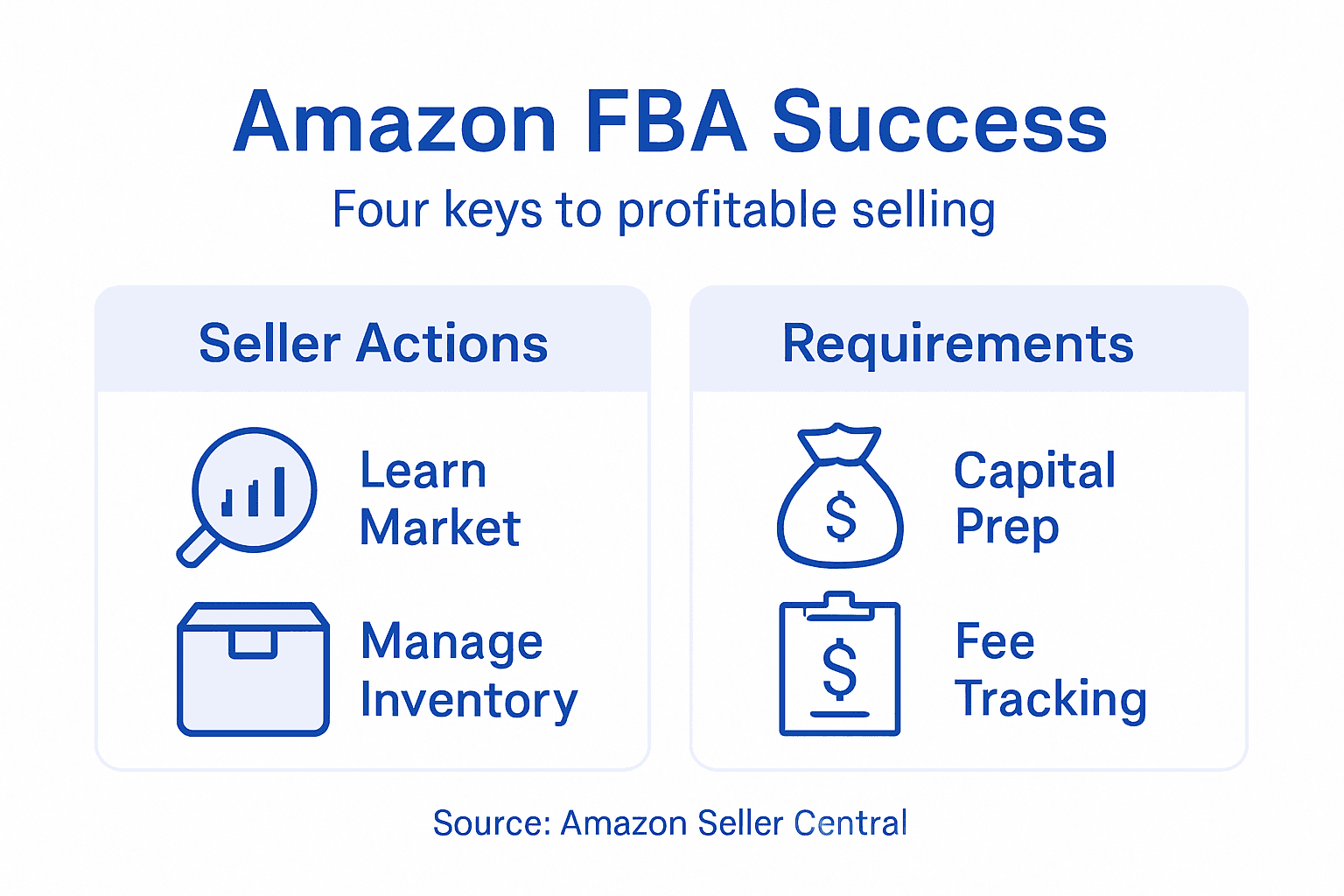
Pro Tip: Create a comprehensive financial model that includes all potential Amazon FBA fees and expenses before launching your first product line.
Common Mistakes FBA Sellers Should Avoid
Navigating the Amazon FBA marketplace requires strategic awareness and careful planning. Fraudulent schemes and unrealistic expectations can quickly derail even the most promising Amazon selling ventures.
The most critical mistakes Amazon FBA sellers consistently make include:
- Unrealistic Income Expectations: Believing in guaranteed earnings
- Poor Product Research: Selecting products without market validation
- Inadequate Inventory Management: Overstocking or understocking items
- Neglecting Amazon’s Complex Policies: Risking account suspension
- Insufficient Marketing Strategy: Failing to differentiate products
- Underestimating Operational Costs: Miscalculating profitability margins
Successful Amazon FBA sellers must develop a comprehensive understanding of potential pitfalls:
- Thoroughly research product demand before investing
- Understand all associated Amazon seller fees
- Develop a robust marketing and pricing strategy
- Maintain excellent customer service standards
- Stay updated on Amazon’s evolving marketplace rules
New sellers often fall into traps that can compromise their business potential. Consumer protection guidelines emphasize the importance of due diligence and realistic business planning.
Pro Tip: Create a detailed business plan that includes comprehensive market research, realistic financial projections, and a contingency strategy for potential marketplace challenges.
Unlock Real Success as an Amazon FBA Seller with Expert Support
Struggling to navigate the complex world of Amazon FBA can be frustrating. Many sellers face challenges like optimizing listings, mastering Amazon SEO, and managing competitive pricing strategies. This article highlights how crucial continuous learning and smart optimization are to overcome common pitfalls and myths in the FBA ecosystem.
Take control of your Amazon FBA journey with professional help tailored to boost your product visibility and sales performance. Explore our E-commerce Tips & Strategies to Grow Your Online Business for proven methods to enhance your listings and gain smarter insights. Ready to transform your Amazon store and build sustainable profit? Visit SearchOneers now to get started and leverage expert Amazon Listing Optimization and SEO that adapt with the marketplace.
Frequently Asked Questions
What is the Amazon FBA business model?
Amazon FBA (Fulfillment by Amazon) allows sellers to store their products in Amazon’s warehouses. Amazon then handles storage, packaging, shipping, and customer service, enabling sellers to focus on product selection and marketing.
What are the common myths about Amazon FBA?
Common myths include the belief that FBA guarantees instant profits, is a passive income source, that any product will sell well, and that there is minimal ongoing work after initial setup. These misconceptions can lead to unrealistic expectations for new sellers.
How do I determine the right type of Amazon FBA seller for my business?
The right type of Amazon FBA seller depends on your experience, capital, and business goals. You can choose from categories such as Individual Entrepreneurs, Small Business Owners, Professional Resellers, Wholesale Distributors, or Private Label Creators, each requiring different operational approaches and strategies.
What are the key steps in the Amazon FBA process?
The key steps in the Amazon FBA process include product preparation, inventory shipment to Amazon fulfillment centers, storage of products, order processing by Amazon, customer service management, and payment to sellers after deducting Amazon’s fees.
Recommended
- Amazon FBA Explained: Boost Product Visibility & Sales – Searchoneers
- 7 Essential Amazon Seller Business Types Explained – Searchoneers
- Complete Guide to Amazon Marketplace Terms – Searchoneers
- Seller Central Explained: Complete Guide for Amazon Sellers – Searchoneers
- Definition of SaaS Ecommerce: Modern Retail Solutions

Leave a Reply