TL;DR:
- Choosing the wrong Amazon campaign type wastes ad spend and hampers product momentum.
- Effective strategy involves understanding and optimizing Sponsored Products, Sponsored Brands, and Sponsored Display campaigns for each growth stage.
- Consistent review, proper campaign structure, and listing optimization are key to maximizing Amazon advertising success.
Choosing the wrong Amazon campaign type does not just waste ad spend. It quietly kills your product’s momentum, buries your listing, and hands sales to competitors who figured out the system. With Amazon’s advertising platform growing more competitive each year, sellers who treat all campaigns as interchangeable are leaving serious money on the table. The good news is that once you understand how each campaign type works, and when to use it, you can build a strategy that improves visibility, lowers wasted spend, and drives consistent sales. This guide breaks down every major Amazon campaign type so you can stop guessing and start growing.
Table of Contents
- Understanding Amazon campaign types: The foundation
- Breaking down the core campaign types
- Best practices: Structuring and optimizing campaigns
- Choosing the right campaign for your growth stage
- What most sellers get wrong about Amazon campaign types
- Boost your Amazon campaigns with expert support
- Frequently asked questions
Key Takeaways
| Point | Details |
|---|---|
| Separate campaign types | For best results, avoid mixing match types or funnels within campaigns. |
| Brand Registry requirements | Sponsored Brands and Display ads require Brand Registry enrollment, but Sponsored Products do not. |
| Leverage auto campaigns for research | Use auto campaigns for ongoing keyword discovery and harvest insights weekly. |
| Match campaigns to growth stage | Choose campaign type and budget based on your product’s lifecycle and current business goals. |
| Optimize and review budgets | A too-low ad budget can cap your reach and slow your growth, so monitor and adjust frequently. |
Understanding Amazon campaign types: The foundation
An Amazon campaign type is the structural framework that determines how your ads are served, who sees them, and where they appear across Amazon’s ecosystem. Think of it as the vehicle you choose for your advertising budget. Pick the wrong one and you are driving a sports car off-road.
Amazon currently offers three primary campaign types:
- Sponsored Products: Ads that appear in search results and on product detail pages, promoting individual listings.
- Sponsored Brands: Headline ads featuring your brand logo, a custom headline, and multiple products. These appear prominently at the top of search results.
- Sponsored Display: Ads that reach shoppers both on and off Amazon, using audience and product targeting for retargeting.
Each type serves a different purpose in your advertising funnel. Sponsored Products drive direct purchase intent. Sponsored Brands build awareness and brand recognition. Sponsored Display re-engages shoppers who viewed your product but did not convert.
| Campaign type | Placement | Targeting options | Brand Registry required |
|---|---|---|---|
| Sponsored Products | Search results, PDPs | Auto, manual (keyword + product) | No |
| Sponsored Brands | Top of search, search results | Keyword, product | Yes |
| Sponsored Display | On and off Amazon | Audience, product | Yes |
One of the most overlooked fundamentals is knowing how to optimize keywords on Amazon before you even launch a campaign. Your keyword strategy directly determines whether your ads reach the right buyers.
Pro Tip: Separate campaigns by match type and funnel to keep your data clean and your optimizations precise. Mixing broad, phrase, and exact match types inside one campaign makes it nearly impossible to diagnose what is working.
Breaking down the core campaign types
With the groundwork in place, let’s tackle how each major campaign type serves unique goals.
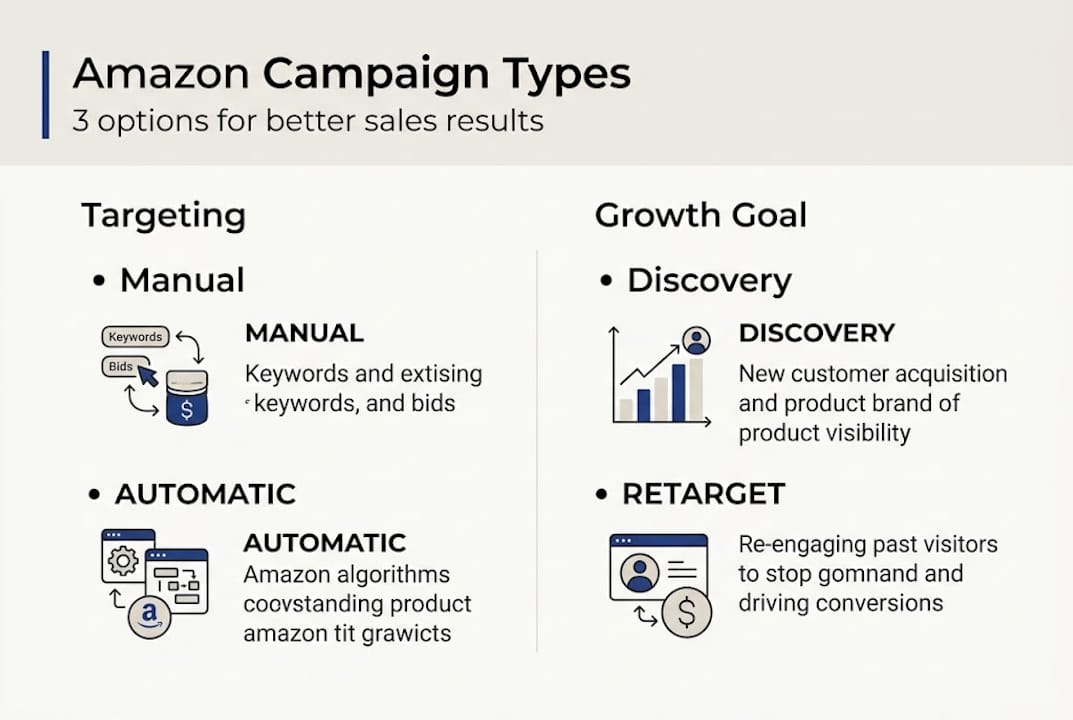
Sponsored Products are the most accessible entry point. They support both automatic and manual targeting. In auto mode, Amazon’s algorithm matches your ad to relevant searches based on your listing content. In manual mode, you control the keywords and bids. Most sellers start with auto to gather data, then shift to manual campaigns using the keywords that converted.

Sponsored Brands let you showcase your brand story at the top of search. You can feature up to three products, add a custom headline, and link to your Store or a custom landing page. These ads are powerful for brand building and cross-selling. However, Brand Registry is required for Sponsored Brands and Sponsored Display, so sellers who have not enrolled cannot access these formats.
Sponsored Display is the retargeting powerhouse. It lets you reach shoppers who viewed your product or similar products, even after they leave Amazon. This is ideal for recovering lost conversions and staying visible during a buyer’s decision process.
Here is a quick comparison to help you choose:
| Campaign type | Avg. cost | Visibility level | Eligibility |
|---|---|---|---|
| Sponsored Products | Low to medium | High (search results) | All sellers |
| Sponsored Brands | Medium to high | Very high (top of search) | Brand Registry |
| Sponsored Display | Low to medium | Medium (on and off Amazon) | Brand Registry |
Steps to pick the right campaign for your product:
- Identify your goal: awareness, conversion, or retargeting.
- Check your Brand Registry status.
- Review your listing quality before spending on ads.
- Start with Sponsored Products if you are new or testing.
- Layer in Sponsored Brands and Display once you have conversion data.
Building a strong keyword foundation is critical before scaling. Explore advanced Amazon keyword strategies and use an Amazon keyword research checklist to make sure your targeting is built on real search data.
Pro Tip: Run auto and manual Sponsored Products campaigns simultaneously. Use auto to discover new converting keywords, then migrate the best performers into your manual campaign with tighter bids.
Best practices: Structuring and optimizing campaigns
After learning the campaign types, the next critical step is mastering their structure and ongoing management.
Structure is where most sellers quietly fail. They launch campaigns in a rush, mix match types, and then wonder why their data looks chaotic. Here is what disciplined campaign structure looks like:
- Keep broad, phrase, and exact match keywords in separate campaigns.
- Never mix branded and non-branded keywords in the same campaign.
- Separate top-of-funnel awareness campaigns from bottom-of-funnel conversion campaigns.
- Use single-product ad groups when possible for cleaner performance data.
- Set realistic daily budgets. A $5 daily cap on a competitive keyword is not a strategy.
Auto campaigns are valuable for keyword discovery when monitored weekly. The mistake sellers make is launching an auto campaign and forgetting about it. Weekly audits let you harvest converting search terms and add irrelevant ones as negative keywords, which sharpens targeting over time.
“The sellers who win on Amazon are not the ones with the most campaigns. They are the ones who review their data consistently and make small, smart adjustments every week.”
Budget discipline matters more than most sellers realize. Underfunding a campaign is like running a store with the lights half on. You get some traffic, but not enough to build momentum or gather statistically significant data.
Pro Tip: Set a weekly calendar reminder to review your Search Term Report. Pull out new converting keywords, add them to your manual campaigns, and add wasted spend terms as negatives. This single habit compounds into major savings over time.
For broader growth context, check out these Amazon sales growth tips and review a proven listing optimization workflow to ensure your ads are driving traffic to listings that actually convert.
Choosing the right campaign for your growth stage
Now, let’s match these strategies to where your Amazon business is today.
Your campaign strategy should not be static. It should evolve as your product moves through its lifecycle. A brand-new listing has different needs than a mature bestseller.
| Growth stage | Recommended campaign | Budget priority | Primary goal |
|---|---|---|---|
| New launch | Sponsored Products (auto) | Medium | Keyword discovery, early sales |
| Growth phase | Sponsored Products (manual) + Sponsored Brands | Higher | Conversion, brand visibility |
| Mature product | Sponsored Display + Sponsored Brands | Targeted | Retargeting, defend rank |
For a new product, auto Sponsored Products campaigns are your best first move. They feed Amazon’s algorithm data about your listing and surface converting keywords you may not have considered. Low budget caps can limit campaign performance, so resist the urge to start too small when launching.
During the growth phase, shift toward manual Sponsored Products campaigns using the keywords your auto campaigns revealed. Add Sponsored Brands to increase your share of search page real estate and build brand recall.
For mature products, Sponsored Display becomes your retention and defense tool. Use it to retarget shoppers who viewed your listing and to appear on competitor product pages.
Actionable next steps by stage:
- Audit your current listings for conversion readiness before increasing ad spend.
- Launch auto Sponsored Products with a sufficient daily budget (at least $20 to $30).
- Review search term reports after 7 to 14 days.
- Build manual campaigns from your top converting search terms.
- Add Sponsored Brands once you have Brand Registry and proven converters.
For more specific tactics, explore tips for boosting 2026 sales and learn how to drive Amazon traffic strategically at each stage.
Pro Tip: Match your campaign investment to your inventory levels. Scaling ad spend on a product with only 20 units in stock creates a stockout risk that can tank your organic rank and undo months of progress.
What most sellers get wrong about Amazon campaign types
Here is a perspective that might challenge how you think about Amazon advertising: complexity is not a strategy.
We see sellers with 40 active campaigns, overlapping targets, and zero clarity on what is actually working. They mistake activity for progress. More campaigns do not mean more sales. They mean more noise.
The sellers who consistently outperform their peers are not running the most sophisticated setups. They are running the most focused ones. They pick two or three campaign types, structure them cleanly using a proven workflow for listing optimization, review performance weekly, and make incremental adjustments.
Consistency beats novelty every time. The algorithm rewards sustained, relevant traffic. A well-maintained Sponsored Products campaign that has been running and optimizing for six months will almost always outperform a freshly launched “innovative” campaign structure.
The uncomfortable truth is that most Amazon advertising problems are not campaign type problems. They are listing quality problems, keyword selection problems, or budget discipline problems. Fix those first, and the campaign type almost takes care of itself.
“Stop chasing the perfect campaign setup. Start building the habit of weekly review and honest data analysis. That is where the real gains live.”
Boost your Amazon campaigns with expert support
Understanding campaign types is only half the equation. Your ads are only as effective as the listing they point to. If your title, bullet points, and backend keywords are not optimized, you are paying for clicks that will not convert.
At Searchoneers, we help Amazon sellers build the foundation that makes every ad dollar work harder. From our detailed listing enhancement guide to a step-by-step listing optimization workflow, our resources are built specifically for sellers who want measurable results. Pair strong campaign strategy with Amazon SEO optimization basics and you have a system that compounds over time. Reach out to us for personalized support tailored to your catalog and growth goals.
Frequently asked questions
What is the best Amazon campaign type for new products?
Auto campaigns are valuable for keyword discovery when monitored weekly, making them the ideal starting point for new product launches on Amazon.
Do I need Brand Registry to run all campaign types?
Brand Registry is required for Sponsored Brands and Sponsored Display, but Sponsored Products campaigns are available to all sellers regardless of Brand Registry status.
How should I organize my Amazon ad campaigns?
Separate campaigns by match type and funnel stage to keep performance data clean, actionable, and easy to optimize without conflicting signals.
What happens if my campaign budget is too low?
Low budget caps can limit campaign performance by restricting impressions and cutting off ad delivery before the day ends, which starves your campaign of the data it needs.
Can I run Sponsored Brands ads without enrolling in Brand Registry?
No. Brand Registry enrollment is a firm requirement to access Sponsored Brands campaigns, and there is no workaround available for sellers outside the program.
Recommended
- Amazon Attribution Explained: Unlocking Smarter Campaigns – Searchoneers
- Amazon Analytics: Unlocking Sales Growth Globally – Searchoneers
- Amazon International Sales: Unlocking EU Growth Potential – Searchoneers
- How to Increase Amazon Sales with Advanced Strategies – Searchoneers
- Ecommerce Archives – SEO Agency London | e-Commerce Specialists | Viaduct Generation