

Most American sellers on Amazon compete in a marketplace where over 60 percent of search traffic goes to the top three product listings. The challenge of standing out is real and impacts every aspect of your e-commerce business, from visibility to sales growth. This guide delivers focused strategies for uncovering hidden opportunities, optimizing your product listings, and attracting highly qualified traffic that can transform your Amazon results.
Table of Contents
- Step 1: Conduct Deep Keyword Research
- Step 2: Optimize Amazon Listings For Visibility
- Step 3: Deploy Strategic Amazon PPC Campaigns
- Step 4: Leverage Off-Amazon Traffic Sources
- Step 5: Analyze Results And Refine Strategies
Quick Summary
| Key Point | Explanation |
|---|---|
| 1. Conduct In-Depth Keyword Research | Identify relevant keywords to attract potential customers and optimize search results for listings. |
| 2. Optimize Listings for Increased Visibility | Craft engaging product titles and descriptions that highlight features while incorporating targeted keywords. |
| 3. Implement Strategic PPC Campaigns | Use targeted Amazon PPC ads to connect products with high-intent buyers, optimizing based on data insights. |
| 4. Leverage Off-Amazon Traffic Sources | Build a multi-channel marketing strategy to draw traffic from social media and other platforms to your listings. |
| 5. Continuously Analyze and Refine Strategies | Regularly review performance metrics to optimize pricing, advertising, and inventory management for better results. |
Step 1: Conduct Deep Keyword Research
Deep keyword research is your strategic roadmap for driving targeted Amazon traffic and maximizing sales potential. By uncovering precise search terms your potential customers are using, you can craft listings that speak directly to their needs and rank higher in search results.
Starting with keyword research methods, you will want to generate a comprehensive list of search terms that balance search volume and competitive difficulty. This means exploring both short tail keywords (broad, high-volume terms) and long tail keywords (specific, niche phrases) that reflect your product’s unique attributes. Begin by brainstorming core product features, potential customer pain points, and descriptive characteristics that shoppers might use when searching.
Utilize Amazon’s own search suggestions, competitor listing analysis, and third party keyword research tools to expand your initial list. Pay special attention to extracting meaningful keywords through advanced extraction techniques that capture user intent. Prioritize keywords with moderate search volume and lower competition to increase your chances of ranking and attracting qualified traffic.
Pro tip: Always prioritize relevance over pure search volume when selecting keywords for your Amazon listings.
Step 2: Optimize Amazon Listings for Visibility
Optimizing your Amazon listings is crucial for capturing potential buyer attention and driving sales. Your goal is to transform your product page into a compelling, searchable, and conversion-focused digital storefront that stands out in Amazon’s competitive marketplace.

Start by crafting a strategic approach to product visibility through comprehensive listing optimization. Focus on four critical components: product title, bullet points, description, and backend keywords. Your product title should include primary keywords, highlight key features, and communicate immediate value. Bullet points need to be concise, benefit-driven, and packed with searchable terms that address customer needs. The description is your opportunity to tell a persuasive product story while incorporating additional relevant keywords.
Remember that product placement and presentation directly influence buyer behavior, so invest time in creating high-quality images that showcase your product from multiple angles and demonstrate its unique value proposition. Analyze top-performing competitor listings in your category to understand effective optimization strategies, but always maintain authenticity and accuracy in your own listing.
Pro tip: Regularly update and refine your listings based on customer feedback and changing search trends to maintain optimal visibility and relevance.
Step 3: Deploy Strategic Amazon PPC Campaigns
Deploying strategic Amazon Pay Per Click (PPC) campaigns is a critical approach to driving targeted traffic and accelerating sales growth. Your goal is to create precise, data-driven advertising that connects your products directly with potential buyers who are most likely to convert.
Amazon’s integrated growth strategy emphasizes the importance of targeted advertising that leverages advanced data analytics for maximum impact. Begin by structuring your campaigns with a clear hierarchy: use Sponsored Product Ads for direct product visibility, Sponsored Brand Ads to build brand recognition, and Sponsored Display Ads for retargeting interested customers. Select keywords strategically, focusing on a mix of broad, phrase, and exact match types that align with your product’s unique selling points and customer search behaviors.
Here’s a comparison of key Amazon ad types and their strategic purposes:
| Ad Type | Primary Goal | Ideal Use Case |
|---|---|---|
| Sponsored Product Ads | Boost direct product visibility | Promote individual listings |
| Sponsored Brand Ads | Build brand recognition | Introduce or reinforce your brand |
| Sponsored Display Ads | Retarget interested shoppers | Re-engage previous visitors |
Implement a continuous optimization approach based on scholarly marketing research techniques that involve iterative testing and audience segmentation. Monitor your campaign performance meticulously, tracking metrics like click through rate, conversion rate, and advertising cost of sales. Be prepared to adjust your bids, refine your keyword selections, and reallocate your budget toward the most successful ad groups. This dynamic approach ensures your PPC strategy remains responsive to changing market conditions and customer preferences.
Pro tip: Allocate approximately 10% of your initial budget for experimental campaigns to discover unexpected high-performing keywords and audience segments.
Step 4: Leverage Off-Amazon Traffic Sources
Leveraging off-Amazon traffic sources is a powerful strategy to expand your product visibility, drive targeted customers, and create additional sales channels beyond Amazon’s native ecosystem. Your mission is to build a comprehensive marketing approach that attracts potential buyers from multiple platforms and directs them toward your Amazon listings.
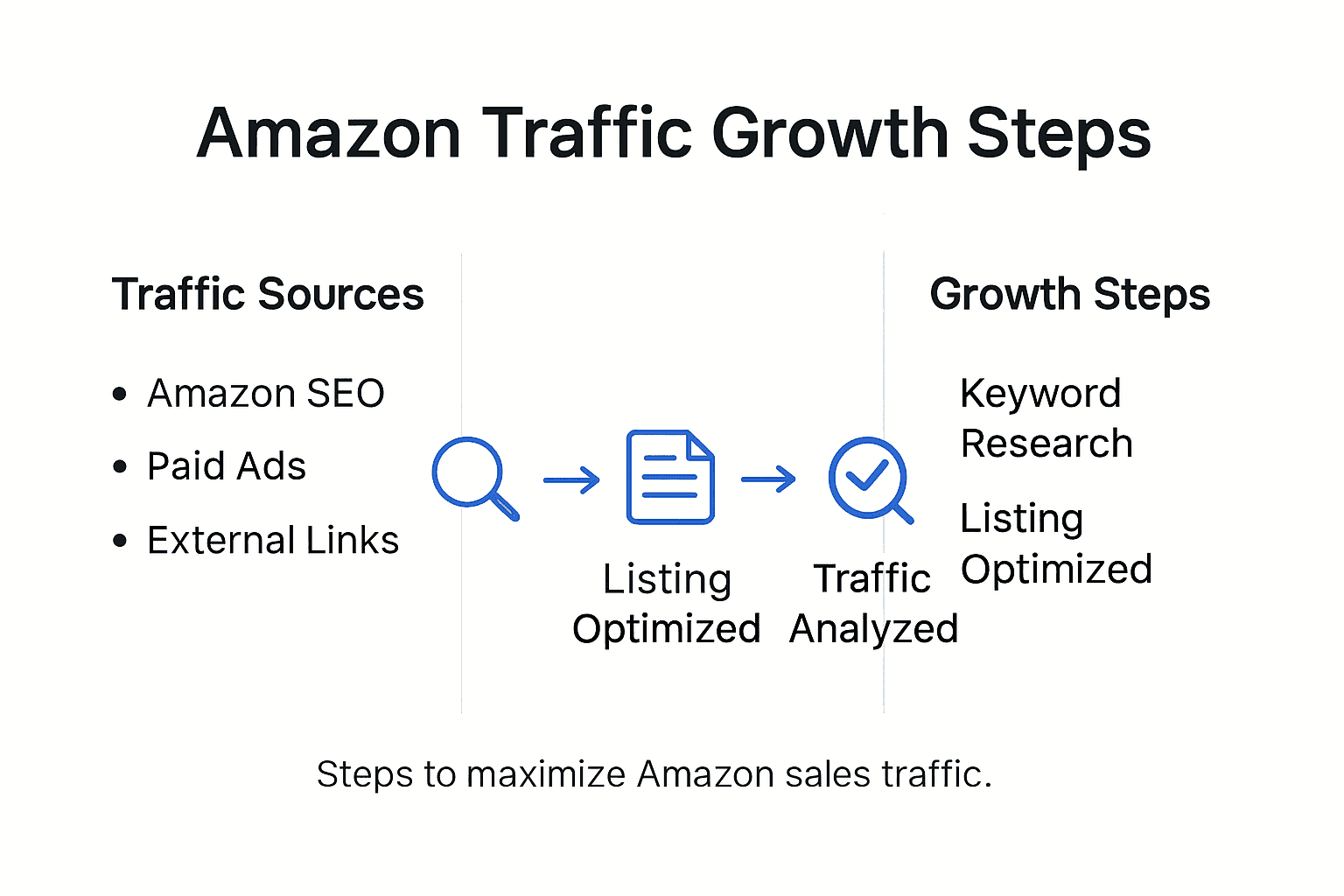
Research on Amazon’s platform dynamics highlights the critical importance of multi-channel marketing strategies. Start by developing a robust social media presence that showcases your products through engaging content, targeted advertisements, and influencer partnerships. Platforms like Instagram, Facebook, and TikTok offer powerful targeting capabilities that can help you reach specific customer segments most likely to be interested in your products.
Utilize external customer acquisition methods such as email marketing, content marketing, and strategic partnerships to create additional traffic streams. Create valuable content that addresses your target audience’s pain points, using blog posts, YouTube videos, and podcasts to demonstrate your product’s unique value. Implement tracking links and custom landing pages that seamlessly guide potential customers directly to your Amazon listings, ensuring you can measure the effectiveness of each traffic source and optimize your marketing efforts accordingly.
Pro tip: Create unique discount codes or special offers for each external traffic source to track conversion rates and identify your most effective marketing channels.
Step 5: Analyze Results and Refine Strategies
Analyzing your Amazon sales performance is a critical process that transforms raw data into actionable insights for continuous improvement. Your objective is to develop a systematic approach to measuring, understanding, and optimizing your sales strategies based on comprehensive performance metrics.
Advanced analytics tools for Amazon sellers provide deep insights into key performance indicators like sales velocity, profit margins, inventory health, and advertising campaign return on investment. Start by establishing a consistent review schedule where you examine critical metrics such as conversion rates, click through rates, total sales, average order value, and customer acquisition costs. Pay close attention to the performance of individual products, identifying which items are driving revenue and which might need strategic adjustments.
Below is a quick-reference summary of core metrics to monitor for Amazon sales optimization:
| Metric | What It Measures | Why It Matters |
|---|---|---|
| Conversion Rate | Visitors who purchase | Optimizes listing performance |
| Click Through Rate | Ad engagement | Gauges ad relevance |
| Inventory Health | Stock availability status | Prevents lost sales, avoids stockouts |
| Advertising Cost of Sales (ACoS) | Ad spend efficiency | Controls marketing profitability |
Amazon’s strategic approach to continuous improvement emphasizes creating a dynamic feedback loop that allows for rapid iteration. Use your analytical findings to make targeted refinements across multiple dimensions including product pricing, advertising spend, inventory management, and listing optimization. Create experiment driven strategies where you test small changes and measure their impact, allowing data to guide your decision making process rather than relying solely on intuition.
Pro tip: Set up automated reporting and use spreadsheet templates to streamline your data analysis process and ensure consistent tracking of key performance metrics.
Boost Your Amazon Success with Expert Strategies
Driving Amazon traffic and maximizing sales growth is no easy feat. You face challenges like pinpointing the right keywords, optimizing listings for visibility, and managing effective PPC campaigns. These critical steps highlighted in the article show how vital it is to master Amazon listing optimization and leverage data-backed SEO insights to outpace the competition and capture your ideal customers.
If you want to transform your Amazon store into a high-converting powerhouse explore our E-commerce Tips & Strategies to Grow Your Online Business for actionable solutions.
Take control of your Amazon sales growth today with tailored optimization and smart analytics from SearchOneers. Visit SearchOneers now to unlock expert support that evolves with marketplace trends and drives measurable results.
Frequently Asked Questions
How can I conduct deep keyword research for my Amazon listings?
To conduct deep keyword research, begin by brainstorming core product features and customer pain points. Use Amazon’s search suggestions, competitor analysis, and third-party tools to gather a list of both short tail and long tail keywords that reflect your product’s unique attributes.
What are the key components of optimizing my Amazon listing for visibility?
The key components include creating a compelling product title, benefit-driven bullet points, and an engaging description. Ensure you incorporate primary keywords and focus on high-quality images to enhance your listing’s appeal and attract potential buyers.
How should I structure my Amazon PPC campaigns for maximum effectiveness?
Structure your Amazon Pay Per Click (PPC) campaigns by using Sponsored Product Ads for visibility, Sponsored Brand Ads for brand recognition, and Sponsored Display Ads for retargeting. Monitor their performance regularly and adjust your keyword selections based on conversion metrics to enhance effectiveness.
What strategies can I use to leverage off-Amazon traffic sources?
To leverage off-Amazon traffic sources, develop a social media presence and create valuable content that addresses your audience’s needs. Utilize email marketing and partnerships to drive traffic directly to your Amazon listings, ensuring tracking links are in place for measurement.
How can I analyze my Amazon sales performance effectively?
You can analyze your Amazon sales performance by regularly reviewing key metrics such as conversion rates, click-through rates, and advertising costs. Set up automated reporting to streamline this process and ensure consistent tracking, which will help optimize your sales strategies.
What adjustments can I make based on the data I collect from Amazon sales analysis?
Based on your data analysis, adjust your product pricing, advertising spend, and inventory management strategies. Testing small changes and measuring their impact will lead to continuous improvements and higher sales growth over time.
Recommended
- Understanding Amazon Growth Strategies – Scale Your Business
- 10 Effective Ways to Increase Amazon Sales in 2025
- How to Evaluate Amazon Data for Stronger Sales Results – Searchoneers
- How to Optimize Amazon Listings: Complete Guide
- Complete Guide to Starting a Style Blog – DressMeUpNY
- How to Align Marketing and Sales for Predictable Growth

Comments
2 responses to “How to Drive Amazon Traffic for Maximum Sales Growth”
[…] How to Drive Amazon Traffic for Maximum Sales Growth – Searchoneers […]
[…] How to Drive Amazon Traffic for Maximum Sales Growth – Searchoneers […]