

TL;DR:
- Most Amazon sellers underestimate how layered and dynamic the fee structure is, which impacts profitability.
- Understanding and modeling all costs—including referral, FBA, storage, and plan fees—are essential for sustainable growth.
Most sellers assume Amazon’s fee structure is simple: pay your monthly plan, sell your product, collect your money. Reality is far more layered. Between referral fees, FBA fulfillment charges, storage costs, and the 2026 fee adjustments, your actual take-home profit can look very different from your initial estimate. Understanding every component of what Amazon charges isn’t just helpful — it’s the foundation of a sustainable, profitable business. This guide breaks down each fee type, shows you how they interact, and gives you a practical framework to model your true costs before you list a single product.
Table of Contents
- The basics: What fees does Amazon charge to sell?
- How selling-plan fees and referral rates affect your bottom line
- FBA fulfillment fees, storage, and inventory surcharges
- Estimating your total costs: Step-by-step framework
- Why fee modeling is the real seller skill most people miss
- Unlock higher profits with expert Amazon listing optimization
- Frequently asked questions
Key Takeaways
| Point | Details |
|---|---|
| Amazon fees are layered | Your total Amazon charges include plan fees, referral fees, FBA costs, and optional services. |
| Plan choice impacts profits | Switching to the Professional plan saves money after selling more than 40 items monthly. |
| FBA fees increased in 2026 | Amazon’s 2026 fee hike adds about $0.08 per unit but no new fee types. |
| Modeling fees prevents surprises | Effective sellers estimate each layer to avoid unexpected costs and maximize profitability. |
| Listing optimization offsets costs | Improved listings help recoup fee increases by driving higher sales and better ROI. |
The basics: What fees does Amazon charge to sell?
Now that you understand why fee clarity matters, let’s break down each component Amazon charges to sell. Amazon charges a selling-plan fee plus a referral fee for each item sold, and if you use FBA, additional fulfillment and storage fees stack on top of those.
There are four primary fee categories every seller should know:
- Selling-plan fee: Either $39.99/month for the Professional plan or $0.99 per item sold for the Individual plan.
- Referral fee: A percentage of the total selling price, charged per item, and varies by product category. Most categories fall between 8% and 15%, though some categories like Amazon Device Accessories can go as high as 45%.
- FBA fees: If you use Fulfillment by Amazon, you pay per-unit fulfillment fees plus monthly storage fees based on the volume your inventory occupies in Amazon’s warehouses.
- Optional program costs: Advertising (Sponsored Products, Sponsored Brands), promotional programs, and marketplace services add to your total expense picture.
Here’s a side-by-side comparison of the two selling plans:
| Feature | Individual plan | Professional plan |
|---|---|---|
| Monthly fee | $0 | $39.99 |
| Per-item fee | $0.99 | $0 |
| Access to advertising | Limited | Full |
| Buy Box eligibility | No | Yes |
| Bulk listing tools | No | Yes |
| Best for | Under 40 units/month | Over 40 units/month |
Understanding the pro seller fees breakdown is critical before you commit to a plan. The right choice depends entirely on your sales volume and how you intend to grow. You can also review the seller account types in detail to make a well-informed decision.
One thing many new sellers overlook: referral fees are not optional. Every sale triggers one, regardless of your plan. If you sell a kitchen product for $30 at a 15% referral rate, that’s $4.50 per sale before any other fees. Multiply that across hundreds of units and it becomes a significant line item. Smart sellers factor referral fees into their pricing strategy from day one, not as an afterthought. Learning about calculating net profitability early on can save you from painful pricing mistakes down the road.
How selling-plan fees and referral rates affect your bottom line
With the broader fee categories explained, let’s see how your chosen selling plan and referral fees directly influence profitability.
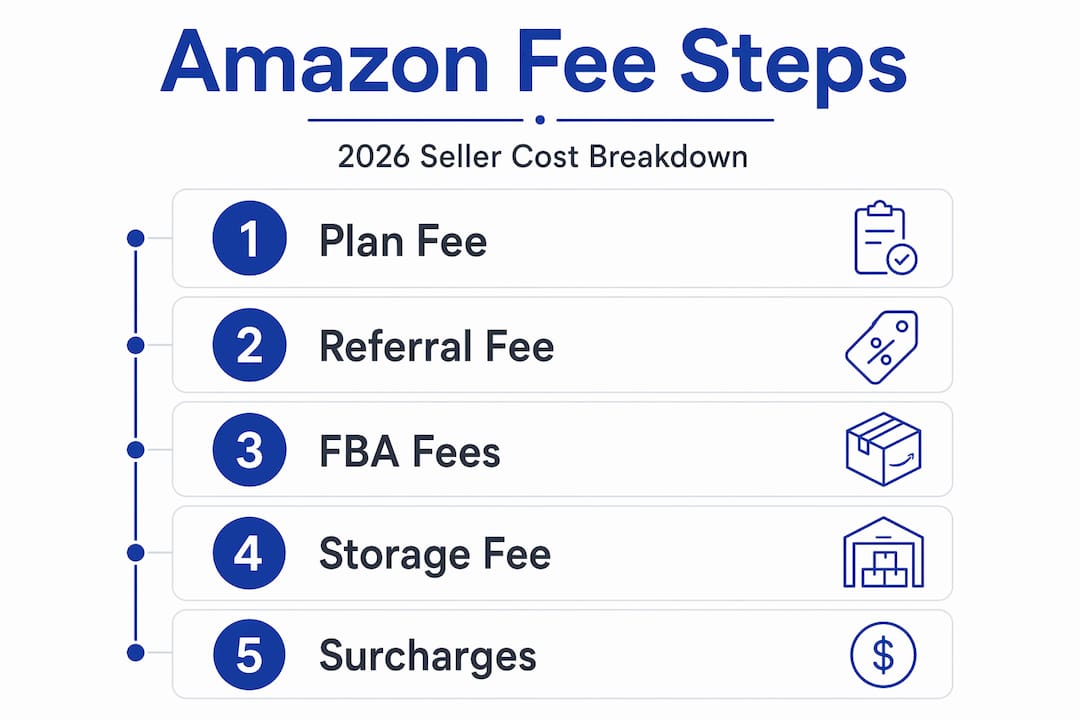
The plan choice comes down to math. The $0.99 Individual plan can become more expensive than the $39.99/month Professional plan around the point where monthly units exceed roughly 40. Sell 41 units in a month on the Individual plan and you’ve paid $40.59 in per-item fees alone. The Professional plan would have cost you $39.99 flat. The math is simple but the implications are real.
Here’s how to model the breakeven point for your own situation:
- Estimate your monthly unit volume. Use your current sales data or a conservative projection if you’re just starting out.
- Calculate Individual plan cost. Multiply your projected units by $0.99.
- Compare to $39.99. If your Individual cost exceeds $39.99, the Professional plan saves you money every month.
- Factor in plan-exclusive benefits. The Professional plan unlocks Buy Box eligibility, bulk listing tools, and full advertising access. These advantages have real revenue value beyond just the fee comparison.
- Reassess quarterly. Your volume will change as your business grows. Choosing the right plan isn’t a one-time decision — it’s an ongoing optimization.
Referral fees deserve equal attention. They are percentage-based and category-dependent, meaning two products priced the same can carry very different referral fee burdens. Here’s a quick comparison across common categories:
| Category | Referral fee rate |
|---|---|
| Electronics | 8% |
| Clothing & accessories | 17% |
| Home & kitchen | 15% |
| Books | 15% |
| Toys & games | 15% |
| Jewelry | 20% (up to $250) |
| Amazon Device Accessories | 45% |
A category referral fee strategy that accounts for these differences can significantly shift how you price and position products. Sellers who ignore category-specific rates often find their margins eroded faster than expected.
The key takeaway: referral fees are baked into every sale. They don’t go away with volume, and they don’t decrease as you grow (unless Amazon adjusts rates). Model them into your pricing before you launch, not after your first month’s payout surprises you. You can also explore listing fee optimization strategies to understand how listing structure impacts your overall cost efficiency.
Pro Tip: Track your monthly sales unit count closely. If you’re hovering near the 40-unit threshold, switching plans at the right time can save you real money every single month. Set a calendar reminder to review your plan choice at the start of each quarter.
FBA fulfillment fees, storage, and inventory surcharges
Once you know your plan and referral fee, FBA adds another calculation layer. Here’s what to expect and how rates have changed for 2026.

Amazon charges FBA fulfillment fees per unit plus monthly storage and other potential FBA-related charges, including an aged inventory surcharge once inventory is in a fulfillment center for 181 days. These fees are not flat. They scale with the size, weight, and category of your product.
FBA fulfillment fees are broken into size tiers. Small standard items (under 16 oz) carry lower per-unit fees, while large bulky or oversized items can cost significantly more to fulfill. For 2026, Amazon increased average Referral and FBA fee rates by about $0.08 per unit sold, effective January 15, 2026, and did not introduce new fee types. That’s less than 0.5% of an average item’s selling price per unit, but at scale, it adds up fast.
Here’s a simplified breakdown of FBA fee components:
| Fee type | How it’s calculated | When it applies |
|---|---|---|
| Fulfillment fee | Per unit, by size and weight | Every FBA sale |
| Monthly storage fee | Per cubic foot of inventory | Monthly |
| Aged inventory surcharge | Per unit, tiered by days stored | After 181 days in warehouse |
| Returns processing fee | Per unit returned | When customer returns item |
“For 2026, the $0.08 per unit increase may seem minor in isolation. Sell 10,000 units a year and that’s $800 in additional costs. Sell 100,000 units and you’re looking at $8,000. Fee modeling at scale is not optional.”
The aged inventory surcharge is one of the most overlooked FBA charges. If your products sit in Amazon’s fulfillment centers past 181 days, you start paying extra. This surcharge is tiered: the longer the inventory sits, the higher the per-unit charge. Sellers who send large quantities to FBA without a clear sell-through plan often get hit hard by this fee.
Storage fees also vary by season. Amazon charges higher monthly storage rates between October and December, the peak holiday season, when warehouse space is at a premium. If you’re planning a Q4 push, factor in elevated storage costs alongside your increased sales volume.
Pro Tip: Use Amazon’s FBA Revenue Calculator before sending any new product to FBA. It lets you input your product dimensions, weight, and selling price to see an estimate of your total FBA costs before you commit inventory. You can explore FBA fee specifics and FBA listing optimization strategies to make your FBA operation leaner and more profitable.
Managing total Amazon expenses across all channels requires a holistic view of FBA costs, not just fulfillment fees in isolation.
Estimating your total costs: Step-by-step framework
With all fees and surcharges defined, let’s build a step-by-step process to calculate your true selling costs and avoid costly oversights.
Sellers generally model multiple layers: selling-plan/account fees, referral fees (category-dependent), plus fulfillment/storage charges if using FBA, and optional program costs such as advertising and promo services. Here’s how to build that model for your own products:
- Start with your selling-plan fee. Divide your monthly plan cost by your expected unit volume to get a per-unit plan cost. For the Professional plan at 200 units/month, that’s $0.20 per unit.
- Calculate your referral fee. Multiply your selling price by your category’s referral rate. A $25 product in Home & Kitchen at 15% = $3.75 per unit.
- Add FBA fulfillment fees. Look up your product’s size tier and weight on Amazon’s FBA fee schedule. A small standard item might cost $3.22 to fulfill.
- Estimate monthly storage costs. Calculate your average monthly inventory volume in cubic feet and multiply by the applicable storage rate ($0.78/cubic foot for standard size, January through September).
- Include advertising spend. If you run Sponsored Products campaigns, add your average cost-per-click multiplied by your expected click volume. Many sellers budget 10 to 15% of revenue for advertising, especially in competitive categories.
- Add any promo or program costs. Lightning Deals, coupons, and promotional discounts reduce your effective selling price and should be factored in.
Here are the most common mistakes sellers make when estimating costs:
- Ignoring aged inventory surcharges. Sending too much inventory to FBA without a realistic sell-through timeline leads to unexpected charges after 181 days.
- Underestimating advertising costs. New listings often require heavy advertising investment to gain visibility. Skipping this line item creates a false picture of profitability.
- Forgetting returns processing fees. High-return categories like clothing can generate significant returns processing costs that erode margins.
- Using list price instead of net price. If you’re running a 20% off coupon, your referral fee is still based on the original price in most cases. Know how Amazon calculates the fee basis for your specific situation.
- Not revisiting estimates after fee changes. The 2026 rate adjustments are a perfect example. A model built in late 2025 without updating for the January 15, 2026 changes will underestimate your costs.
Pro Tip: Build a fee-tracking spreadsheet for each product line with columns for plan fee (per unit), referral fee, FBA fulfillment fee, storage cost, advertising spend, and net margin. Update it every quarter. This single habit separates sellers who scale confidently from those who are perpetually surprised by their payouts.
The expense estimation guide on Seller Central walks through each fee component in detail. You can also review the 2026 fee impact analysis to understand exactly how the new rates affect your specific product categories. For advertising-specific cost management, advertising fee strategies can help you build a leaner paid traffic approach.
Why fee modeling is the real seller skill most people miss
Here’s an uncomfortable truth: most Amazon sellers spend hours optimizing their listing titles and product photos but have never built a complete fee model for a single SKU. That’s backwards.
Listing optimization matters enormously. But if your fee structure is wrong, a perfectly optimized listing just sells you into a loss faster. We’ve seen sellers with top-ranked listings running at negative margins because they never accounted for FBA storage costs during slow months or the compounding impact of advertising spend on thin-margin products.
Amazon’s 2026 fee rate increase is a good case study. An $0.08 per unit increase sounds trivial. But consider a seller moving 5,000 units a month. That’s $400 in additional monthly costs, or $4,800 per year, from a single fee adjustment. If that seller never updated their cost model, they’d be wondering why their margins quietly shrank throughout 2026 without any obvious cause.
The sellers who build durable businesses on Amazon treat fee modeling as a living document, not a one-time setup task. They revisit their cost breakdowns every quarter. They update their models when Amazon announces changes. They know their exact breakeven price for every SKU. This discipline is what separates profitable sellers from those who are always chasing their next restock without understanding why the money isn’t adding up.
Our perspective: fee modeling is a core business skill, not an accounting chore. Pair it with strong listing optimization and you have a genuinely powerful combination. Explore 2026 fee change insights to stay ahead of the curve as Amazon continues to adjust its fee structure.
The sellers who win long-term are the ones who treat every fee as a variable they can understand, model, and respond to strategically.
Unlock higher profits with expert Amazon listing optimization
You now have a clear picture of Amazon’s fee structure and how to model your true costs. The next step is making sure every listing you run is working as hard as possible to offset those fees and drive maximum ROI.

At Searchoneers, we specialize in turning fee-aware sellers into high-performing ones. Our listing enhancement guide shows you exactly how optimized titles, bullet points, and backend keywords drive more organic traffic and reduce your dependence on paid advertising. Pair that with our optimization workflow built specifically for Amazon sellers, and you have a repeatable system for improving every product page. Start with the SEO optimization basics to build a strong foundation, then layer in advanced strategies as your catalog grows. Better listings mean better conversion rates, and better conversion rates mean every dollar you spend on fees generates more revenue.
Frequently asked questions
What is the difference between Amazon’s Individual and Professional selling plans?
The Individual plan charges $0.99 per item sold with no monthly fee, while the Professional plan charges $39.99 per month but no per-item fee, making Professional more cost-effective once you sell over 40 items a month.
What are Amazon referral fees and how are they calculated?
Referral fees are paid per item and vary by category, calculated as a percentage of the total selling price, typically ranging from 8% to 45% depending on the product type.
How do the 2026 Amazon fee changes affect sellers?
Amazon increased average Referral and FBA fee rates by about $0.08 per unit sold starting January 15, 2026, but did not introduce new fee types, meaning the structure stays the same while rates edge slightly higher.
What is FBA and what fees should I expect?
FBA charges per-unit fulfillment fees plus monthly storage fees based on inventory volume, and may apply an aged inventory surcharge for items stored in a fulfillment center for more than 181 days.
How can I estimate my total costs as an Amazon seller?
Sellers model multiple layers: start with your account plan fee, add category-based referral fees, layer in FBA fulfillment and storage costs if applicable, then include advertising and promotional expenses for a complete and accurate cost picture.

Comments
One response to “Amazon Seller Fees Explained: Maximize Profits in 2026”
[…] Amazon Seller Fees Explained: Maximize Profits in 2026 – Searchoneers […]