

TL;DR:
- Amazon’s 2026 sales calendar is increasingly complex, requiring sellers to plan for staggered dates, multi-day deals, and AI-driven product discovery. Preparation involves early inventory shipments, timely deal submissions, continuous campaign monitoring, and marketplace-specific strategies to capitalize on these events effectively. Success depends on comprehensive listing optimization, personalized content, and attentive execution across all regional sales windows.
Amazon’s sales calendar has gotten complicated, and that complexity costs unprepared sellers real money. Tracking amazon next sales used to mean circling Prime Day on a calendar. Now it means managing staggered marketplace dates, multi-day rolling deal windows, AI-powered product discovery, and region-specific launch times. Miss the preparation window and you lose the ranking momentum that drives sales long after the event ends. This guide breaks down every major upcoming Amazon sales event in 2026, explains how each one affects your operations, and gives you the strategy to capitalize on all of them.
Table of Contents
- Key Takeaways
- Amazon next sales: the 2026 event calendar
- How event timing reshapes your operations
- AI merchandising: the new visibility factor
- Practical steps to maximize every upcoming event
- Comparing major Amazon sales events
- My honest take on navigating 2026’s sales calendar
- Get your listings ready before the next event
- FAQ
Key Takeaways
| Point | Details |
|---|---|
| Prime Day moved to June | Amazon confirmed June 2026 timing across 26 countries, requiring earlier inventory and ad preparation. |
| Sales are multi-day events | Rolling Lightning deals and staged markdowns mean you must monitor and adjust continuously, not just on day one. |
| AI now shapes discovery | Amazon’s AI-powered merchandising surfaces products beyond price alone, so listing quality directly affects event visibility. |
| Marketplace dates differ | India, Australia, Brazil, and Japan shop later in summer, so global sellers need segmented event calendars. |
| Listing optimization wins | Sellers who align titles, keywords, and content with AI-driven personalization capture more traffic during every event. |
Amazon next sales: the 2026 event calendar
The single biggest shift for 2026 is timing. Prime Day lands in June across 26 countries, which is earlier than many sellers historically planned for. That matters because your inventory needs to be at fulfillment centers, your deals need approval, and your ad spend needs to be ramping before the event opens.
Here is a clear breakdown of the major upcoming Amazon sales events and what you need to know about each one.
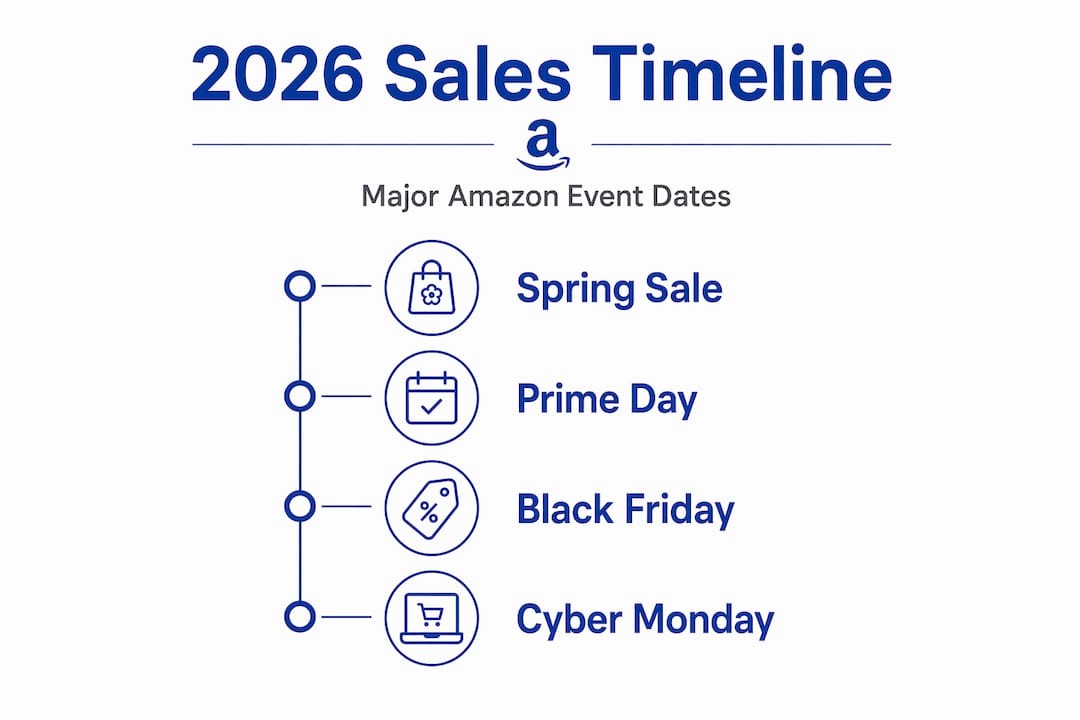
| Event | Dates | Key Details |
|---|---|---|
| Big Spring Sale | March 25–31, 2026 | 40% off across 35+ categories, open to all customers with Prime-exclusive extras |
| Amazon India Great Summer Sale | Starting May 8, 2026 | AI-curated product discovery, fashion, electronics, groceries |
| Prime Day 2026 | June (most markets) | 26 countries, India and select markets follow later in summer |
| Prime Day (India, AU, BR, JP) | Later summer 2026 | Staggered timing requires separate planning for these marketplaces |
| Black Friday / Cyber Monday | Late November 2026 | Deepest discounts of the year, highest buyer intent across all categories |
| Year-End Clearance | Late December 2026 | Post-holiday demand for deals on excess inventory |
The Big Spring Sale deserves more credit than most sellers give it. It ran March 25–31 with discounts spanning nearly 40 categories, and unlike Prime Day, it is open to all customers. That broader audience reach makes it a strong event for new customer acquisition, not just Prime member conversions.
Prime Day 2025 set the benchmark: independent sellers drove 60%+ of all sales during that event, which tells you the marketplace heavily rewards prepared third-party sellers who show up with optimized listings and funded ad campaigns.
How event timing reshapes your operations
Here is what most sellers get wrong. They treat Amazon sales events as single-day spikes that require a last-minute price drop. That model is outdated and leaves money on the table.
Amazon has structured its sales as multi-day shopping windows with staged markdowns and rotating Lightning deals. Consumer traffic and deal discovery ramp up days before the official start date. Buyers add items to wishlists, compare prices, and set alerts well in advance. If your listing is not visible before the event opens, you are already behind.
The specific operational adjustments you need to make:
- Inventory receiving deadlines: With Prime Day in June, your shipments to Amazon fulfillment centers need to arrive weeks earlier than you may have planned based on prior years’ July timing.
- Deal and promotion approvals: Lightning deals and Prime Exclusive Discounts require lead time for Amazon to review. Submit early, not the week before.
- Ad budget ramp-up: Sponsored Products campaigns perform better when the algorithm has recent data. Start increasing bids and budgets 2–3 weeks before an event, not the day it launches.
- Marketplace segmentation: India’s Prime Day runs in July while most markets run in June. If you sell across multiple Amazon regions, your calendars need to be country-specific, not global.
- Continuous monitoring: Rolling deals and flash rotations mean you need to check pricing, inventory levels, and competitor activity throughout the event window, not just at open and close.
Pro Tip: Set daily budget caps on your ad campaigns 20–30% higher than normal for the full event window, not just day one. The traffic tail extends several days after the main event dates, and that is often when conversion rates are highest because competition from other sellers’ deals has thinned out.
AI merchandising: the new visibility factor
Price cuts used to be the whole game during Amazon sales events. They still matter, but they are no longer sufficient on their own. Amazon’s 2026 events reflect a deliberate shift toward AI-powered personalized discovery, where the platform surfaces products based on individual shopper behavior rather than just deal depth.
Amazon India’s Great Summer Sale made this explicit, featuring AI-curated product finds as a core shopping experience alongside traditional discounts. This is not limited to India. The same personalization infrastructure is at work across all major events.
What this means for your listings:
- AI Review Highlights summarize customer sentiment directly on the product page. Listings with richer, more authentic reviews get surfaced more favorably during events.
- Personalized homepages mean two shoppers browsing the same sale can see completely different product recommendations. Your listing’s keyword relevance determines whether it appears in those personalized feeds.
- Smart price alerts notify buyers when items they viewed hit a deal price. Sellers who consistently price near or at a discount threshold during events get more alert-driven traffic.
- Buying Guides and Quick Learn features favor listings with complete, accurate, and detailed content. Sparse bullet points are a liability when AI is parsing listing quality to decide what to recommend.
The sellers who treat AI merchandising as someone else’s problem are the same ones who wonder why their sales spike less than competitors’ during events. Listing quality is no longer just an SEO tactic. It is a visibility requirement.
Pro Tip: Update your back-end keywords and bullet points specifically for each upcoming event. If you sell fitness equipment and Prime Day is approaching, your listing should reflect seasonal language and use cases that align with what buyers are searching for in June, not December.
Practical steps to maximize every upcoming event
Knowing the Amazon sales schedule is step one. Executing against it is where the real competitive edge lives. Here is a practical sequence that works across all major events.
Build a segmented event calendar. Map every major sale date by marketplace. If you sell in the US, UK, Canada, and India, your calendar has at least four separate timelines to manage. Use the table in the previous section as your starting framework and leverage Amazon’s holiday calendar to fill in regional gaps.
Audit your listings 6–8 weeks before each event. Check title keyword alignment, image quality, bullet point completeness, and A+ Content presence. This is your highest-leverage window because changes made now will have time to index and affect organic rank before traffic spikes.
Submit deal requests early. Lightning deals and Prime Exclusive Discounts have submission deadlines. Missing them means sitting out the event while competitors who planned ahead capture your potential buyers. Check Seller Central deal submission windows as soon as event dates are announced.
Fund your ad campaigns before the ramp. Continuous monitoring during events is critical, but underfunded campaigns go dark when impression volume surges. Set daily budgets high enough to sustain full-day visibility and use rules-based automation to prevent budget exhaustion by early afternoon.
Track competitor pricing in real time. Buyers comparison-shop aggressively during events. If a competitor undercuts your price mid-event, your conversion rate will drop. Tools that monitor competitor listings let you respond before you lose meaningful sales volume.
Post-event analysis within 48 hours. Your sales data, ad performance, and ranking changes right after an event are some of the richest data you will see all year. Review them quickly and apply the lessons to the next upcoming event on your calendar. For a structured approach, exploring sales growth strategies that incorporate data review cycles is worth your time.
Pro Tip: Do not drop your ad bids back to pre-event levels immediately after an event ends. The organic ranking gains you captured during high-traffic periods can persist for weeks if you maintain spend momentum. Treat the two weeks after a major sale as a consolidation phase, not a wind-down.
Comparing major Amazon sales events
Not all events deserve equal investment. Here is how the major upcoming Amazon deals opportunities stack up for sellers.
| Event | Audience reach | Discount depth | Category focus | Seller opportunity |
|---|---|---|---|---|
| Prime Day | Prime members globally | High (20–50%) | Broad: tech, home, fashion | Massive; peak seller traffic all year |
| Big Spring Sale | All customers + Prime extras | Moderate (up to 40%) | Seasonal, home, tech | Strong for new customer acquisition |
| Great Summer Sale (India) | India Prime members | Moderate | Fashion, electronics, groceries | High for India marketplace sellers |
| Black Friday / Cyber Monday | All customers | Deepest of year | Universal | Highest buyer intent; most competitive |
| Year-End Clearance | All customers | Variable | Overstocked categories | Best for clearing slow inventory |
Prime Day and Black Friday are the two events where your preparation budget and listing quality pay off most. But the Big Spring Sale is the hidden opportunity many sellers overlook. It reaches all customers, not just Prime members, which means broader top-of-funnel exposure at a time when fewer sellers are competing at peak intensity.

My honest take on navigating 2026’s sales calendar
I have seen sellers spend weeks stress-testing their ad strategies for Prime Day while completely neglecting the listing itself. That is backwards. In my experience, the single biggest driver of event performance is whether your product appears in front of the right buyer at all. No ad budget fixes a listing that the A10 algorithm does not trust.
The shift to AI-powered merchandising has changed what “prepared” actually means. It used to mean having stock and a deal submitted. Now it means having a listing that reads well to both a buyer and an algorithm that is constantly learning what converts. That requires genuine content work, not just keyword stuffing in your title.
What I have found works: doing a full listing audit 6 weeks out, refreshing images to match seasonal intent, tightening bullet points so they answer the most common pre-purchase questions, and updating back-end search terms to capture event-specific queries. Sellers who approach it this way consistently outperform those who just cut prices and hope for traffic.
The multi-marketplace timing issue is also genuinely underestimated. I have watched sellers miss India’s summer sale window entirely because they assumed global events run on a single date. Treat each marketplace as its own business unit with its own event calendar.
— Goga
Get your listings ready before the next event
Every Amazon sales event is a timed opportunity. Sellers who show up with optimized listings, funded campaigns, and event-specific content capture disproportionate traffic. Those who wing it get outranked before the first Lightning deal fires.

At Searchoneers, we specialize in exactly this kind of preparation. Our listing enhancement services are built for sellers who want to convert event traffic, not just attract it. We optimize titles, bullet points, A+ Content, and back-end keywords with the AI merchandising trends in 2026 fully accounted for. If you want a structured workflow to get your listings event-ready fast, our listing optimization workflow walks you through every critical step. Stop leaving event revenue on the table and start showing up prepared.
FAQ
When is Amazon Prime Day 2026?
Prime Day 2026 is scheduled for June across 26 countries, with India, Australia, Brazil, and Japan shopping later in summer. Amazon has not released exact dates but confirmed the June timing for most major markets.
What is the Amazon Big Spring Sale?
The Big Spring Sale ran March 25–31, 2026, with discounts up to 40% across 35+ categories. Unlike Prime Day, it is open to all customers, not just Prime members, though Prime members receive exclusive pricing and early access.
How should sellers prepare for upcoming Amazon sales events?
Submit deal requests early, audit listings 6–8 weeks before each event, segment your calendar by marketplace, and increase ad budgets ahead of the traffic ramp. Continuous monitoring throughout the event window is more effective than a one-time setup.
Does Amazon use AI during sales events to surface products?
Yes. Amazon’s 2026 sales emphasize AI-curated product discovery, personalized homepages, and AI Review Highlights. Listings with strong content, complete attributes, and relevant keywords perform better in these personalized discovery feeds.
Do Amazon sales events run on the same dates globally?
No. Events like Prime Day are staggered by marketplace due to regional logistics and market factors. Sellers operating across multiple Amazon regions need separate event calendars for each country to avoid missing key preparation windows.

Comments
5 responses to “Amazon Next Sales in 2026: Seller’s Strategy Guide”
[…] Amazon Next Sales in 2026: Seller’s Strategy Guide – Searchoneers […]
[…] Amazon Next Sales in 2026: Seller’s Strategy Guide – Searchoneers […]
[…] Amazon Next Sales in 2026: Seller’s Strategy Guide – Searchoneers […]
[…] Amazon Next Sales in 2026: Seller’s Strategy Guide – Searchoneers […]
[…] Amazon Next Sales in 2026: Seller’s Strategy Guide – Searchoneers […]