

TL;DR:
- Improving Amazon sales requires a layered approach focusing on listing quality, strategic pricing, and active traffic management. Regularly updating content and leveraging AI-driven discovery are essential for maintaining visibility into 2026 and beyond. Consistent optimization, prompt responses, and diversified promotion are key to sustained growth.
You’re putting real effort into your Amazon listings, running ads, and watching your competitors rack up reviews while your sales stay flat. Sound familiar? Knowing how to improve sales on Amazon isn’t just about one clever trick. It requires a layered approach covering listing quality, smart pricing, paid traffic, operational health, and now, AI-powered discovery. This guide breaks down each layer with specifics so you can stop guessing and start selling more.
Table of Contents
- Key takeaways
- How to improve sales on Amazon through better listings
- Pricing and promotions that actually move product
- Advanced advertising and traffic generation
- Inventory health and customer service for sustained growth
- AI-driven discovery and staying visible in 2026
- My honest take on scaling Amazon sales
- Ready to put these strategies to work?
- FAQ
Key takeaways
| Point | Details |
|---|---|
| Listings drive everything | Optimized titles, bullet points, and images directly impact both ranking and conversion rate. |
| Promotions create urgency | Lightning Deals and coupons accelerate sales velocity and push your Best Sellers Rank upward. |
| Ads amplify organic gains | Structured PPC campaigns surface high-converting keywords that feed back into your listing strategy. |
| Operations protect growth | Inventory sync, fast shipping, and review management keep you Buy Box eligible and ranking consistently. |
| AI search is the next frontier | Refreshing content every 10 to 14 days positions your products for AI-driven discovery platforms too. |
How to improve sales on Amazon through better listings
Your listing is your storefront, your salesperson, and your billboard combined. If it isn’t pulling its weight, no amount of ad spend will fix the underlying problem.
Start with keyword research that targets high-intent terms. These are phrases buyers type when they’re ready to purchase, not just browse. Tools like Helium 10 or Jungle Scout surface search volume and competition data, but don’t ignore long-tail terms with lower volume. Those convert at higher rates because the buyer already knows what they want.
Once you have your keywords, build them naturally into your listing structure:
- Title: Lead with your primary keyword, include the top two or three secondary terms, and keep it under 200 characters. Clarity beats cleverness every time.
- Bullet points: Listings with 5 keyword-rich bullet points perform significantly better in search results. Use each bullet to address a specific buyer concern or benefit, not just a product feature.
- Images: Six to seven high-quality images, including lifestyle shots and an infographic, give buyers the visual context they need to feel confident purchasing.
- A+ Content: If you’re brand-registered, use A+ Content to add comparison charts, brand storytelling, and enhanced visuals. This can measurably lift conversion rates.
- Backend keywords: These are the invisible gold of your listing. Stuff them with synonyms, alternate spellings, and Spanish-language terms if your audience is bilingual. Use every character Amazon allows.
Amazon’s A9 algorithm considers relevance and performance to rank products, which means your listing quality and conversion rate feed directly into your organic placement. One without the other leaves results on the table.
Pro Tip: Updating your listing every 10 to 14 days signals active management to Amazon’s algorithm and improves indexing. Even a small punctuation change counts. Build this into your calendar like clockwork.
| Listing element | Impact on ranking | Impact on conversion |
|---|---|---|
| Keyword-rich title | High | Medium |
| 5 bullet points | Medium | High |
| 6 to 7 quality images | Medium | Very high |
| A+ Content | Low | High |
| Backend keywords | High | None directly |
Pricing and promotions that actually move product
Pricing is where most sellers leave serious money on the table. Not because they price too high, but because they price without strategy.
Here’s a practical sequence for running promotions effectively:
- Run Lightning Deals during peak traffic windows. Lightning Deals typically run 6 to 8 hours and appear prominently on Amazon’s Deals pages. The burst of sales velocity they generate pushes your Best Sellers Rank up, which means more organic visibility after the deal ends.
- Layer in coupons for sustained lift. Coupons display a green badge on your listing thumbnail in search results. That visual signal alone increases click-through rates even before the buyer reads your listing.
- Use an automated repricer. Manual repricing puts sellers at a disadvantage compared to competitors using automated tools that adjust prices in real time based on Buy Box dynamics. Tools like Feedvisor or BQool handle this without constant manual attention.
- Protect your margin before discounting. Calculate your break-even price including FBA fees, referral fees, and ad spend. Then set a floor price in your repricer so you’re never selling at a loss chasing the Buy Box.
Pro Tip: Use a Lightning Deal to spike your sales velocity, then immediately follow it with a coupon at a smaller discount. The rank improvement from the deal sticks longer when you keep conversion rates elevated right after.
Lightning Deals and coupons create urgency that drives short-term sales spikes. But the longer-term benefit is the rank momentum they generate, which compounds over time if you sustain conversion rates after the promotion ends.
Advanced advertising and traffic generation
SEO isn’t magic. It’s strategy. And paid ads are the fastest way to test which keywords your listing actually converts on before committing to long-term organic optimization.
Structure your campaigns with purpose:
- Sponsored Products auto campaigns: Run these first to collect data. Amazon’s algorithm will surface your ads across a wide range of search terms and show you which ones drive clicks and purchases.
- Sponsored Products manual campaigns: Take your top-converting terms from auto campaigns and build tight, niche-focused manual campaigns around them. Sponsored Ads with niche keywords effectively reach buyers and increase sales velocity.
- Sponsored Brands campaigns: If you’re brand-registered, use Sponsored Brands to capture category-level searches and direct buyers to a curated selection of your products.
- Sponsored Display Ads: These retarget shoppers who viewed your listing but didn’t purchase. They’re underused by most sellers and can recover a significant percentage of lost sales.
Beyond Amazon’s internal ad tools, external traffic is an underrated growth lever. TikTok creators and Instagram influencers in your product niche can drive buyers who were never even searching on Amazon. This external traffic, when it converts, sends a strong ranking signal to Amazon’s algorithm.
Pro Tip: Check your Search Term reports weekly. Negative-match any irrelevant terms burning your ad budget. Every dollar you redirect from wasted clicks to proven converters improves your ACoS and your ranking simultaneously.
Monitor your campaigns in real time during promotions and peak seasons. Bids that work in March may need adjustment in November. The sellers who boost Amazon sales sustainably treat their ad accounts like living systems, not set-and-forget machines.
Inventory health and customer service for sustained growth
Here’s the operational side that most optimization guides skip over: you can have the best listing on Amazon and still lose the Buy Box, drop in rankings, and tank your conversion rate if your operations are broken.
Keep these areas tight:
- Inventory sync across platforms: Synchronizing inventory across platforms prevents stockouts and overselling, both of which damage your seller metrics and Buy Box eligibility. Use a multi-channel inventory tool if you sell on Walmart, Shopify, or other marketplaces alongside Amazon.
- FBA storage limits: Overstocked slow-moving products incur long-term storage fees and eat into your IPI score. Run an ABC analysis quarterly to identify which SKUs deserve restocking priority.
- Shipping speed: Buyers filter by Prime eligibility. If your FBA shipments are delayed or your merchant-fulfilled orders ship slowly, your conversion rate suffers directly.
- Review generation: Positive reviews correlate with higher conversion rates and trust. Use Amazon’s Request a Review button for every order. Don’t violate ToS by incentivizing reviews, but do make it part of your post-purchase workflow without exception.
Pro Tip: Respond to negative reviews publicly and quickly. A professional, solution-focused response signals to potential buyers that you stand behind your product. Sellers who manage feedback well consistently outperform those who ignore it.
Think of inventory health and customer service as the foundation your listing optimization sits on. Without it, every other improvement you make will eventually crumble.

AI-driven discovery and staying visible in 2026
This is where the game is changing fast, and most sellers aren’t paying attention yet. Platforms like ChatGPT, Perplexity, and Google AI Overviews now send product recommendations directly to buyers without them ever typing into a search bar. If your product data isn’t structured for AI parsing, you’re invisible to an entire and growing segment of buyers.
Content updated within the last 30 days is up to 3.2x more likely to be cited by AI search engines. That stat alone should change how you think about listing maintenance. A listing you optimized six months ago and never touched is progressively losing ground in AI-driven discovery, even if its Amazon rank looks fine.
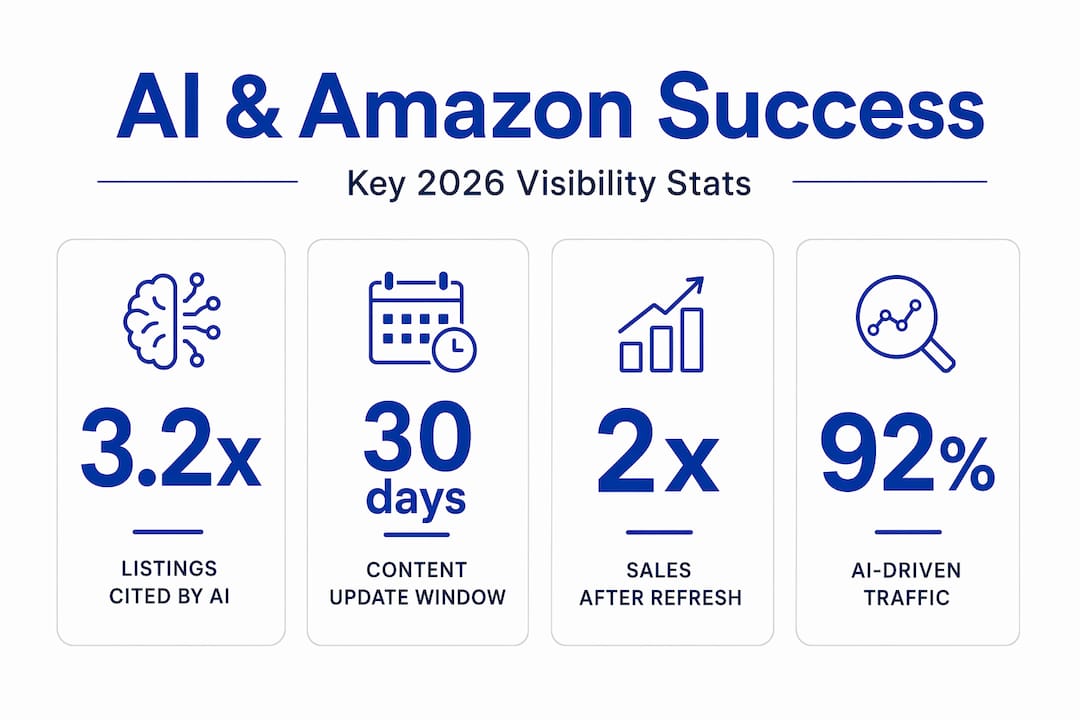
What you can do right now:
| Strategy | What it does | Difficulty |
|---|---|---|
| Refresh product descriptions monthly | Signals recency to AI crawlers and Amazon’s algorithm | Low |
| Add structured data and schema markup | Helps AI tools parse and categorize your product accurately | Medium |
| Sync content updates across platforms | Compounds visibility across ChatGPT, Perplexity, and Google AI | Medium |
| Use factual, verifiable product claims | AI tools favor citable, specific information over vague copy | Low |
Answer Engine Optimization is becoming a real discipline alongside traditional SEO. It favors structured content and verifiable data rather than keyword density alone. The sellers who learn this now will own category placements in AI search before their competitors even realize the shift happened.
Pro Tip: Coordinate content updates across multiple AI platforms for compounded visibility. Update your Amazon listing, your brand website product page, and any retailer feeds at the same time. Consistency across sources increases the likelihood that AI tools will surface your product confidently.
My honest take on scaling Amazon sales
I’ve watched sellers pour thousands of dollars into ads while their listing titles were still generic, their images were blurry, and their backend keywords were stuffed with irrelevant terms. The results were predictably mediocre.
In my experience, the sellers who scale sustainably share one trait: they treat listing optimization as an ongoing practice, not a one-time task. They’re refreshing content, testing images, and analyzing search term data on a regular schedule. The one-and-done approach might get you a short-term bump. It rarely builds lasting momentum.
What I’ve also seen is that the sellers who adapt fastest to platform changes, whether that’s Amazon’s algorithm updates or the rise of AI-driven discovery, are the ones who were already in the habit of consistent refinement. They didn’t have to scramble to adapt because their processes were built for change.
The uncomfortable truth about shortcuts is this: they work until they don’t. Review manipulation gets accounts suspended. Keyword stuffing tanks readability and CTR. Aggressive discounting without a margin floor erodes profitability. The path that’s actually faster, in the long run, is doing the fundamentals well and repeating them consistently.
— Goga
Ready to put these strategies to work?
If you’ve made it this far, you know there’s a clear path forward. The challenge is execution, and that’s where having the right resources makes all the difference.

Searchoneers has built step-by-step tools specifically for Amazon sellers who want results without the guesswork. The listing optimization workflow walks you through every element of a high-converting listing in the exact order it matters. For sellers who want a quick audit of where they stand, the listing enhancement guide covers what to fix first and why. Both resources are built around the same data-backed strategies covered in this article. Start with one, implement it fully, and you’ll have a measurable advantage over sellers who are still guessing.
FAQ
How do I improve my Amazon product listing fast?
Focus on your title, bullet points, and primary image first. These three elements have the highest combined impact on both click-through rate and conversion rate, and improvements show up in ranking within days.
What are the best ways to increase Amazon sales quickly?
Run a Lightning Deal or add a coupon badge to spike sales velocity, then follow up with a Sponsored Products campaign targeting your top-converting keywords. High sales velocity directly influences your organic ranking, so short-term promotions create lasting rank benefits.
How often should I update my Amazon listing?
Update your listing every 10 to 14 days, even with minor changes. Consistent updates signal active management to Amazon’s algorithm and increase indexing frequency, which improves your search visibility over time.
Do backend keywords still matter for Amazon SEO?
Yes. Backend search terms are invisible to buyers but fully indexed by Amazon. Fill every character of the allowed space with relevant keywords, synonyms, and alternate phrases your buyers might use that don’t already appear in your visible listing content.
How does AI search affect Amazon product visibility in 2026?
Platforms like ChatGPT and Google AI Overviews now recommend products directly to users. Fresh, structured product content is far more likely to be cited by these tools, so regular listing updates and verifiable product claims are no longer optional for sellers who want full-spectrum visibility.

Comments
4 responses to “How to Improve Sales on Amazon in 2026”
[…] How to Improve Sales on Amazon in 2026 – Searchoneers […]
[…] How to Improve Sales on Amazon in 2026 – Searchoneers […]
[…] How to Improve Sales on Amazon in 2026 – Searchoneers […]
[…] How to Improve Sales on Amazon in 2026 – Searchoneers […]