

TL;DR:
- Improving e-commerce sales involves optimizing checkout, pricing, and personalization systems to increase conversion rates and revenue.
- Focusing on removing checkout friction, adopting strategic pricing models, and leveraging customer data are essential for sustained growth in 2026.
Ways to increase sales is defined as the set of conversion rate optimization (CRO), pricing, and customer engagement strategies that grow revenue from your existing traffic without requiring proportional ad spend increases. The most effective techniques for increasing sales combine checkout friction removal, data-driven pricing, and AI-powered personalization into one cohesive system. This guide covers tested, specific tactics that e-commerce business owners and marketers can apply immediately, drawing on 2025 and 2026 data from Adobe, Salesforce, Baymard Institute, Stripe, and Klaviyo. Whether you run a Shopify store, an Amazon storefront, or a custom-built site, the strategies below are built for results you can measure.
What are the most effective ways to increase sales through checkout optimization?
Checkout is where revenue is won or lost. Most stores lose the majority of their potential buyers at this single step, and fixing it delivers faster ROI than almost any other initiative.
The numbers are stark. Mandatory account creation increases cart abandonment by 26%, making guest checkout one of the highest-leverage changes you can make today. Shoppers do not want to create a password to buy a phone case. Remove that barrier and you will see an immediate lift.
Surprise fees are the second-biggest killer. 48% of cart abandonments happen because shoppers see unexpected shipping costs, taxes, or fees at the final step. The fix is straightforward: display all costs, including shipping estimates, on the product page and in the cart before the customer ever reaches checkout.
Payment method variety matters more than most store owners realize. Offering 5 or more payment methods lowers cart abandonment by 4.2%. One-tap options like Apple Pay, Google Pay, and Shop Pay are especially critical on mobile, where thumb-friendly interfaces and autofill reduce the friction that kills conversions. Trust signals at the payment step, such as SSL badges, recognized payment logos, and clear return policies, further reduce payment-related drop-off.
Key checkout improvements to prioritize:
- Enable guest checkout as the default path, with account creation offered post-purchase
- Show total costs upfront, including shipping and taxes, before the checkout page
- Add one-tap payment options including Apple Pay, Google Pay, and Shop Pay
- Display security badges and recognized payment logos directly at the payment form
- Use exit-intent popups to offer free shipping or a small discount to abandoners before they leave
Pro Tip: Set up a 3-email cart abandonment sequence using Klaviyo. Send the first email within one hour as a simple reminder with no discount. The second email at 24 hours can highlight social proof. The third email at 72 hours offers free shipping. This approach recovers 10 to 20% of abandoned carts without training customers to wait for discounts.
What role do pricing, packaging, and positioning play in boosting sales?
Pricing is the fastest lever you control. According to Stripe, pricing changes influence not just who buys but also how confident customers feel about the purchase. A price that feels misaligned with perceived value creates hesitation. A price that feels earned creates momentum.
The most effective pricing structures for e-commerce use tiers and bundles to guide buying decisions. A three-tier structure, with a basic, standard, and premium option, anchors the middle tier as the obvious choice. Bundles increase average order value by grouping complementary products at a slight discount, which feels like a win for the customer and grows revenue per transaction for you.

Here is a comparison of common pricing approaches and their impact:
| Pricing approach | Best use case | Revenue impact |
|---|---|---|
| Tiered pricing | SaaS, subscriptions, service packages | Anchors mid-tier as default choice |
| Product bundling | Complementary physical goods | Raises average order value |
| Value-based pricing | Premium or niche products | Supports higher margins |
| Promotional pricing | Seasonal campaigns, clearance | Drives volume, reduces margin |
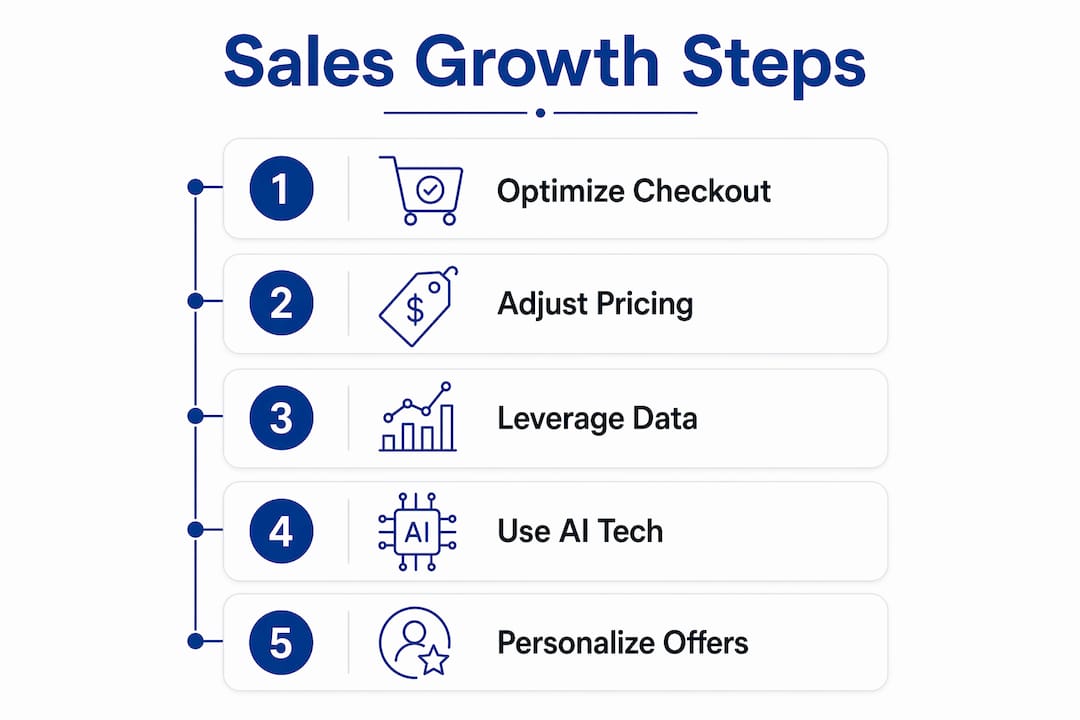
Value positioning is where most stores leave money on the table. Customers buy outcomes, not features. “Sleeps better in 7 days” sells a mattress faster than “memory foam with 12-inch profile.” Reframe every product description around the result the buyer gets, and you shorten the decision cycle.
Sales and marketing alignment produces 32% average annual revenue growth by improving deal size and acquisition efficiency. That means your pricing page, your ad copy, your email sequences, and your product descriptions all need to tell the same story. Inconsistent messaging creates doubt, and doubt kills conversions.
Pro Tip: Review your pricing strategy options at least once per quarter. Test one pricing change at a time using A/B testing tools like Google Optimize or VWO so you can isolate what actually moved the needle.
How does leveraging customer data and sales process improvements increase revenue?
Data-driven strategies are not just for enterprise brands. Zendesk’s research shows that buyer personas, lead scoring, and CRM automation increase sales team productivity and close rates without requiring large budget increases. The same principles apply whether you have a sales team of one or fifty.
Here is a practical framework for applying data to your sales process:
Build buyer personas from real purchase data. Pull your top 20% of customers by lifetime value from your CRM or Shopify analytics. Identify shared demographics, purchase triggers, and product categories. These are your highest-value segments, and every campaign should speak directly to them.
Score your leads by intent signals. Not every visitor is equal. Someone who viewed a product three times, added it to a wishlist, and opened your last email is far more likely to convert than a first-time visitor. Tools like HubSpot, Klaviyo, and Drip all support behavioral lead scoring that lets you prioritize follow-up accordingly.
Map a repeatable sales process to your customer’s buying behavior. If your analytics show that customers typically visit three times before purchasing, your email and retargeting sequences should be designed around that three-touch pattern. Align your touchpoints to the actual decision timeline, not an assumed one.
Automate administrative tasks with CRM tools. Time spent on manual follow-up, order confirmations, and data entry is time not spent on selling. Platforms like HubSpot, Salesforce, and Klaviyo automate these workflows so your team focuses on high-value interactions.
Set specific, measurable sales goals and review them weekly. Vague goals produce vague results. “Increase revenue” is not a goal. “Increase average order value from $48 to $58 by August 1 through bundle promotions” is a goal. Tracking weekly keeps you accountable and surfaces problems before they compound.
Focusing on lead quality over lead quantity reduces wasted effort and improves conversion more than chasing volume alone. Sending 10,000 emails to cold, unqualified contacts produces worse results than sending 1,000 emails to warm, segmented buyers. Quality beats quantity every time.
Pro Tip: Use your Amazon sales data to identify which products have the highest repeat purchase rate. Build post-purchase email sequences specifically for those products to drive replenishment and upsell, since retaining an existing customer costs far less than acquiring a new one.
What emerging technologies can e-commerce stores use to grow sales in 2026?
The technology gap between stores that grow and stores that plateau is widening fast. The stores winning in 2026 are using AI, personalization, and mobile optimization as core infrastructure, not optional extras.
AI-generated traffic to retail sites increased 693.4% year over year during the 2025 holiday season, driving $257.8 billion in total online sales. These visitors arrive with high purchase intent because they have already researched their options through AI tools like ChatGPT and Perplexity. Stores that align their product content to pre-purchase questions, covering specs, delivery timelines, and return policies, convert these visitors at significantly higher rates.
Personalization is no longer a nice-to-have. Personalized homepages, product recommendations based on browsing history, and dynamic email content all drive measurable lifts in conversion. Amazon’s recommendation engine is the gold standard, but tools like Nosto, LimeSpot, and Rebuy bring similar functionality to Shopify stores at accessible price points.
Mobile commerce now accounts for over 60% of global e-commerce sales, yet mobile converts at a lower rate than desktop. The gap closes with thumb-friendly button sizing, autofill-enabled address forms, and one-tap payment options. PayPal Express Checkout alone has produced up to 44% conversion lifts in documented Blend Commerce case studies.
The payment flexibility trend is accelerating. BNPL services are projected to exceed $560 billion in spend in 2026, and 53% of shoppers globally now use digital wallets. Offering Klarna, Afterpay, or Affirm alongside traditional card payments removes the price objection for higher-ticket items.
Retailers using AI-powered customer service agents saw 59% higher sales growth and a 10% increase in Net Promoter Score. AI agents handled 126% more service requests during peak seasons, meaning faster responses and fewer abandoned purchases due to unanswered questions. This is a direct revenue driver, not just a cost-saving tool.
Key takeaways
Increasing e-commerce sales requires aligning checkout optimization, pricing strategy, and data-driven personalization into one system rather than treating each as a standalone fix.
| Point | Details |
|---|---|
| Checkout friction is the top priority | Remove mandatory account creation and surprise fees before testing other tactics. |
| Pricing shapes confidence, not just volume | Align tiers, bundles, and value messaging to customer outcomes for faster decisions. |
| Lead quality beats lead quantity | Use CRM scoring and segmentation to focus effort on high-intent buyers. |
| AI traffic demands content alignment | Prepare product pages to answer pre-purchase questions that AI-referred shoppers bring. |
| Mobile and BNPL close the conversion gap | Thumb-friendly checkout and flexible payment options directly reduce abandonment. |
What I’ve learned about sales growth that most guides won’t tell you
After working with dozens of e-commerce sellers, the pattern I see most often is this: stores invest in traffic while ignoring the conversion leaks already costing them thousands every month. A 10% relative increase in conversion rate adds $50,000 in revenue to a $500,000 store without a single additional visitor. That math should stop every store owner in their tracks.
The second thing I have seen consistently is that isolated fixes underperform. You can nail your checkout flow, but if your pricing page tells a different story than your ads, customers feel the inconsistency and hesitate. Pricing, messaging, and checkout need to work as one system. When they do, the results compound.
My honest recommendation: start with checkout, then pricing, then data. In that order. Checkout optimization delivers the fastest ROI with the least complexity. Pricing changes require more testing but produce durable margin improvements. Data infrastructure takes time to build but eventually makes every other tactic more precise.
The stores I see growing fastest in 2026 are not the ones with the biggest ad budgets. They are the ones that treat their conversion rate optimization as a continuous practice, not a one-time project. Small changes, tested systematically, compound into significant revenue over a 12-month horizon.
— Goga
How Searchoneers helps you turn optimization into real sales
If you sell on Amazon, the same principles that drive e-commerce sales growth apply directly to your listings. Optimized titles, bullet points, backend keywords, and A+ content are the checkout flow, pricing page, and personalization engine of the Amazon marketplace combined.

Searchoneers specializes in Amazon listing optimization that translates data-backed keyword strategies into higher visibility and stronger conversion rates. The team uses a structured, checklist-driven approach to identify friction points in your listings and fix them systematically, the same way this guide recommends fixing checkout before chasing traffic. You can also explore the Amazon listing checklist to see exactly what a fully optimized listing looks like and where your current listings may be leaving revenue behind.
FAQ
What is the fastest way to increase e-commerce sales?
Removing checkout friction, specifically mandatory account creation and surprise fees, produces the fastest measurable lift. Baymard Institute data shows mandatory accounts alone increase abandonment by 26%.
How does pricing strategy affect sales volume?
Pricing influences both who buys and how confident they feel about the purchase. Tiered pricing and product bundles guide customers toward higher-value options and raise average order value without requiring more traffic.
What role does AI play in e-commerce sales growth in 2026?
AI-generated traffic to retail sites grew 693.4% year over year in the 2025 holiday season, bringing high-intent shoppers who convert well when product content answers their pre-purchase questions directly.
How many payment options should an online store offer?
Offering five or more payment methods, including digital wallets and BNPL options like Klarna or Afterpay, lowers cart abandonment by 4.2% and removes price objections for higher-ticket purchases.
What is the most underused technique for increasing sales?
Post-purchase email sequences targeting repeat buyers are consistently underused. Identifying your highest repeat-purchase products and building automated replenishment sequences around them drives revenue at near-zero acquisition cost.

Leave a Reply