TL;DR:
- Product information management (PIM) centralizes and governs product data to maintain accuracy and consistency across sales channels. It differs from ERP and PLM systems, focusing on customer-facing content and enrichment for ecommerce success. Implementing PIM requires clear workflows, data normalization, and cross-team ownership to maximize its strategic benefits.
Product information management (PIM) is defined as the centralized process and system for capturing, enriching, validating, and distributing all product-related data across every sales and commerce channel you operate. If you sell on Amazon, Shopify, or any wholesale portal, PIM is the infrastructure that keeps your product content accurate, consistent, and ready to publish. Without it, you are managing product data in disconnected spreadsheets, and errors compound fast. This article breaks down what PIM covers, how it differs from ERP and PLM, and exactly how to implement it in an online retail environment.
What is product information management and what does it actually cover?
Product information management is more than software. It is a set of methods and processes that spans marketing, sales, commerce, field service, and supply chain to govern how product data is created, maintained, and distributed. That distinction matters because many teams buy a PIM platform and then wonder why data quality does not improve. The platform is the tool. The process is what drives results.
The core data types PIM manages
A PIM system centralizes product descriptions, specifications, pricing, compliance documentation, and digital assets to maintain consistent and accurate product data across channels. Here is what that looks like in practice:
- Product content: Titles, descriptions, bullet points, feature lists, and marketing copy tailored per channel
- Technical attributes: Dimensions, materials, weight, color codes, compatibility specs, and category taxonomy
- Pricing and compliance: MSRP, regional pricing tiers, safety certifications, and regulatory documents
- Digital assets: Product images, 360-degree photos, videos, and downloadable PDFs
- Channel-specific overlays: Localized content, marketplace-specific attributes, and language variants
The concept tying all of this together is the “single source of truth.” Every team, from marketing to fulfillment to customer service, pulls product data from one governed record instead of maintaining their own version. This eliminates the version-control chaos that kills data quality in growing catalogs.
How PIM connects to your existing tech stack
PIM systems integrate with ERP, CRM, and other business platforms to aggregate, de-duplicate, enrich, and distribute product data, reducing manual entry and errors. In practical terms, your ERP feeds cost and inventory data into PIM, your PLM feeds engineering specs, and PIM transforms all of it into channel-ready content. Master data exchange standards like GS1’s GDSN are commonly integrated with PIM systems to enable consistent product information flow between companies and trading partners. That level of interoperability is what separates a real PIM setup from a glorified spreadsheet.

| Data Type | Source System | PIM Role |
|---|---|---|
| Inventory and cost | ERP | Receives and references |
| Engineering specs | PLM | Receives and transforms |
| Marketing copy | Internal teams | Creates and governs |
| Channel attributes | Marketplace requirements | Enriches and publishes |
| Digital assets | DAM or internal storage | Stores and distributes |
How does PIM differ from ERP and PLM systems?
This is the question that trips up most ecommerce teams when they start evaluating product data tools. All three systems touch product data, but they serve completely different audiences and purposes.
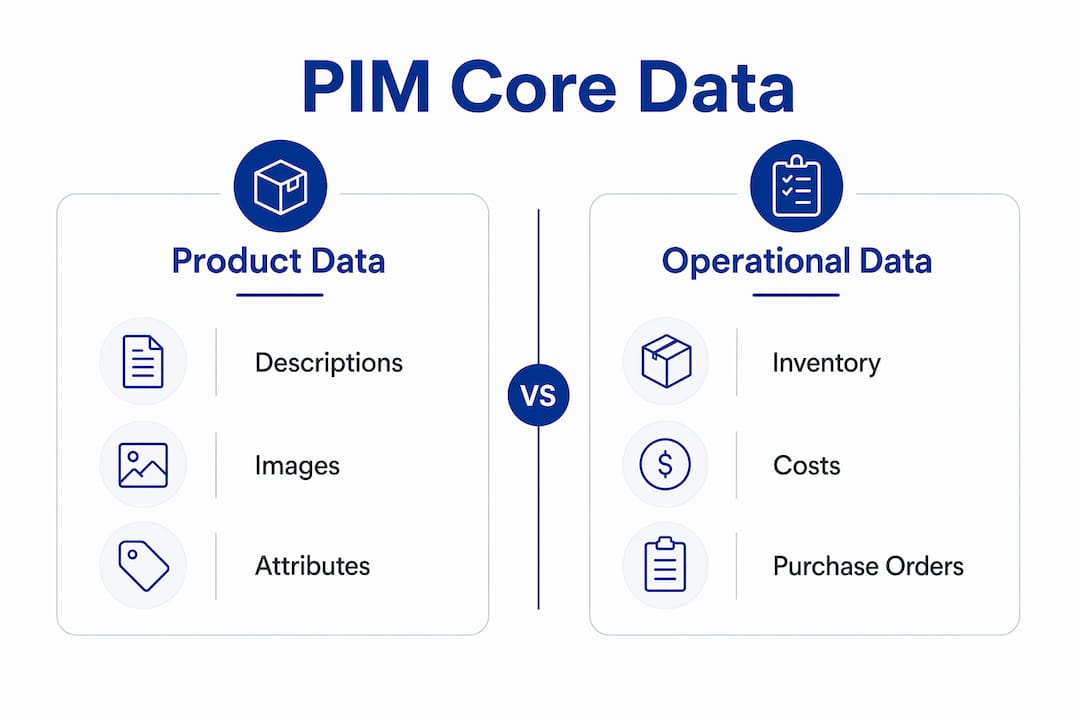
ERP systems like SAP or Oracle manage operational and transactional data: inventory levels, purchase orders, production costs, and financial records. PLM systems like Siemens Teamcenter manage product design and engineering specifications for R&D and manufacturing teams. Neither system is built to produce the kind of customer-facing, channel-optimized content that drives conversions on Amazon or a Shopify storefront.
PIM manages customer-facing content and channel-specific enrichment rather than operational data such as inventory and costs. That is its unique market-facing role. Your ERP knows you have 500 units of SKU-1234 at $12.50 cost. Your PIM knows that SKU-1234 is a “Stainless Steel French Press, 34 oz, BPA-Free” with five product images, three bullet points, and a localized German description for your EU storefront.
| System | Primary User | Data Focus | Channel Output |
|---|---|---|---|
| ERP | Finance, operations | Costs, inventory, orders | Internal systems |
| PLM | Engineering, R&D | Design specs, BOMs | Manufacturing |
| PIM | Marketing, ecommerce | Product content, assets | Customer-facing channels |
Many teams mistakenly assume ERP or PLM cover marketing-facing product content, but PIM is uniquely designed to govern channel-ready, commercial product data including localized attributes. Recognizing this gap is the first step toward fixing it.
Why product information management is critical for ecommerce success
The importance of product information management becomes obvious the moment your catalog scales past a few hundred SKUs. Managing product data manually across Amazon Seller Central, a Shopify store, a wholesale portal, and a retail partner feed is not a workflow problem. It is a data architecture problem.
PIM is valuable for managing complex, multi-channel catalogs that exceed the capabilities of native platform tools like Shopify metafields. That is the tipping point most growing retailers hit between 500 and 2,000 SKUs, when update frequency and channel count make manual management unsustainable.
Here is what a well-implemented PIM system delivers for your ecommerce operation:
- Faster time to market: New products go live across all channels simultaneously instead of being updated one platform at a time
- Fewer listing errors: Centralized data means a spec change in one place propagates everywhere, eliminating the “wrong size on Amazon, right size on the website” problem
- Better customer experience: Accurate, rich product content reduces returns and negative reviews caused by mismatched expectations
- Cross-team alignment: PIM democratizes product data access across marketing, sales, supply chain, and customer service teams to improve customer interactions and reduce time to market
- Regulatory compliance: Centralized compliance documents and certifications prevent costly listing takedowns on regulated product categories
Pro Tip: Before investing in PIM software, audit how many people in your organization maintain their own version of the product catalog. If the answer is more than two, you already have a data governance problem that PIM is designed to solve.
PIM also plays a direct role in procurement and supply chain efficiency by improving product data management across supplier relationships. When your suppliers send raw data in inconsistent formats, PIM provides the workflow to normalize and enrich it before it ever reaches a customer-facing channel.
How to implement product information management in online retail
Implementation is where most teams either build something that lasts or create a more expensive version of the spreadsheet problem they started with. Follow these steps to get it right.
Assess your catalog complexity. Count your active SKUs, the number of channels you publish to, and how often product data changes. If you manage more than 500 SKUs across three or more channels, you need a dedicated PIM solution, not a shared Google Sheet.
Define your product data model. A product-centric data model supports reuse of structured attributes across channels and manages overlays for channel-specific variants to avoid data duplication. Map every attribute your products need: core attributes shared across channels, and channel-specific attributes that vary by marketplace or locale.
Clean and normalize your existing data. Before migrating anything into a PIM system, run a data audit. Remove duplicate records, standardize units of measurement, and fill in missing attributes. Garbage in, garbage out applies here more than anywhere else in ecommerce.
Build enrichment workflows. Effective PIM workflows include data cleansing, normalization, enrichment, and governance stages to transform supplier raw data into rich, customer-facing content fit for publishing. Assign ownership for each stage: who writes copy, who approves images, who signs off on compliance docs.
Integrate with your existing platforms. Connect PIM to your ERP for cost and inventory data, your ecommerce platform for publishing, and your CRM for customer-facing context. Most enterprise PIM platforms offer native connectors for Shopify, Salesforce, and SAP. For Amazon specifically, your listing optimization workflow should feed directly from PIM-governed data to maintain consistency.
Establish governance rules. Without master-data management governance, PIM platforms risk amplifying duplicate records instead of eliminating them. Set rules for who can create new product records, who can approve changes, and how conflicts between data sources are resolved.
Pro Tip: Start with your top 20% of SKUs by revenue. Get those records perfect in PIM first, then expand. Trying to migrate and enrich your entire catalog at once is the fastest way to stall an implementation.
Pair your PIM efforts with ecommerce growth strategies that account for how enriched product data feeds into search visibility and conversion rates across marketplaces.
Key takeaways
Product information management succeeds when it combines a governed data model, cross-system integration, and clear ownership workflows to produce accurate, channel-ready product content at scale.
| Point | Details |
|---|---|
| PIM is process and platform | Buying software without governance workflows will not fix data quality problems. |
| PIM differs from ERP and PLM | ERP handles operations; PLM handles engineering; PIM handles customer-facing content. |
| Catalog complexity triggers adoption | More than 500 SKUs across three or more channels is the standard tipping point for PIM. |
| Data model design is foundational | A product-centric attribute schema prevents duplication and speeds up channel publishing. |
| Governance prevents data decay | Master record rules stop duplicate records from multiplying through enrichment pipelines. |
Why most ecommerce teams underestimate PIM until it’s too late
I have watched dozens of ecommerce teams treat PIM as an IT project rather than a commercial strategy. They assign it to a developer, pick a platform, and declare victory at go-live. Six months later, the catalog is still inconsistent because no one owns the data model and no one defined what “publishable” actually means for their business.
The uncomfortable truth is that PIM is primarily a people and process problem. The software is the easy part. Convincing your marketing team, your ops team, and your supplier relations team to agree on a single attribute schema is where the real work happens. I have seen companies with enterprise-grade PIM platforms still running shadow spreadsheets because the governance layer was never built.
The other thing most teams miss is the connection between PIM quality and search performance. On Amazon specifically, the richness and accuracy of your product attributes directly affects indexing and ranking. A PIM system that enforces complete, accurate attribute data is not just an operational tool. It is a competitive advantage in search. Teams that treat their product content as a strategic asset, and govern it accordingly, consistently outperform those that treat it as a data entry task.
The future of PIM is also getting more complex, not less. AI-driven attribute generation, real-time syndication to social commerce channels, and voice search optimization are all adding new data requirements to the product record. The teams building strong PIM foundations now will absorb those changes without disruption. The teams still managing data in spreadsheets will not.
— Goga
Take your product data further with Searchoneers

Strong PIM governance gives you clean, accurate product data. But getting that data to perform on Amazon requires a different layer of expertise. At Searchoneers, we specialize in translating well-structured product information into high-converting Amazon listings. That means titles, bullet points, descriptions, and backend keywords that are built to rank and built to sell. If you are ready to turn your product data quality into real marketplace results, explore our Amazon listing enhancement guide to see exactly how we approach it. You can also learn how integrated marketing strategies connect PIM-driven content to broader ecommerce growth. Your product data is only as valuable as the visibility it earns.
FAQ
What is the definition of product information management?
Product information management is the centralized process and system for capturing, enriching, validating, and distributing all product-related data across sales channels. It covers product descriptions, specifications, pricing, digital assets, and compliance documentation.
What is PIM in ecommerce specifically?
In ecommerce, PIM manages the customer-facing product content published to marketplaces, online stores, and wholesale portals. It is particularly valuable for catalogs with more than 500 SKUs or products sold across multiple channels and locales.
How does PIM differ from an ERP system?
ERP manages operational data like inventory, costs, and purchase orders. PIM manages customer-facing product content and channel-specific attributes. The two systems are complementary and typically integrated, not interchangeable.
What are the biggest challenges in product information management?
The most common challenges are poor data governance, duplicate records, and lack of cross-team ownership. Without strict master record rules, PIM platforms can amplify data inconsistencies rather than eliminate them.
Which teams benefit most from a PIM system?
Marketing, ecommerce, sales, supply chain, and customer service teams all benefit from centralized product data. PIM gives every team access to the same accurate product record, reducing errors and speeding up time to market.