

TL;DR:
- An effective Amazon strategy aligns product listings, advertising, fulfillment, and pricing to maximize visibility and conversions within the marketplace. Sellers who treat their Amazon presence as a system centered on customer obsession, operational excellence, and platform leverage can build sustainable organic growth and competitive advantage. Prioritizing keyword velocity, TACoS, buffer inventory, and disciplined campaign management are essential for long-term success.
An effective Amazon strategy is defined as the systematic alignment of product listings, advertising campaigns, fulfillment reliability, and pricing to maximize visibility and conversion within Amazon’s marketplace. At its core, this approach mirrors Amazon’s Flywheel concept: customer obsession drives lower prices, broader selection, and better service, which attracts more traffic and fuels organic growth. For sellers, understanding this self-reinforcing loop is not optional. It is the foundation every profitable Amazon business plan is built on. The sellers who win in 2026 are the ones who treat their Amazon presence as a system, not a collection of individual product pages.
What are the core pillars of a winning Amazon strategy?
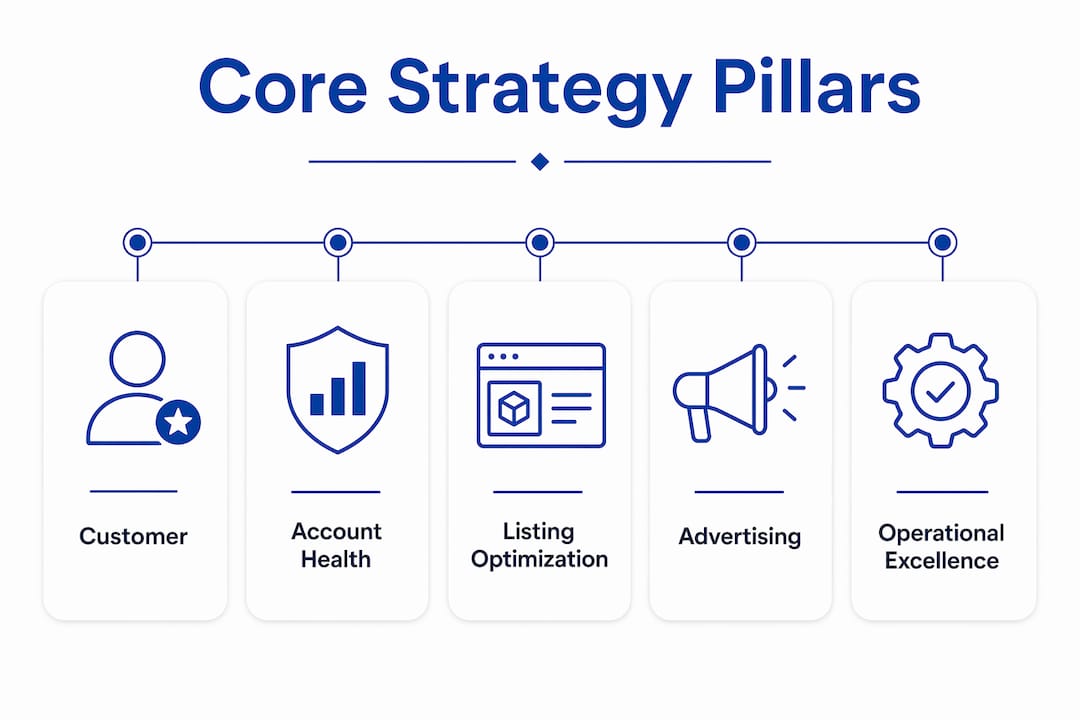
A winning Amazon strategy rests on four interconnected pillars: customer-centricity, account health, listing optimization, and inventory management. Each one feeds the others. Neglect one, and the entire system slows down.

Customer-centricity means competing on the factors Amazon’s A10 algorithm rewards most: fast delivery, competitive pricing, and broad selection. These are not soft values. They are measurable signals that determine your organic rank and Buy Box eligibility every single day.
Account health is your operational scorecard. Buy Box eligibility depends on keeping your Order Defect Rate below 1%, Late Shipment Rate below 4%, and cancellation rate below 2.5%. Pricing accounts for roughly 30 to 35% of Buy Box weighting, fulfillment for 20 to 25%, and stock availability for 10 to 12%. That means the cheapest listing does not always win. The most reliable one does.
Listing optimization is where most sellers leave money on the table. Your title, bullet points, backend keywords, and images are not just marketing copy. They are indexed data points that determine whether Amazon’s algorithm surfaces your product for the right search queries. Keyword research using tools like Helium 10 or Jungle Scout is the starting point, not the finish line.
Inventory management closes the loop. Stockouts suppress your Buy Box position, and recovering that position after a stockout takes time because the algorithm needs to reweight your eligibility. Maintaining approximately 30 days of sales velocity as buffer inventory is the standard practice among top sellers.
“Amazon’s leadership principles operationalize strategy around customer obsession and operational excellence rather than short-term hacks. Sellers who align with this model outperform those who chase quick wins.”
When these four pillars work together, they feed Amazon’s Flywheel directly. Better listings drive more clicks. More clicks drive more conversions. More conversions improve your organic rank. Higher rank generates more traffic. The cycle compounds.
How to strategically launch and optimize a new product on Amazon
Most sellers make the same mistake when launching a new product: they optimize for profit too early. The first 30 days of a launch should focus entirely on indexed keyword velocity, not ACoS. Amazon’s algorithm needs sales data to understand where your product belongs in search results. Feed it that data aggressively.
Here is the three-stage PPC launch sequence that consistently produces results:
- Weeks 1 to 2: Auto and broad campaigns. Run automatic campaigns alongside broad match manual campaigns to harvest keyword data. Your goal is discovery, not efficiency. Let the algorithm show you which search terms convert.
- Weeks 3 to 4: Move winners to exact match. Transfer your converting keywords from auto campaigns into manual exact match campaigns with tighter bid control. This gives you precision without losing the discovery benefits of the auto campaign.
- Weeks 5 to 6: Prune underperformers. Add non-converting search terms as negative keywords. This cuts wasted spend and concentrates your budget on terms that actually drive sales.
Target top organic placements within 90 days by tracking ACoS trends, conversion rates, and review velocity on a weekly basis. These three metrics tell you whether your launch is gaining traction or stalling.
Early reviews are not optional. Amazon’s Vine program lets you seed up to 30 units to trusted reviewers before your listing has social proof. Combine Vine with a review automation tool like Jungle Scout’s Review Automation or Amazon’s own Request a Review button to build review velocity systematically.
External traffic is the multiplier most sellers ignore. Driving traffic from Meta ads or influencer seeding through Amazon Attribution gives you clean ROI measurement and qualifies for Amazon’s Brand Referral Bonus, which provides a 10% average bonus on attributed sales in 2026. That bonus alone can offset a meaningful portion of your external ad spend.
Pro Tip: During your launch window, prioritize keyword rank gains over profitability. A product ranking on page one for three high-volume keywords will generate compounding organic revenue that far outpaces any short-term margin you sacrifice in weeks one through four.
What are the best advertising and campaign management strategies for Amazon sellers?
Amazon advertising is not a set-it-and-forget-it channel. It is an active management system that rewards sellers who treat it like one. The three-stage PPC loop described in the launch section applies throughout your product lifecycle, not just at launch.
For ongoing campaign management, structure your advertising around full-funnel coverage:
- Sponsored Products drive direct conversion. These are your workhorses. Use them for exact match keywords with proven purchase intent.
- Sponsored Brands build discovery. Use them to capture shoppers earlier in the search journey, especially for branded and category-level queries.
- Sponsored Display handles retargeting. Use it to re-engage shoppers who viewed your product but did not purchase.
Negative keyword management is the discipline that separates efficient campaigns from wasteful ones. Review your search term reports weekly and add irrelevant or non-converting terms as negatives. This single habit can reduce wasted ad spend by 20 to 30% within the first two months.
The metric that matters most for long-term growth is not ACoS. It is TACoS, or Total Advertising Cost of Sales. TACoS measures your ad spend as a percentage of total revenue, including organic sales. A declining TACoS with a stable ACoS is the clearest signal that your ads are building organic rank, not just buying sales. Cutting ad spend based on ACoS alone is one of the most common and costly mistakes sellers make. It can stall organic growth by removing the traffic signals the algorithm depends on.
Expect ACoS improvements within 30 to 60 days of structured campaign optimization, with measurable revenue growth following at the 60 to 90 day mark. Patience is not passive here. It means continuing to optimize while the algorithm catches up to your inputs.
Pro Tip: Build a separate campaign for your top five converting keywords at exact match with aggressive bids. Protect those placements at all costs. Losing page-one position on a proven keyword costs far more in organic revenue than the ad spend required to hold it.
How to maintain operational excellence to sustain marketplace performance
Operational excellence is the foundation that makes every other part of your Amazon marketing strategy work. You can have the best listing and the most efficient ad campaigns in your category. If your fulfillment metrics slip, your Buy Box share drops and your visibility collapses with it.
The two primary fulfillment options each carry distinct trade-offs:
| Fulfillment Method | Buy Box Advantage | Cost Profile | Best For |
|---|---|---|---|
| FBA (Fulfilled by Amazon) | Highest eligibility score | Higher fees, lower logistics complexity | High-volume, standardized products |
| FBM (Fulfilled by Merchant) | Lower eligibility unless metrics are excellent | Lower fees, higher operational burden | Oversized, custom, or low-volume products |
FBA gives you a structural advantage in Buy Box competition because Amazon treats its own fulfillment network as the most reliable option. FBM can compete, but only if your shipping speed, ODR, and cancellation rate are consistently excellent.
Supply chain digitization is the operational lever that most mid-size sellers underinvest in. Syncing your inventory management system with Amazon’s API in real time prevents the stockout scenarios that suppress Buy Box eligibility. Measurable improvements in fulfillment performance typically appear after six months of consistent digital inventory management.
Buffer inventory is not a luxury. Sellers should maintain roughly 30 days of sales velocity in reserve at all times. Stockout recovery is slow because the algorithm takes time to reweight your eligibility after availability drops. Prevention is far cheaper than recovery.
How do Amazon marketplace tactics drive e-commerce growth beyond listings?
The sellers who build durable businesses on Amazon think beyond individual listings. They think about platform economics. Amazon monetizes through advertising, Prime subscriptions, FBA logistics, and third-party seller fees. Sellers who understand this ecosystem can position themselves to benefit from it rather than just participate in it.
Here are the strategic behaviors that separate growing sellers from stagnant ones:
- Leverage Subscribe and Save for consumable products. This feature locks in repeat purchases, improves lifetime customer value, and generates predictable revenue that stabilizes your sales rank.
- Use Amazon’s data analytics tools including Brand Analytics and Search Query Performance reports to identify keyword gaps, competitor weaknesses, and conversion drop-off points in your own listings.
- Invest in brand registry early. Amazon Brand Registry unlocks Sponsored Brands, A+ Content, and the Amazon Storefront. These tools collectively improve conversion rates and build brand recognition that compounds over time.
- Monitor competitor pricing and inventory weekly. When a competitor goes out of stock, their Buy Box share redistributes. Sellers who are positioned with healthy inventory and strong metrics capture that traffic immediately.
- Adapt to AI-driven personalization. Amazon’s product discovery is increasingly shaped by machine learning that weighs purchase history, browsing behavior, and review sentiment. Listings with high CTR, strong CVR, and consistent review quality are the ones the algorithm favors in personalized results.
You can explore ecommerce growth tactics that connect these platform-level behaviors to specific listing and advertising improvements. The sellers who treat Amazon as a platform to partner with, rather than a channel to exploit, build the most defensible positions.
Key takeaways
A successful Amazon strategy requires aligning listing quality, advertising discipline, operational reliability, and platform-level thinking into one connected system.
| Point | Details |
|---|---|
| Flywheel alignment | Build every decision around customer obsession: price, selection, and fulfillment reliability feed organic growth. |
| Launch with velocity first | Prioritize keyword rank gains over ACoS efficiency in the first 30 to 90 days of a new product launch. |
| TACoS over ACoS | Use TACoS to measure long-term rank building; declining TACoS with stable ACoS signals healthy organic growth. |
| Buffer inventory is non-negotiable | Maintain 30 days of sales velocity in reserve to protect Buy Box eligibility and prevent costly stockout recovery. |
| Platform economics matter | Leverage Subscribe and Save, Brand Analytics, and Brand Registry to build compounding advantages beyond single listings. |
What I’ve learned from watching sellers win and lose on Amazon
After working with dozens of Amazon sellers across categories, the pattern is consistent. The sellers who struggle are almost always optimizing the wrong thing at the wrong time. They cut ad spend the moment ACoS looks high, right when the algorithm is starting to reward them with organic rank. They launch products without buffer inventory, then spend weeks recovering Buy Box eligibility after their first stockout. They treat their listing as a one-time setup rather than a living asset that needs weekly attention.
The sellers who grow are not necessarily smarter. They are more patient and more systematic. They understand that keyword velocity in the first 90 days is more valuable than margin. They track TACoS weekly and use it as a compass, not just a report. They treat operational metrics like ODR and late shipment rate as marketing metrics, because that is exactly what they are.
The uncomfortable truth is that Amazon rewards sellers who think like Amazon. Customer obsession is not a brand value. It is an algorithm signal. Every five-star review, every on-time delivery, every in-stock day is a data point that the platform uses to decide who gets visibility. When you internalize that, the strategy becomes obvious. Execute the fundamentals with discipline, iterate based on data, and let the Flywheel do the rest.
— Goga
Ready to turn your listings into a growth engine?
If you have read this far, you already understand that winning on Amazon requires more than good products. It requires precision at every layer of your listing, from title structure to backend keywords to image sequencing.

Searchoneers specializes in exactly this. The Amazon listing enhancement guide walks you through the specific optimizations that improve visibility and conversion, backed by data from real seller accounts. For sellers who want a structured process, the listing optimization workflow gives you a repeatable system for keeping every listing performing at its peak. Your next sale starts with a better listing. Let Searchoneers help you build it.
FAQ
What is an Amazon strategy for sellers?
An Amazon strategy is the coordinated approach to optimizing listings, advertising, pricing, and fulfillment to maximize visibility and sales on Amazon’s marketplace. It is built around Amazon’s Flywheel model, which rewards customer obsession with compounding organic growth.
How long does it take to see results from Amazon PPC?
ACoS improvements typically appear within 30 to 60 days of structured campaign optimization, with measurable revenue growth following at the 60 to 90 day mark. Patience and weekly optimization are required during this window.
What is TACoS and why does it matter?
TACoS, or Total Advertising Cost of Sales, measures ad spend as a percentage of total revenue including organic sales. A declining TACoS with stable ACoS signals that your ads are building organic rank, making it a more reliable long-term health metric than ACoS alone.
How do I protect my Buy Box eligibility?
Keep your Order Defect Rate below 1%, Late Shipment Rate below 4%, and cancellation rate below 2.5%. Maintain approximately 30 days of buffer inventory to prevent stockouts, which suppress Buy Box position and require time for the algorithm to restore eligibility.
Should I use FBA or FBM?
FBA provides a structural Buy Box advantage and is best for high-volume standardized products. FBM can compete effectively for oversized or low-volume products, but only if your fulfillment metrics consistently match or exceed FBA standards.

Comments
One response to “Amazon Strategy for Sellers: Win the Marketplace in 2026”
[…] Amazon Strategy for Sellers: Win the Marketplace in 2026 – Searchoneers […]